

Can Foreigners Buy Property in Vietnam? (2026 Rules & Process)
It is the single most common question international investors ask about this market: can foreigners buy property in Vietnam? The short answer is yes — but with specific conditions that differ sharply from most countries. This guide lays out exactly what a foreigner can and cannot own in Vietnam in 2026, the rules that apply, and how the process works. It is part of our step-by-step guide to the property buying process in Vietnam.
Table of Contents
The Short Answer: Yes — With Conditions
Foreign individuals and foreign-invested companies are legally allowed to own residential property in Vietnam, primarily apartments, under a 50-year leasehold that is renewable. This has been the case since Vietnam opened its market to foreign buyers, and the framework remains in force in 2026. The conditions revolve around three things: what type of property, a foreign-ownership quota, and how you pay.
What Foreigners CAN Buy
- Apartments / condominiums in commercial housing projects — the most common and straightforward option.
- Some landed homes (villas, townhouses) within licensed projects, subject to a tighter quota. Update 17 Sep 2026: the draft amended Housing Law would remove this category — see the update below.
- Off-the-plan units from developers — buying before completion on a payment schedule.
In practice, the overwhelming majority of foreign buyers purchase apartments in established projects in Ho Chi Minh City, Hanoi and Da Nang.
What Foreigners CANNOT Buy
- Raw land / land-use rights on their own — land ownership is reserved for Vietnamese citizens.
- Resale homes outside eligible projects — foreign ownership is tied to qualifying developments.
- Units beyond the foreign quota in a building (see below).
If land is essential to your goals, note that Vietnamese-origin buyers have broader rights — see our Viet Kieu property guide.
September 2026 Update: Draft Housing Law Would End Foreign Ownership of Landed Homes
On 16 September 2026 Tuoi Tre published an analysis of a change in the draft amended Housing Law that LuatVietnam had already read in the 13 September version: foreign organisations and individuals would be allowed to own apartments only — bought, lease-purchased, gifted or inherited — capped at 30% of the units in any one building (applied building by building in multi-tower projects) and only in projects outside defence and security zones. The right to own landed homes (villas and townhouses inside licensed projects) and the current cap of 250 landed units per ward-sized area under the 2023 Housing Law no longer appear in the draft.
Why. Both sources point to Resolution 21-NQ/TW of 28 July 2026, the Party Central Committee’s direction for rewriting the Land Law: land must “absolutely not be privatised”, and foreigners may not acquire land-use rights in any form — with one carve-out, overseas Vietnamese of Vietnamese origin. A villa sits on its own residential land plot; an apartment sits on the building’s shared land-use right. Keeping the apartment and dropping the landed home is how the drafters avoid creating a back door to an individual land plot. Tuoi Tre is careful to say this is not a closed door: home ownership is a property right under housing and civil law, separate from rights over land.
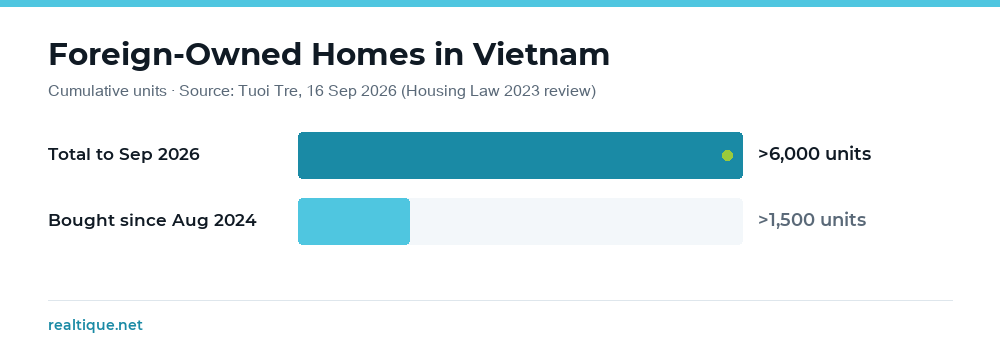
The numbers are smaller than the headline suggests. Since the 2023 Housing Law took effect on 1 August 2024, foreigners have bought more than 1,500 homes; the cumulative total is just over 6,000 — overwhelmingly apartments. The article states plainly that the change is not driven by how many landed homes foreigners hold, but by the link between a landed home and the land beneath it.
Transition clause — read this if you already own. According to LuatVietnam (citing Article 132(2) of the draft), foreigners who already own, or have signed a purchase contract for, a landed home before the new law takes effect continue under the 2023 Housing Law. Tuoi Tre argues the draft must go further and spell out the right to keep, resell, gift, bequeath and mortgage those homes — a single missing line here is the difference between a liquid asset and a stranded one.
What this means in practice:
- Apartments: nothing changes. The 30% per-building quota, the 50-year renewable term and the published project lists all survive in the draft. Everything else on this page still applies.
- Villas and townhouses: the window is closing, not closed. Until the National Assembly passes the law and it takes effect, the 2023 rules stand — and if the transition clause survives, a sale-and-purchase contract signed before the effective date is honoured. If you are weighing a landed unit in a foreign-eligible project, ask the developer two things: whether the unit sits inside the ward’s landed-home quota, and when the SPA (not just the deposit) can be signed.
- Viet Kieu are outside this change. Resolution 21 keeps the exception for overseas Vietnamese; those who still hold Vietnamese citizenship buy on the same terms as residents. For a foreign buyer who wants a landed home, the two realistic routes remain a Viet Kieu spouse or family member on title, or a long-term lease (LTLA).
Caveat: this is a draft. It has gone to the Ministry of Justice for appraisal and is scheduled for the National Assembly’s second session in October 2026; article numbers, the transition wording and the effective date can all still move. The same draft dropped the “fixed-term condominium” concept on 10 September, which shows how much is still in flux. We will update this section when the Assembly debates it.
Added 18 September 2026 — the official numbers behind the draft: according to VnExpress (17 September 2026, citing the Ministry of Construction’s submission), foreign organisations and individuals currently own 6,188 homes nationwide, and 1,519 apartments have been bought by foreigners since 1 August 2024, when the 2023 Housing Law took effect. Foreign demand is concentrated almost entirely in apartments — the segment the draft keeps — so for an apartment buyer the practical question is still how much of the 30% quota is left in that specific tower. A live example in South Saigon: Nam Long launches tower T3, the final tower of Trellia Cove at Mizuki Park, on 19 September; the developer has not published per-tower foreign quotas, and the compound’s 24 townhouses are exactly the product type the draft would close to foreigners (Vietnamese analysis: Trellia Cove 2026).
Which Projects Actually Qualify? The Approved List (Updated August 2026)
The rule that trips up most foreign buyers is not the 30% quota — it is that the project itself must sit on an officially published list of developments where foreigners are permitted to own. A perfectly legal, fully licensed commercial housing project can still be off-limits to you simply because it has not been added to that list.
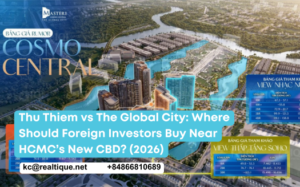
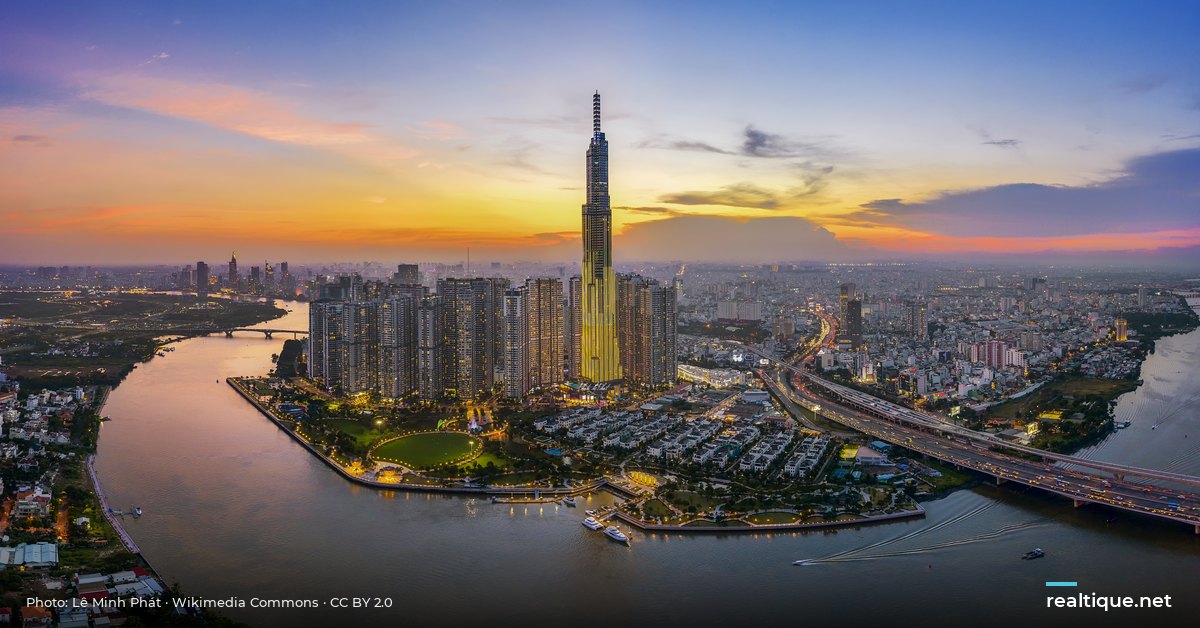
On 10 August 2026, Ho Chi Minh City added four more housing projects to its list, bringing the citywide total to 148 approved projects. Two of the four sit inside the Thu Thiem New Urban Area, the city’s planned new financial district:
- Thu Thiem Observation Tower Complex — a 145,600+ sqm mixed-use scheme in Thu Thiem’s functional zone 2, comprising an 88-storey tower, a five-star hotel, retail, offices and roughly 3,787 apartments.
- Lot 3-11 in Thu Thiem functional zone 3, developed by Vietnam GS Enterprise (~0.9 ha).
- A GS Enterprise high-rise cluster in the former Thao Dien ward (~1.7 ha) — the established expat district.
- Phuong Viet Apartments at 1002 Ta Quang Buu (~2.1 ha).
Why this matters to you: Thu Thiem and Thao Dien are exactly the areas where foreign quota is chronically tight. Each addition to the list opens genuinely new legal supply in districts where buyers are routinely turned away at the deposit stage. Ho Chi Minh City has expanded the list repeatedly through 2026 as it pushes to become an international financial centre with a free trade zone and a semiconductor industry — all of which bring long-staying foreign professionals who need housing they can hold in their own name.
Two practical cautions. First, the list is revised continuously — a printout from last month may already be out of date, so always verify against the current published list before you commit. Second, being on the list is necessary but not sufficient: you still need remaining headroom inside that specific tower’s 30% quota. Check both, in writing, before you place a deposit.
The 30% Foreign-Ownership Quota
Vietnam caps foreign ownership at 30% of the units in any single apartment building (and up to 10% of landed homes in a project). Once that cap is reached, no more units in that building can be sold to foreigners. This is why desirable projects fill their foreign allocation quickly — so checking availability early matters. We explain this fully in our guides, and it is worth confirming a specific unit’s quota status before you place any deposit.
The 50-Year Leasehold Explained
Foreign buyers own on a 50-year leasehold, renewable at expiry — as opposed to the freehold-style ownership Vietnamese citizens enjoy. Within that term you have full rights to live in, rent out, sell or bequeath the property. For most investors the 50-year horizon comfortably exceeds their holding period, but it should be factored into long-term and inheritance planning.
Eligibility: Who Qualifies
To buy, a foreign individual must have legally entered Vietnam (a valid entry/visa stamp) — you do not need residency or a work permit. Foreign-invested enterprises operating in Vietnam may also purchase for housing their staff. There is no nationality restriction: buyers from Singapore, Hong Kong, South Korea, the United States, Europe and Australia all buy under the same framework.
How the Buying Process Works
Once you have chosen an eligible unit within quota, the process runs: reservation and deposit, Sale & Purchase Agreement (SPA), legal transfer of funds, payment schedule, handover, and finally the pink book (ownership certificate) in your name. Each step is detailed in our property buying process guide — follow it and the transaction is straightforward.
Costs, Taxes & Getting Your Money Out
Beyond the price, budget for a registration fee (0.5%), VAT (10% on new units, usually in the price) and a 2% maintenance fund for apartments. Crucially, remit your purchase funds through documented bank channels — this is what later allows you to legally repatriate the proceeds when you sell. See our guide on banking & money transfers.
Where Viet Kieu can own — Ho Chi Minh City to the coast
You can buy in Vietnam. Here is what that looks like by project and region:
Your status sets the ownership type: a Viet Kieu with Vietnamese residency or citizenship owns freehold, like a local (any project below). A Viet Kieu who is a foreign national buys within the 30% foreign quota or via long-term lease (the first three groups).
District 1 — Ho Chi Minh City
- One Central Saigon — Ritz-Carlton branded, foreign quota available
District 2 — East of Ho Chi Minh City
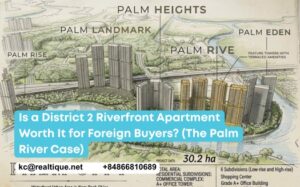
- BOOKINGPalm River — riverside, booking stage since 09/2026 (foreign quota not yet confirmed)
- SELLINGThe Global City — foreign quota available
- SELLINGGladia Heights by Keppel Land — foreign quota available
- RESALEDiamond Island — handed over, buy from current owners
- RESALEThao Dien Green — foreign-quota unit, resale
Coastal (foreign-eligible)
- Nobu Residences (Da Nang) — long-term lease resort
- Mandarin Oriental (Da Nang) — freehold for Vietnamese residents; long-term lease for non-residents
✓ Also yours freehold — if you hold Vietnamese residency or citizenship
These sell to domestic buyers (no foreign quota), but a Viet Kieu with residency owns them freehold, like a local:
- SELLINGBeachtro Tower — Blanca City, Vung Tau (final sea-view tower)
- SELLINGRung Phuong — Eco Retreat, Long An (low-rise, education hub)
- Haus Coastal — Quang Ngai (94ha coastal township)
Not sure which fits your status? Confirm your eligibility and live availability with a Realtique advisor — contact us or email [email protected].
Frequently Asked Questions
1. Can foreigners buy property in Vietnam in 2026?
Yes — apartments (and some landed homes in licensed projects) on a renewable 50-year leasehold, within a 30% per-building quota. Note: the September 2026 draft amended Housing Law would limit foreigners to apartments only; landed homes already owned or contracted before it takes effect would stay under the 2023 rules.
2. Can a foreigner own land in Vietnam?
No — land-use rights are reserved for Vietnamese citizens. Foreigners own the dwelling on a leasehold basis.
3. Do I need to live in Vietnam to buy?
No, but you must have legally entered Vietnam. Residency is not required.
4. Can I rent out my apartment?
Yes — foreign owners can lease their property (rental income is taxable in Vietnam).
5. Can I sell later and take the money abroad?
Yes, provided your funds entered through documented channels. See banking & transfers.
6. Will foreigners still be able to buy villas or townhouses in Vietnam?
Under the current 2023 Housing Law, yes, inside licensed projects and within a 250-unit-per-ward cap. The draft amended Housing Law (13 September 2026 version, due before the National Assembly in October 2026) removes that right and keeps only apartments at 30% per building. Foreigners who already own or have signed a contract for a landed home before the new law takes effect would continue under the 2023 law. Viet Kieu are not affected. This is a draft and may change.
Why International Investors Choose Vietnam
Beyond ‘can I buy’, most foreign buyers want to know ‘should I’. Vietnam’s appeal rests on a few durable drivers:
- Strong, sustained economic growth — one of Asia’s fastest-growing economies over the past decade, underpinning housing demand.
- Young, urbanising population — a large workforce moving into cities fuels long-term demand for quality apartments.
- Relative affordability — prices per square metre in Ho Chi Minh City remain well below Singapore, Hong Kong or Sydney, leaving room for appreciation.
- Rental demand from expats and professionals — supporting yields in central and riverfront districts.
- Improving infrastructure — the Metro Line 1, new expressways and Thu Thiem’s development lifting connected areas.
These fundamentals are why buyers from Singapore, Hong Kong, Korea, the US, Europe and Australia keep looking at Vietnam — provided they buy correctly within the rules above.
Freehold vs Leasehold: What 50 Years Really Means
Foreign ownership is a 50-year leasehold, renewable at expiry — while Vietnamese citizens hold effectively freehold rights. In day-to-day terms the difference is small: within the term you can live in, lease, sell or bequeath the property freely. What matters is planning — the leasehold clock and its renewal should be considered in long-hold and inheritance strategies. For buyers who want the broader rights citizens enjoy, restoring Vietnamese nationality (for those of Vietnamese origin) is an option we cover in the Viet Kieu guide.
Best Cities for Foreign Property Investors
Foreign demand concentrates in three markets, each with a different profile:
- Ho Chi Minh City — the largest, most liquid market. Thu Thiem (the new financial district across the river from District 1), District 2/Thu Duc and District 7 offer the deepest choice of foreign-eligible apartments and the strongest expatriate rental demand.
- Hanoi — the capital, with growing branded developments in the west and around West Lake; steadier, more end-user driven.
- Da Nang — coastal lifestyle and resort-style condominiums, popular for holiday-home and rental-yield buyers.
For most first-time international investors, Ho Chi Minh City offers the best combination of liquidity, rental demand and resale depth.
Mistakes Foreign Buyers Make — and How to Avoid Them
- Not checking the foreign quota before depositing — the number-one costly error.
- Assuming they can buy land — foreigners own the dwelling, not the land.
- Using informal money transfers — this jeopardises legal repatriation later.
- Skipping independent contract review of the SPA.
- Buying resale outside eligible projects, which foreigners generally cannot own.
Every one of these is avoidable with the right local guidance from the start.
Do You Need a Lawyer or an Agent?
For a straightforward apartment purchase in an eligible project, a reputable agent can guide the whole transaction — verifying quota, coordinating the SPA, and following your pink book. For higher-value deals, resale, or anything unusual, engaging an independent lawyer to review the contract is money well spent. Because agent commission is typically paid by the seller/developer, working with a strong buyer’s agent usually costs you nothing extra — while independent legal review is a modest fee that protects a large investment. Most foreign buyers use both: an agent to run the process and a lawyer to check the paperwork.
How Realtique Helps
Realtique works with international investors every week. We confirm your eligibility, check a unit’s foreign-quota status before you commit, run due diligence on the developer and project, coordinate the SPA and legal funds transfer, and follow your pink book to completion — all with one accountable, English-speaking team in Ho Chi Minh City.
Want to Buy in Vietnam as a Foreigner? Ask Realtique
Realtique guides international investors end to end — eligibility, quota, due diligence, legal transfer and the pink book.
Start today. Leave your name and email — a Realtique specialist will reach out. Or email [email protected].

KC and the Realtique team guide international investors through buying property in Vietnam — safely and in full compliance, from eligibility to the pink book.