
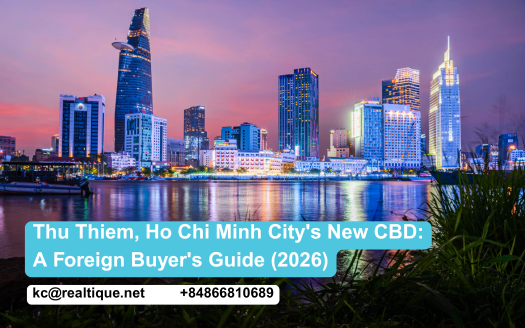
Thu Thiem, Ho Chi Minh City’s New CBD: A Foreign Buyer’s Guide (2026)
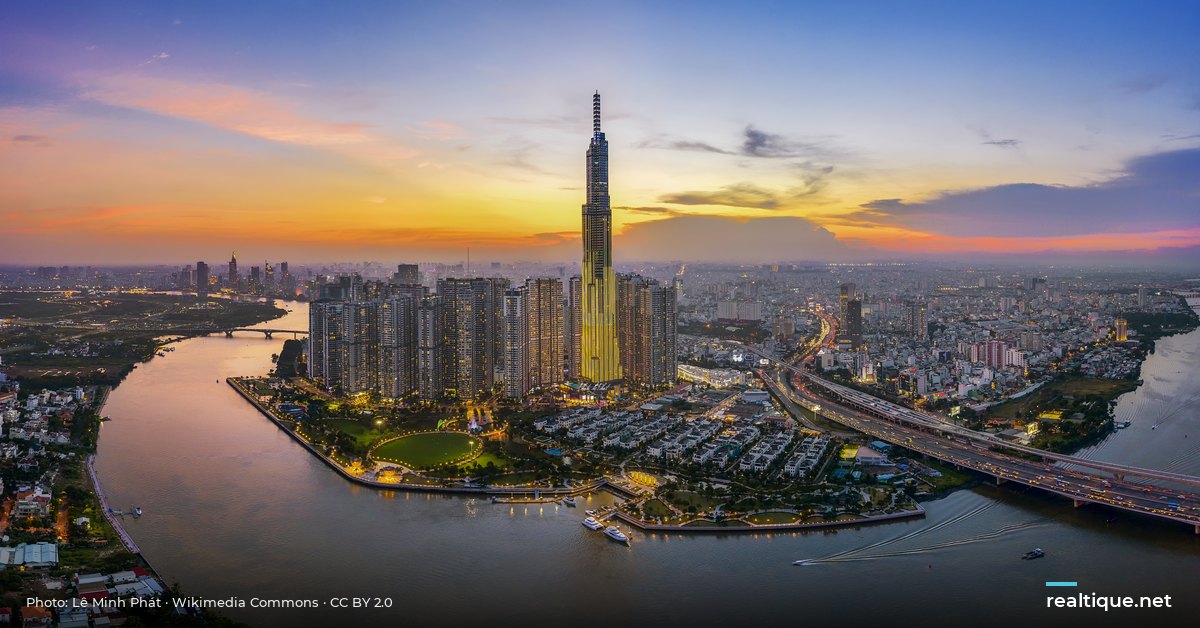
Thu Thiem is the most ambitious urban project in Vietnam: a purpose-built financial and cultural centre rising on a 657-hectare peninsula directly across the Saigon River from District 1. For a foreign buyer, it is the city’s clearest long-horizon bet — a chance to buy into a new central business district while it is still being built, rather than after it is finished.
This guide explains what Thu Thiem is, the landmark projects taking shape, how bridges and the metro connect it to the old core, the investment case and its risks, and the rules that govern foreign ownership there.
Table of Contents
What Thu Thiem is meant to become
The landmark residential projects
Connectivity — bridges and the metro
The investment case
August 2026 Update: The Financial Centre Opens Its Membership Portal
On 17 August 2026, the operating agency of the Vietnam International Financial Centre in Ho Chi Minh City (VIFC-HCMC) launched its online membership registration and recognition system for the 2026–2027 period, hosted on the vifc.gov.vn portal. Companies can now file, track and update membership applications entirely online, under Decision 01/Q&Đ-CQ&ĐH dated 11 August 2026, which standardised 31 forms (20 for businesses, 11 for administrative bodies).
One caveat matters for anyone reading this as a signal: in this first phase the portal covers organisations operating outside banking and financial services. Banks and financial institutions still go through a separate licensing route, so the 17 August milestone is not the moment international banks began registering online.
The numbers behind the centre, roughly six months after it opened on 11 February 2026: about US$20 billion in committed capital, with a narrower count showing over US$9 billion in registered capital from 13 founding and strategic members and more than 500 businesses signed up as applicants. Committed capital is not disbursed capital — the distinction is worth holding onto. In the GFCI 39 index (2026), Ho Chi Minh City ranked 84th of 120 centres, up 11 places and third in Southeast Asia.
Why this belongs in a Thu Thiem property discussion: the VIFC boundary covers roughly 898 hectares across parts of Ben Thanh ward, Sai Gon ward and most of Thu Thiem ward — and the 9.2-hectare core sits in Thu Thiem, with the VIFC-HCMC headquarters expected to relocate there after 2027. CBRE counts 765,144 sqm of office space across 33 buildings inside the boundary today, with about 165,229 sqm of Grade-A supply due in 2026–2028 and total supply projected to pass 1.09 million sqm by 2030. Demand is forecast to come from IT and software, financial services and multinational Global Capability Centres — the professional workforce that rents and buys within a short commute.
The separate proposal for a 99-storey, ~500m financial tower on plot 1.K1.8.HH in An Khanh ward dates from March–April 2026 and remains at the planning-consultation stage, not approved. Treat it as an intention, not a delivery date.
The risks to weigh
How Thu Thiem compares
Price and rental snapshot
Where Viet Kieu can own — Ho Chi Minh City to the coast
Wherever you are in the journey, here is where Viet Kieu buy — central Ho Chi Minh City to the coast:
Your status sets the ownership type: a Viet Kieu with Vietnamese residency or citizenship owns freehold, like a local (any project below). A Viet Kieu who is a foreign national buys within the 30% foreign quota or via long-term lease (the first three groups).
District 1 — Ho Chi Minh City
- One Central Saigon — Ritz-Carlton branded, foreign quota available
District 2 — East of Ho Chi Minh City
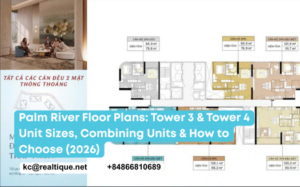
- BOOKINGPalm River — riverside, booking stage since 09/2026 (foreign quota not yet confirmed)
- SELLINGThe Global City — foreign quota available
- SELLINGGladia Heights by Keppel Land — foreign quota available
- RESALEDiamond Island — handed over, buy from current owners
- RESALEThao Dien Green — foreign-quota unit, resale
Coastal (foreign-eligible)
- Nobu Residences (Da Nang) — long-term lease resort
- Mandarin Oriental (Da Nang) — freehold for Vietnamese residents; long-term lease for non-residents
✓ Also yours freehold — if you hold Vietnamese residency or citizenship
These sell to domestic buyers (no foreign quota), but a Viet Kieu with residency owns them freehold, like a local:
- SELLINGBeachtro Tower — Blanca City, Vung Tau (final sea-view tower)
- SELLINGRung Phuong — Eco Retreat, Long An (low-rise, education hub)
- Haus Coastal — Quang Ngai (94ha coastal township)
Not sure which fits your status? Confirm your eligibility and live availability with a Realtique advisor — contact us or email [email protected].
Who Thu Thiem suits
The cultural and civic anchor
The riverfront and the view premium
A typical Thu Thiem buyer
Can foreigners buy in Thu Thiem?
August 2026 Update: Eight Thu Thiem Land Lots Return to Auction
On 18 August 2026 the Ho Chi Minh City People’s Committee approved auction plans for two land lots in the Thu Thiem New Urban Area, An Khanh ward. Lot 1.K3.5.HH (formerly lot 3-12) covers 10,059 sqm with a provisional starting price of nearly VND 2,968 billion; lot 1.K3.4.HH (formerly lot 3-5) covers 6,446 sqm at just over VND 1,901.57 billion. Both work out to roughly VND 295 million per square metre of land, calculated provisionally from the An Khanh ward land price table applied in 2026. Land tenure is 50 years from the date of the land allocation decision. The auctions are expected to take place in September 2026.
On 20 August the city approved two more: lot 1.K1.5.DV (formerly 1-12, 31,995 sqm of city-level service land, VND 5,663 billion) and lot 1.K3.3.HH (formerly 3-9, 5,009 sqm of mixed residential land, VND 739 billion). That makes four of eight lots priced, totalling roughly VND 11,272 billion, within a plan covering eight lots and over 138,000 sqm. Crucially, the per-square-metre land price is not uniform: it ranges from VND 147.5 million (lot 3-9) through VND 177 million (lot 1-12) to VND 295 million (lots 3-5 and 3-12) — a two-fold spread within the same district. Note also that the service lot 1.K1.5.DV is leased by the state with a one-off payment, not allocated with land-use fees like the residential lots. Starting prices for the remaining four lots have not been announced. Notably, the two largest lots — 74,393 sqm and 31,995 sqm — are zoned as city-level service land rather than residential, so the residential component of this round is modest: roughly 30,000 sqm across four lots.
Why this matters if you remember 2021. These are the same lots behind the auction of 10 December 2021, when four Thu Thiem plots with a combined starting price of about VND 5,266 billion sold for VND 37,346 billion — seven times the opening level. Ngoi Sao Viet, part of Tan Hoang Minh, bid VND 24,500 billion for lot 3-12 alone. All four winners subsequently failed to complete their contracts, and deposits of more than VND 1,051 billion were handled under the applicable regulations. The 2026 starting price for lot 3-12 is around 12% of the 2021 winning bid — a reminder that a headline auction figure and a completed transaction are two very different things.
What it means for a foreign buyer. This process allocates land to developers, so individual foreign purchasers are not participants. Foreign demand in Thu Thiem continues to be served the same way it is today: through the 30% per-building quota in projects already cleared for sale, on 50-year ownership terms that are renewable under current rules. Any new apartment supply arising from these lots is several years away — land payment, allocation, permitting and construction all sit between the auction and a sales launch. In practical terms, the auction is a pricing signal for the district, not a near-term addition to the buying options in front of you.
Full Vietnamese analysis, including the eight-lot table and a floor-area cost comparison: Đấu Giá Đất Thủ Thiêm 2026. Sources: VnExpress and Tien Phong, 18 August 2026. Dates and prices are provisional and may change.
August 2026 Update: Empire City on the Ownership List — and Keppel Exits
Two things happened at Empire City, the 14.6-hectare riverfront complex in Thu Thiem’s core, within days of each other in August 2026.
Keppel is selling out. On 5 August, Singapore’s Keppel announced a conditional agreement to transfer its entire 40% stake in Empire City LLC for S$343 million (about US$270 million). Twenty percent goes to Denver Power Vietnam and twenty percent to Golden Axis, a vehicle 99.99% owned by local partners Tran Thai and Tien Phuoc. Once complete — expected in Q4 2026, subject to regulatory approval — ownership would sit at roughly 50% Denver Power Ltd and 50% Tran Thai/Tien Phuoc. Keppel frames it as portfolio rebalancing; Vietnamese coverage places it alongside a dispute over the project’s land financial obligations. Both readings are on the record, and neither is settled.
The project also appears on the city’s foreign-ownership list, in the August 2026 update that took the citywide total to 148 projects — alongside a lot 3-11 development in Thu Thiem and Xi Riverview Palace in the former Thao Dien area, both by Vietnam GS Enterprise.
What this does and does not mean. The complex is planned for roughly 3,787 apartments in total — but that is the full masterplan figure, not a quantity available to foreign buyers. Only four residential phases have reached the market: Linden (MU4), Tilia (MU7) and Cove (MU11) are built and handed over; Narra (MU8) broke ground in November 2025 and is expected to complete around Q2 2027. The rest of the masterplan has not launched.
Because the 30% cap applies per building rather than per project, the handed-over towers have already used much of their foreign allowance through earlier sales — in practice you may need an existing foreign owner to sell before a slot frees up. Narra and the unlaunched phases are where room is more likely to remain. Never treat list inclusion as confirmation you can buy: get written confirmation of the current foreign ownership ratio for the specific building first — see our guide to checking the 30% quota.
September 2026 Update: Sala Relaunches After Eight Years — Sarene and Savila
On 4 September 2026 Dai Quang Minh, the Thaco subsidiary behind the 106-hectare Sala township inside Thu Thiem, opened sales on its first two residential projects in eight years. Sala is the part of the peninsula that already works — Sarimi, Sarica, Sarina and Sadora apartments, Saroma villas, the Thiso Sala Center mall and an international school — so a new launch here is a different proposition from buying into a masterplan.
- Sarene (North Sala, plot 6.8): a mixed-use tower with close to 500 premium apartments over a retail street, launch prices from VND 172 million per m² (roughly US$6,500), handover targeted for December 2027. The developer quotes about 260 m to a future Metro Line 2 station — read that as a future benefit, since Line 2 is still in preparation.
- Savila (South Sala): two low-density towers with 56 sky villas and 40 shop-apartments, each villa served by a private lift and lobby, launch prices from VND 184 million per m² (roughly US$7,000), handover targeted for September 2027.
Why the eight-year gap matters. Sala’s land was the payment for build-transfer (BT) contracts — four arterial roads (11.9 km, eight bridges, about VND 12,182 billion approved) and the Ba Son bridge. A 2019 Government Inspectorate conclusion found the land used to settle those contracts had been undervalued by about VND 3,901 billion, and the re-valuation stalled the undeveloped northern half. The knot was cut by Decree 91/2025/ND-CP (24 April 2025), which fixes the land-price reference date for Thu Thiem BT settlements at the date the BT contract was initialled; Sarene broke ground on 13 January 2026. For a buyer, the practical reading is that the biggest legal risk has been addressed at government level — and that the sale-eligibility certificate and land-obligation status of the specific plot are still the two documents to ask for before paying a booking deposit.
Where the price sits. Resale listings for the existing Sala towers are quoted across a wide band — roughly VND 110–135 million per m² at the low end to 150–250 million at the top, depending on tower, floor and fit-out (asking prices, not transactions). Sarene at 172 million therefore lands in the middle of Sala’s own secondary market, with the premium being a new building on the financial-centre side of Mai Chi Tho. The 2026 Thu Thiem land auctions, where two lots carry starting prices near VND 295 million per m² of land, explain why no new launch in the core is likely to come in below about 150 million.
For foreign buyers. Apartments in a commercial housing project can be sold to foreigners within the 30%-per-building cap on a 50-year renewable title, provided the project is on the Department of Construction’s eligible list (Ho Chi Minh City’s list stood at 148 projects in August 2026). Earlier Sala towers did sell to foreigners; for Sarene and Savila we have not yet seen a project-specific confirmation, so ask the developer for it and for the remaining quota of the exact building. Savila’s 56 villas across two towers imply at most 16–17 foreign units in total (our arithmetic from the 30% rule) — if that is the product you want, ask that question first. Overseas Vietnamese who still hold Vietnamese citizenship buy on the same terms as residents under the 2024 Land Law and are outside both limits. Full Vietnamese-language analysis: Khu Đô Thị Sala 2026.
September 2026 Update: Lotte Eco Smart City Restarts — 60 Trillion VND, Ground-Breaking 23 October
On 21 September 2026 Phat Dat (HoSE: PDR) confirmed that construction of Lotte Eco Smart City — the 7.54-hectare, eleven-tower complex on Functional Zone 2A, the riverfront plot directly opposite Bach Dang wharf — will begin on 23 October 2026 with two commercial blocks (2-1 and 2-3, about 171,580 m² of floor area, a 36-month build to October 2029). Total investment is now put at roughly 60 trillion VND (≈US$2.3 billion), about three times the US$900 million quoted when Lotte signed in 2017. The project had been Thu Thiem’s most conspicuous stalled site: a ground-breaking ceremony in September 2022 with no construction, then a letter from Lotte Properties HCMC on 20 August 2025 saying it could not continue — chiefly because the land-use fee, finally set in June 2025 at just over 16.19 trillion VND, landed eight years after signing. The City met Lotte within days, backed its requests to the Prime Minister, and Lotte reversed course on 3 October 2025.
What changed the arithmetic was a domestic partner. Phat Dat paid 7.666 trillion VND for 35% of Lotte Properties HCMC (completed 13 August 2026, implying a company valuation of about 21.9 trillion VND), and the developer paid the full 17.569 trillion VND land-use fee on 31 July 2026. Lotte’s three entities still hold 65%. For a foreign buyer the practical reading is threefold. First, no residential product exists yet: the housing blocks (2-2, 2-4, 2-6) have no schedule, so nothing here can be legally reserved, and sites styling themselves the “official website” are brokers. Second, the project is not on the Department of Construction’s list of developments cleared for foreign ownership — it cannot be until units are eligible for sale, after which the 30%-per-building quota applies as usual. Third, 17.569 trillion VND for 7.54 hectares works out to roughly 233 million VND per m² of land (our own rough division, before netting out public land), in the same band as the starting prices of the neighbouring auction lots — one more data point that Thu Thiem land costs have been locked in at the top, not the bottom, of the cycle. Realtique’s full Vietnamese analysis: Lotte Eco Smart City Thủ Thiêm 2026. Sources: VnExpress 21 Sep 2026; CafeF and Znews 21–22 Sep 2026; Tuoi Tre 3 Oct 2025; Thanh Nien 21 Sep 2025. The 23 October date is the developer’s announced plan, not yet an event.
Frequently asked questions
Is Thu Thiem a good investment in 2026?
It is a capital-growth play: you are buying into a planned CBD before it fills in. That suits patient buyers who can hold through the build-out, rather than those needing immediate rental yield.
How far is Thu Thiem from District 1?
Just a few minutes across the Thu Thiem 2 (Ba Son) bridge — the peninsula sits directly opposite District 1 on the far bank of the Saigon River.
Which Thu Thiem projects can foreigners buy?
The apartment schemes — Empire City, The Metropole, The River, Zeit River and similar — are open to foreign buyers within the 30% per-building cap. Confirm remaining quota project by project.
Related guides
New to buying here? Start with Can foreigners buy property in Vietnam? and the step-by-step buying process.

KC and the Realtique team help international buyers pick the right Ho Chi Minh City neighbourhood — matching lifestyle, budget, rental yield and foreign-ownership eligibility, then handling the purchase end to end.
Thinking about buying early in Thu Thiem?
Realtique guides international buyers end to end — area selection, eligibility, quota, due diligence, legal transfer and the pink book.
Start today. Leave your name and email — a Realtique specialist will reach out. Or email [email protected].