
Where to Buy Property in Ho Chi Minh City: A Foreign Buyer’s Area Guide (2026)
Choosing where to buy in Ho Chi Minh City matters as much as choosing what to buy. The city — home to more than nine million people and Vietnam’s economic engine — is really a collection of very different neighbourhoods, each with its own price level, tenant profile, rental yield and pace of development. For a foreign buyer, the right district can mean the difference between a hard-to-let apartment and one that rents itself, or between a capital-growth story and a flat one.
This guide maps the areas that international buyers ask about most, from the historic core of District 1 to the master-planned townships of the east and the emerging satellite cities to the north. Use it as a starting point, then dive into the dedicated guide for any neighbourhood that fits your budget and goals. Every one of these areas offers apartments where foreigners can legally own within the 30% building quota — but the lifestyle, price and outlook differ enormously.
Table of Contents
Why the district decides your return
Three things move with location in Ho Chi Minh City. First, tenant demand: expat families cluster around international schools in Thao Dien and Phu My Hung, while young professionals and corporate tenants prefer District 1 and Binh Thanh. Second, infrastructure: the new Metro Line 1, the ring-road network and the future Long Thanh airport are re-drawing the value map, pushing growth east and south-east. Third, supply: central districts have almost no new land, so prices are defended by scarcity, while the eastern townships add tens of thousands of units, trading lower entry prices for higher volume.
As a rule of thumb, the closer to District 1 you buy, the higher the price per square metre and the lower the rental yield — but the safer the liquidity. The further east or north you go, the more affordable the entry and the higher the potential growth, in exchange for a longer hold and more reliance on infrastructure delivering on schedule.
District 1 — the central business district
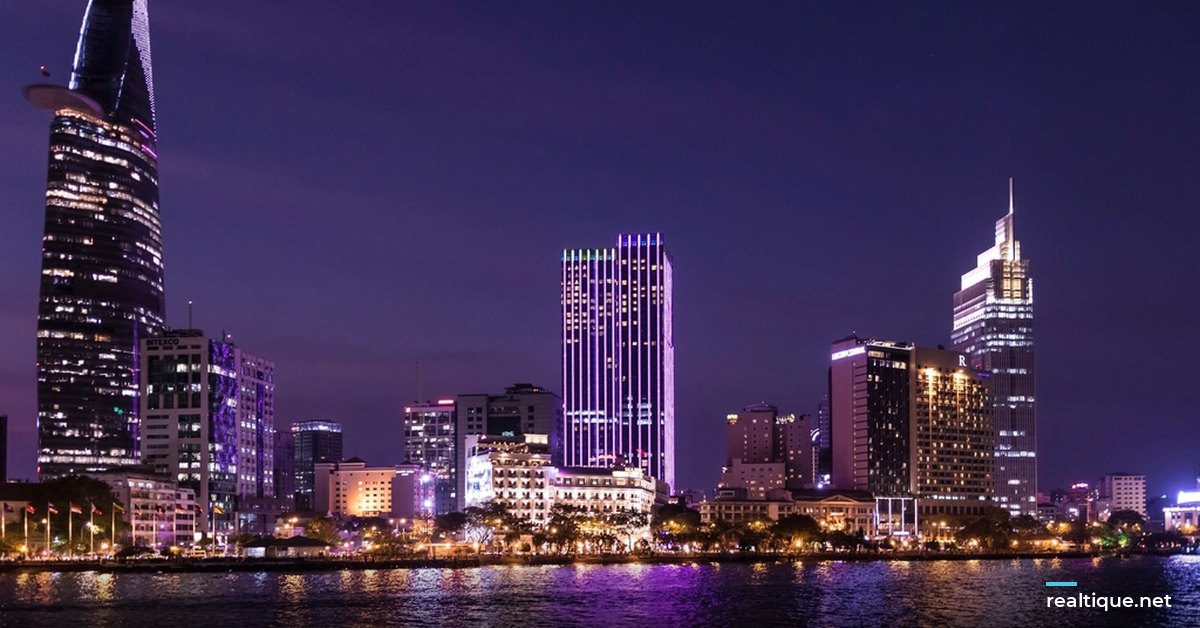
District 1 is the heart of Ho Chi Minh City: Ben Thanh Market, Nguyen Hue walking street, the Bitexco tower and the government offices. It is where the branded residences live — The Marq, Grand Marina (Marriott), and the Ritz-Carlton Residences at One Central. Prices per square metre are the highest in the country and the foreign quota in trophy buildings sells out fast, but liquidity and prestige are unmatched. Best for buyers who want a landmark address, a corporate tenant, and a store of value in the city’s most supply-constrained core.
District 4 — the overlooked strip beside District 1
District 4 is the small wedge of land directly south of District 1, separated from it only by the Ben Nghe canal. For years it was overlooked — denser, older housing stock, a reputation that lagged well behind reality. That is changing, and the numbers now say so plainly.
The clearest signal came on 24 August 2026, when Trung Thuy Group relaunched sales at Lancaster Lincoln (428–430 Nguyen Tat Thanh, Xom Chieu ward) at roughly VND 300 million per sqm — about USD 11,400 per sqm at current rates. For context, market data reported in August 2026 shows that in the first half of the year Ho Chi Minh City launched some 3,700 new apartments, with 80% priced above VND 120 million per sqm. A District 4 project asking 300 million puts the area firmly in the city’s upper price tier — something that would have been unthinkable here five years ago.
What makes District 4 work: it is a genuine walk-or-short-drive to District 1’s offices and restaurants, it fronts the river, and it still has redevelopment sites that the CBD itself has run out of. What to watch: the district’s supply is thin and much of it comes from projects that stalled during the 2018–2024 legal clean-up. Lancaster Lincoln itself is the cautionary example — construction was halted from 2018, and a Government Inspectorate conclusion in November 2024 found violations involving 1,273 sqm of public land and a portion of the site transferred without auction. Work on the superstructure only resumed on 16 May 2026.
The practical lesson for a foreign buyer looking at District 4: this is an area where project-level due diligence matters more than area-level optimism. Ask for the Department of Construction’s letter confirming the specific units are eligible for sale, the bank guarantee certificate for your unit, and written confirmation of the 30% foreign-ownership quota against your exact unit code — not a general assurance that “the project sells to foreigners”. Where a project has a history of suspension, also ask what remains outstanding on land financial obligations, because that is what determines whether the pink book eventually issues.
Thao Dien (District 2, Thu Duc City) — the expat heartland
Thao Dien is where much of the international community actually lives. Riverside villas, leafy lanes, international schools (BIS, ISHCMC), Western restaurants and the An Phu metro station make it the default choice for expat families and long-stay tenants. Landmark projects include Masteri Thao Dien, The Nassim, D’Edge and The Estella. Rental demand is deep and year-round, which supports some of the strongest yields for family-sized apartments in the city.
Thu Thiem (District 2, Thu Duc City) — the new CBD
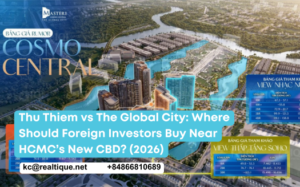
Directly across the Saigon River from District 1, Thu Thiem is the planned new financial centre. Empire City, The Metropole, The River and Zeit River are rising alongside a future opera house, boulevards and a lakeside park. The Thu Thiem 2 (Ba Son) bridge put it minutes from the old core. This is the city’s premier long-horizon bet: buyers here are pricing in a decade of institutional development and riverfront scarcity.
Nam Rach Chiec / An Phu (Thu Duc City) — The Global City corridor
The An Phu–Nam Rach Chiec belt sits at the interchange of the Hanoi Highway and the Ho Chi Minh City ring road, wiring it into the airport, the expressway to the coast and the metro. Its headline project is Masterise’s The Global City, a mixed-use downtown with a sports complex and a canal-side promenade. The area suits buyers who want new, well-connected stock at a slight discount to Thao Dien with a clear master-plan story.
Phu My Hung (District 7) — the master-planned township
Phu My Hung is Southeast Asia’s benchmark for master planning: wide boulevards, parks, RMIT University, international hospitals and schools, all laid out by a Taiwanese developer over 30 years. The Crescent, Midtown, Sunrise City and the Riverpark low-rises anchor a mature, family-friendly community south of the centre. Demand skews to Korean, Japanese and Taiwanese tenants, and the completeness of the neighbourhood makes it one of the most rentable addresses outside the core.
Binh Thanh — Landmark 81 and the riverfront
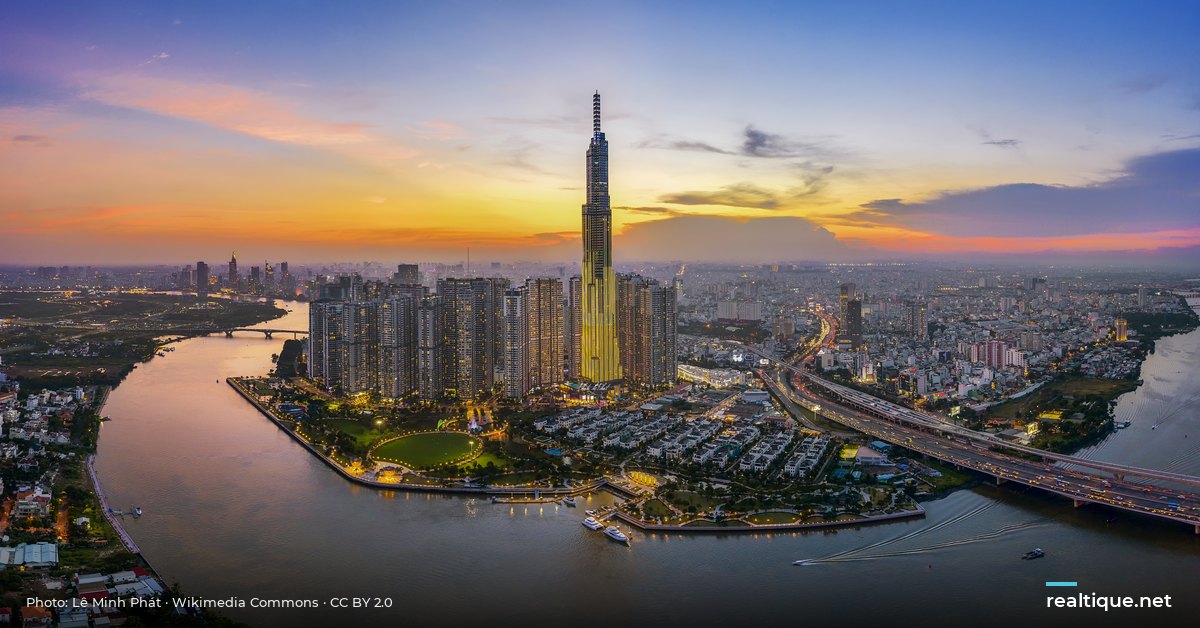
Binh Thanh bridges District 1 and the east. Its icon is Landmark 81 — Vietnam’s tallest tower — inside the riverside Vinhomes Central Park, alongside Saigon Pearl and City Garden. You get central-adjacent convenience, a large park, and strong tenant demand from professionals who want to be minutes from the CBD without District 1 prices. A practical sweet spot for yield-focused buyers.
Where Viet Kieu can own — Ho Chi Minh City to the coast
Wherever you are in the journey, here is where Viet Kieu buy — central Ho Chi Minh City to the coast:
Your status sets the ownership type: a Viet Kieu with Vietnamese residency or citizenship owns freehold, like a local (any project below). A Viet Kieu who is a foreign national buys within the 30% foreign quota or via long-term lease (the first three groups).
District 1 — Ho Chi Minh City
- One Central Saigon — Ritz-Carlton branded, foreign quota available
District 2 — East of Ho Chi Minh City
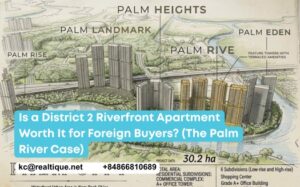
- BOOKINGPalm River — riverside, booking stage since 09/2026 (foreign quota not yet confirmed)
- SELLINGThe Global City — foreign quota available
- SELLINGGladia Heights by Keppel Land — foreign quota available
- RESALEDiamond Island — handed over, buy from current owners
- RESALEThao Dien Green — foreign-quota unit, resale
Coastal (foreign-eligible)
- Nobu Residences (Da Nang) — long-term lease resort
- Mandarin Oriental (Da Nang) — freehold for Vietnamese residents; long-term lease for non-residents
✓ Also yours freehold — if you hold Vietnamese residency or citizenship
These sell to domestic buyers (no foreign quota), but a Viet Kieu with residency owns them freehold, like a local:
- SELLINGBeachtro Tower — Blanca City, Vung Tau (final sea-view tower)
- SELLINGRung Phuong — Eco Retreat, Long An (low-rise, education hub)
- Haus Coastal — Quang Ngai (94ha coastal township)
Not sure which fits your status? Confirm your eligibility and live availability with a Realtique advisor — contact us or email [email protected].
Thu Duc City — the eastern megacity
Formed in 2021 by merging Districts 2, 9 and Thu Duc, Thu Duc City is a municipality of over a million people and the government’s designated innovation hub, home to the National University and the Saigon Hi-Tech Park. It is the single biggest growth story in the region, tied directly to Metro Line 1 and the ring roads. Thu Duc contains several of the neighbourhoods in this guide — think of it as the umbrella for the city’s eastward expansion.
Vinhomes Grand Park (District 9, Thu Duc City) — the mega-township
Vinhomes Grand Park is a 271-hectare city-within-a-city in the far east: tens of thousands of units, a 36-hectare central park, its own Vincom mall, and a planned metro connection extending Line 1. Entry prices are among the most accessible for new, well-managed stock, which makes it popular with first-time investors and buy-to-let owners targeting the young domestic renter. The trade-off is distance from the centre and reliance on transport upgrades.
Binh Duong New City — the northern satellite
Technically in neighbouring Binh Duong province, Binh Duong New City is the administrative capital of Vietnam’s industrial powerhouse, ringed by the VSIP parks and a huge base of factory investment and foreign management staff. It offers the lowest entry prices in this guide and a tenant pool tied to industry rather than the CBD. Best understood as an industrial-corridor play for yield rather than a central-city lifestyle purchase — and worth confirming project eligibility carefully, as this is a separate province.
The Metro and the ring roads — the infrastructure re-rating
Metro Line 1 (Ben Thanh–Suoi Tien) opened in early 2025 and now stitches the eastern corridor to the centre; Line 2 and further lines are in the pipeline. Combined with Ring Roads 2, 3 and 4 and the Long Thanh International Airport, the transport map is the strongest single driver of where value will migrate over the next decade. Buying within walking distance of a station — the transit-oriented-development premium — is one of the clearest strategies available to a foreign buyer.
How to choose — and the eligibility rule that applies everywhere
Match the area to your goal. For rental yield and easy letting, look at Thao Dien, Phu My Hung and Binh Thanh. For prestige and liquidity, District 1. For long-term growth, Thu Thiem, the An Phu corridor and the eastern townships. For the lowest entry and industrial-driven yield, Vinhomes Grand Park and Binh Duong.
Whatever you choose, the same national rule applies: foreigners may own apartments within a 30% cap per building on a 50-year renewable title, and cannot own landed houses or land outright. Before you fall in love with a specific unit, confirm the building still has foreign quota available and that the developer’s paperwork is clean. Our team checks both as a matter of routine.
KC and the Realtique team help international buyers pick the right Ho Chi Minh City neighbourhood — matching lifestyle, budget, rental yield and foreign-ownership eligibility, then handling the purchase end to end.
Not sure which Ho Chi Minh City neighbourhood fits you?
Realtique guides international buyers end to end — area selection, eligibility, quota, due diligence, legal transfer and the pink book.
Start today. Leave your name and email — a Realtique specialist will reach out. Or email [email protected].