
Vietnam Real Estate Market 2026: Q2 Outlook, Analysis & Forecast
Table of contents
The Vietnam real estate market 2026 is taking clearer shape after the first half of the year: a favourable macro backdrop, surging foreign investment and a wave of large-scale infrastructure all under way at once. Drawing on CBRE’s Vietnam Real Estate Market Insights, Q2 2026 and data from the General Statistics Office, Realtique summarises and analyses the most important shifts — from macroeconomics and infrastructure to supply, pricing and the outlook to 2028.
This in-depth piece compares the two biggest markets, Hanoi and HCMC (post-merger), explains why HCMC’s condo supply has concentrated in the former Binh Duong, and draws out the practical implications for both owner-occupiers and investors.
The Macroeconomic Picture: Foundation for Recovery
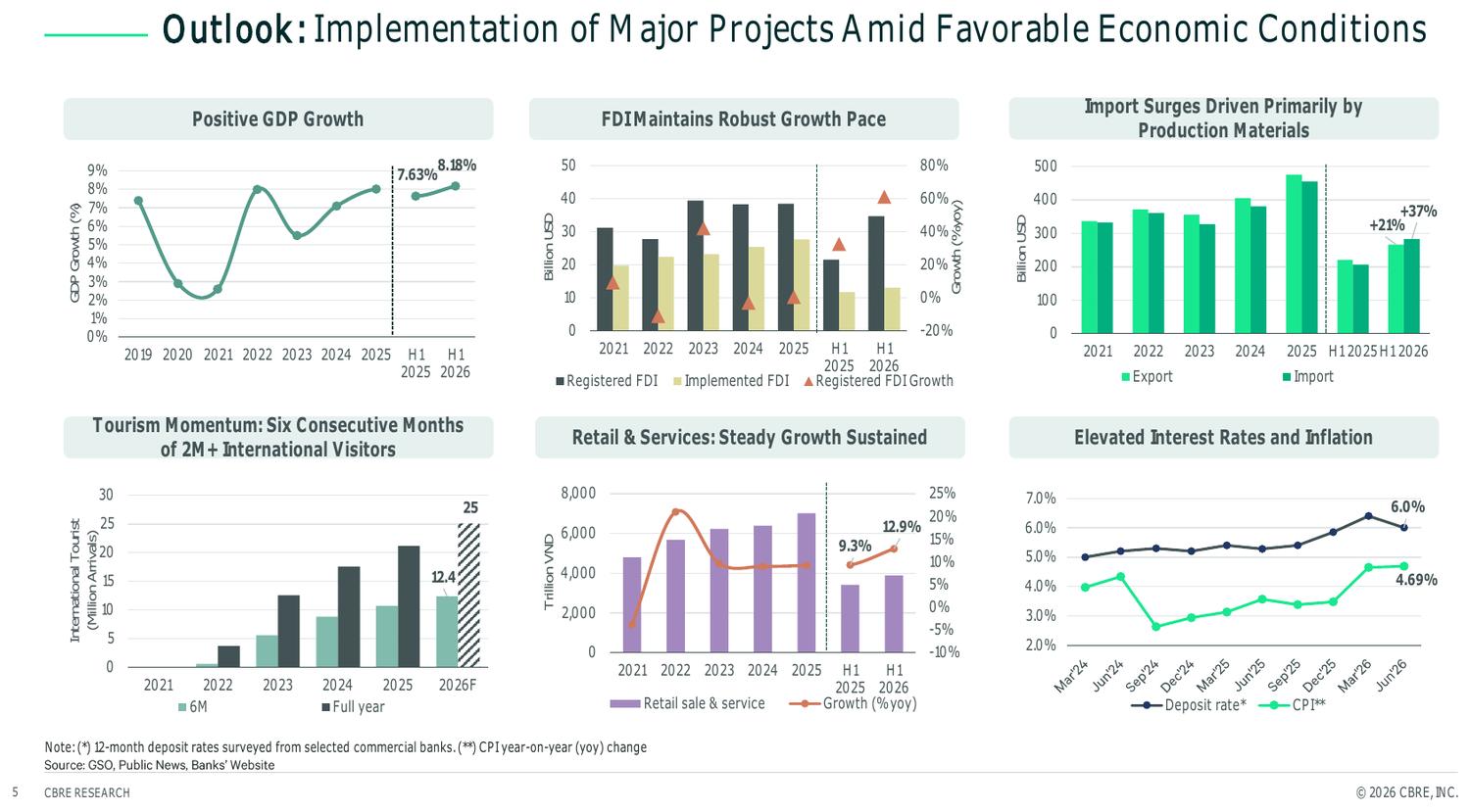
In the first half of 2026 Vietnam kept growing strongly, with GDP around 7.63%–8.18% year-on-year — a crucial foundation for housing demand. The standout is registered FDI up 61% year-on-year, led by Singapore (36%), Korea (26%) and Japan, with billion-dollar projects such as the Samsung chip-packaging plant (USD 4B, Thai Nguyen) and an AI data centre in HCMC.
Tourism rebounded with six straight months above 2 million international arrivals (about 12.4 million in H1); retail and services grew nearly 12.9%. On the other side, 12-month deposit rates edged up to around 6.0% and CPI to about 4.69% — pushing up mortgage costs and weighing on absorption, as discussed below.
Infrastructure — Reshaping Housing Demand
The 2026–2031 public capital plan reaches VND 8.22 quadrillion, 2.7x the previous period, turning 2026 into a giant construction site. This is the single most important variable reshaping the housing price map: connectivity shifts demand and land value toward the ring-road corridors and outer areas.
In HCMC, five TOD zones along Metro Line 2 (940 ha), the Ring Road 3 system, Long Thanh Airport and especially the HCMC master plan toward 2050 are creating new growth poles. Can Gio International Port (571 ha, 16.9M TEUs) is a long-term catalyst for the South — home to mega-projects such as Vinhomes Green Paradise Can Gio.
Condo Supply: Hanoi Leads, HCMC Shifts to Former Binh Duong
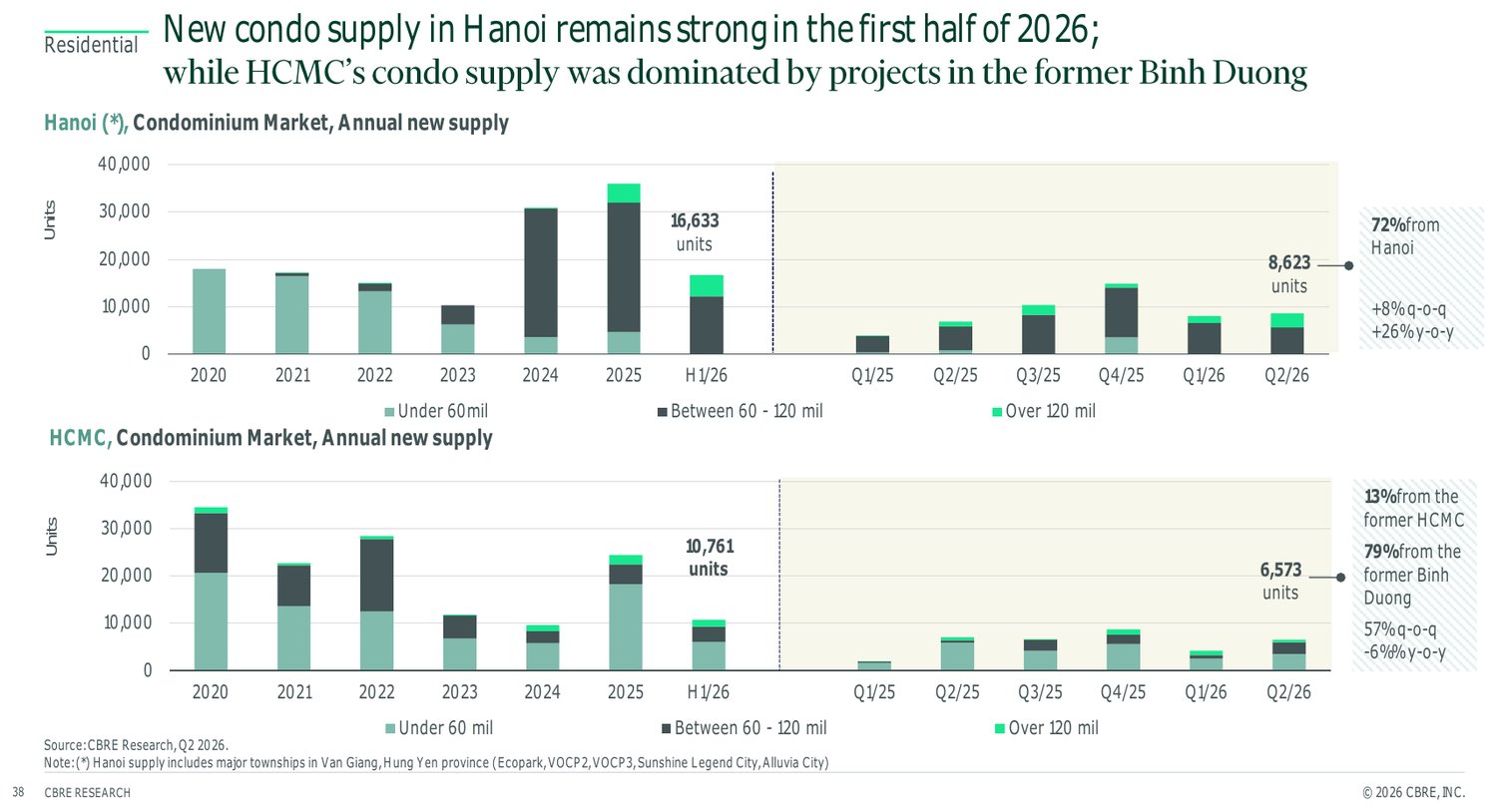
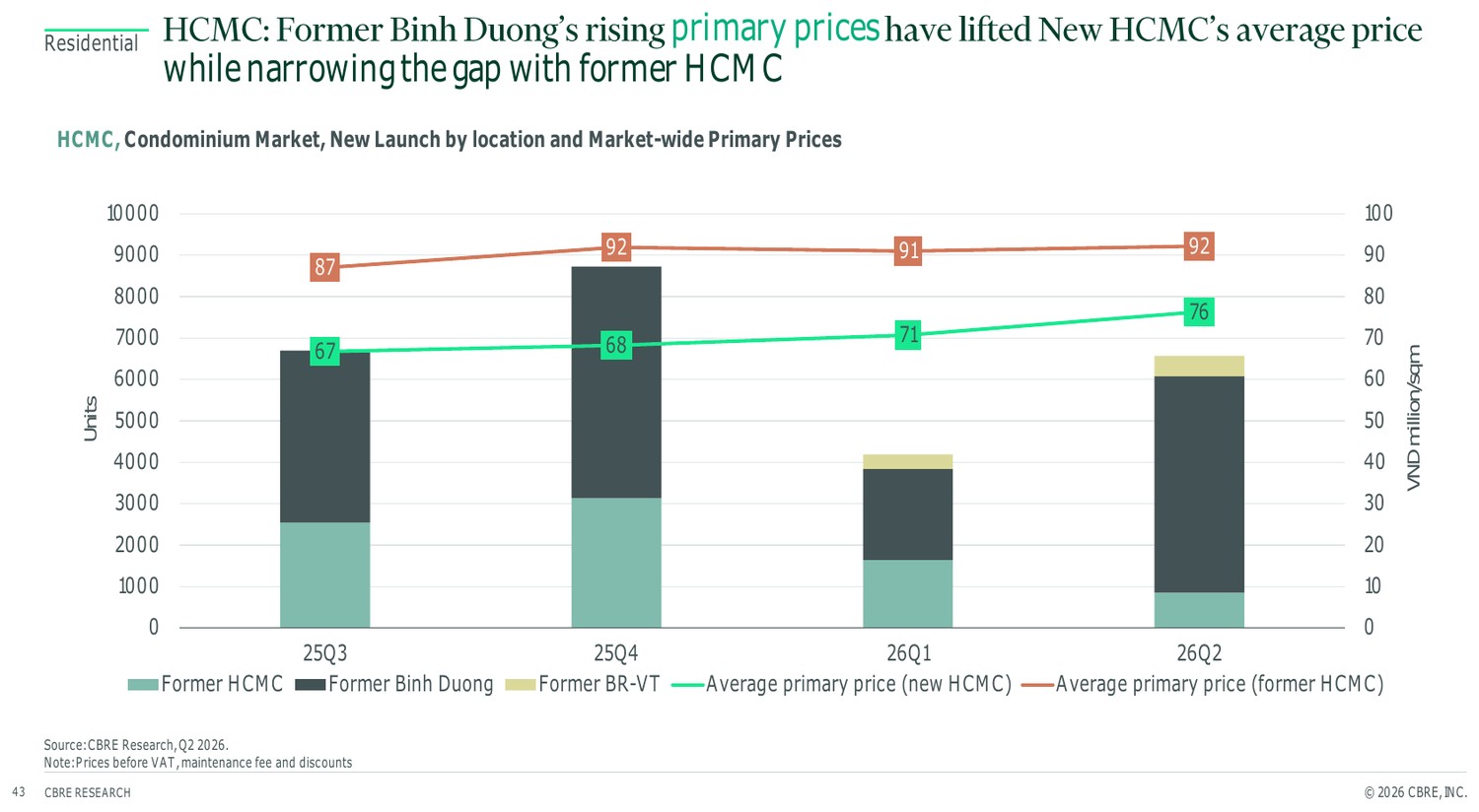
In H1 2026 Hanoi kept leading condo supply with 16,633 units launched (up 26% year-on-year), mostly from mega-townships in the east. HCMC (post-merger) recorded 10,761 units, but with an unusual mix: only 13% came from the former HCMC, while 79% came from the former Binh Duong.
This shift reflects the move toward the urban fringe: inner-city land is scarce and expensive, while the former Binh Duong offers ample land, reasonable entry prices and improving connectivity. It is the essential context for reading the price trends below.
Notable New Launches in Q2 2026
Q2 2026 saw a wave of major launches, heavily concentrated in the former Binh Duong with international developers and partners on board:
| Project | Developer | Location | Units | Primary price (VND M/sqm) | Timing |
|---|---|---|---|---|---|
| Midori Park (The Nest) | Becamex Tokyu | Binh Duong (former Thu Dau Mot) | 972 | 49 – 51 | May–Jun 2026 |
| Orchard Collection | CapitaLand | Binh Duong (former Thu Dau Mot) | ~800 | 76 | Jun 2026 |
| MonRei Saigon | Mitsubishi | Thuan Giao (Binh Duong) | ~1,800 | 54 | Jun 2026 |
| Masteri Cosmo Central | Masterise | Binh Trung (former Thu Duc, HCMC) | 500 | 150 | May 2026 |
What the supply leaders share is a reputable developer and a self-contained, fully amenitised product. The same pattern is visible in eastern mega-townships such as Palm City next to Thu Thiem, where infrastructure and disciplined master planning become the key drivers of long-term value.
Primary Prices and Absorption
The market-wide primary price across expanded HCMC reached about VND 76 million/sqm in Q2 2026, up from VND 67 million in Q3 2025. An interesting twist: rising prices in the former Binh Duong lifted the overall average and narrowed the gap with the former inner city (around VND 91–92 million/sqm).
Absorption, however, is softening in both cities. The drivers are higher mortgage rates (around 9.2%) plus a robust future pipeline that gives buyers more choice and more caution. International buyers weighing an entry should also review our step-by-step property buying guide for Vietnam.
26 August Update: Why “HCMC Apartment Prices Fell 17.4%” Is a Misreading
On 25 August 2026, at the Real Estate Forum 2026 (“Mega-city — Mega-opportunity”, hosted by TheLEADER), CBRE Vietnam managing director Duong Thuy Dung put the post-merger Ho Chi Minh City apartment market at roughly VND 76.1 million per sqm on the primary market and about VND 62 million per sqm on the secondary market. Around 80% of new apartment supply in the first half of 2026 came from the former Binh Duong area.
Vietnamese media promptly ran the line “HCMC apartment prices fell VND 16 million per sqm, or 17.4%” — arrived at by subtracting 76 from 92. That subtraction compares two different baskets. The VND 92 million figure describes the old inner city; the VND 76.1 million figure is the average across the enlarged city, which now folds in Binh Duong and Ba Ria – Vung Tau supply. Widen the basket toward cheaper areas and the average falls. Nothing actually got cheaper.
Read it against the figures in the section above and the direction reverses: the post-merger average of about VND 76 million per sqm is up from VND 67 million in Q3 2025, not down from 92. The same number supports “prices rose 13%” or “prices fell 17.4%” depending on which baseline the writer picks.
What each number is actually good for:
- VND 76.1m/sqm — primary average, whole enlarged city. Useful for tracking the market quarter to quarter. Useless for pricing a specific unit.
- VND 62m/sqm — secondary average. Closer to realised resale pricing, but still an average across the entire new administrative area.
- VND 91–92m/sqm — the old inner city. This is the relevant benchmark if you are looking at District 1, Thu Thiem, Thao Dien or District 4. Branded residences sit far above even this — see our 2026 branded residences analysis.
For foreign buyers and overseas Vietnamese this distinction matters more than for anyone else. The supply pulling the average down sits mostly on the urban fringe, while this group tends to shop in the centre, along the river, or in projects that still have foreign-ownership room left. A citywide average says almost nothing about what those units cost. When you assess a price, ask for figures by district and by project, with a date attached — never the market average.
Source: CBRE Vietnam, presented at the Real Estate Forum 2026 (TheLEADER), 25 August 2026; compiled from Dan Tri and Sai Gon Giai Phong.
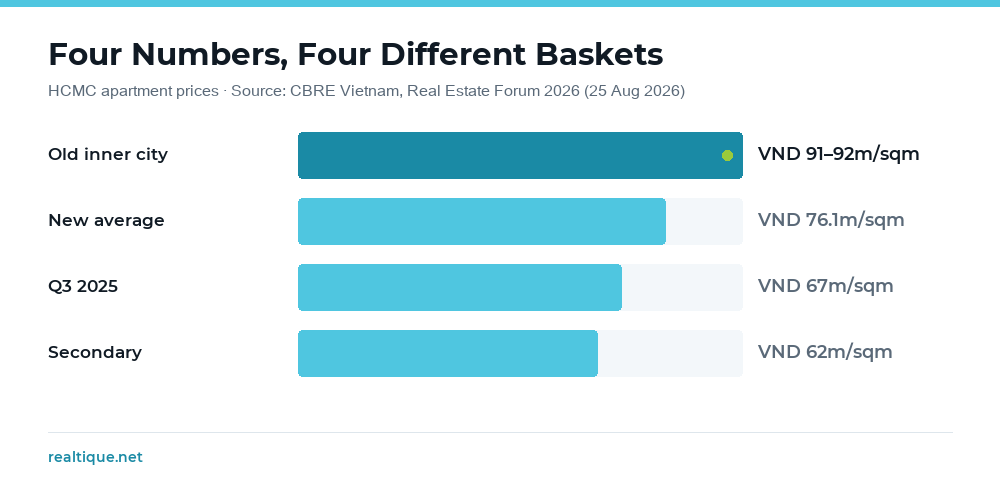
Graphic: Realtique · Data: CBRE Vietnam, Real Estate Forum 2026, 25 Aug 2026. These four figures are not directly comparable — each covers a different basket.
Market Outlook 2026–2028
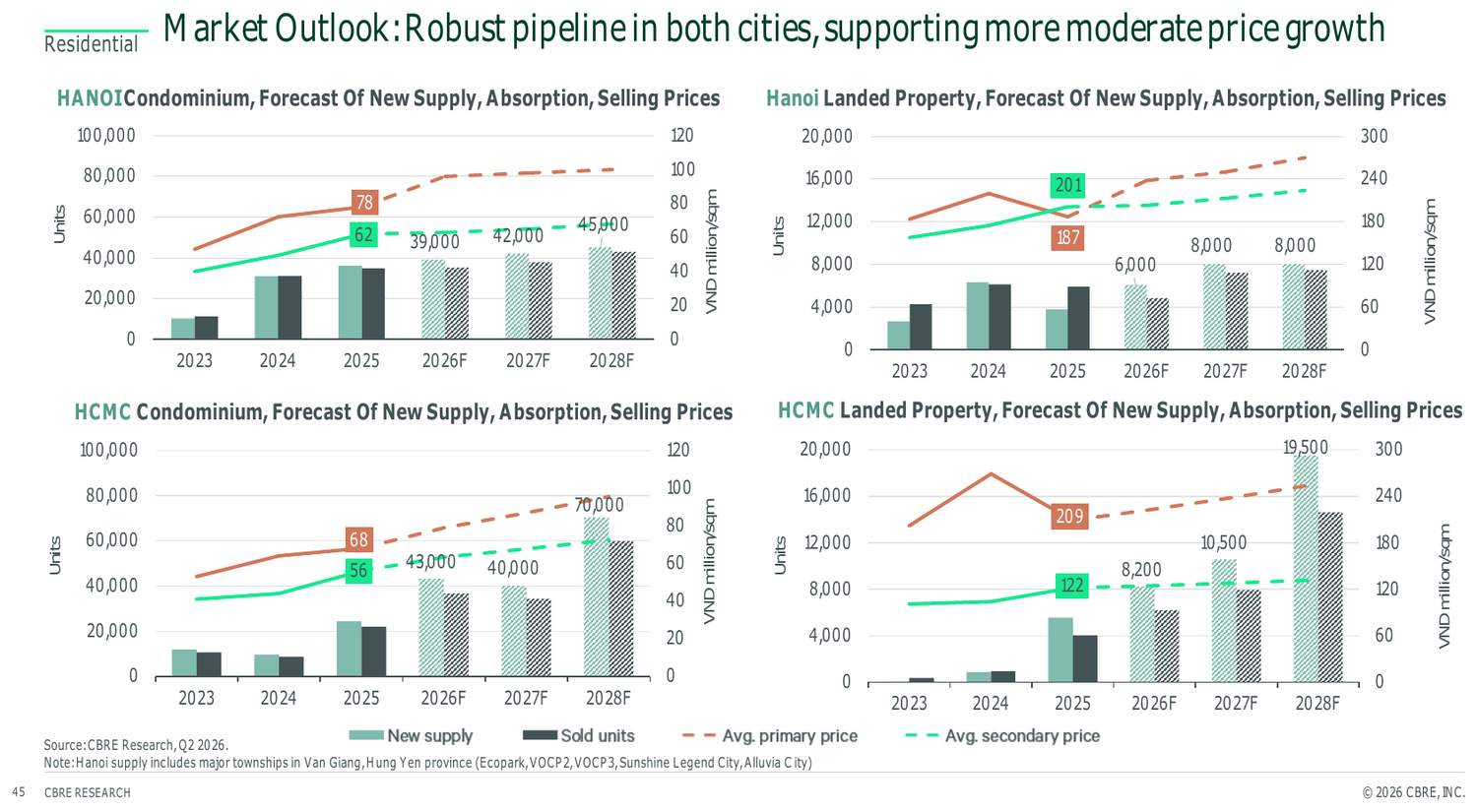
CBRE forecasts that housing supply in both Hanoi and HCMC will stay strong through 2028, supporting more moderate and sustainable price growth rather than sharp spikes. Hanoi condo primary prices are heading toward ~VND 78M/sqm and HCMC ~VND 68M/sqm; HCMC landed property could reach around VND 209M/sqm of land.
Three key themes are expected: (1) outer-ring urban areas reshape housing demand; (2) prices maintain an upward trend on better product quality and buyer confidence; (3) infrastructure connectivity reinforces long-term demand from both owner-occupiers and investors.
Implications for Buyers and Investors
- Follow the infrastructure. Long-term value clusters where connectivity is clear — ring roads, metro lines, airports and seaports. This is the most important filter when choosing an area.
- Favour reputable developers and self-contained products. The 2026 supply leaders are all major brands with complete amenities — the trait that protects liquidity and value as the market differentiates.
- Use the softer absorption window. When demand is cautious and supply is ample, buyers gain negotiating leverage and more choice — well suited to owner-occupier and medium-to-long-term investment goals.
- Match the segment to your goals. The former Binh Duong fits moderate budgets; eastern HCMC suits premium riverfront living; the South benefits from Can Gio Port for long-horizon plays. Foreign buyers should confirm eligibility early — see our foreign buyer guide.
Overall, the 2026 market is not a story of overheating but a selective recovery — where infrastructure, legal clarity and developer reputation decide the winners.
Frequently Asked Questions

KC Pham
KC Pham is the CEO of Realtique, advising local and international clients on Vietnam’s most exclusive properties.