
How to Stay in Vietnam Long-Term For Foreigners — Strategy Consultation
Vietnam has no retirement visa. If you are not married to a Vietnamese citizen and not of Vietnamese origin, the stable way to live here long-term is to own a Vietnamese company and hold a residence card through it. For most people that means the work-permit route: incorporate (Ho Chi Minh City sets no minimum capital for consulting or trading – roughly US$5,000-10,000 is a normal registration), obtain a work permit, then convert it into a temporary residence card – in practice one or two years depending on your file. Everything else – the licences, the accounting, the renewals – exists to keep that residence card alive.
- Why people really open a company in Vietnam
- Vietnam has no retirement visa: your real options
- The route that works: company, work permit, residence card
- Where plans break - five hard constraints
- What “safe and legit” actually costs, year after year
- Who we can help - and who we cannot
- Frequently asked questions (FAQ)
1. Why people really open a company in Vietnam
Almost nobody who contacts us wants a Vietnamese company for its own sake. They want to live here – to retire near the coast, to stay close to a partner or children, to keep running an online business from Da Nang or Hoi An instead of from home.
The company is the instrument, not the goal. Vietnam does not hand out residency for lifestyle reasons, so people work backwards: to stay, you need a residence card; to get one without a Vietnamese spouse, you need an investor visa; to get that, you need a company you own. Once you see it in that order, the whole process makes sense – and so do the constraints.
This page is written for that reader. It is deliberately blunt about what does not work, because the expensive mistake is not choosing the wrong consultant – it is registering the wrong structure, in the wrong city, for the wrong activity, and discovering it after the money is in.
Long-term visa options for foreigners in Vietnam — explained by Realtique.
2. Vietnam has no retirement visa: your real options
This surprises most people. Thailand, Malaysia and the Philippines all have retirement schemes; Vietnam does not. What exists instead is a short menu, and only one option on it is open to everyone:
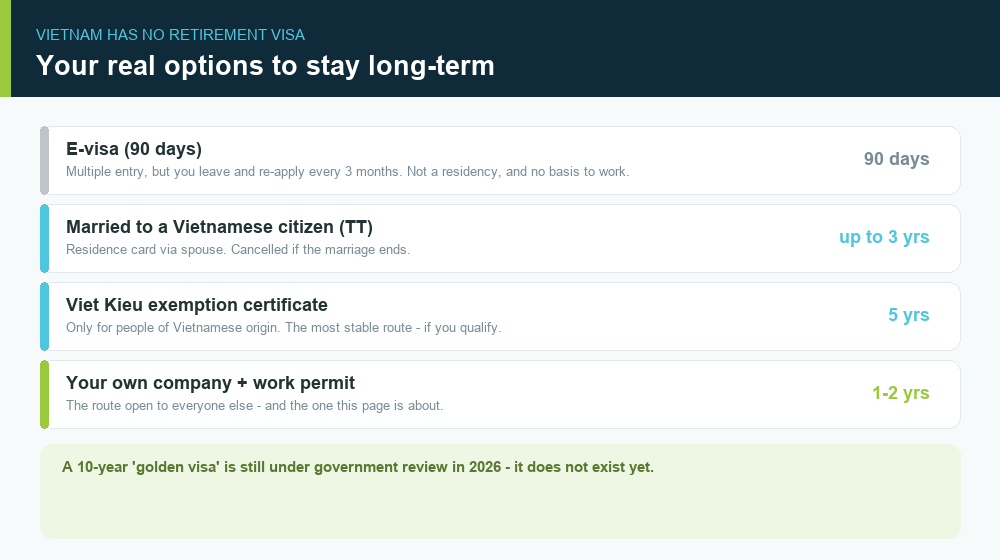
E-visa, 90 days. Multiple entry and easy to obtain, but it is a visitor status, not residency. You leave and re-apply every three months, indefinitely. Many people live this way for years; it is legal, but it is not a life you can plan around, and it gives you no basis to work.
Spouse route (TT), up to 3 years. Married to a Vietnamese citizen, you can hold a residence card. Note the fragility: the card is cancelled when the marriage ends, because the sponsorship basis ceases. If a divorce is coming, the replacement should be arranged before the current basis lapses.
Viet Kieu exemption certificate, 5 years. The most stable route – but only for people of Vietnamese origin.
Your own company plus a work permit, 1-2 years. The route open to everyone else, and the reason this page exists. It is not the easiest option on this list, but it is the only one you can qualify for by decision rather than by birth or marriage.
A 10-year “golden visa” has been widely reported but remains under government review in 2026. Do not build a plan on it.
3. The route that works: company, work permit, residence card
Here is the sequence, in the order it actually happens. Nothing about it is exotic – but each step depends on the one before it, which is why doing them in the wrong order is the most common way to lose months.
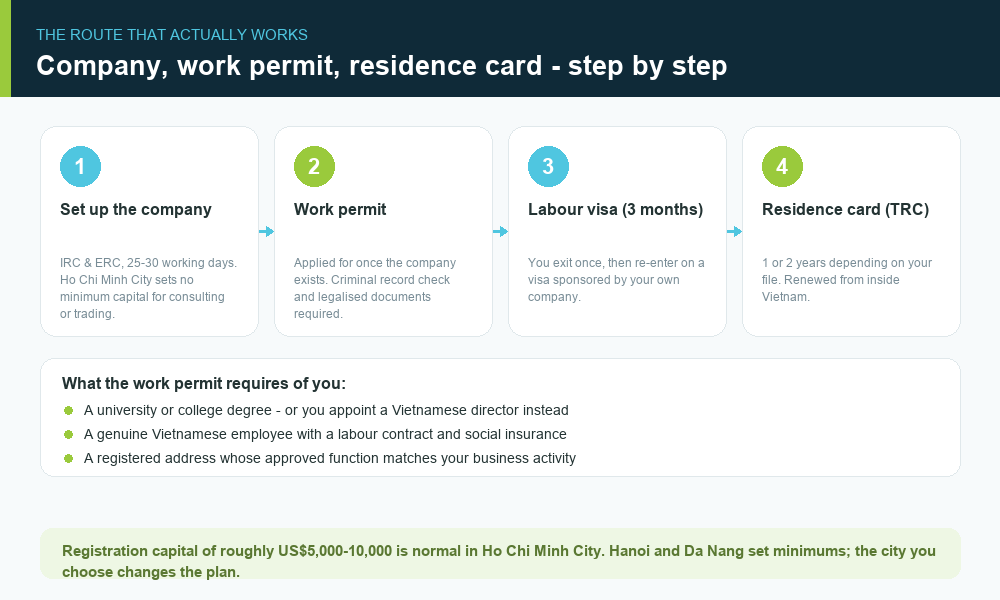
Step 1 – the company. You incorporate a foreign-invested company: the IRC and ERC together take about 25-30 working days. Ho Chi Minh City imposes no minimum capital for trading or consulting, and a registration of roughly US$5,000-10,000 is normal. Hanoi and Da Nang are different – they set minimums per business activity – so the city you choose changes the plan before anything else does.
Step 2 – the work permit. Applied for once the company exists, because the company is your sponsor. Expect a criminal record check (obtainable at home or in Vietnam) and consular legalisation of your degree and supporting documents. This is the step that carries the real conditions, and we come back to them below.
Step 3 – the labour visa. With the permit issued, you exit Vietnam once and re-enter on a three-month labour visa sponsored by your own company. The exit is normal and planned, not a setback.
Step 4 – the residence card. The labour visa is then upgraded to a temporary residence card. In practice cards are issued for one or two years depending on your file – your passport validity, the term of your work permit and the standing of the company all affect it. From then on you renew from inside Vietnam rather than leaving every 90 days.
What the work permit asks of you. Three things, and they are where most plans meet reality. A university or college degree – or you appoint a Vietnamese director in your place. A genuine Vietnamese employee with a labour contract and social insurance. And a registered address whose approved function matches your activity. The employee requirement in particular is deliberate: it exists so that residency rests on a real company rather than an empty shell.
One note on the rules themselves: the work permit regime changed on 7 August 2025 under Decree 219/2025, which replaced Decree 152/2020 and Decree 70/2023. Anything you read from before that date should be treated with care.
4. Where plans break - five hard constraints
These are the five points on which otherwise sensible plans fail. We would rather you read them now than pay to discover them later.
1. Your activity may not be open. Consulting, trading and IT allow 100% foreign ownership and register without special appraisal. Selling art or prints, running a gallery, retail and food & beverage are different: distribution of cultural products can require sector approvals plus a separate retail licence. This is checked before incorporation, not after.
2. “I do not need employees” usually does not survive contact with the rules. To obtain the work permit you generally need both a degree of your own (or a Vietnamese director in your place) and a genuine Vietnamese employee on a labour contract with social insurance. This is deliberate: it exists to stop shell companies being used purely to obtain residency. For a one-person online business this is the constraint to solve first, because everything downstream – the labour visa, the residence card – depends on it.
3. Premises are assessed, and living above the shop is not automatic. A foreign-invested company needs a registered address whose approved function matches the activity. Consulting can often use a co-working or virtual office. A gallery, shop or café needs real premises that pass function and zoning checks – and combining your home and your business in one address needs to be verified, not assumed.
4. Losing money in year one is normal; the compliance is not optional. Nobody expects a new business to profit immediately, and your visa does not depend on profit. But a foreign-invested company files monthly or quarterly tax reports, an annual audited financial statement and IRC project reports regardless. That cost runs from day one.
5. Tax residency arrives at 183 days. Spend 183 days or more here in a calendar year and you are a Vietnamese tax resident, taxable on worldwide income. American readers in particular: the Foreign Earned Income Exclusion is a US relief – it does not reduce Vietnamese tax, and Vietnam has no income tax treaty in force with the United States. Both systems apply to you at once.
5. What “safe and legit” actually costs, year after year
Set-up is the visible cost; staying compliant is the one people forget. Fees below are professional fees, shown from, and exclude 8% VAT, government fees and out-of-pocket costs.
Most people who come to us for residency take the complete package rather than buying the steps one by one – because the steps depend on each other, and a gap between them is what costs you months.
| Or step by step | From (USD) |
|---|---|
| Company incorporation – IRC & ERC, 1 standard activity, 1 investor (25-30 days) | 1,725 |
| Work permit (per person) | 800 |
| Temporary Residence Card / TRC (per person) | 460 |
| E-visa – urgent, 4 hours (per person) | 230 |
| Conditional / restricted activity (each) | 460 |
And then, every month and every year, for as long as you live here:
| Ongoing | From (USD) |
|---|---|
| Accounting, tax reports, payroll (1-5 people), IRC project reports | 270 / month |
| Annual audited financial statement (third-party audit firm) | quoted separately |
| TRC and visa renewals for you and your family | per cycle |
A realistic first-year budget for a single founder is therefore the setup package plus roughly US$3,200 a year in ongoing compliance – on top of your registration capital and the cost of the Vietnamese employee the work permit requires. The incorporation fee above applies to a single-investor structure; two or more investors incur additional fees, quoted case by case.
6. Who we can help - and who we cannot
We would rather turn work down than take a fee for a plan we do not believe in.
We can usually help if your activity is consulting, trading, IT or a similar open sector; you hold a degree or are willing to appoint a Vietnamese director; you accept that a real Vietnamese employee is part of the structure; you want to run it properly and pay tax; and you are planning a life here of several years, with or without family.
We are probably the wrong fit if you want residency without a real business behind it; you are looking for a nominee structure or a Vietnamese person to hold things in their name; you want a foreign-owned company to buy land (it cannot – it may only lease, and may buy property only inside projects licensed for foreign sale); or your budget covers the licence but not the years of compliance that follow.
What we do is straightforward: we assess your case honestly, we tell you which route your numbers actually support, and if it works we set it up and stay with you through the accounting, the renewals and the family cards – so your right to live here does not depend on remembering a deadline. The legal work is delivered by our licensed Vietnamese corporate law partner under one confidential engagement.
This page is general information current as of August 2026, not legal advice. Immigration, labour and tax rules change – Decree 219/2025 replaced the previous work permit regime on 7 August 2025 – and outcomes depend on your nationality, sector and circumstances. Your case should be assessed individually.
7. Frequently asked questions (FAQ)
Does Vietnam have a retirement visa?
No. Vietnam has no retirement visa. Retirees generally stay on 90-day e-visas with repeated exits, on a spouse (TT) card if married to a Vietnamese citizen, on a five-year exemption certificate if they are of Vietnamese origin, or on an investor (DT) visa obtained by owning a Vietnamese company. A 10-year “golden visa” is still under government review in 2026 and does not exist yet.
How much capital do I need?
Less than most people expect. Ho Chi Minh City sets no minimum capital for trading or consulting - registrations of about US$5,000-10,000 are normal. Hanoi and Da Nang do set minimums per business activity, which is one reason the city you register in matters. What the process really demands is not capital but conditions: a degree or a Vietnamese director, a Vietnamese employee on payroll, and premises whose function matches your activity.
Do I still need a work permit if I own the company?
Yes. Owning the company does not by itself give you the right to work in it or to live here; the work permit is what converts your company into a basis for residency, and the residence card follows from it. The work permit regime is now governed by Decree 219/2025, effective 7 August 2025, which replaced Decree 152/2020 and Decree 70/2023.
I do not want employees. Is that possible?
This is exactly where plans break. To obtain a work permit you generally need a genuine Vietnamese employee with a labour contract and social insurance, plus a degree of your own or a Vietnamese director in your place. The requirement is deliberate - it exists so that residency rests on a real company, not a shell. If you are running a one-person online business, this is the single most important thing to work through before you commit any money.
My residence card comes from marriage and I am divorcing. What happens?
A marriage-based (TT) residence card is cancelled when the marriage ends, because the sponsorship basis has ceased. This is one of the most common reasons people come to us. The realistic replacement is a company of your own and a DT visa - and the timing matters, because you want the new basis in place before the old one lapses.
Can I sell art, prints or photography through my company?
Possibly, but this is a conditional area. Distribution of cultural products and running a gallery can require sector approvals and a separate retail licence on top of your investment registration. Consulting, trading and IT are open to 100% foreign ownership; art and cultural products are not automatically so. This needs checking before, not after, incorporation.
My business will lose money for a year or two. Is that a problem?
Not for your visa - but the compliance cost does not pause. A foreign-invested company files monthly or quarterly tax reports, an annual audited financial statement and IRC project reports whether it profits or not. Budget roughly US$270 a month for accounting and compliance from day one, plus the annual audit fee.
Am I taxed in Vietnam on my overseas income?
If you are present in Vietnam for 183 days or more in a calendar year (or in 12 consecutive months from arrival), you are a Vietnamese tax resident and taxable on worldwide income. The US Foreign Earned Income Exclusion is a US relief only - it does not exempt you from Vietnamese tax, and Vietnam has no income tax treaty in force with the United States. Plan for both systems.