
How to Check the 30% Foreign Quota in a Vietnam Building Before You Buy (2026)
Updated 2026. How to confirm a building still has room in its 30% foreign-ownership quota before you pay a single dong of deposit.
It is the most important due-diligence step in the whole process, and the one most buyers skip: is there still room for a foreigner to own in this building? Vietnam caps foreign ownership at 30% of the apartments in any one project. If that share is already sold, you cannot take ownership — no matter how much you love the unit. Here is exactly how to check, what to ask for, and the red flags that mean walk away.
Table of Contents
What the 30% Rule Actually Means
The Law on Housing allows foreign individuals and organisations to own a maximum of 30% of the apartment units in a single building. For landed housing in a given ward the cap is different (a limited number of houses), but foreigners rarely buy landed property, so the 30% apartment cap is what matters for most buyers. The limit is per building, which means availability swings block to block: one tower may be wide open while the one next door is closed to foreigners entirely.
August 2026: Being on the City's Approved List Is Not the Same as Having Room
Ho Chi Minh City publishes a running list of commercial housing projects foreigners may legally own. The August 2026 update took it to 148 projects, adding — among others — the Thu Thiem Observation Tower Complex, better known as Empire City.
That addition is a useful worked example of the distinction this guide is about, because the coverage around it got the arithmetic wrong. Empire City is planned for roughly 3,787 apartments across an approximately 14.6-hectare masterplan. Several listings sites multiplied that by 30% and reported an allowance of "over 1,100 units" for foreign buyers. That number is meaningless, for two reasons.
- The cap is per building, not per project. Each apartment block carries its own 30% ceiling. There is no project-level pool to divide up.
- Most of that 3,787 does not exist yet. Only four phases have launched, three of them already handed over — and those three have been trading for years, so much of their foreign allowance is already taken.
So the two questions stay separate:
- The city list answers is this project permitted to sell to foreigners at all? A yes/no gate at project level. Not on the list means closed to you, whatever the quota.
- The 30% quota answers is there room left in this specific building today? A live number that moves with every transaction.
A long-completed project joining the list can therefore coexist with buildings that are effectively full, while a newly launched phase in the very same development still has its full 30% intact. Treat list inclusion as permission to start checking — never as confirmation that you can buy.
Why Checking Before You Deposit Matters
Deposits in Vietnam can be difficult to recover. If you place one on a unit in a building that has already hit its foreign cap, you may be pushed into a long-term lease instead of ownership — a completely different legal structure — or lose time and money unwinding the deal. Confirming the quota first turns a risky purchase into a clean one.
How to Check the Quota — Step by Step
- Ask the developer for the building’s foreign-ownership status and how many of the foreign slots have already been sold.
- Request the official registry. Developers are required to track foreign-owned units; a legitimate seller can show you where the count stands in writing.
- Confirm with the building management board for resale units, since the developer may no longer manage day-to-day records.
- Have a broker or lawyer verify independently before the deposit. Do not rely on a verbal “still available”.
- Get it in writing. A dated confirmation of remaining foreign quota protects you if the count is disputed later.

What Documents to Ask For
At minimum, ask for the project’s approval showing it is eligible for foreign ownership, and the current foreign-ownership count for the building. For a resale, also ask to see the seller’s pink book so you can confirm the unit is genuinely a foreign-eligible slot being transferred, not a Vietnamese slot that cannot pass to you. Cross-check names and unit numbers carefully.
Red Flags
- The seller or agent cannot produce the current foreign count.
- You are told the quota is full but pushed into a long-term lease dressed up as ownership — know the difference (see lease vs sale & purchase agreement).
- Pressure to deposit “today” before any quota confirmation.
- The price looks unusually low for the building — sometimes a sign the unit cannot actually be owned by a foreigner.
What If the Building Is Already Full?
If a building has reached 30%, ownership is off the table for foreigners, but you are not out of options: a long-term lease can give you decades of use, or you can look at a comparable building nearby that still has room. A good broker will simply redirect you to the next eligible tower rather than force a bad structure.
A Real Scenario
A buyer falls for a resale unit and is told it is “definitely available for foreigners.” On paper the building looks open — but the specific unit’s slot is held by a Vietnamese owner, and the tower is already at its 30% foreign cap. Ownership cannot transfer to a foreigner. A ten-minute check of the written foreign count before depositing would have surfaced this immediately; discovering it after a deposit is a costly, stressful unwind. This is exactly why the written confirmation step is non-negotiable.
Landed Property: A Different Rule
The 30% figure is the apartment cap. For landed housing (villas and townhouses on their own land) the limit is set as a maximum number of houses foreigners may own within a given ward, and land-use rights for foreigners are far more restricted — most foreign buyers stay with apartments for this reason. If you are considering landed property, treat it as a separate, specialist question and get legal advice early.
Where Viet Kieu can own — Ho Chi Minh City to the coast
Want us to check the live quota on a specific building for you? Here is where Viet Kieu buy, central Ho Chi Minh City to the coast:
Your status sets the ownership type: a Viet Kieu with Vietnamese residency or citizenship owns freehold, like a local (any project below). A Viet Kieu who is a foreign national buys within the 30% foreign quota or via long-term lease (the first three groups).
District 1 — Ho Chi Minh City
- One Central Saigon — Ritz-Carlton branded, foreign quota available
District 2 — East of Ho Chi Minh City
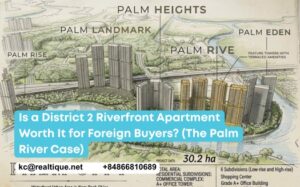
- SELLINGPalm River — riverside, opening Sept 2026 (foreign quota expected)
- SELLINGThe Global City — foreign quota available
- SELLINGGladia Heights by Keppel Land — foreign quota available
- RESALEDiamond Island — handed over, buy from current owners
- RESALEThao Dien Green — foreign-quota unit, resale
Coastal (foreign-eligible)
- Nobu Residences (Da Nang) — long-term lease resort
- Mandarin Oriental (Da Nang) — freehold for Vietnamese residents; long-term lease for non-residents
✓ Also yours freehold — if you hold Vietnamese residency or citizenship
These sell to domestic buyers (no foreign quota), but a Viet Kieu with residency owns them freehold, like a local:
- SELLINGBeachtro Tower — Blanca City, Vung Tau (final sea-view tower)
- SELLINGRung Phuong — Eco Retreat, Long An (low-rise, education hub)
- Haus Coastal — Quang Ngai (94ha coastal township)
Not sure which fits your status? Confirm your eligibility and live availability with a Realtique advisor — contact us or email [email protected].
Frequently Asked Questions
Who tracks the 30% count?
The developer and the local authority. A serious seller can produce the current figure on request.
What if the quota is full?
You cannot own; the alternative is a long-term lease, which is a different legal structure — not freehold ownership.
Does the 30% apply to the whole project or each building?
Per building. A large project can have some towers open to foreigners and others closed.
Can a Vietnamese-owned unit be sold to me as a foreigner?
Only if the building is still under 30% and a foreign slot is available for that transfer. Verify before you deposit.
Information for reference at 2026; not legal advice. Confirm the quota in writing with the developer and a licensed advisor before you deposit.
Ready to Buy Property in Vietnam? Talk to Realtique
We guide local, overseas Vietnamese and international investors end to end — eligibility, due diligence, legal transfer and the pink book.
Start today. Leave your name and email — a Realtique specialist will reach out. Or email [email protected].

KC and the Realtique team guide local, overseas Vietnamese and international investors through buying property in Vietnam — safely and in full compliance, from the first viewing to the pink book.