
Thao Dien: Why It’s Vietnam’s #1 International Enclave
Table of Contents
Thao Dien occupies a 350-hectare slice of Ho Chi Minh City’s east, bounded by the Saigon River, the Hanoi Highway, and the elevated metro viaduct. It is the only neighbourhood in Vietnam where the international school system, the F&B scene, the residential building stock, and the local-government posture have co-evolved over twenty years to produce something genuinely cosmopolitan rather than performatively international. For The Berkley’s target buyer, Thao Dien is not a feature; it is the proposition.
This article unpacks what Thao Dien actually offers as a place to live and invest in 2026 — and what it doesn’t.
What Makes Thao Dien Different
A twenty-year head start on internationalisation
Most “international” neighbourhoods in Asian cities were built by master developers in the last decade — Marina Bay, Songdo, top-down projects with a five-year operating history. Thao Dien is older. The first international school opened in 1996. The first European-managed F&B venues followed in the early 2000s. The expat community has been continuously resident for two and a half decades, with multi-generational families now common — a child born in Thao Dien in 2005 is now an adult.
The accumulated effect: Thao Dien feels lived-in rather than launched. The post office speaks English. Pharmacies stock Western prescriptions. Veterinarians handle imported pet vaccines. The infrastructure of expat life is mature, not aspirational.
School cluster gravity
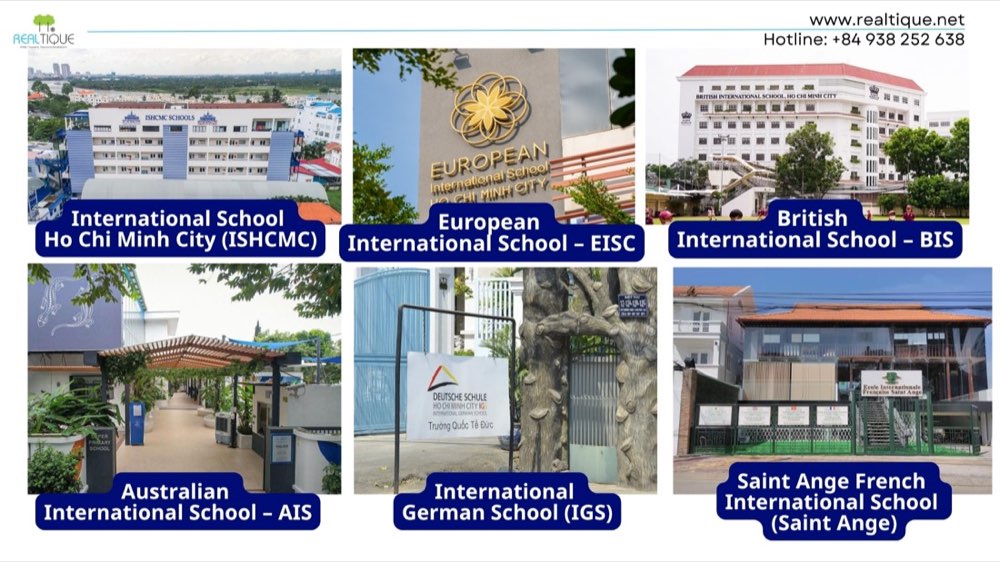
Thao Dien hosts or sits within fifteen minutes’ drive of the city’s leading international schools: International School of Ho Chi Minh City (ISHCMC, both campuses), British International School (BIS), Australian International School (AIS), European International School (EIS), Saigon South International School (SSIS) bus catchment, and the Korean International School. For families with school-age children, this concentration is the single largest gravity well — once a family enrols a child, the move-out cost rises sharply.
The downstream real-estate effect: family-rental demand is structural rather than cyclical. Two-bedroom and three-bedroom inventory leases reliably to expat families on company packages, often for two-to-four-year contracts.
F&B and lifestyle density
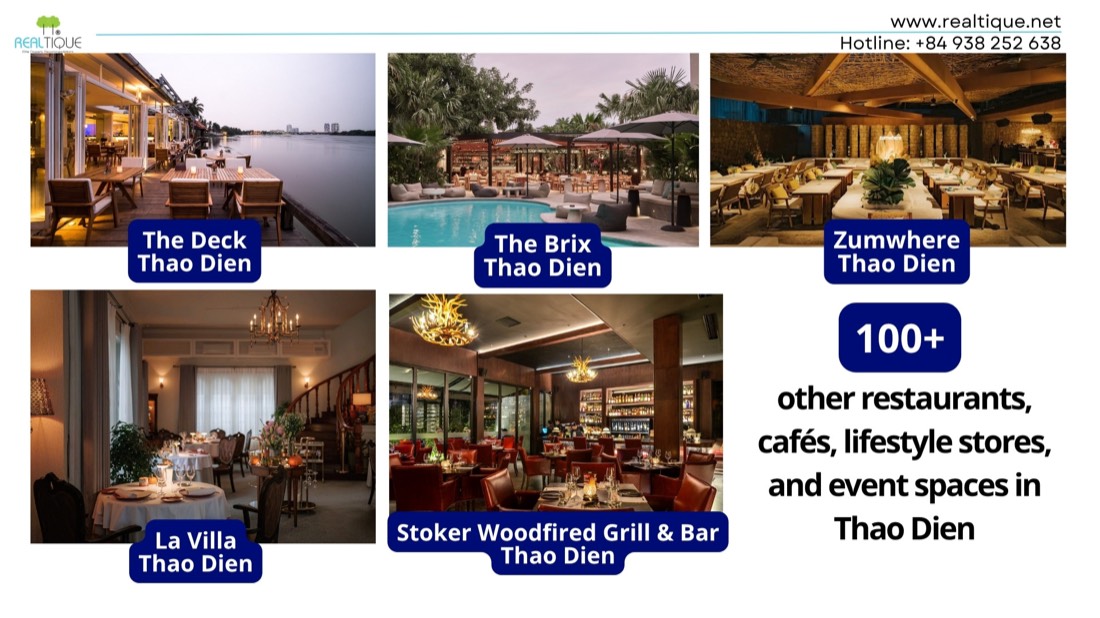
Within a 1km radius of The Berkley, the brochure’s amenity map identifies 25 curated venues: 14 fine-dining restaurants, 4 specialist cafeterias, 7 lounges and cocktail bars, 5 shopping anchors, and 5 healthcare/spa destinations. The relevant point: density. Most of HCMC’s premium suburbs require a car or motorbike for any non-residential errand. Thao Dien, particularly the central core around the An Phu metro station, allows daily life to be conducted on foot or by short cycle.
Riverside geography
Thao Dien curves along the Saigon River for roughly three kilometres of waterfront. The riverside is publicly accessible at multiple points (notably Deck Saigon, The Brix, Thao Dien Pearl waterfront) and supports a small but real boating and rowing scene. The river is not a swimming or fishing river, but it is a visual asset that ages well — riverside-facing units consistently command 8–12 per cent premium over interior-facing units in the same building, a premium that has been stable for over a decade.
What Thao Dien Doesn't Have
Honesty matters more for foreign buyers than for local ones, because foreign buyers do not have the casual conversational network to discover these things informally.
It is not an "easy" car neighbourhood
Thao Dien’s internal road network is narrow, traffic-clogged at peak hours, and increasingly hostile to private cars as the metro pulls more residents toward transit. Driving from The Berkley to a school 1.5km away can take 25 minutes during morning rush. Walking and the metro both work better than driving for most intra-Thao-Dien errands.
It does not have a major shopping mall inside the neighbourhood
The two large malls relevant to Thao Dien residents — Vincom Mega Mall and Estella Place — sit just outside the neighbourhood proper, requiring either a 10-minute drive, a metro hop, or a 25-minute walk. Inside Thao Dien itself, retail is small-format: boutiques, specialist grocers, and the MM Mega Market warehouse-format store. Buyers expecting Singapore-style internal mall experience will be disappointed.
It is increasingly expensive
Thao Dien’s secondary-market apartment prices have approximately tripled over the past decade. Yields have correspondingly compressed — gross rental yields now sit at 4–5 per cent for premium product, versus 6–8 per cent in newer suburbs. Investors prioritising current yield should look elsewhere; investors prioritising capital preservation, currency stability, and tenant quality should still look here.
It has a "two Thao Diens" structure
The Thao Dien presented in marketing materials — riverside walks, cocktail bars, art galleries — is the central core. The peripheral Thao Dien, particularly the alleys behind Tran Ngoc Dien and Nguyen Van Huong, retains the older, denser, more Vietnamese-vernacular character. Both are real. Buyers should walk the specific micro-neighbourhood around any candidate building before committing, because the experience changes block by block.
The Berkley sits in the central core, on the metro side of Vo Nguyen Giap, which is the most internationally-oriented and most appreciated portion of the neighbourhood.
Connectivity From The Berkley
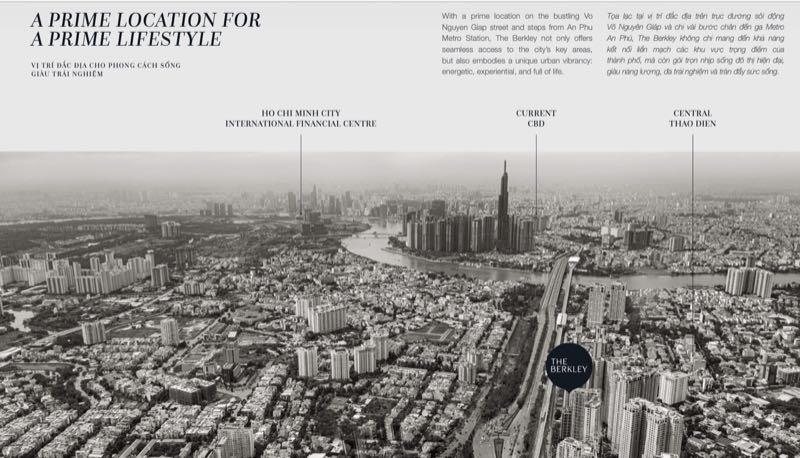
Walking and driving distances:
- An Phu Metro Station: ~150m (under 3 minutes walk)
- Vincom Mega Mall: ~750m (10 minutes walk, or 1 metro stop)
- ISHCMC primary campus: ~2.5km (8 minutes drive, school bus catchment)
- BIS Tu Xuong campus (D3): metro + bus, 35 minutes
- Tan Son Nhat International Airport: 18km, 35–55 minutes by car
- District 1 (Ben Thanh, Opera House): 11km, 25 minutes by metro, 30–55 minutes by car
- Thu Thiem International Financial Centre (under development): 6km, 15 minutes by car
Metro Line 1, operational since Q1 2025, runs from Ben Thanh through Tan Cang, Thao Dien, An Phu, and Rach Chiec. The An Phu station immediately fronts The Berkley’s site.
The Tenant Pool — What Rental Demand Actually Looks Like
For investor-buyers, the tenant economics matter as much as the resident economics. The active tenant pool breaks down approximately as follows:
- Western expat families on multinational corporate packages — typically 2-4 year postings, paying USD 2,500–5,000 per month for premium 2-3 bedroom units, looking for school proximity, secure lobbies, and Western-style fittings.
- East Asian expat families (Korean, Japanese, Taiwanese) — similar profile, often slightly longer postings, with strong preference for buildings with established compatriot communities.
- Single executives and senior consultants — Big 4 partners, fund managers, multinational country heads — typically renting 1-2 bedroom units, often paying USD 1,800–3,500 per month.
- Vietnamese HNW moving in for school or lifestyle reasons — increasingly significant share, paying market rates.
Vacancy in well-maintained Thao Dien stock typically runs at 4–7 per cent annually, materially lower than newer-district averages. The structural demand is the genuine asset.
How Thao Dien Compares to Saigon's Other Premium Neighbourhoods
| Neighbourhood | Strength | Trade-off |
|---|---|---|
| Thao Dien | Mature international, school cluster, riverside, metro | Compressed yields, narrow internal roads |
| District 1 (Ben Thanh, Le Thanh Ton) | CBD core, walkability, heritage, dining density | Limited family-residential stock, traffic, parking scarcity |
| District 2 (Thu Thiem) | New construction, master-planned, future financial district | Empty during evenings, no established community, longer build-out |
| District 7 (Phu My Hung) | Family-friendly, Korean/Taiwanese community, calm | Distance from CBD, less culturally diverse, no metro |
| District 3 (Vo Thi Sau, Tu Xuong) | French-colonial character, central, established | Dense, parking constrained, less family-oriented |
Thao Dien is the right answer when the priorities are international community continuity, school cluster access, and riverside-plus-metro combination. It is the wrong answer for buyers prioritising CBD walkability or maximum yield per dollar.
Bottom Line
Thao Dien is Vietnam’s most mature international residential neighbourhood, with a twenty-year head start that newer districts cannot replicate within the next decade. It is also expensive, increasingly transit-dependent, and asymmetrically structured (the central core differs materially from the peripheral alleys). For The Berkley specifically, the location is in the central core, on the metro side of Vo Nguyen Giap, which is the most internationally-oriented and most appreciated portion of the neighbourhood.
For a buyer choosing between Thao Dien and a more aggressive growth bet in Binh Duong or Long An, Thao Dien is the conservative pick: lower upside, materially lower downside, and the highest tenant-quality in the country.
Get the Full The Berkley Investment Report
Pricing by stack and floor · Payment track comparison · Lease structure summary for foreign buyers
Only 85 residences. Allocations move fast. Drop your details below — we will send you the live availability map, payment-scheme math run on your entry size, and a private walkthrough invitation within the same working day. Or speak directly: +84 866 810 689.