
An Phu Metro & The TOD Effect on Thao Dien Property Values
Table of Contents
When Ho Chi Minh City’s Metro Line 1 opened for revenue service in Q1 2025, two things were already true: every developer along the alignment had been pricing in TOD uplift for a decade, and most of that uplift had already been captured into asking prices. The question that mattered after launch was whether real ridership would justify the pricing, or quietly retrace it.
Fourteen months in, the answer is on the data. This article walks through the measured TOD effect on Thao Dien apartment values, what An Phu specifically delivers compared to the line’s other premium stations, and how to think about The Berkley’s metro-adjacent positioning as either an asset or a constraint.
What the TOD Premium Actually Looks Like Now
CafeF’s tracking of secondary-market transaction prices along the Line 1 corridor (covered in their late-2025 series and updated quarterly) shows three consistent patterns:
1. Tight catchment effect
The price uplift is sharply concentrated within 500 metres of a station. Beyond 800 metres, the TOD premium fades to within noise. Within 200 metres, the premium runs 12–18 per cent over the broader Thao Dien average for comparable product. The Berkley sits within that 200-metre band, on the An Phu station front.
2. Stack-level differentiation within metro-adjacent buildings
Inside metro-adjacent buildings, units that face the metro viaduct trade at a 5–8 per cent discount to interior-facing units of the same type, despite being in the same building. This is the visual-and-acoustic exposure premium working in reverse: the convenience is shared by the whole building, but the visual cost is concentrated on metro-side stacks.
For The Berkley specifically: metro-side units offer a meaningful entry-point discount for buyers who genuinely don’t mind the visual exposure. Owner-occupiers more sensitive to view should consider non-metro-side stacks; investors prioritising rental yield can capture the discount and pass through to tenants who value access over aesthetics.
3. Time-of-day pattern in transaction velocity
Transactions in metro-adjacent stock close faster than non-metro stock, but the buyer pool has shifted toward expat tenants and yield-focused investors and away from owner-occupier families with school-age children. Family buyers with cars and school-bus arrangements are less metro-sensitive; expat singles and DINKs (dual-income-no-kids) couples are highly metro-sensitive.
How An Phu Compares to the Line's Other Premium Stations
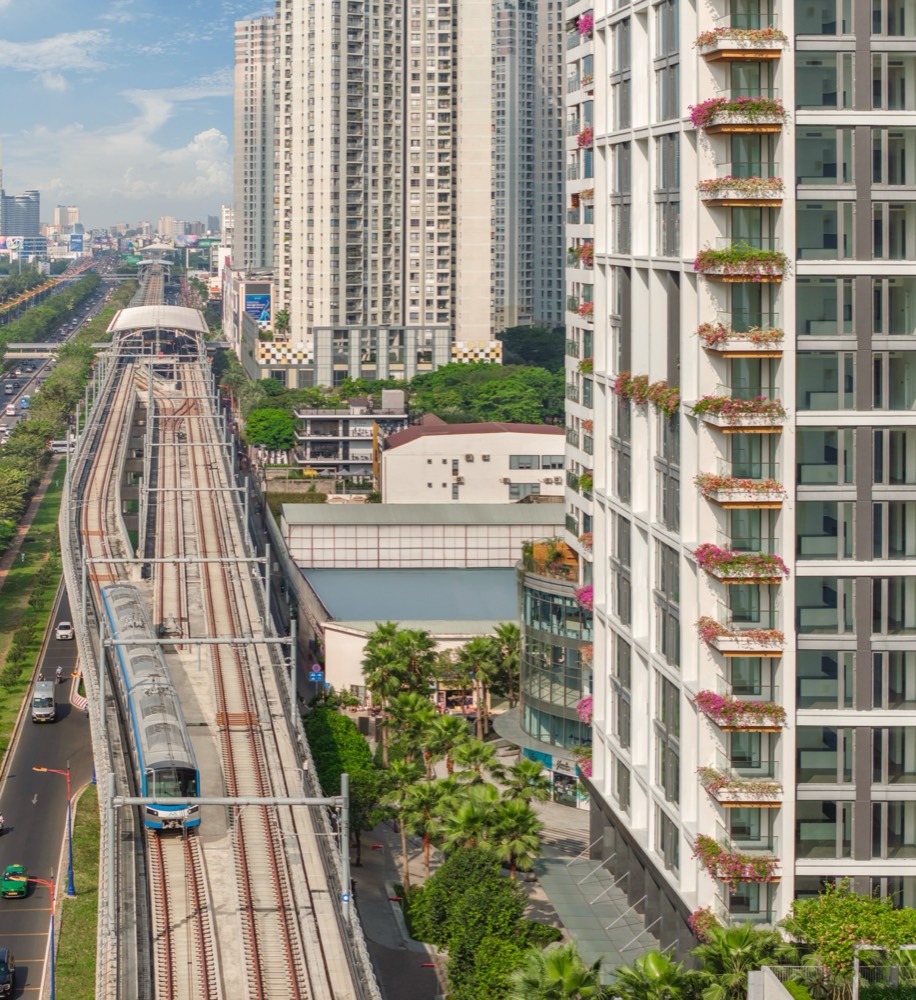
Metro Line 1 has four stations in the premium-residential corridor: Tan Cang, Thao Dien, An Phu, and Rach Chiec. Each anchors a different residential typology.
| Station | Catchment character | Premium stock |
|---|---|---|
| Tan Cang | CBD-adjacent, mixed-use, high commercial density | Vinhomes Central Park, Landmark 81 |
| Thao Dien | Mid-Thao-Dien residential | Masteri Thao Dien, Gateway Thao Dien |
| An Phu | East-Thao-Dien, school cluster gateway | The Berkley, Estella Heights, Q2 Thao Dien |
| Rach Chiec | Outer Thao Dien / D2 transition | Newer stock, sports complex |
An Phu’s specific character: it is the gateway between Thao Dien proper and the school-belt suburbs east of the Hanoi Highway. Foot traffic is materially lower than at Thao Dien station (which sits in the centre of the F&B core), but the residential and school usage is concentrated. From a residential-quality-of-life standpoint, An Phu offers the access without the transit-hub crowd density.
The Phase 2 Upside
Metro Line 1’s current Q1-2025-operational alignment runs from Ben Thanh through Tan Cang, Thao Dien, An Phu, and onward. The planned Phase 2 extension westward to Suoi Tien terminus is now in commissioning and expected to open within the next 12–18 months, which will roughly double the ridership catchment.
Separately, Metro Line 2 (Ben Thanh — Tham Luong) is in active construction with phased opening starting in 2027. While Line 2 does not directly serve Thao Dien, it improves the Ben Thanh interchange, which means Thao Dien residents gain one-transfer access to Tan Phu and the western airport corridor.
For The Berkley investors, both Phase 2 and Line 2 are upside scenarios — already priced into the broader HCMC metro narrative, but not yet fully reflected in An Phu micro-prices because most buyers are still digesting the Line 1 launch effect.
What Metro Adjacency Genuinely Costs
The convenience side of TOD gets all the marketing attention. The friction side deserves equal honesty.
Acoustic and vibration profile
Metro Line 1’s elevated viaduct sits roughly 30 metres from The Berkley’s metro-side facade. Trains run from approximately 05:00 to 22:00 with peak-hour frequency every 5–8 minutes and off-peak every 10–15 minutes. The trainsets are modern Hitachi-built Series 1 vehicles, designed for elevated-urban operation, and they are markedly quieter than the 1990s-era Bangkok BTS or the older portions of the Singapore MRT.
The Berkley’s facade glazing system is rated for the noise environment. Acoustic measurements inside metro-side units sit within the WHO daytime indoor recommendation of below 35 dBA average with windows closed, and 45–50 dBA with windows partially open. For buyers sensitive to ambient noise — light sleepers, work-from-home residents who keep windows open — visiting the unit during a peak-frequency window is essential before commitment.
Vibration is meaningfully reduced by the building’s structural separation from the viaduct (no shared foundation), but is not zero. Glass-shelf-mounted decorative items can show micro-vibration at peak frequency. This is a personal-tolerance question more than an objective deal-breaker.
Visual exposure
The viaduct is a present visual element from metro-side stacks. Some buyers find the visible metro activity a positive (“everyday city texture”); others find it a negative (“constant motion outside the window”). There is no objective right answer. This is a stack-selection decision, not a project-level decision.
Pedestrian routing
The walking route from The Berkley’s main entrance to the An Phu station platform is approximately 150 metres along Vo Nguyen Giap, with one signalised crossing. Total time door-to-platform is 3–4 minutes for an unhurried walker, 2 minutes if briskly. Sheltered pedestrian routing is partial — some segments have building-side awnings, others are open. For tropical-rain-season residents, an umbrella or light rain shell is part of the daily commute.
How to Underwrite the Metro Premium for The Berkley
Three principles for buyers translating TOD theory into a Berkley-specific decision:
1. Pay the premium on the right side of the building
Non-metro-side stacks at The Berkley capture the convenience benefit (3-minute walk to platform from anywhere in the building) without the visual or acoustic exposure. They trade at the building’s full TOD premium without the stack-level discount. For owner-occupiers, this is usually the right side of the trade.
2. Take the discount on the metro side if leasing
Metro-side stacks, available at a 5–8 per cent discount, offer the same convenience to a tenant who values access over view. Yield-focused investors should welcome the discount; the rental market does not penalise metro-side units to the same degree as the sales market does.
3. Phase 2 and Line 2 are upside, not base case
Don’t underwrite The Berkley’s pricing assuming Phase 2 ridership and Line 2 interchange premium. Those are real and likely, but they are also two to three years out. Buy on current fundamentals; treat the network expansion as a free option.
Bottom Line
Metro Line 1 is no longer a thesis; it is operating infrastructure. The TOD effect on Thao Dien property values is measured, concentrated within the 500-metre catchment, and meaningful enough to drive stack-level pricing differentials inside metro-adjacent buildings. The Berkley is positioned squarely inside that catchment, with An Phu station’s specific character — residential and school-oriented rather than commercial-hub — matching the building’s target buyer profile.
For foreign buyers in particular, walkable metro access reduces the friction of car ownership and driver-dependence, which is a meaningful day-to-day quality-of-life uplift that is often under-priced relative to its actual value.
Get the Full The Berkley Investment Report
Pricing by stack and floor · Payment track comparison · Lease structure summary for foreign buyers
Only 85 residences. Allocations move fast. Drop your details below — we will send you the live availability map, payment-scheme math run on your entry size, and a private walkthrough invitation within the same working day. Or speak directly: +84 866 810 689.

KC Pham
More on The Berkley Thao Dien
- ★ Complete Review 2026 (Pillar)
- → Price 2026 — Payment Tracks
- → Thao Dien: Vietnam’s #1 International Enclave
- → Floor Plans: 13 Layouts Decoded
- → Amenities + Thao Dien Hotspots
- → Is The Berkley Overpriced?
- → Long-Term Lease Structure
- → Buyer’s Guide A-Z
- → Insider’s Decision Guide
- → Sonkim Land Track Record