
Condotel Vietnam 2026: Proposal To Let Foreigners Buy, Capped At 30%
On 3 September 2026, the Ho Chi Minh City Real Estate Association (HoREA) asked lawmakers to build a single legal framework for the more than 146,000 hospitality properties already standing in Vietnam. Buried in that submission is the line that matters most to foreign buyers: let foreign individuals who enter Vietnam legally buy tourist apartments, capped at 30%.
This is a proposal, not a rule. But it lands squarely on the question overseas buyers ask Realtique most often when they look at a beachfront project: “Can I actually buy this unit, and if I can, what do I end up holding?”
Below we separate three things that routinely get blurred together — the condotel (tourist apartment), the residential apartment that may sit in the very same tower, and who is allowed to buy which. That blur is exactly where foreign buyers lose money.
Hospitality Property & Foreign Ownership — Updated 4 September 2026
Contents
What Just Happened
On 3 September 2026, HoREA published its submission to the drafters of the amended Law on Real Estate Business. Its core idea: stop regulating by marketing label — condotel, officetel, farmstay, tourist shophouse, sleep box — and adopt one umbrella concept, “construction works serving office, tourism and accommodation purposes”, with specific product types listed beneath it.
The reasoning is practical. The market keeps inventing new labels and the law keeps arriving late. The 2014 Law on Real Estate Business contained no concept of “tourism real estate” at all. Only the 2023 Law on Real Estate Business (Article 5) introduced “real estate serving accommodation purposes”. Hundreds of thousands of units were sold during that gap.
The proposals that touch buyers directly:
- Allow foreign individuals who enter Vietnam legally to buy tourist apartments in tourism projects — in HoREA’s words, “similar to the provisions being amended for foreigners buying apartments in residential buildings”.
- A 30% ownership cap on the foreign-eligible portion of a building.
- Recalculate the land-use term from the date the certificate is issued (or reissued) rather than from the original land allocation decision — which directly changes how many years a buyer actually receives.
The submission was presented by Le Hoang Chau, Chairman of HoREA, at the Vietnam Resort Real Estate Forum 2026 on 26 August and carried forward into early September.
Read the status correctly: this is an industry association submission feeding into a drafting process — not an enacted rule. The amended Law on Real Estate Business is still in consultation; the timing of submission and passage is not consistent across sources, and the content can still change before enactment.
How Big Is The Market, And Why Do The Numbers Disagree?
Read a few reports on this story and you will meet four different figures: 146,438, 118,000, 48,000 and 35,538. None of them is wrong. They count different things.
- 146,438 — total hospitality properties in existence per HoREA, excluding more than 10,000 officetels. A cumulative figure across all product types.
- 35,538 — only what was built between 2022 and June 2026: 24,767 tourist apartments plus 10,771 tourist villas and townhouses. A time slice, not a total.
- 118,000 — condotels only, adding roughly 83,000 units from 2008–2020 to roughly 38,000 from 2022–June 2026.
- 48,000 — the Ministry of Construction’s figure, on its own scope and reporting period.
That reconciliation is Realtique’s reading of the published figures, not an official cross-walk from the authorities.
The transferable habit: whenever you meet a market-size number, ask three questions — which product types does it count, over what period, and who published it. Without all three, it cannot be compared with any other number.
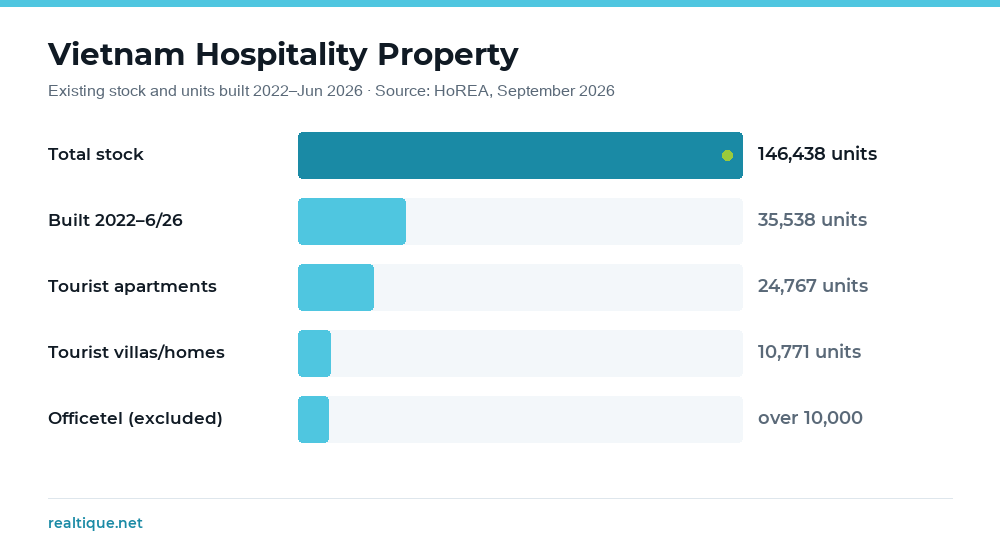
Graphic: Realtique · Data: HoREA, published September 2026
The surrounding scale is worth noting: roughly 130 tourism commercial projects completed or under way, about VND 1.3 quadrillion of investment across 10,000 hectares. In Q2 2026 the segment recorded 3,690 transactions worth roughly VND 7,600 billion — liquidity exists, but it is thin against the standing inventory.
Can Foreigners Buy A Condotel In Vietnam Right Now?
Short answer: no. The reason sits in a distinction most buyers never hear — a condotel is not housing.
Foreign individual ownership of housing is governed by the Law on Housing, with the familiar conditions: purchase only within eligible projects, no more than 30% of the residential apartments in a single building, nothing inside defence and security zones, and a 50-year term that may be considered for extension.
A tourist apartment falls outside the definition of housing. It is a construction work serving accommodation purposes, normally built on commercial – service land, and governed by real estate business law rather than the Law on Housing. So a foreign individual has no clear legal basis to buy and be named on a condotel — precisely the gap HoREA is asking lawmakers to close.
The trap worth memorising: a single beachfront tower can hold two different products — residential apartments (foreign-eligible, inside the 30% quota, term-limited title) and tourist apartments (not purchasable by foreigners today). From the outside they can share the same sea view, the same floor and the same price list. What separates them is the land category and the contract type.
The Proposed 30% Cap: Two Ways To Count It, Neither Settled
The 30% figure appears in the submission in two different formulations, and the gap between them is not trivial:
- No more than 30% of the units serving accommodation purposes in a building — counted per unit, mirroring the rule applied to residential apartments.
- No more than 30% of the total floor area put into business operation in that building — counted per square metre.
Why should a buyer care? Because tourist apartments in one tower are usually very uneven in size: 30–35 m² studios sit alongside 70–90 m² two-bedroom units and larger penthouses. Counted per unit, the foreign allocation can concentrate in the small stock and run out quickly. Counted per floor area, a handful of large units can absorb most of the allowance.
Right now neither method has been adopted, and the 30% cap itself remains a proposal. We flag it not so you can plan around it, but so that when a rule is actually issued you know which clause to read first.
Condotels And Title: Why So Many Still Have None
Since Decree 10/2023/ND-CP (effective 20 May 2023), condotels can be issued a certificate — conditionally. The building must sit on commercial – service land and satisfy land, construction and real estate business requirements. The term follows the project term, typically 50 years and in some cases up to 70 — not perpetual ownership as with a residential apartment on residential land.
In practice a large share of standing inventory still has no certificate, for a different reason: the project was originally approved as hotel apartments for lease, so the contract signed with the buyer is in substance a long-term lease, and no individual certificate can be split out.
That is also why the seemingly technical request to recalculate the term from the certificate date matters more than it looks. If a 50-year term runs from the land allocation date, a project delayed eight to ten years hands the buyer a unit with roughly 40 years left — at the price of a 50-year asset.
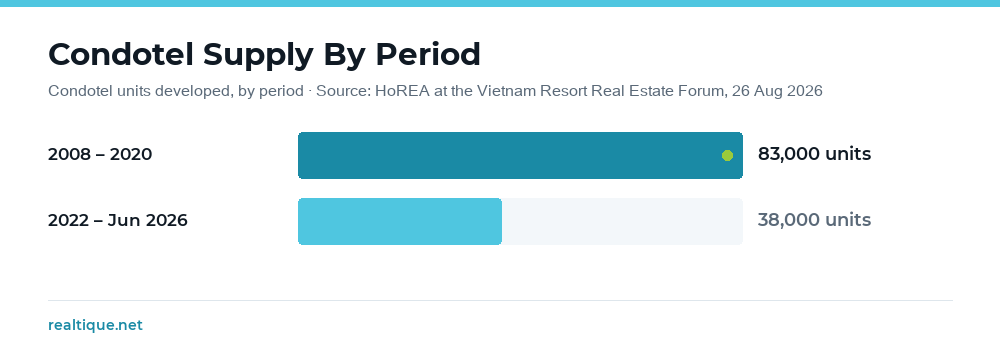
Graphic: Realtique · Data: HoREA at the Vietnam Resort Real Estate Forum 2026, 26 August 2026
What Changes For Foreign Buyers And Viet Kieu
For foreign nationals. For now, nothing changes. Until the amendment passes and takes effect, a foreign individual can still only buy the housing portion within a building’s 30% quota, not a tourist apartment. The useful move today is to establish which category your target unit belongs to — not to place a deposit on the expectation that the law will open.
For Viet Kieu who still hold Vietnamese nationality. This group is treated as domestic citizens under the 2024 Land Law and the 2023 Law on Housing, so most of the barrier HoREA wants removed does not apply to them. It is a practical advantage many overseas Vietnamese clients under-use.
For people of Vietnamese origin without Vietnamese nationality. The scope is narrower and depends on documents evidencing Vietnamese origin. Check this project by project and file by file rather than reasoning from someone else’s case.
Across the projects Realtique tracks, the distinction shows up clearly:
- Libera Nha Trang — the foreign-eligible stock runs on 50-year term ownership within a 30% per-building quota. That is the housing mechanism, not the tourist-apartment one.
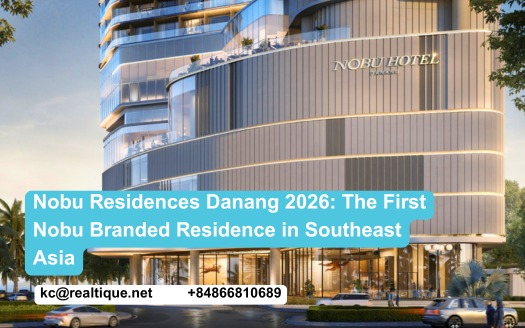
- Nobu Residences Danang — transacted through a long-term lease agreement, with no individual certificate per unit. This is exactly the product type HoREA’s submission is aimed at.
- Beachtro Tower, Blanca City — currently not offered to foreign buyers; eligible Viet Kieu remain the realistic route.
Five Questions To Ask Before You Place A Deposit
- What land category is this unit on? Residential land points toward perpetual title; commercial – service land means a term tied to the project, typically 50 years. This answer drives almost everything else.
- Which contract will I actually sign? A housing sale contract, a construction-works sale contract, or a long-term lease? The three give materially different rights on resale and inheritance.
- If I am a foreign national: is this unit part of the housing stock inside the building’s 30% quota, or is it a tourist apartment? If the latter, you cannot currently buy it and be named on it.
- From what date does the remaining term run? From land allocation, or from issuance of the certificate? Ask for the number of years remaining, not a generic “50 years”.
- If a yield is promised: who is giving the commitment, funded from what, recorded in which annex of the contract, and what happens if the operator cannot pay?
None of these needs a lawyer to ask. The answers, however, should arrive in writing.
Frequently Asked Questions
Can foreigners buy a condotel in Vietnam?
Not under current law. Foreign individual ownership is governed by the Law on Housing and applies only to housing, whereas a tourist apartment is a construction work serving accommodation purposes, usually built on commercial and service land, and falls outside that scope. HoREA has proposed opening this right in the amended Law on Real Estate Business, but it remains a proposal.
How would the proposed 30% cap be calculated?
The submission sets out two methods: no more than 30% of the units serving accommodation purposes in a building, or no more than 30% of the total floor area put into business operation in that building. The two produce different outcomes when unit sizes vary widely, and neither has been adopted.
Can a condotel receive a certificate of ownership?
Yes, since Decree 10/2023/ND-CP took effect on 20 May 2023, provided the building sits on commercial and service land and meets land, construction and real estate business requirements. The term follows the project term, typically 50 years, rather than perpetual ownership. In practice many projects still cannot issue certificates because the contract signed with buyers is in substance a long-term lease.
Can Viet Kieu buy hospitality property in Vietnam?
Overseas Vietnamese who still hold Vietnamese nationality are treated as domestic citizens under the 2024 Land Law and the 2023 Law on Housing, so the restriction currently applied to foreign individuals does not bind them. For people of Vietnamese origin without Vietnamese nationality the scope is narrower and depends on documents evidencing origin, so it should be checked project by project.
Why do published figures for Vietnam hospitality property differ?
Because each number covers a different scope. The 146,438 figure is total hospitality stock excluding officetels; 35,538 covers only units built between 2022 and June 2026; roughly 118,000 counts condotels alone across two periods; and 48,000 is the Ministry of Construction figure on its own reporting scope. Always establish which product types a number counts, over what period, and who published it.
⚠️ Important note. This article is market commentary and information gathering, not legal advice. The HoREA positions described here are a submission to lawmakers, not enacted regulation; the amended Law on Real Estate Business may still change, and the timing of its submission, passage and entry into force is not consistent across sources. The instruments cited (the 2014 and 2023 Laws on Real Estate Business, Decree 10/2023/ND-CP, the 2023 Law on Housing and the 2024 Land Law) are those in force at the date of publication. How they apply depends on the specific project, land category and file — ask the developer to confirm in writing and consult a licensed lawyer before placing a deposit.

Not sure which category your unit falls into?
Realtique checks the land category, contract type, remaining term and foreign-quota status of the specific unit you are considering — and gives you the list of documents to request from the developer before you place a deposit.
📞 Hotline: +84 866 810 689

Grace Le
Grace Le is a Branch Manager at Realtique, advising bilingual and overseas buyers on ownership structures, eligibility and long-term value across Vietnam’s residential and coastal markets.