
Cash-Flow Property in Vietnam: Two Studios at 2 Billion VND, Two Very Different Outcomes
Cash-flow property is bought to collect rent, not to be resold at a profit. The catch is that the “rental yield” figures quoted in the market are rarely comparable with one another — two apartments at the same price can sit on completely different operating models.
This article works through two studios priced at roughly 2 billion VND from Realtique’s own portfolio — one at Sun FourS Tower in southern Da Nang, one at Beacon 1, Blanca City, Vung Tau — and answers the questions a yield percentage hides: what rent do you actually need each month, what gets deducted, how is the rent taxed, and how long before the first rent arrives at all. Every assumption is stated so you can substitute your own.
Read this first if you are a foreign national. Neither project in this article is open to you. Sun FourS Tower is not sold to foreign individuals or organisations and is not on the list of developments licensed for foreign ownership; Blanca City is closed to foreign buyers as well. Overseas Vietnamese who still hold Vietnamese nationality buy and hold title at both exactly as a domestic citizen does. The method below applies to any rental property in Vietnam — but if you need a project you can actually buy, ask a Realtique advisor to filter for buildings with foreign quota remaining.
Rental Cash Flow — Two Models, September 2026
Contents
What Is Cash-Flow Property?
There are two ways to make money from property, and they suit two very different temperaments.
Capital growth means buying and waiting for the asset to appreciate, then selling. The money arrives once, at the point of sale, and depends on someone being willing to buy at that moment.
Cash flow means buying and letting. The money arrives monthly, without selling the asset. You gain predictability and the ability to service part of a loan from the property itself; you give up passivity, because you now have to operate — find tenants, keep them, repair things, file tax.
The usual measure is gross yield: annual rent divided by purchase price. A 2 billion VND apartment let for 100 million VND a year is a 5% gross yield. The word gross is doing a lot of work — it is revenue, with no costs deducted at all. Most disagreements about whether letting “makes money” come down to one side quoting gross yield while the other is thinking about what actually stays in their pocket.
What Does a 5% Gross Yield Mean Per Month?
This is the first thing worth doing, because it converts an abstract percentage into something you can go and verify.
The assumption used here: a 5% gross yield for long-term letting. This is Realtique’s general reference level, not a guarantee and not a measurement of any single project. Price is taken at 60 million VND per m², the midpoint of the 55–66 million VND per m² range recorded in actual Sun FourS Tower transactions in April 2026 (inclusive of VAT and the maintenance fund).
Working the percentage back into monthly rent
| Unit type | Size | Estimated price | Rent needed per month |
|---|---|---|---|
| Studio | 30.5–35.3 m² | ~1.97bn VND | ~8.2m VND |
| 1 bedroom | 45.2 m² | ~2.71bn VND | ~11.3m VND |
| 1 bedroom + | 48.5–60.7 m² | ~3.28bn VND | ~13.7m VND |
| 2 bedrooms | 64.4–73 m² | ~4.12bn VND | ~17.2m VND |
| 3 bedrooms | 91.5 m² | ~5.49bn VND | ~22.9m VND |
Now take the last column to the market. Can a studio in Hoa Quy actually be let long-term at 8.2 million VND a month? If yes, the 5% assumption holds. If the local market only pays 6 million, the real gross yield is 3.7% and every figure downstream moves with it. Yield is an output, not an input — anyone who hands you a yield percentage without the corresponding monthly rent has given you a number you cannot check.
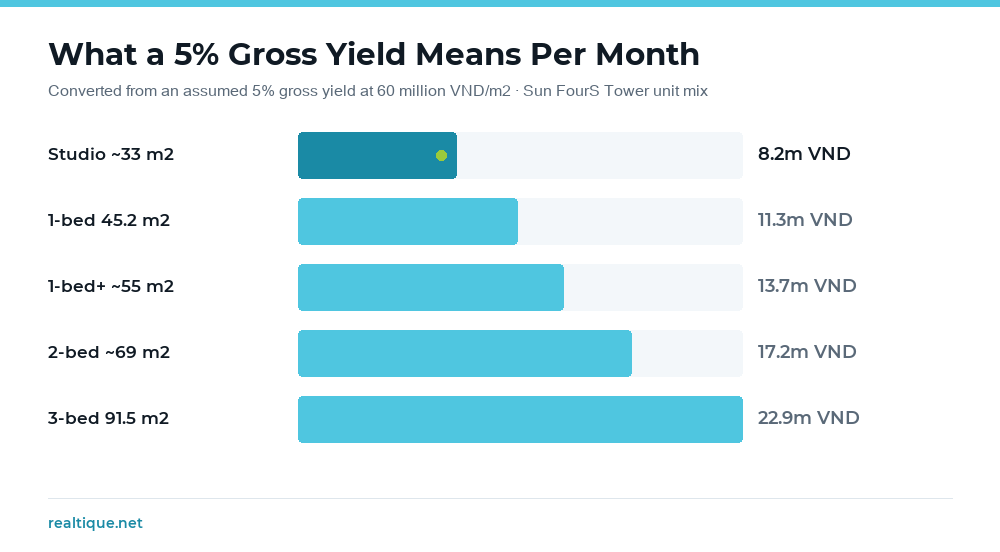
Graphic: Realtique · Based on an assumed 5% gross yield across the 55–66 million VND/m² range recorded at Sun FourS Tower, April 2026
From Gross Yield to Real Cash Flow: Four Deductions
Gross yield is revenue. What stays with you is lower, and it erodes in four fairly predictable layers.
- Vacancy. Few units let for twelve uninterrupted months. Allowing one vacant month a year is moderately conservative — on its own it removes roughly 8% of revenue.
- Building management fees. Assumed at 12,000 VND per m² per month: a ~33 m² studio costs about 4.7 million VND a year. At Sun FourS specifically, sales policy CSBH04 waives management fees for the first year from handover, so this line is zero in year one and appears from year two.
- Maintenance and furnishing wear. A let apartment ages faster than an owner-occupied one. Setting aside around 0.3% of the unit value per year for progressive replacement is realistic.
- Letting agency fees. Each tenant changeover typically costs half a month to a full month of rent.
Together these pull a 5% gross yield down to roughly 3.8% a year — and that figure is still before tax and before loan interest. If you use bank leverage at the interest rates common in this market, the interest bill can easily exceed rental cash flow in the early years.
Same ~2 Billion VND — So Why Does Beacon 1 Look So Different?
Here is where a second data point turns the picture upside down.
From Realtique’s own operating record at Beacon 1 (Blanca City, Vung Tau): a studio of around 2 billion VND can be operated at 20–25 million VND a month. Annualised that is 240–300 million VND, a gross yield of roughly 12–15% a year — close to three times the 5% used for the Da Nang unit, at essentially the same price.
Neither number is wrong. They come from two different operating models:
| Sun FourS (South Da Nang) | Beacon 1 (Blanca City, Vung Tau) | |
|---|---|---|
| Model | Long-term letting to settled tenants | Short-stay accommodation for holidaymakers |
| Who operates it | The owner — the project has no hotel operator | Supported by a developer rental programme |
| Source of demand | Residents and workers around the township | Leisure travellers, strongly seasonal |
| Gross yield | Assumed 5% a year | Recorded at 12–15% a year |
| Effort required | Low — one long lease, revisited every few months | High — check-ins, cleaning, constant review management |
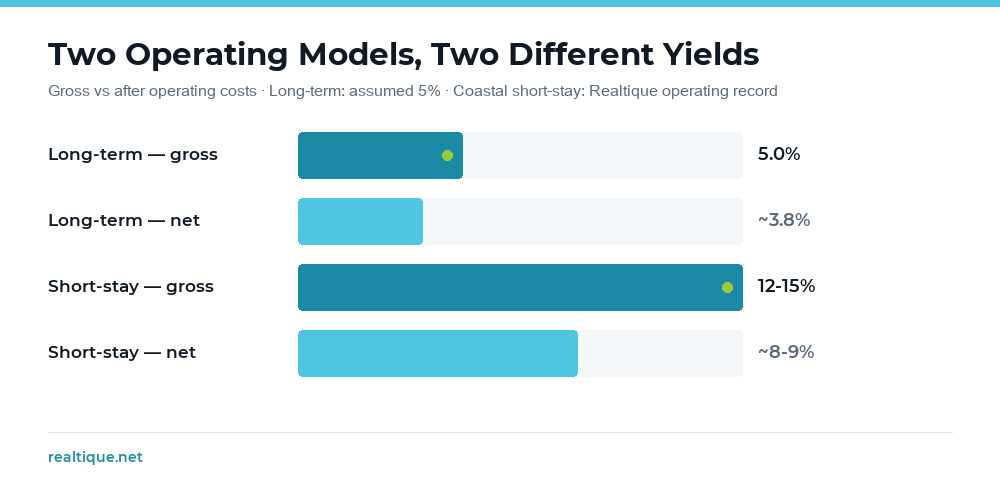
Graphic: Realtique · Long-term: assumed 5% a year · Short-stay: Beacon 1 (Blanca City) operating record, gross revenue
Why These Two Numbers Cannot Be Compared Directly
This is the section that matters most: 12–15% and 5% are not two numbers you pick the larger of.
Three reasons the gap narrows sharply in real money
- Short-stay operating costs are far heavier. Booking-platform commission, cleaning and laundry after every guest, consumables, and furnishings that wear out much faster than in a long let. This is closer to running a hospitality business than to passive letting.
- Seasonality and occupancy. Coastal property has full months and empty ones. A peak-month revenue figure multiplied by twelve produces an annual number that will never be achieved. Whenever you are handed an operating figure, the necessary question is: is this a peak month or a full-year average, and at what assumed occupancy?
- Concentration of risk. A long lease depends on one tenant; short-stay income depends on tourist volumes across an entire region. The latter swings far more, on factors no owner controls.
After operating costs, the gap narrows to roughly 3.8% against 8–9% on Realtique’s estimates. Short-stay still comes out clearly ahead — but with materially more work and more variance, not the “three times better” the gross figures imply.
Rental Tax in 2026: The 1 Billion Threshold and the Eleventh-Unit Trap
From 2026 the rental tax calculation is simpler, but it carries a threshold effect worth understanding before you buy an additional unit.
- The threshold is 1 billion VND of rental revenue per year, measured across ALL units held in one person’s name — not unit by unit.
- Below the threshold: exempt from value-added tax and personal income tax — but a declaration is still required.
- Above it: VAT at 5% on the entire revenue, plus personal income tax at 5% on the portion above 1 billion.
Why the eleventh unit is the expensive one
Using the same studio at 8.2 million VND a month, about 99 million VND a year each:
- 10 units → roughly 987 million VND a year → still below the threshold → no VAT and no personal income tax due.
- 11 units → roughly 1,086 million VND → above the threshold → VAT at 5% on the full 1,086 million is 54.3 million, plus personal income tax at 5% on the 86 million excess is 4.3 million → about 58.6 million VND in total.
The eleventh unit brings in an extra 99 million in rent and triggers 58.6 million in tax across the whole portfolio — close to 59% of its own revenue. For a landlord sitting near the threshold, buying one more unit stops being a question about that unit’s yield.
Note: this reflects the rules in force at the time of writing and is provided for reference only. It is not tax advice. Application varies by locality and by individual circumstances — confirm with the tax authority or a qualified tax adviser before acting.
The Gap Nobody Budgets For: Negative Cash Flow Before Handover
This part rarely appears in project marketing, and it determines whether you reach the point of collecting rent at all.
Sun FourS Tower is scheduled for handover on 31 March 2028. A buyer in the 2026 launch rounds is therefore paying for close to two years before letting can begin — and in practice longer, since fitting out and finding a tenant both follow handover.
Three features of sales policy CSBH04 bear directly on this:
- Interest-rate support for up to 24 months from first disbursement, but no later than 31 October 2028 — whichever comes first.
- The “Sun Early Key” programme: pay 70% of value (including VAT) to take the unit at completion, with the remaining 30% spread over up to 45 months.
- An additional 5% discount for buyers who do not use the interest-support package.
Put the two dates side by side. Handover is scheduled for 31 March 2028; interest support ends no later than 31 October 2028. That is a buffer of about seven months — while a newly handed-over apartment usually needs several months to be fitted out and tenanted. The scenario to plan for is that the support period ends before rental income is running steadily, and the gap has to be covered from your own funds. This is precisely the trap examined in the article on principal grace periods linked below.
A completed, already-operating project has no such negative window — but you pay a higher entry price and forgo launch-stage discounts. It is a genuine trade-off; neither side is free.
Which Model Suits Whom?
Neither model is better in the abstract. Choose according to what you have most of.
Long-term letting suits
- Owners who want as little to do as possible — sign one long lease and leave it.
- Owners living abroad, including overseas Vietnamese, who cannot realistically manage weekly guest turnover.
- Owners who need predictable income to sit alongside a bank loan.
Short-stay operation suits
- Owners willing to treat it as a business rather than a passive investment.
- Owners with family or an operator on the ground, or buying into a project with a developer rental programme.
- Owners who can absorb revenue that swings by season without monthly debt pressure.
And if you are a foreign national
Both projects discussed here are closed to you, as set out at the top. Two further points are worth carrying into any project that is open: foreign ownership quotas are applied per building, so a well-located tower can exhaust its foreign allocation long before you have finished evaluating it; and quota availability moves independently of yield, so the unit that suits your cash-flow model may simply not be available to you. Confirm the current quota position in writing on the specific building before you commit to anything.
Frequently Asked Questions
What is cash-flow property?
Cash-flow property is property bought to be let and to produce regular monthly income, rather than bought to be resold at a higher price. The common measure is gross yield, calculated as annual rent divided by purchase price. Gross means revenue before operating costs, tax and loan interest.
What does a 5% gross yield mean in monthly rent?
For a studio of around 33 square metres priced at 60 million VND per square metre, a total of roughly 1.97 billion VND, a 5% gross yield corresponds to about 99 million VND a year, or roughly 8.2 million VND a month. A quick way to test any yield figure is to convert it back into monthly rent and compare that against actual asking rents in the area.
Why do two apartments at the same price show very different yields?
Because they run different operating models. Long-term letting to settled tenants generally shows a lower gross yield but requires little work and produces predictable income. Coastal short-stay operation can show a much higher gross yield but carries heavy operating costs, depends on season and occupancy, and is closer to running a hospitality business than to passive investment.
How is rental income taxed in Vietnam in 2026?
The threshold is 1 billion VND of rental revenue per year, measured across all units held in one person’s name rather than unit by unit. Below the threshold, value-added tax and personal income tax are exempt but a declaration is still required. Above it, value-added tax of 5% applies to the entire revenue, plus personal income tax of 5% on the portion above 1 billion. This is reference information, not tax advice.
Can foreign nationals buy the projects in this article?
No. Sun FourS Tower is not sold to foreign individuals or organisations and is not on the list of developments licensed for foreign ownership, and Blanca City is also closed to foreign buyers. Overseas Vietnamese who still hold Vietnamese nationality can buy and hold title at both exactly as a domestic citizen does. Foreign buyers should ask a Realtique advisor to identify projects with foreign ownership quota still available.
⚠️ Important. This article is market analysis. It is not investment advice, not tax advice, and not a guarantee of return. The 5% gross yield is a reference assumption set by Realtique to demonstrate the method, not a measurement of any single project. The 20–25 million VND per month figure at Beacon 1 is gross revenue from Realtique’s operating record and varies with season, occupancy and how the unit is run — it is not an assured level. Prices, sales policies and handover schedules are set by the developer and may change. Ask for a calculation built on the specific unit you are considering before committing funds.


Want this calculation run on a unit you can actually buy?
Realtique builds the model on the real price of a specific unit, rents surveyed in that district, operating costs and the payment schedule — with a conservative scenario, so you see the negative cash-flow window before handover. For foreign buyers we confirm remaining ownership quota in writing first.
📞 Hotline: +84 866 810 689

KC Pham
KC Pham leads Realtique and has advised domestic and international buyers on Vietnamese residential property for over a decade.