
Dong Nai to Become an Asia-Pacific Aviation Hub: Property Opportunity from the Long Thanh Airport City
On 21 July 2026, Vietnam’s Politburo issued a Resolution on developing Dong Nai, setting the direction for it to become a modern Asia-Pacific aviation hub. Anchored by Long Thanh International Airport, Dong Nai is targeted to grow into a multi-centre “airport city” — a direction with major implications for the property market across the southern region. This article summarises the key points of the Resolution and analyses what they mean for investors.
Dong Nai → Aviation Hub — In 30 Seconds
Mục lục
What the Resolution Sets Out
The Resolution defines a three-stage roadmap: by 2035, Dong Nai becomes a “riverside, multi-centre, green, smart airport city” meeting international aviation-economy standards; by 2045, a modern Asia-Pacific aviation hub; and with a 2065 vision of a globally connected city among the world’s leading multi-function airport cities.
Economically, it targets average GRDP growth of at least 10% a year in 2026–2030, with the economy scaling sharply across milestones:
| Year | GRDP | GRDP per capita |
|---|---|---|
| 2030 | US$44bn | US$9,200 |
| 2035 | US$70bn | US$13,000 |
| 2045 | US$150bn | US$23,000 |
| 2065 | US$600bn | US$67,500 |
Long Thanh Airport — The Core of the Airport City
At the centre of the plan is Long Thanh International Airport, designated as Vietnam’s primary international air gateway and international transshipment hub. The Long Thanh–Nhon Trach area is planned as an airport city of roughly 2.5 million people. This is the “aerotropolis” model — a city built around an airport — proven in several places worldwide, where the airport drives logistics, trade, services and urban development rather than simply moving passengers.
September 2026 Update: 80% Built — but International Traffic Only Arrives from 2027
Short answer: 1 December 2026 is not the date international traffic arrives at Long Thanh. Under the agreed roadmap, most international flights only move across from 28 March 2027, and the transfer runs until 25 March 2028. For property, that is the clock that matters.
Where the project actually stands, early September 2026
As of 2 September 2026, the project has reached roughly 80% of total work value, with close to 100% of the workforce staying on site through the National Day holiday. By component: the second runway is 100% structurally complete (surface drainage past 80%, with the remainder targeted for 30 September 2026); the passenger terminal is about 80% built and now in architectural finishing — ceilings, partitions, interiors and landscaping; the baggage handling system (BHS) has its steel frame and mechanical equipment 100% installed with belt conveyors in final stages, but control-system commissioning is only around 50% complete; and internal airport roads stand at roughly two-thirds of contract value.
For scale: total investment across the whole project is about VND 336,630 billion (~US$16.03 billion at 2014 prices), with Phase 1 at roughly VND 114,450 billion (~US$5.45 billion). Phase 1 capacity is 25 million passengers and 1.2 million tonnes of cargo a year.
Three trial phases, each with a different scope
ACV has split trial operations into three rounds of widening scope rather than three identical rehearsals: September 2026 tests the airfield and the terminal’s west wing; October 2026 tests integration with aircraft and completed components; November 2026 tests the airport as a whole, ahead of commercial service from 1 December 2026.
Added 25 September 2026: the opening date is now being described as a month rather than a day. On 17 September ACV’s deputy general director said the target is “commercial operation in December, possibly before Christmas” (Tuoi Tre, 17 September 2026), and the Prime Minister’s latest instruction refers to “the end of 2026”. By mid-September the passenger terminal was past 77% of plan, but equipment installation stood at roughly 71%; ACV is prioritising the west wing and central section of the terminal, and 15–20 core trial-operation scenarios are due to start in late September (Dan Tri, 21 September 2026). The 2027–2028 flight-transfer schedule below is unchanged — so for property decisions, the dates that matter are still 28 March 2027 and March 2028.
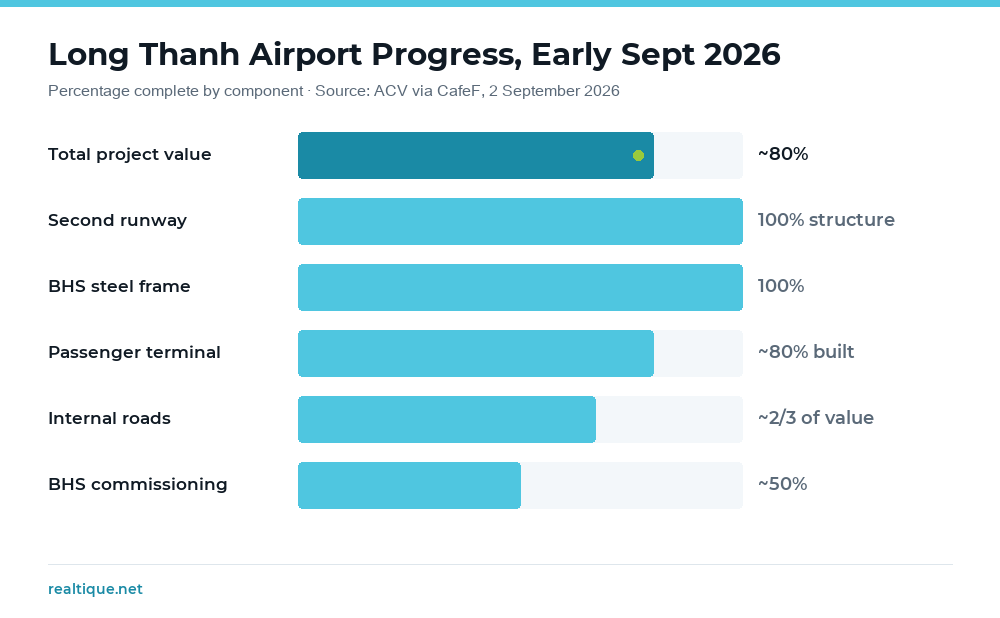
Graphic: Realtique · Data: ACV via CafeF, 2 September 2026
The part that matters for property: the transfer runs into 2028
Airlines do not all move on opening day. The agreed roadmap has three stages:
- Stage 1 — 1 December 2026 to 27 March 2027: carriers operate international routes (including freight) at Long Thanh according to each airline’s own commercial needs. Movement is by choice, not by mandate.
- Stage 2 — 28 March 2027 to 29 October 2027: all long-haul international flights to and from Europe, the Americas, Oceania, Africa, the Middle East, South Asia and Central Asia transfer to Long Thanh.
- Stage 3 — 30 October 2027 to 25 March 2028: all remaining international flights transfer, except short-haul routes under 1,000 km flown by Vietnamese carriers.
How to read this as a buyer. An airport lifts surrounding property when sustained passenger flow arrives — not when the ribbon is cut. This roadmap puts that moment at 28 March 2027, when the long-haul block moves, reaching full state only in Q1 2028. The sensible evaluation window for Dong Nai airport-city property is therefore 2027–2028, not the weeks around first commercial service. Anyone buying on the thesis that “prices jump the month the airport opens” is betting on a milestone the official roadmap does not promise.
Caveat: every date above is a plan announced by ACV and the regulators, and can shift with construction and acceptance testing. BHS control-system commissioning at roughly 50% is the item worth watching, since baggage handling is one of the classic bottlenecks that delays an opening. Track official announcements rather than modelling around a fixed date.
For foreign buyers specifically: the staged transfer favours patience over timing. A holding period that ends before Q1 2027 sits entirely inside the discretionary stage, when traffic volumes are set by individual airline decisions rather than by rule — the least predictable window of the whole sequence. Note too that foreign ownership quotas are applied per building, so availability in a well-placed project can run out well before the airport-city thesis plays out. A Realtique advisor can confirm the current quota position on any specific development.
Sources: ACV via CafeF (2 September 2026 and 31 July 2026); Vietnam Government Portal (28 July 2026); VnExpress (29 July 2026).
Four Strategic Development Corridors
The Resolution defines four corridors linking Dong Nai to the region and beyond:
- Ho Chi Minh City – Bien Hoa – Long Thanh – Phuoc An port: an air, seaport and logistics axis.
- Bien Hoa – Dau Giay – Tan Phu – Central Highlands: industry, agriculture and eco-tourism.
- Long Thanh – Lam Dong – South Central Coast – Central Highlands: connecting aviation with seaports and the highlands.
- Phuoc Long – Dong Xoai – Chon Thanh – Hoa Lu – Cambodia – ASEAN: cross-border logistics.
Dong Nai will also study special mechanisms similar to Ho Chi Minh City’s across investment, finance, land, planning, science-technology and talent, plus functional zones such as a free-trade zone, a digital-technology zone, an innovation zone and a higher-education zone. Priority industries include aviation, semiconductors, high-tech, AI, cloud computing and biotechnology.
Realtique’s View: What It Means for Property
For investors, this direction reinforces a clear trend: infrastructure and capital are shifting east. Three effects stand out:
- The Long Thanh – Nhon Trach – Bien Hoa axis benefits directly: an airport city of 2.5 million residents creates enormous long-term demand for housing, services, logistics and commercial property.
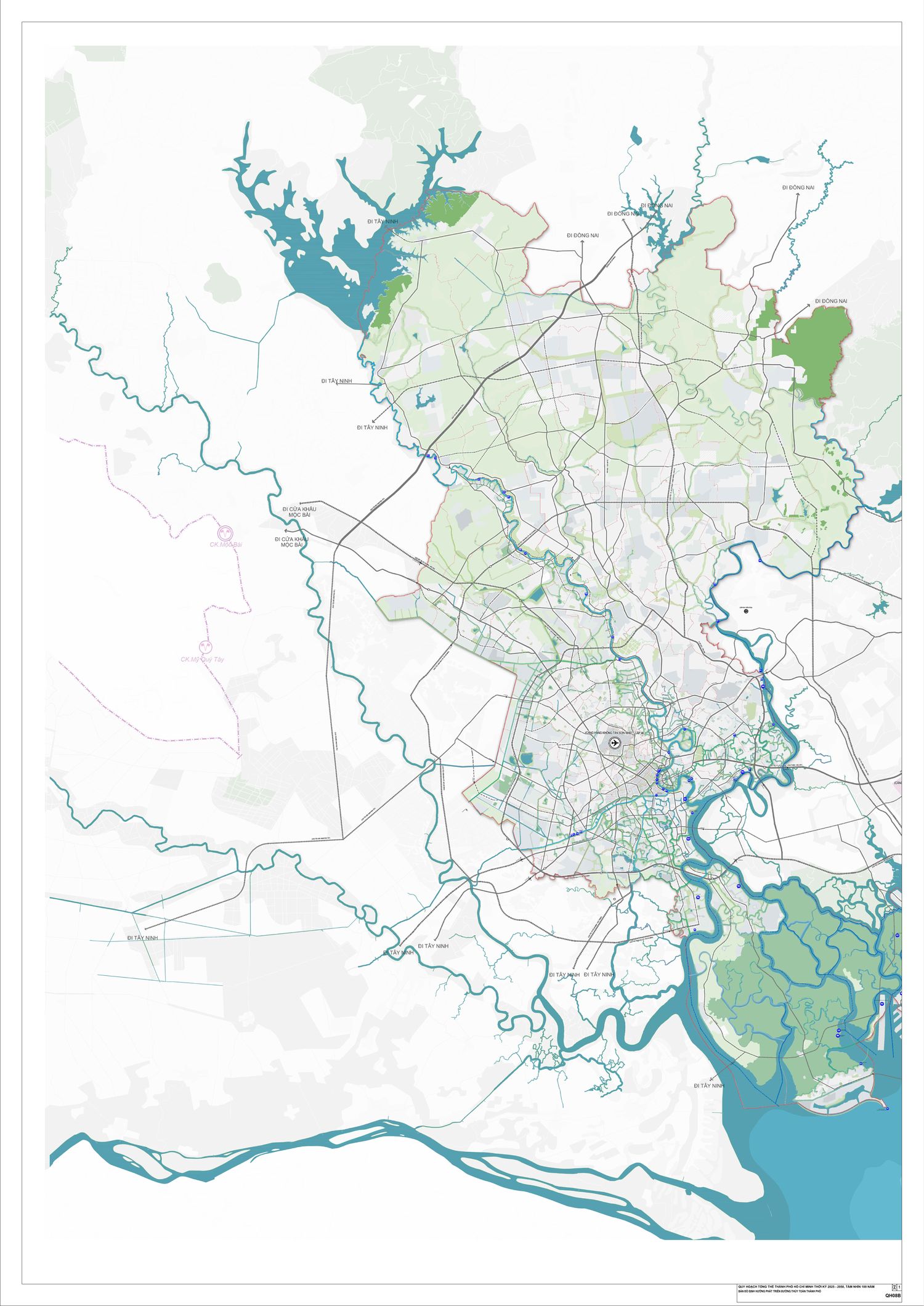
- A spillover to Ho Chi Minh City: Long Thanh sits on the axis connecting to the city’s eastern innovation pole (Thu Duc) in the HCMC master plan — two mutually reinforcing directions that support property values in the city’s east.
- A note on patience: a plan is direction, not a delivery guarantee. “Airport-linked” property values tend to re-rate at each real infrastructure milestone (connecting roads, opening dates) rather than on news alone — so favour clear legal title, genuine proximity to nodes, and a long holding horizon.
In short, the Dong Nai Resolution is not just a local story but one piece of a regional mega-city picture — with Long Thanh airport set to become one of the most important growth drivers in southern Vietnam over the next 20–40 years.
Why “Airport Cities” Re-Rate Property
The aerotropolis model has proven its pull worldwide, from Incheon in South Korea to Changi in Singapore and Daxing in China. The mechanism that lifts property values comes from three flows: people (tens of millions of passengers and hundreds of thousands of workers and specialists each year create demand for housing, rentals and services), goods (logistics, warehousing and free-trade zones pull in industrial and commercial real estate), and capital (domestic firms and FDI locate headquarters, plants and R&D centres near the airport).
For Long Thanh, the 2.5-million-person scale of the Long Thanh–Nhon Trach airport city, together with its four connecting corridors, shows this is not a standalone airport but a new economic pole for the south. As connecting infrastructure (expressways, ring roads, rail) is completed, the “time distance” from Long Thanh to central Ho Chi Minh City shrinks — historically the leading indicator ahead of price growth in peripheral areas.
How Foreign Buyers Can Position
For overseas investors, the practical takeaway is to favour the mature, liquid markets first — the eastern core of Ho Chi Minh City (Thu Duc and the riverfront) where apartments carry clear foreign-ownership rights within the 30% building quota — while treating the Long Thanh frontier as a longer-horizon, higher-conviction play. Landed property along the airport corridor is generally accessed by foreigners only through a long-term lease structure rather than outright ownership, so eligibility and title should be checked project by project. As always, prioritise developers with strong delivery records and legal clarity, and size positions to a multi-year horizon rather than a news cycle. For the ownership rules that apply everywhere, see our Foreign Buyer Guide.
Frequently Asked Questions
When will Long Thanh Airport open?
Under ACV’s plan, Phase 1 of Long Thanh Airport runs three rounds of trial operations across September, October and November 2026, followed by commercial service from 1 December 2026. These are planned milestones announced by ACV and the regulators and may shift with construction and acceptance testing. Update, 17 September 2026: ACV now describes the target as commercial operation during December, possibly before Christmas — read it as a December window rather than a fixed date.
Is Long Thanh Airport finished?
As of 2 September 2026 the project had reached roughly 80% of total work value. The second runway is 100% structurally complete and the passenger terminal is about 80% built and in architectural finishing, while the baggage handling system has its steel frame and mechanical equipment fully installed but control-system commissioning is only around 50% complete.
What do the three trial phases cover?
September 2026 tests the airfield and the terminal’s west wing. October 2026 tests integration with aircraft and completed components. November 2026 tests the airport as a whole, ahead of commercial service.
When do international flights move to Long Thanh?
The transfer runs in three stages. From 1 December 2026 to 27 March 2027, airlines move according to their own commercial needs. From 28 March 2027 to 29 October 2027, all long-haul international flights to and from Europe, the Americas, Oceania, Africa, the Middle East, South Asia and Central Asia transfer. From 30 October 2027 to 25 March 2028, all remaining international flights transfer, except short-haul routes under 1,000 km flown by Vietnamese carriers.
What is the right timeframe for judging airport-city property?
Property around an airport re-rates on sustained passenger flow rather than on an opening ceremony. Because the long-haul block only transfers from 28 March 2027 and the roadmap reaches full state in Q1 2028, the sensible evaluation window is 2027 to 2028, not the weeks around first commercial service.
This article is market and planning commentary, not personal investment advice. All timelines are plans announced by the regulators and the project owner and are subject to change.
Position early on the eastern corridor
Leave your details and a Realtique advisor will call you back within two business hours with the projects and areas best placed to benefit from the Long Thanh airport city.
Hotline: +84 866 810 689

KC Pham
KC and the Realtique team help local and international investors read Vietnam’s planning moves and position early in the right growth corridors.
View full profile →