
A Metro to Link Thu Dau Mot with Central HCMC: 35.1km, 24 Stations & the Binh Duong Property Angle
Update 16 October 2026: On 6 October 2026 the HCMC People’s Committee approved the final alignment of the Thu Dau Mot – Tao Dan line: about 33.2 km (the consultation version below said 35.1 km), 24 stations, with C10 in front of Becamex International Hospital as the last elevated station before the line goes underground and leaves Highway 13 until Binh Trieu. It is one of five metro lines due to break ground in late 2026 — see the full update and the projects along each line.
The Management Authority for Urban Railways HCMC (MAUR) has released a proposed alignment for a metro line connecting Thu Dau Mot (Binh Duong) with central Ho Chi Minh City for public consultation. Running roughly 35.1 km with 24 stations, the line would tie directly into two of HCMC’s metro lines — an important piece for the regional rail network and for property along the Binh Duong–HCMC corridor. This article summarises the key facts and analyses what they mean for investors.
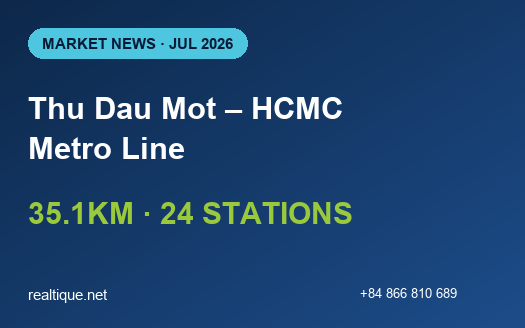
Thu Dau Mot – HCMC Metro — In 30 Seconds
Mục lục
Where the Line Runs
The proposed line starts at Station C0 in Binh Duong ward (the new Binh Duong City), connecting to Station S5 of Metro Line 1 (Binh Duong – Suoi Tien – HCMC), and ends at Station C23 near Tao Dan Park in Ben Thanh ward, linking into HCMC’s Metro Line 2. It passes through around 18 wards. The C0–C10 section (16.78 km) runs mostly elevated, while the remainder goes underground into the centre along Nguyen Thi Minh Khai street.

Technical Specifications
The line is designed as double-track, standard 1,435 mm gauge, fully electrified, with 24 stations (13 underground, 11 elevated) and a roughly 33-hectare Hiep Binh Phuoc depot in Tam Binh ward. Design speeds are 110 km/h on elevated sections and 90 km/h underground. The plan is on public display for feedback until 30 July 2026. Total investment, contractor and construction start date have not yet been announced.
A Piece of the Regional Metro Network
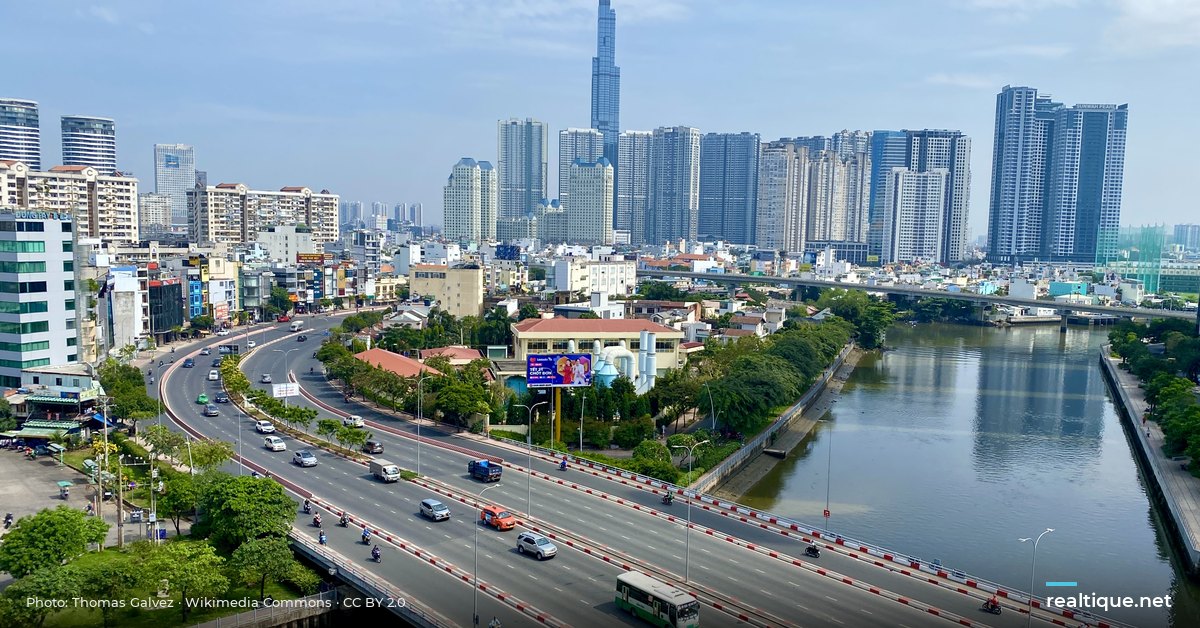
The most notable point is that the line would connect two of HCMC’s metro lines directly: Line 1 (already in commercial operation) on the Binh Duong side and Line 2 in the centre. Once complete, a resident of the new Binh Duong City could ride the rail seamlessly to Ben Thanh — previously hard to imagine. It is a concrete step toward positioning Binh Duong as the northern industry–logistics pole in the HCMC master plan, tied to a transit-oriented development (TOD) strategy.
Context: A Regional Metro Network Taking Shape
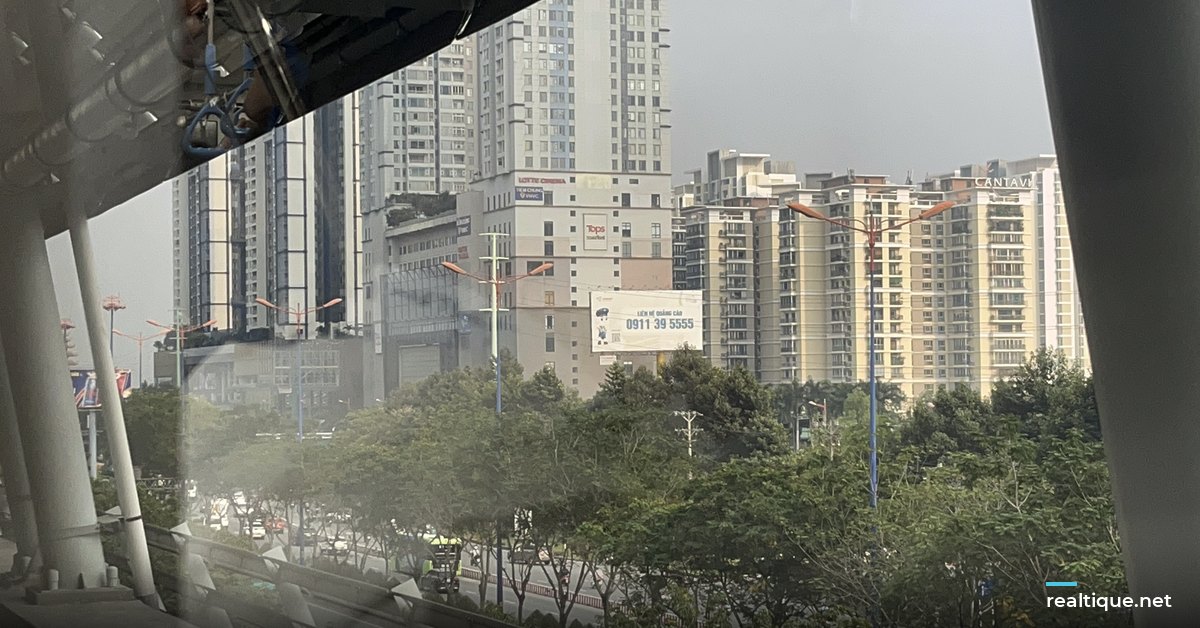
The Thu Dau Mot–HCMC line does not stand alone. Ho Chi Minh City is rolling out a large urban-rail network: Line 1 (Ben Thanh – Suoi Tien) is already in commercial operation and has demonstrated a clear uplift in property values along the Hanoi Highway corridor; Line 2 is under way in the centre; and several more lines are planned. Connecting a line from Binh Duong straight into this network signals a shift in planning thinking — from “individual lines” to a “regional network” where administrative borders no longer constrain the flow of people and capital.
International experience shows major cities such as Tokyo, Seoul and Singapore all grew around urban-rail networks, with station areas becoming live-work-shop hubs. That is the essence of the TOD model the HCMC master plan pursues — and a useful lens for investors weighing the long-term potential of specific locations along the line.
August 2026 Update: Route Approval Now Weeks Away
On 13 August 2026, the Management Authority for Urban Railways (MAUR) said it is finalising the paperwork needed to submit the route alignment and along-route structures of three metro projects for approval within August 2026 — including this Thu Dau Mot–HCMC line (Metro Line 2), alongside the Line 1 extension (Binh Duong New City – Suoi Tien) and Line 6 Phase 1 (Tan Son Nhat Airport – Phu Huu).
Together the three lines run roughly 89.5 km with preliminary capital of about VND 254,530 billion, expected to be funded from the state budget. The published sequence: feasibility study and technical design completed in October 2026, investment approval submitted in November 2026, and construction starting within 2026. The city is targeting roughly 255 km of metro in operation by 2030 — above the 200 km national target it was assigned.
The Line 1 extension along the old Binh Duong corridor is planned at 31.6 km with 17 elevated stations, was put to public consultation on its alignment in early August 2026, and is slated to break ground in Q4 2026 for completion in Q4 2030, with about 1,120 hectares zoned for transit-oriented development along the corridor.
A note on certainty: these are planned milestones announced by the authorities, not final commitments. Capital, alignment and timing can all shift once the project dossier receives formal approval. For a foreign buyer, treat this as evidence of how high the project sits on the city’s priority list — not as a fixed date to underwrite short-term cash flow against.
Sources: Tuoi Tre and the HCMC People’s Council portal (13 Aug 2026); Thanh Nien (7 Aug 2026).
👉 Update, 23 September 2026: the “late 2026” start refers to priority packages at three depots; main civil works are targeted for 30 April 2027. Full-alignment capital figures have also now been published — see the section below.
👉 Update, 5 October 2026: 2 October reports now put approval in December 2026 — see the 5 October update section below.
September 2026 Update: What “Construction Starts Late 2026” Really Means — Main Works Set for 30 April 2027
On 22 September 2026, the Management Authority for Urban Railways (MAUR) said it is finalising feasibility studies and legal procedures to move ahead with three metro lines totalling roughly 90 km and 60 stations, funded from the state budget and targeted for completion in 2030:
- Thu Dau Mot – Tao Dan (Binh Duong Line 2) — the line covered in this guide: 35.1 km per the route dossier circulated for public consultation in July 2026 (13 underground and 11 elevated stations across 18 wards); some 22 September reports cite 33.2 km instead, a gap of about 1.9 km that has not been officially explained and most likely reflects how transition and depot-link sections are counted. 24 stations, preliminary capital ~VND 113,000 billion, depot at Hiep Binh Phuoc, with site clearance alone costing about VND 34,374 billion.
- Line 6 (Tan Son Nhat – Phu Huu), phase 1 — ~23 km (about 19 km underground), 17 stations, preliminary capital ~VND 86,529 billion, depot at Binh Trieu, including two underground stations inside Tan Son Nhat Airport.
- Binh Duong New City – Suoi Tien (Binh Duong Line 1) — ~32 km, 19 stations, capital VND 64,370 billion, depot at Phu Chanh.
What “construction starts in late 2026” actually means
Coverage on 22 September uniformly used the phrase “expected to start construction late this year,” which reads as though all three lines will be on site during Q4 2026. The schedule MAUR published earlier is more specific: late 2026 is the milestone for breaking ground on priority packages at three depots — Binh Trieu, Hiep Binh Phuoc and Phu Chanh — while the main civil works on all three projects are targeted for 30 April 2027.
The two dates sit roughly four months apart and mean very different things. A depot is a stabling and maintenance yard, usually at the edge of the alignment. The main works are what runs through the urban corridor, and that is the part which actually changes accessibility — and therefore property values — along the route. If you are timing a purchase, 30 April 2027 is the date to watch, not the late-2026 ceremony.
Two different totals published on the same day
On 22 September 2026 Vietnamese media reported two different totals for the same three lines: “over VND 254,000 billion” and “over VND 260,000 billion”, the latter accompanied by a line-by-line table that sums to VND 263,899 billion.
The roughly VND 10,000 billion gap is not spread across all three lines — it sits entirely in the Binh Duong New City – Suoi Tien line, reported as ~VND 55,000 billion for 17 stations in one version and VND 64,370 billion for 19 stations in the other. These are two scopes of the same line: the smaller figure is phase 1, the larger is the full alignment (about 32 km, comprising just over 29 km of main line plus a 3.43 km depot connection).
For transparency: the VND 263,899 billion total is Realtique’s own addition of the three published line figures, not an official aggregate. Neither number is wrong — they simply measure different scopes. Whenever an infrastructure headline quotes a total, the question worth asking is: does this cover the full alignment, or only the phase being built?
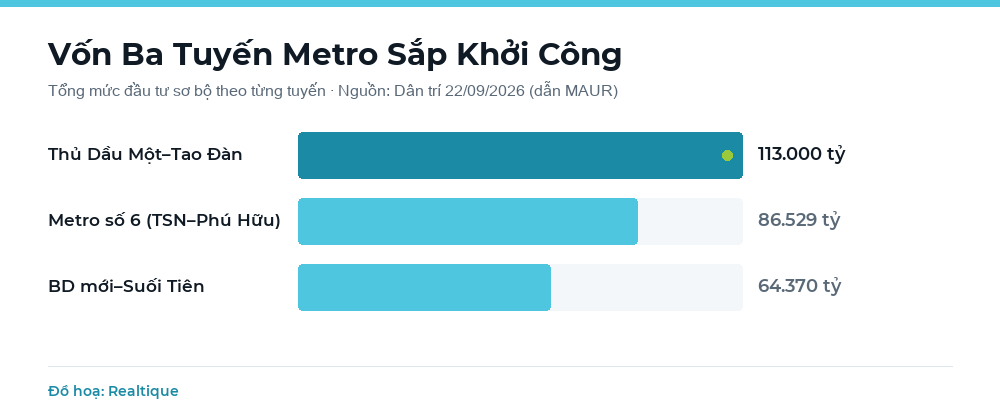
Graphic: Realtique · Data: Dan Tri, 22 September 2026 (citing MAUR), preliminary capital by line
How a foreign buyer should read this
Three milestones are worth tracking, in order of how much they actually tell you: (1) investment approval, which converts a plan into a committed budget; (2) 30 April 2027, when main works begin and the alignment and station locations are effectively locked; and (3) publication of TOD zoning around each station, which is what creates the sharpest value gap between two plots a few hundred metres apart.
Line 1 (Ben Thanh – Suoi Tien) showed that prices along a corridor respond to real construction milestones rather than to the volume of news coverage. With all three lines still at dossier stage, the sensible approach is unchanged: prioritise clean legal title and genuine proximity to a published station location over buying on the expectation of a groundbreaking ceremony.
Please note: every timeline, capital figure and alignment above is preliminary and subject to change as the projects move through formal approval. Foreign buyers should also remember that the 30% per-building foreign ownership quota applies regardless of how close a project sits to a future station.
Sources: VnExpress, Thanh Nien and Dan Tri, 22 September 2026 · Bao Dau Tu, 13 August 2026 · Znews, 14 August 2026 (depot packages and the 30 April 2027 milestone).
Update, 5 October 2026: “Approval in December” Now Has Multiple Sources — Where the Three Files Stand
On 2 October 2026, several outlets carried the same timetable: Ho Chi Minh City’s three new metro lines — Line 1 Binh Duong (New Binh Duong City – Suoi Tien, ~32.8 km), Line 2 Binh Duong (Thu Dau Mot – Tao Dan, ~35 km) and Line 6 phase 1 (Tan Son Nhat – Phu Huu, ~23 km) — are “expected to be approved in December and start construction at the end of 2026” (VTV and CafeF, both 2 October; Tuoi Tre and Bao Xay Dung ran the same day on the three files). As of 3 October the “December approval” had a single source; it now has two independent ones we read directly.
Where each file stands
- Line 1 (New Binh Duong City – Suoi Tien): technical documents and the feasibility study are being finalised.
- Line 2 (Thu Dau Mot – Tao Dan) — the line in this article: standards and the feasibility study are under appraisal. Length is given as about 35 km (Station S5 on Line 1 to Tao Dan, 24 stations: 11 elevated, 13 underground), consistent with the 35.1 km alignment file; the 33.2 km figure in some 22 September reports is a different measure.
- Line 6 phase 1: the standards file has been sent to the Ministry of Construction for review.
This status summary is Realtique’s reading of Tuoi Tre’s 2 October report; no appraisal document has been published.
How “December” differs from the earlier timetable
Our August update cited MAUR’s roadmap: submit the investment decision in November 2026. The 2 October reports say “approved in December”. These need not conflict — “submit” and “approve” are separate steps — but it could also mean approval slipped about a month; the reports do not say. We keep both and will update when an official document appears. The reports also do not specify whether “start at the end of the year” means the depot packages or the main works; under the roadmap in our September update, main works are targeted for 30 April 2027.
A yardstick: Line 2 (Ben Thanh – Tham Luong) on the ground
For comparison, the in-city Line 2 (11.3 km, 10 underground stations) broke ground on 15 January 2026. Per CafeF and Bao Xay Dung (2 October), diaphragm walls at two stations stand at roughly 42–46%, traffic has been diverted at five stations, the first TBM is scheduled to begin boring in October 2027, and operation is targeted for end-2030 — nearly five years from groundbreaking to trains. A reasonable yardstick for three lines that are still at the paperwork stage.
Note: every date above is a planned target that may change once the competent authority formally approves the projects. Do not underwrite short-term cash flow on it.
Sources: VTV, 2 Oct 2026 · CafeF, 2 Oct 2026 · Tuoi Tre, 2 Oct 2026 · Bao Xay Dung, 2 Oct 2026.
Update, 11 October 2026: Tao Dan — This Line’s Planned Terminus — Is Now a Line 2 Construction Site
The Thu Dau Mot line is planned to end at Tao Dan, which is also a station on the in-city Line 2 (Ben Thanh – Tham Luong). That interchange became a physical construction site on 10 October 2026: the contractor fenced off the Tao Dan (ST2) and Bay Hien (ST7) station areas, Nguyen Thi Minh Khai street (about 1.5 km, Cao Thang → Huyen Tran Cong Chua) and a 350 m stretch of Cach Mang Thang Tam (Nguyen Du → Nguyen Thi Minh Khai) became one-way, and through-traffic at the Bay Hien junction was restricted. Five other Line 2 underground stations are already under construction; underground station works are expected to last more than three years (VnExpress, 2 October; Tien Phong via CafeF, 10 October 2026).
New milestones from MAUR (Tien Phong, 10 October): the tunnel boring machine (TBM) is due in Vietnam in June 2027, the first train arrives for testing in 2028, structural completion in 2029 and commercial operation at end-2030. Sources differ slightly on when boring starts — Tien Phong says Q3 2027, while CafeF and Bao Xay Dung (2 October) said October 2027 — so we read it as Q3 to October 2027. All of these are planned targets and may change.
Two related facts matter for property around the interchange. In June 2026 the city approved study boundaries for five TOD areas along Line 2, about 938 ha in total, the first of them covering Ben Thanh and Tao Dan (over 188 ha) (VnExpress, 24 June 2026). And a new city resolution effective 1 October 2026 waives underground-space fees for urban transport works and public underground walkways, and for the part of a land plot down to 15 m deep (CafeF citing VTC News, 10 October 2026) — the legal basis for future buildings to connect directly to stations below ground. Our full Vietnamese-language explainer on Line 2 — stations, timeline and TOD areas — is here.
Frequently Asked Questions
1. Will the three HCMC metro lines really start construction in late 2026?
Late 2026 is the milestone for breaking ground on priority packages at three depots (Binh Trieu, Hiep Binh Phuoc and Phu Chanh), not for the lines as a whole. Under the schedule published by MAUR, the main civil works on all three projects are targeted for 30 April 2027. These are planning milestones and may be adjusted.
2. Is the total investment VND 254,000 billion or VND 264,000 billion?
Both figures were published on 22 September 2026 and neither is wrong — they measure different scopes. The gap sits entirely in the Binh Duong New City – Suoi Tien line: ~VND 55,000 billion covers phase 1 (17 stations), while VND 64,370 billion covers the full 32 km alignment (19 stations). Adding the three full-alignment figures gives VND 263,899 billion (Realtique’s own calculation).
3. Does a nearby metro line change the rules for foreign buyers?
No. Proximity to a metro line affects value and liquidity, but it does not change ownership rules. Foreign buyers are still limited to 30% of apartments in any one building and to a 50-year renewable ownership term, and the building must appear on the Department of Construction list approved for foreign ownership. Always verify remaining quota for the specific building before paying a deposit.
4. When will HCMC’s three new metro lines be approved?
According to 2 October 2026 reports (VTV, CafeF), Lines 1 and 2 Binh Duong and Line 6 phase 1 are expected to be approved in December 2026 and start construction at the end of the year. The August roadmap had the investment decision being submitted in November. These are planned targets and may change; no formal approval document has been issued yet.
How Foreign Buyers Can Read It
For overseas investors, the near-term liquid opportunity remains HCMC apartments with clear foreign-ownership rights within the 30% building quota, particularly in the eastern and central districts the network already serves. The Binh Duong corridor is a longer-horizon, higher-conviction play: as stations are confirmed and construction milestones are met, well-located projects near future interchanges should re-rate. Landed property in Binh Duong is generally accessed by foreigners via a long-term lease structure rather than outright ownership, so eligibility and title should be checked project by project. For the rules that apply everywhere, see our Foreign Buyer Guide.
Realtique’s View: What It Means for Property
For the housing market, an inter-provincial metro line creates three layers of impact:
- Property around the 24 stations — especially interchange stations — typically benefits most under the TOD model: improved access lifts land values and demand for apartments and retail.
- The Binh Duong–HCMC corridor shrinks in “time distance”, making townships and housing projects in Binh Duong (home to many industrial parks and skilled workers) more attractive to owner-occupiers and investors alike.
- Patience matters: this is still a consultation-stage proposal with no construction date. “Metro-linked” property values tend to re-rate at real infrastructure milestones rather than on news — so favour clear legal title, genuine proximity to stations and a long holding horizon.
More broadly, the Thu Dau Mot–HCMC metro is one more step in the emergence of a regional mega-city, where the administrative lines between HCMC and its neighbours blur as connecting infrastructure is built.
The bottom line: a direct rail link from Binh Duong to Ben Thanh would knit a fast-growing industrial province into the heart of the mega-city, and history suggests property near confirmed stations tends to lead the market. For now it is a proposal, not a schedule — but it is exactly the kind of infrastructure signal worth tracking early, and building a shortlist around, before the milestones arrive.
Position along the transit corridor
Leave your details and a Realtique advisor will call you back within two business hours with the areas and projects best placed to benefit from the Binh Duong–HCMC metro.
Hotline: +84 866 810 689

KC Pham
KC Pham is the CEO of Realtique, advising local and international clients on Vietnam’s most exclusive properties.