
Four Twin Towers R1-R2-F1-F2: Symmetry Philosophy & Tower-Pair Design at Eco Forest Onsen
Quick Take. Four high-rise towers (R1, R2, F1, F2) arranged in two mirrored pairs around a central wellness deck. Same massing, rotated axes, shared podium amenities. The pairing isn’t aesthetic — it’s an engineering decision that delivers privacy + amenity scale + view diversity from a single complex.
Mục lục

Why Twin Pairs (Not One Big Tower or Many Small Towers)
Most high-rise developments are either one big tower (privacy, but tight amenity scale) or many small towers (lots of amenity options, but compromised views and privacy).
Eco Forest Onsen’s solution is the twin pair: two towers that share a podium and core systems but rotate so no apartment looks directly into another. You get:
- The privacy of a standalone tower (no facing-window neighbors)
- The amenity scale of a complex (shared 1,800sqm wellness deck)
- Diverse view orientations (each tower captures a different slice of lake + city + forest)
- Operational efficiency (1 management team, 1 elevator system, 1 maintenance contract)
Two pairs × 2 towers each = 4 towers total. R1+R2 (the “Onsen pair”) faces directly to Swan Lake. F1+F2 (the “Forest pair”) rotates to face the inland forest.
Architectural Influences
The architectural reference points for Eco Forest Onsen aren’t mass-market high-rise developers. They’re firms working at the wellness-architecture intersection:
- BIG (Bjarke Ingels Group) — known for sculptural massing that prioritizes outdoor amenity decks at every level. Influence visible in the wellness deck integration.
- Heatherwick Studio — vertical green facades + sculpted skyline. The Forest Onsen vertical green strategy borrows this language.
- WOHA (Singapore) — tropical Asia high-rise with cross-ventilation + sky terraces. The 2BR-with-garden line directly references WOHA’s “vertical village” approach.
- Onsen Town vernacular (Hakone, Kinosaki) — rooflines, wood detailing, water infrastructure pacing. The lobby and spa interiors reference this directly.
The result isn’t a copy-paste of any single reference. It’s a vernacular blend — high-rise scale with tropical Asia language and Japanese wellness detailing.
How Symmetry Was Engineered — The Rotation Logic
The four towers aren’t placed on a grid. Each pair sits on the lake’s western edge and rotates ~30° from vertical alignment. The technical reasons:
- View diversity — units in R1 looking northwest get a different lake view than units in R2 looking north. Variety reduces resale competition between units.
- Privacy — when towers rotate rather than stack, no apartment window directly faces another. You don’t see a neighbor’s living room from your kitchen.
- Daylight — rotated facades get morning + afternoon sun on different faces. Lower cooling load.
- Wind — Mekong Delta prevailing winds (southeast) hit rotated facades at oblique angles. Less stress on facade systems, less perceived noise.
From a buyer’s perspective: every apartment has at least one view that no other apartment in the complex shares.
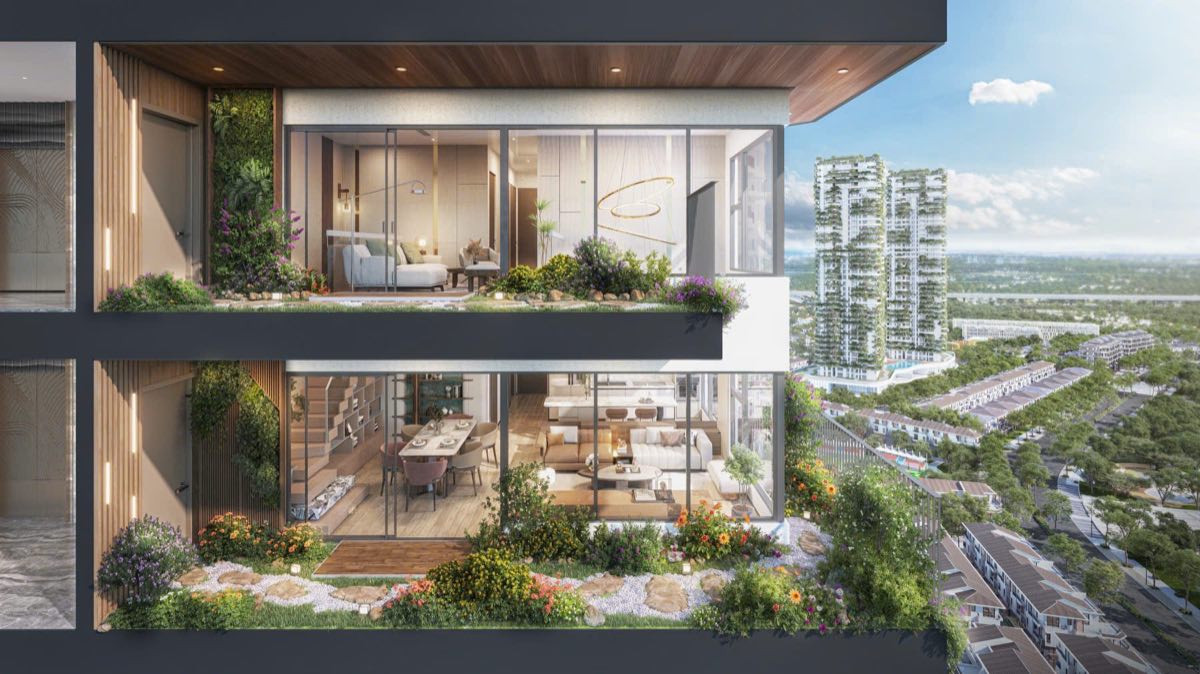
Sky Terraces and Vertical Green — Not Decoration
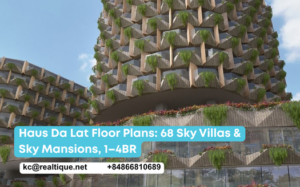
The vertical green strategy isn’t decoration. It’s an integrated mechanical + ecological system:
- Sky terraces every 4–6 floors — drainable, soil-loaded, irrigation-piped. Same engineering as Singapore’s Marina One or Bosco Verticale Milan.
- Plant species selection — tropical lowland adapted, low-maintenance, edible understory option. The 8-vegetation-layer DNA from Eco Retreat scales onto the towers.
- Cooling effect — green facades reduce skin temperature 3–5°C vs bare concrete. Direct apartment cooling load reduction.
- Acoustic damping — vertical green absorbs ~5–8 dB of street noise. Particularly valuable in lower-floor units near amenity activity.
For 2BR-with-Garden line specifically: each unit’s private 18–28 sqm garden is structurally engineered into the slab — not a balcony retrofit. Drainage, soil depth, and irrigation are pre-installed.
Tower-by-Tower Personality
Each tower has slight personality:
| Tower | Position | Best Views From | Signature Lines |
|---|---|---|---|
| R1 | Lake-facing west | Direct Swan Lake + sunset | 3BR Lake View, Dualkey |
| R2 | Lake-facing east | Lake + Forest mix + sunrise | 3BR Lake View, Dualkey, Penthouse |
| F1 | Forest-facing south | 17 themed gardens + Retreat Circle | Dualkey, 2BR Garden |
| F2 | Forest-facing north | Retreat River + city skyline distance | 2BR Garden, 2BR no Garden |
In practice: R1 + R2 (the Onsen pair) launch first with handover Q3 2028. F1 + F2 (Forest pair) follow on a TBD schedule — likely 2027 launch, 2029–2030 handover.
Maintenance Access and Long-Term Value
One of the underrated value drivers in Vietnamese real estate: how a developer designs maintenance access directly affects long-term unit value.
Twin-tower architecture with shared podium gets this right:
- Single elevator maintenance contract across 4 towers (lower per-unit OPEX)
- Shared waste collection + delivery systems (less perimeter clutter)
- Centralized building management = one accountable team
- Easier to keep facade in good condition (specialist crews can serve 4 towers, not 1)
For owners selling 5–10 years out, this matters: well-maintained twin-tower complexes in Hung Yen and Hanoi (Ecopark precedents) hold value better than equivalent standalone towers because the building “looks new” longer.
Related Articles
- Eco Forest Onsen 2026: A Guide for International Buyers (Pillar) — the master overview of this cluster.
- Location: Why Western HCMC Is the Next Wellness Frontier — location & infrastructure deep dive.
- Apartment Layouts: Studio to Duplex Buyer’s Reference — unit-by-unit walkthrough.
- The Free Prescription: Onsen + Forest Bathing as Healthcare — the wellness science story.
- Floor 5A Onsen Clubhouse: Tokyo-Standard Mineral Hot Springs — wellness facilities deep dive.
- Swan Lake 12ha + 220ha Eco Retreat: Daily Wellness Infrastructure — amenity infrastructure walkthrough.
- Pricing & Payment Plans 2026: Methods + 12% Discount — pricing & financing.
- Foreign Buyer’s Guide: Legal, SPA, Tax 2026 — legal + tax for international buyers.
- Eco Forest Onsen vs Hung Yen vs Hilton Quang Hanh: Comparison — competitive comparison.
Reserve Your Unit Today