
What to Invest In for 2026? Why Parking Money in Gold & Savings Isn’t Enough
Quick answer. What should you invest in for 2026? The answer lies in understanding the interest-rate cycle. When deposit rates stay high, keeping cash in savings makes sense for the short term — but that is only half the story. The savvy look past the turning point: when policy loosens credit room, pushes rates down and capital flows into real estate, the optimal move is to split the portfolio — lock in part of your capital with cash-flow real estate at the “bottom of the wave”, and keep the rest in the bank earning a high short-term rate.
Table of Contents
A tough market in 2026 — and "hard for everyone"
Agents and buyers alike feel that demand is slower this year than last, with the familiar objections: “rates are too high”, “the bank raised rates again”, “the market is bad”. But this difficulty is a shared, cyclical one — not personal.
Instead of worrying with the headlines, ask three questions: why is the market hard, how hard, and for how long? Answer those and you decide by principle, not emotion.
Why do interest rates rise? The bank’s "input–output" mechanism
To understand the market, understand how a bank works. A bank has two poles: the deposit rate (input — the cost of “buying” capital from households and the economy) and the lending rate (output — the price of “selling” capital to the market). The key point: these two do not move together. Deposit rates usually react first with money supply and demand, while lending rates lag.
The two poles do not move together — that phase gap is exactly where those who understand the cycle find opportunity.
Four main drivers push deposit rates up: internal liquidity (banks need to offset outflows and meet credit-growth limits), macro policy (the central bank raises policy rates to curb inflation), competition (retaining customers) and the need for capital to expand lending. When these pressures combine, deposit rates stay high — and that is when the “savings” story looks attractive.
High savings rates — and the "reinvestment trap" of years 2–3
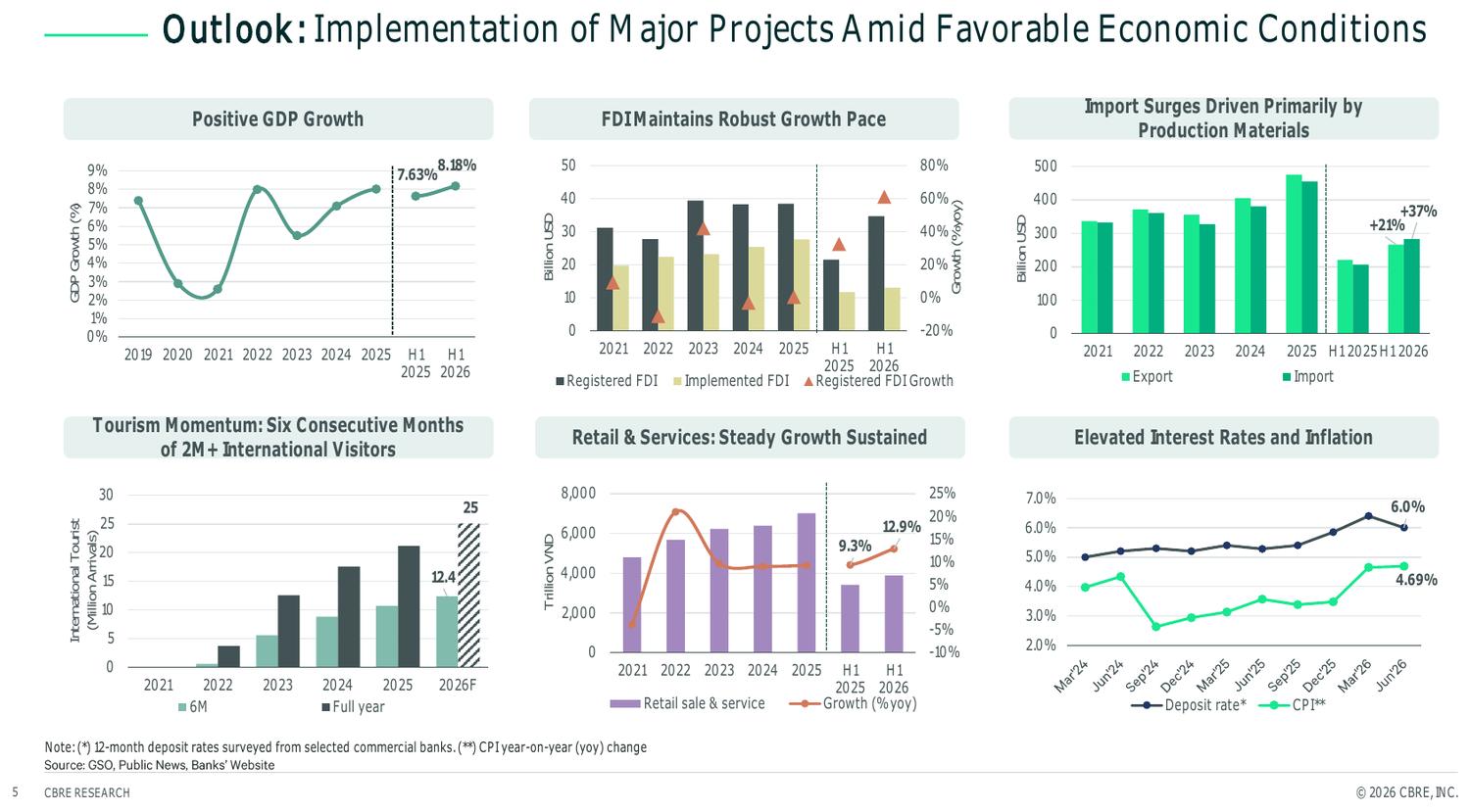
When deposit rates stay elevated versus previous years (12-month deposits around 6% per year per CBRE data), keeping cash in savings is a reasonable choice for short-term liquidity. That is correct — but only for right now.
The core question few ask: will that rate hold when the deposit matures in years 2 and 3? If you lock 12 months today, a year later at maturity the cycle may have turned and prevailing rates may be much lower. That is reinvestment risk: you only “lock in” the high rate for a short window, then must reinvest at a lower level. Savings is a tactic for one phase of the cycle, not a strategy for the whole cycle.
The turning point & the new LDR policy → capital flows to real estate
Every cycle has a turning point. Signs of the peak: the central bank stops raising policy rates and shifts to a growth-support message; banks start issuing “certificates of deposit” at high rates to lock in long-term funding before rates fall.
At the same time, a key technical change: when the Loan-to-Deposit Ratio (LDR) calculation is loosened — for example, counting part of State Treasury deposits in the denominator — the large banks gain more credit room. The chain reaction: liquidity stabilises → deposit pressure eases → deposit rates fall → capital flows toward production and real estate. That is when real estate enters a more favourable phase.
Counts part of Treasury deposits in the denominator
Big-4 banks + gold-market control
Deposit pressure eases
Cycle shifts phase
& the production sector
Illustrative of the mechanism only; not investment advice.
In other words, interest rates and real estate are two sides of the same cycle. See more on lending rates in High Loan Interest Rates in Vietnam 2026.
Money must circulate — why letting it "sit idle" isn’t enough
An economy grows when money circulates. When you concentrate capital in passive assets — gold, silver, or land held idle — the money largely “sits still” and creates no new value. That is why policy alternately tightens and loosens to keep money moving. Those who understand this see the swings as normal; those who do not get FOMO (“gold crashed”, “real estate is dead”), lose conviction, then panic-sell or stay on the sidelines. Herd psychology and panic are an investor’s worst enemies.
Portfolio allocation: X% cash-flow real estate + Y% savings
Once you understand the cycle, the answer is not “all-in” on one asset but to structure the portfolio like a “barbell”: fix part of your capital with well-located real estate bought at the “bottom of the wave” (cycle low, stable price); keep the rest in the bank earning a high short-term rate and staying flexible to seize opportunities.
X + Y = 100%. The exact split depends on your goals, holding horizon and risk appetite.
Three principles across every capital level:
- Diversify: don’t “put all your eggs in one basket” — spread across real estate, gold, equities and cash.
- Dollar-cost average (DCA): deploy in tranches over time to reduce timing risk.
- Prioritise cash-flow assets: instead of assets that just “sit idle”, choose working assets — rentable, or growing with infrastructure and planning.
Reasons for
- Lower risk by spreading across asset types
- DCA discipline avoids buying the top
- Cash-flow assets help "feed" your capital
- Stay calm through tighten–loosen phases
Watch-outs
- Takes time and knowledge to manage a portfolio
- Real estate is illiquid and capital-heavy
- No channel is a "sure win" — risk always exists
- Avoid leverage beyond your repayment capacity
Cash-flow real estate to explore
If you want the real-estate slice of your portfolio to be a working asset (rentable, or growing with infrastructure), here are a few projects Realtique advises on:
Masteri Park Place – The Global City
Central East-Saigon apartments (Masterise) — a rentable, liquid location.
Explore →Beachtro Tower – Blanca City
Freehold seaside apartments in Vung Tau (Sun Group) — resort rental and long-hold store of value.
Explore →Rung Phuong – Eco Retreat
Low-rise eco homes in Long An next to HCMC (Ecopark) — freehold, long-hold store of value.
Explore →Want a product that fits your portfolio & budget? Contact Realtique or email [email protected] for advice.
Real estate in the 2026 portfolio — pick assets that generate cash flow
Real estate is a sensible component, but not every product is equal. In this phase, prioritise assets that generate cash flow or have clear growth drivers: apartments in strong rental locations, projects anchored to infrastructure and planning, reputable developers, transparent legal status. Conversely, an asset bought just to “hold”, illiquid and with no growth story, is often the part that keeps capital idle the longest.

Updated for 2026. The 2026 backdrop: lending rates are still elevated and the market is selective, but policy signals (looser credit room, gold-market control) are paving the way for a more favourable real-estate phase. This is often when disciplined buyers pick good products with developer support — rather than chasing the crowd when the market is hot.
Frequently asked questions
What should you invest in for 2026?
There is no single “right” channel. The general principle is to diversify (real estate, gold, equities, cash), invest steadily over time (dollar-cost averaging) and prioritise assets that generate cash flow rather than letting capital sit idle. This is general information, not investment advice.
With high savings rates, should you lock in a long or short term?
A long term “locks in” the high rate through the cycle peak but reduces flexibility. The main risk of a short term is “reinvestment risk”: when it matures after a year, if the cycle has turned, prevailing rates may be much lower.
How does the new LDR policy affect real estate?
When the Loan-to-Deposit Ratio (LDR) calculation is loosened — for example, counting part of State Treasury deposits in the denominator — banks gain more lending headroom (credit room), liquidity stabilises and deposit-rate pressure eases; capital then tends to flow toward production and real estate.
Gold or real estate?
Gold is a safe-haven asset but “sits idle” and generates no cash flow; working real estate (rentable, or growing with infrastructure) can generate cash flow but needs larger capital and is less liquid. Many investors hold both in a proportion that suits their risk appetite.
Should you buy real estate in a tough market?
A tough market is a shared cycle, not permanent. Quiet phases are often when you can pick good products with developer support. What matters is choosing cash-flow assets with clean legal status and not over-leveraging.
Disclaimer: this content is for general education and reference about market mechanics — it is NOT financial advice or an investment recommendation. Rate and policy figures are illustrative and change over time. Every investment decision depends on your goals, risk appetite and financial situation; consider consulting an independent financial/legal professional before committing.
Need the right project at the right time? Talk to Realtique
Leave your details and a Realtique advisor will call you back within two business hours — a project matched to your goals and budget, anchored to infrastructure, with clean legal status and the right support policy.
📞 Hotline: +84 866 810 689

KC and the Realtique team guide local, overseas Vietnamese and international investors through buying property in Vietnam — safely and in full compliance, from the first viewing to the pink book.