


High Loan Interest Rates in Vietnam (2026): What Home Buyers Should Do
Borrowing to buy a home in Vietnam is more expensive in 2026 than it was a year ago. After the low-rate window that followed the pandemic, banks have re-priced upward: many lenders now quote home-loan rates of roughly 9–11.5% a year once the introductory promotion ends, with promotional fixed rates of about 6–7.5% for the first 6–24 months. Deposit rates have climbed too — commonly 7–8% for a 12-month term, and higher at some banks — which is what pushes lending rates up. This guide explains why rates are elevated, what it actually costs a buyer, and the practical moves that matter most when money is expensive.
Update, 1 November 2026: The State Bank Governor told the National Assembly on 31 October that real-estate credit grew 9.84%, below system-wide credit growth of 12.27%; deposit rates rose 1.42 points against 0.99 points for lending rates. See the 1 November 2026 Update section below.
Vietnam Loan Rates At A Glance
Table of Contents
What Is Happening To Interest Rates
The headline is simple: the cheap-money period is over for now. Through late 2025 and into 2026, several commercial banks lifted their average lending rates by more than a percentage point as funding costs rose. Public reporting on the market has noted individual lenders whose average lending rate moved up sharply over a few quarters, and business loans in the 7.5–9% range. For a homebuyer, the number that bites is the floating rate after the promotional period — that is where most loans settle for the bulk of their life.
Two features of Vietnamese mortgages make this especially important to understand:
- The teaser rate is temporary. A loan advertised at 6.5% is usually fixed for only the first 6–24 months. After that it floats at a reference rate plus a margin — often landing in the 10–11.5% band in the current environment.
- The reset can be a shock. Buyers who budget around the promotional payment can be caught out when the rate resets. Planning for the post-promo rate from day one is the safer approach.
Why Rates Are Staying High Through 2026
Several forces are keeping the cost of credit up, and none of them reverses overnight:
- Competition for capital. Banks need deposits to lend, and to attract savers they must offer competitive deposit rates. Higher deposit rates feed straight through to lending rates.
- Heavy funding demand. Vietnam is financing a large pipeline of infrastructure — metro lines, ring roads, expressways and airports — alongside strong corporate credit demand. When the economy wants to borrow a lot, the price of borrowing rises.
- A high global rate backdrop. Vietnam does not set rates in isolation; elevated rates in major economies limit how far domestic rates can fall without pressuring the exchange rate.
- Inflation management. Keeping real rates positive is part of protecting the currency and price stability.
Market commentary generally expects rates to remain elevated across 2026 rather than fall quickly. For a buyer, the sensible planning assumption is that borrowing stays expensive for the near term — and to structure the purchase accordingly.
What High Rates Actually Cost A Buyer
Consider a VND 2 billion loan over 20 years — a realistic amount for a mid-market apartment:
During the promo year (~6.5%) → roughly VND 15 million a month
After it resets (~10.5%) → roughly VND 20 million a month
The jump → about VND 5 million more every month for the rest of the loan
That VND 5 million a month is roughly VND 60 million a year — and it lasts for years. It dwarfs many of the small discounts buyers negotiate on price. In a high-rate environment, the structure of your financing and payment schedule can matter more than the sticker price.
August 2026 Update: Mortgage Rates Sit at 12–14%, Some Floating Loans Touch 16%
August 2026 data confirms the scenario described above: borrowing costs have not eased. According to the Dat Xanh Services Economics – Finance – Real Estate Research Institute (DXS-FERI), property loan rates are commonly 12–14% per year, and some floating-rate loans have reached 15–16%. DXS-FERI expects rates to stay elevated through the final six months of 2026.
An early-August survey shows the gap between the advertised teaser rate and what borrowers actually pay is widening — the second number is the one that matters:
- VIB: 9.5–12% fixed depending on the lock-in period; once the promotional window ends the loan resets under bank policy and can move to 12–14%.
- OCB: 10.75% if fixed for the first 6 months, or 11.5% if fixed for 12 months; afterwards priced off the 13-month base rate plus a margin of 3.25–3.5%, which can exceed 14% when the base rate is high.
- VPBank: advertised from 4.6%, but surveyed effective rates range 6.9–12.3% depending on loan conditions and tenor.
Social housing sits on a separate track — 6.5% for the first five years and 7.5% for the following ten, for loans drawn between 1 July and 31 December 2026 — but that programme does not apply to commercial apartments, and foreign buyers cannot access it.
How to read this as a buyer. The figure that decides your payment from year two onward is not the promotional rate but the margin added to the bank’s base rate after the fixed period ends. When comparing projects, test the developer’s grace-period or interest-support policy against a 14–16% floating scenario rather than against the first-year teaser. Foreign buyers should also remember that onshore mortgage access is limited in practice, which makes developer payment schedules the more relevant lever.
August 2026 Update: Buyers Draw the Line at 9%, and Rates May Stay High Into 2027
Two further data points sharpen the picture above — one from the borrower side, one from the forecast side. Both push the conclusion past the “through 2026” horizon.
1. Buyers have set their own ceiling: 9% a year
A Batdongsan.com.vn survey puts hard numbers on the pain threshold:
• 84% of respondents are willing to borrow to buy a home.
• 81% will only borrow if the rate is below 9% a year.
• 91% will only borrow less than 50% of the property value.
Against actual market pricing — commonly 11–13% a year, rising to 14–15% once the grace period ends — the gap between what buyers accept and what banks offer is two to six percentage points. That arithmetic, not weak demand, is what is slowing transactions.
The most telling figure is the 91%. The market is shifting toward equity-funded purchases: most buyers want to borrow less than half the price. On a VND 5 billion apartment that means having VND 2.5 billion or more in cash — and the binding question stops being “what is the rate?” and becomes “is the payment schedule stretched enough for me to assemble the equity?”
2. A newer forecast: elevated rates possibly through Q2 2027
This article originally set the horizon at “high through 2026,” following DXS-FERI. An August 2026 forecast from Dinh Minh Tuan of Batdongsan.com.vn extends it: rates are unlikely to fall in the short term and may hold at elevated levels through the second quarter of 2027. Four drivers are cited: accelerating credit growth, exchange-rate pressure, inflation, and banks’ own funding needs.
Some lenders do advertise below the market average as of August 2026 — TPBank at 10.95%, OCB at 10.78%, BVBank at 10.45%. These are headline rates: the fixed period and the post-promotional margin still decide what you actually pay, exactly as the comparison above shows.
3. What this changes about choosing a property
If elevated rates really do run into mid-2027, then “wait for rates to fall” means waiting roughly three more quarters while primary prices in central districts keep climbing. That pushes the focus onto three things: (1) favour projects with stretched payment schedules or long principal grace periods; (2) model your cash flow against a floating rate of 14–15%, not the first-year promotional rate; and (3) keep borrowing under 50% of the property value, as most buyers now do.
Sources: Batdongsan.com.vn survey (Tien Phong, 27 July 2026) · Vietstock (3 August 2026) · DXS-FERI. Rate forecasts can change with monetary policy — see the note at the end of this article.
Please note: these are surveyed rates as of August 2026 and vary by bank, borrower profile and timing. This section is not financial or credit advice — ask your lender for a full amortisation schedule before signing.
17 September 2026 Update: The Fed's First Hike Since 2023 — Three New Numbers Pointing the Same Way
Three weeks after the 22 August update, three new data sets — one from the US, two from Vietnam — have landed, and all three push in the same direction: money stays expensive for longer.
1. The Fed raised rates for the first time since July 2023. On 16 September the FOMC lifted the federal funds target by 25 basis points to 3.75–4.00% on a 12–0 vote; Chair Kevin Warsh said inflation “is too high and has been for too long.” The dot plot shows 16 of 18 officials expect at least one more hike in 2026 (twelve see +25 bp, four see +50 bp), none for 2027, and gradual cuts only from 2028. Bonds reacted at once: the 2-year yield touched 4.73%, the 10-year closed near 5.01% — its highest since 2007; the dollar index rose 0.65% and gold and silver fell about US$100/oz (Bloomberg, CNBC, Yahoo Finance, 16 Sep).
What it means for Vietnam. On the morning of 17 September the State Bank’s central rate rose to 25,632 VND/USD, with Vietcombank and BIDV quoting 25,805–26,185 (+30 dong); Techcombank had already lifted its top base lending rate to 13% a year from 15 September (Bnews, 17 Sep). Transmission runs exchange rate → interbank liquidity → deposit rates → lending rates, over months rather than days (Dan Tri, 12 Sep). The key point: while the Fed leans toward further hikes, the State Bank has almost no room to cut without paying for it in the currency — so the “elevated until mid-2027” call in the section above gets firmer, not weaker.
2. Developers: debt growing fast, bonds priced at 11.4%. S&I Ratings (VnExpress 12 Sep, CafeF 13 Sep) reports that listed developers’ borrowings rose by VND 60,897 billion in one quarter to VND 360,240 billion (+20.3% q/q), taking debt-to-equity to 0.72x, the highest in 15 quarters; Vinhomes accounted for roughly 82% of the increase. Property-sector bond issuance hit VND 102,400 billion in Q2 (+228% y/y, 44% of the whole market), with Vingroup, Masterise and Sun Group making up 83.9%; the average coupon was 11.4%, typically 12.5–13.5%. Maturities in 2027 are forecast at VND 156,521 billion (+16%), and 28 bond lots totalling VND 28,558 billion were already late in 2026. Why a buyer should care: developers are borrowing at roughly the same rate as a mortgage, so a “24–36-month principal-and-interest holiday” is the developer carrying an 11–13% cost on your behalf — more valuable while rates stay high, and more reason to check the balance sheet of whoever is carrying it.
3. Buyers: demand cooling, resale prices slipping. Searches to buy apartments in Ho Chi Minh City fell 14% in August, primary absorption was only about 11%, and resale prices at several “hot” projects dropped 1–6% in Q3 versus Q2 (VnExpress 15 Sep, citing Batdongsan.com.vn). This is the mechanical result of the gap between the 9% buyers will accept and the 12–14% the market charges — demand has not disappeared, it is waiting.
What the three numbers change in practice:
- Lock the longest fixed period you can get (24–36 months) rather than a 6–12-month teaser, because the earliest plausible rate-cut window has slid into the second half of 2027.
- Borrow under 50% of value, as 91% of surveyed buyers now intend to; on a VND 5 billion apartment that is VND 2.5 billion of equity.
- Negotiate harder on resales: a documented 1–6% decline is a real anchor, especially in projects that ran hot in 2025.
- Foreign and Viet Kieu buyers holding US dollars: the same apartment costs fewer dollars than it did two weeks ago — the exchange rate is doing part of the discounting for you.
Caveat: rate forecasts are the views of the sources cited, not commitments; if the Fed stops after this hike, pressure on the dong and on domestic rates will be lighter than the scenario above. For the wider capital-flow picture see our FDI in Vietnam real estate 2026 update.
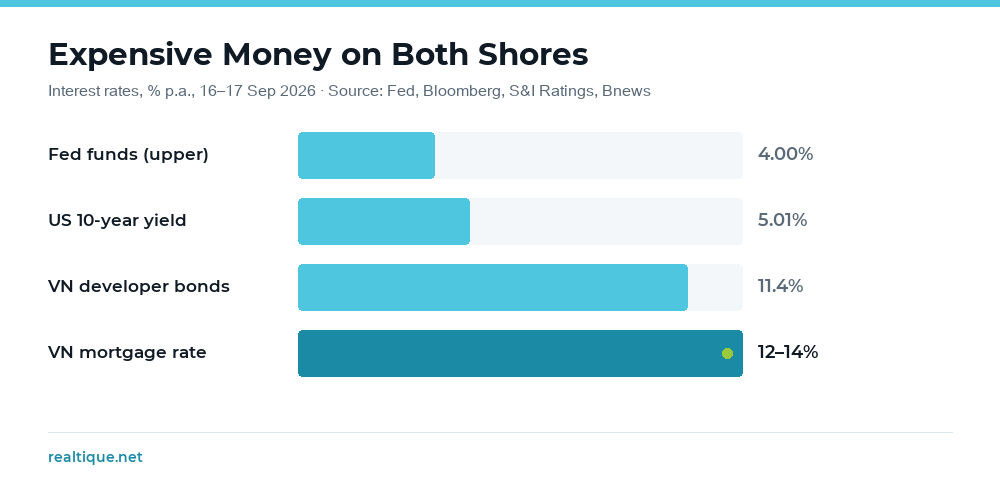
Graphic: Realtique · Data: Fed and Bloomberg 16 Sep 2026, S&I Ratings (Q2 2026), Bnews 17 Sep 2026
3 October 2026 Update: US Yields at a 24-Year High, a Weak US Jobs Report, and China’s Mortgage Subsidy — What Vietnamese Borrowers Should Take From It
Two weeks after the 17 September update, the world has sent three signals that do not point the same way — and the disagreement between them is exactly what a buyer financing a home in Vietnam needs to read correctly.
1. The US 10-year yield has passed its 2007 peak and sits at the highest level since 2002. On 30 September the 10-year Treasury yield touched 5.306%, above the 5.303% reached in 2007 and the highest since May 2002 (Seoul Economic Daily, 2 October 2026, citing Reuters); on 1 October it climbed further to 5.33%, and the 30-year yield also hit its highest since 2002 (Yahoo Finance/Bloomberg, 1 October 2026). Against the 5.01% noted in our 17 September update, long-term yields have added roughly 30 basis points in two weeks. Overnight-indexed swaps now fully price one more Fed hike before year-end. Three drivers are named: persistent inflation, heavy US government borrowing and still-strong growth — plus higher oil on Middle East tensions and the capital pouring into AI infrastructure.
2. But September US jobs came in weak. The Bureau of Labor Statistics report released on 2 October showed non-farm payrolls up only 29,000 against a forecast of 84,000; unemployment at 4.2% (7.1 million people); July revised from +21,000 to −10,000 and August from +162,000 to +133,000 — 60,000 fewer jobs than first reported; average hourly earnings of USD 37.81, up 3.0% year on year (BLS, CNBC, 2 October 2026). Before the report, CME FedWatch put the probability of the Fed holding at its 27–28 October meeting at roughly 62–65%, with a 25-basis-point hike at 34–38%; August PCE inflation printed 3.4% year on year, below the 3.7% expected (Seoul Economic Daily, 2 October 2026). A jobs report this soft usually tilts the balance further toward “hold” — but hold is not cut, and long-term rates are set by the bond market, not by the Fed.
3. China is moving the other way: the first central-government mortgage subsidy. From 1 October 2026, China’s Ministry of Finance, the People’s Bank of China and the National Financial Regulatory Administration subsidise 1 percentage point a year of mortgage interest for first-time buyers, on loans of up to RMB 1 million for up to five years, provided the home is no larger than 120 m² and priced at no more than RMB 1.5 million; the scheme runs for a trial year and is expected to save close to RMB 50,000 in interest on a RMB 1 million loan (Xinhua, 30 September 2026; Caixin, 29 September 2026). It is the first time Beijing has subsidised commercial home loans — a shift from supply-side to demand-side support. For Vietnam, the policy targets China’s domestic mass market, so it does not change the picture for Chinese buyers in Vietnam (who buy through long-term leases). What is worth noticing is the mechanism: “one point for five years” is exactly what Vietnamese developers already do with their own balance sheets through principal-and-interest grace periods — see The Smart Move below.
4. At home: mortgages at 13–14%, and some luxury resale prices down by close to VND 1 billion. Dan Tri (2 October 2026, citing DKRA Consulting) reports that the primary-market absorption rate for apartments in Ho Chi Minh City and surrounding areas was only about 11% in August, down 5 percentage points from July — consistent with the figure in our 17 September update — with typical mortgage rates of 13–14% a year on loans covering 60–70% of the price. Three resale listings from the same article: a 140 m² three-bedroom at The Vista An Phu cut from VND 13.6 billion to 12.8 billion (down 800 million, with a further 120 million off for a direct buyer); a 75 m² two-bedroom at The Sun Avenue from 7.4 billion to 7.2 billion; an 87 m² three-bedroom at Eco Green Saigon down more than 500 million from its original asking price. Nguyen Anh Que, chairman of G6 Group, attributes this to prices pushed too far above reality, with heavily leveraged owners forced into deep discounts to exit; MB Securities’ sector report expects the market to enter a correction phase, with prolonged high-rate pressure and abundant supply around 2029–2030. Note: these are three listings from one article (n = 3), illustrating the 1–6% secondary-price decline noted above, not a market-wide statistic.
What these four signals change in practice
- Do not wait for a Fed “pause” to expect Vietnamese mortgage rates to fall. The anchor for the dong and for deposit rates is the long-term US Treasury yield — at 5.3%, not the 4% policy rate. While that yield stays high, the State Bank of Vietnam has little room to loosen; the “high into mid-2027” scenario in the sections above remains the base case.
- Cash buyers of upper-end apartments have the negotiating edge. With sellers carrying 13–14% interest and primary absorption at 11%, resale discounts of 5–7% (as in the three examples) are real at some handed-over projects; compare the asking price with the latest actual transaction price, not with the previous asking price.
- For overseas Vietnamese and foreign buyers holding USD: a 5.3% Treasury yield is the direct benchmark against rental yields on Ho Chi Minh City apartments — which, according to recent market reports, mostly sit below that level. A purchase now should be a decision about the asset and the location (a specific project, clean title, foreign quota still available), not about short-term rental cash flow.
- If you must borrow: the rules above still apply — lock the longest fixed period you can, keep the loan under 50% of the price, and favour projects with long principal-and-interest grace periods, which are the developer-funded version of a “five-year subsidy”.
Addendum, 4 October — after the jobs report. Markets have repriced the 27–28 October meeting: CME FedWatch now puts the chance of another 25-basis-point hike at roughly 17–22% (CNBC, 2 October: 17%; Real Estate News the same day: 21.6% — the two differ because they were captured at different moments), which leaves about 78–83% for a hold (a Realtique subtraction). But traders still price a hike in December, and the US 10-year yield ended the week near 5.28% (2 October), only slightly below the previous day’s 5.33% high — fewer odds of a hike do not mean cheap money is coming back. At home, the Statistics Office’s 3 October release showed Q3 GDP up an estimated 9.95% and the nine-month average CPI up 4.52% year-on-year; growth that hot with inflation at that level is hard to square with an early fall in loan rates (a cautious reading, subject to State Bank policy). For borrowers the “rates stay high into mid-2027” scenario above is intact; the next markers are US CPI on 15 October and the Fed meeting on 27–28 October.
Addendum, 9 October — the Fed minutes. The minutes of the 15–16 September meeting, released on 7 October, confirm that the first hike since 2023 (to 3.75–4.00%) had the backing of all officials, and that “most” see another increase as appropriate by year-end. Officials agreed inflation remained elevated, with little progress toward the 2% target in recent months (Bloomberg, AP/ABC, investingLive, 7 October). According to AP, futures markets mainly price a hold at the 27–28 October meeting and a hike in December — that is market pricing, not part of the minutes. For borrowers in Vietnam: the Fed’s tightening signal is not over, so do not bet on an early cycle of rate cuts; the markers ahead remain US CPI on 15 October and the Fed meeting at month-end (a cautious reading, subject to the data).
Addendum, 15 October — a hotter-than-expected US CPI. According to the US Bureau of Labor Statistics (released 14 October, US time), consumer prices rose 0.6% in September and 3.7% year-on-year (August: 3.4%; consensus about 3.6%); core inflation rose 0.3% on the month and 2.6% on the year, up from 2.4%. Energy did most of the work — gasoline rose about 9% in the month (Yahoo Finance, citing AAA). Same-day market reaction: the US 10-year Treasury yield briefly topped 5.3% before settling around 5.24–5.30% depending on when it was captured; CME FedWatch lifted the odds of a further 25-basis-point hike at the 27–28 October meeting to roughly 40–45% (Yahoo Finance: 43.7%, up from about 20% before the data); the dollar index rose to about 102.8, its highest since April 2025. Market figures differ slightly between sources because they were recorded at different points in the session. For anyone borrowing to buy in Vietnam: (1) the “hold in October, hike in December” path described in the 9 October addendum has become “a hike is possible as soon as October” — dollar funding gets dearer and pressure on the dong increases; (2) the 10-year anchor is still around 5.3%, so there is no reason yet to expect domestic loan rates to fall early — the “high into mid-2027” scenario above remains the base case; (3) cash buyers, especially overseas Vietnamese and foreigners holding USD, keep the negotiating edge in the resale market described above. Next marker: the Fed decision on 28 October (US time). A cautious reading, subject to the data; not financial advice.
International figures are as of the 2 October 2026 session (the Fed minutes: released 7 October 2026; US CPI: the 14 October 2026 session) and can move quickly around the 27–28 October Fed meeting; domestic figures are surveys at the time of publication. This section is not financial or credit advice.
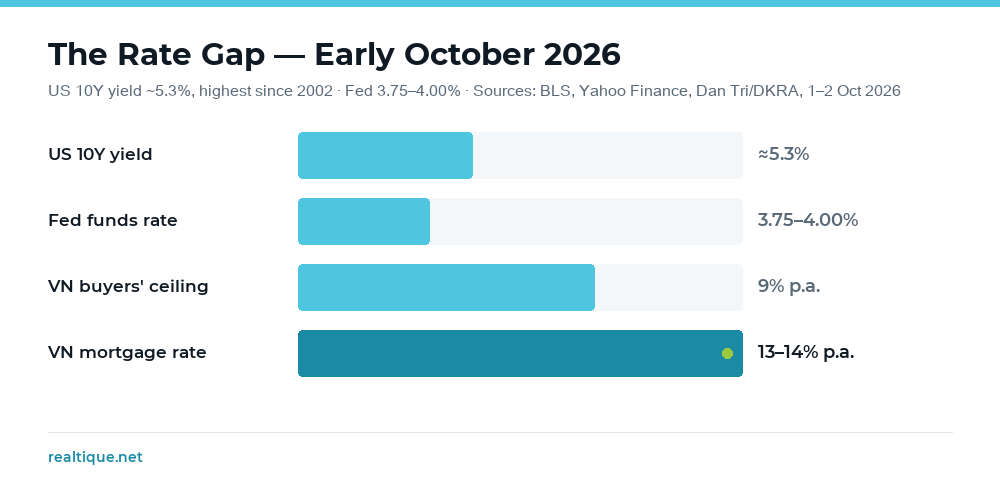
Graphic: Realtique · Data: BLS 2 Oct 2026, Yahoo Finance/Bloomberg 1 Oct 2026, Seoul Economic Daily (Reuters) 2 Oct 2026, Dan Tri/DKRA 2 Oct 2026
19 October 2026 Update: The State Bank Orders Deposit Rates Down by at Least 0.5 Points — Will Mortgage Rates Follow?
For the first time since this article was written, the domestic signal has turned. On 18 October 2026 the State Bank of Vietnam issued Official Letter 9608/NHNN-CSTT. Realtique’s reading of what it means for anyone borrowing to buy a home, together with what banks did in the 72 hours around it:
1. What the letter says. Lenders must cut listed deposit rates by at least 0.5 percentage points a year on terms of six months or longer and stop bidding up deposit rates; they must also cut lending rates by 1.5–2 points for production, business and priority sectors, without loosening credit standards (Government News, CafeF, VnExpress, 18 October). According to CafeF (19 October), banks that do not comply by year-end may have their remaining 2026 credit-growth room reviewed, receive lower 2027 quotas and be held to higher safety ratios.
2. What banks have done. BIDV has offered short-term dong loans from 6% a year since 15 October, up to 2 points below its usual rate, for priority sectors; Vietcombank’s chairman pledged cuts of at least 2 points through year-end to support businesses; Agribank cuts rates by up to 2 points from 19 October, setting aside about VND 2 trillion, focused on production and business (Government News, 18 October).
3. Where home loans sit. In the documents and reports we read, home loans are not named as a priority sector — the 1.5–2 point cuts target businesses. The effect on mortgage borrowers is therefore indirect and lagged: many Vietnamese home loans float at a reference rate (usually tied to long-term deposit rates) plus a fixed margin. As deposit rates on six-month-plus terms fall, the reference rate may follow at the next reset — by how much, and when, depends on the bank and the contract.
Against the US tide. The Fed raised rates to 3.75–4.00% in September and the 10-year Treasury yield still sits near 5.10% (FRED, 15 October) after peaking around 5.35% early in the month; markets lean toward a hold at the 27–28 October meeting (CNBC, 15 October, citing CME FedWatch). Vietnam cutting while US rates stay high narrows the rate gap — pressure on the dong is the risk the State Bank has to balance, which is why the letter pairs the cuts with inflation control and system safety.
How Realtique now reads the “high into mid-2027” scenario. For deposits, the peak has most likely passed. For home loans we move our base case to “slow and lagged”: floating rates may edge down from resets in late 2026 to early 2027 if banks follow the directive, but are unlikely to return to the cheap money of 2024 — margins are unchanged and the Fed has not turned. What to do now: (1) get the floating-rate formula in writing (which reference rate, what margin, how often it resets); (2) on an existing loan, ask whether the next reset will use the new reference rate; (3) do not pick a project on the hope that rates will fall — developer payment support (next section) remains the more reliable lever. Overseas Vietnamese and foreigners buying in cash are unaffected directly, but a softer dong makes dong-priced homes cheaper in dollar terms. A cautious reading that may change with State Bank policy; not financial or credit advice.
Addendum, 19 October 2026 (afternoon): the Governor meets the banks. On 19 October State Bank Governor Phạm Đức Ấn met commercial-bank leaders in Hanoi and restated the terms: deposit rates down by at least 0.5 points, lending rates down 1.5–2 points for production, business and priority sectors, applied to existing as well as new loans, and not as a blanket cut across every sector (VietnamPlus, 19 October). At the meeting BIDV put a size on its programme — VND 100 trillion of short-term preferential loans at 6–7% a year depending on tenor and sector; ACB announced business-loan cuts of 1.5–2 points and a lower deposit-rate schedule from 20 October; Vietcombank restated its pledge to cut lending rates, focused on priority sectors. Every announcement points the same way: production, business and priority sectors. As of the afternoon of 19 October we have not seen a directive or a bank statement that names home loans.
What to do if you have, or are about to take, a home loan. Ask your bank directly whether your loan falls within the 1.5–2 point cut, and get the answer in writing. On the savings side, rates on six-month-plus terms will fall by at least 0.5 points. That narrows the gap between what a deposit pays and the rental yield on an apartment — which, on the figures quoted above, still sits below long-term deposit rates — so the “savings account or buy-to-let” comparison tilts a little less towards savings. We will review this article again after the Fed’s 27–28 October meeting.
Update, 21 October 2026: from 20 October, Vietcombank and Agribank cut the 12-month counter deposit rate from 5.9% to 5.4% a year; about 15 private banks cut six-month-plus rates by 0.5–0.7 points; VietinBank and BIDV still listed 5.9% on the evening of 20 October (CafeF, 20 Oct). On loans, only about 15 of 46 commercial banks had cut average lending rates by 1.5–2 points as of 20 October, with Vietcombank cutting up to 3 points for some short-term priority loans — home loans are still not named. Big Four rates before and after 20 October, and what it does to the deposit-versus-rental comparison: Investing in Vietnam 2026: four options compared.
Sources: Government News (baochinhphu.vn), 18 Oct 2026 · CafeF, 18 Oct 2026 · VnExpress, 18 Oct 2026 · CafeF, 19 Oct 2026 · Government News, 18 Oct (BIDV, Vietcombank) · Government News, 18 Oct (Agribank) · FRED DGS10 · CNBC, 15 Oct 2026 · VietnamPlus, 19 Oct 2026.
29 October 2026 Update: The Fed Holds at 3.75–4% With Two Votes for a Hike — Why Vietnamese Mortgage Rates Are Unlikely to Fall Quickly in November
In the early hours of 29 October Vietnam time, the US Federal Reserve ended its 27–28 October meeting by holding the target range at 3.75–4%, where it has sat since September’s quarter-point hike. The vote was 10–2: Governor Lisa Cook and Cleveland Fed President Beth Hammack wanted another 25-basis-point increase now (CNBC 28/10/2026; thông cáo FOMC 28/10/2026; CafeF 29/10/2026). The statement upgraded its description of the economy from “solid” to “expanding at a strong pace”, repeated that inflation “remains elevated” and said the committee is waiting for more information before deciding its next step; Chair Kevin Warsh declined to give forward guidance. Futures pricing after the meeting still leans towards a hike in December and possibly one or two more in 2027 (CafeF citing CME).
Three numbers from the same 24 hours:
- The 10-year US Treasury yield at about 5.01% in Asian trading on 28 October — still around the 24-year high noted in the 3 October update. One detail worth keeping: in the first eight months of 2026, America’s closest allies bought a net USD 174.3 billion of Treasuries (−60% year on year); Japan bought a net USD 389 million (−99%) and South Korea sold a net USD 23.8 billion — the traditional buyers are stepping back, which makes a quick fall in yields unlikely (CafeF 29/10/2026 (dẫn dữ liệu Bộ Tài chính Mỹ); single source citing US Treasury data, not yet cross-checked by Realtique against the TIC tables).
- Gold at about USD 4,055 an ounce on the morning of 28 October (+1% ahead of the meeting); SJC bars at VND 139.7–142.7 million a tael bid–ask (VietnamPlus 28/10/2026; Báo Đà Nẵng 28/10/2026).
- September core PCE is expected to come in above 3% — well above the 2% target (CafeF 29/10). The official print is due later this week.
What it means for a mortgage borrower in Vietnam. The 19 October update recorded the State Bank’s order to cut deposit rates by at least 0.5 points, and the Big Four have since taken 12-month deposits down to 5.4%. The Fed’s decision does not reverse that direction — but it narrows the room: with dollar rates held at 3.75–4% and the 10-year yield near 5%, the rate differential and exchange-rate pressure make it hard for domestic mortgage rates to fall as fast as deposit rates. DXS-FERI’s base case for Q4 (floating rates at 12–14%, absorption at 30–35%) therefore remains the most reasonable scenario; a move to 10–12% needs the Fed to cut, or at least to stop leaning towards hikes. See our savings–gold–stocks–rental comparison and the weekly macro review.
A client asks: “The Fed didn’t hike — so has my mortgage rate come down yet?” — Answer: the Fed did not hike; it has not turned. Two members voted for a hike and markets still price one in December. If you are choosing a loan now, the value lies in how long the rate is fixed and the cap on the floating margin, not in the first-year teaser — the sections below show how to read the contract. Next check: September PCE data and the 15–16 December 2026 Fed meeting.
Sources: thông cáo FOMC 28/10/2026 · CNBC 28/10/2026 · CafeF 29/10/2026 · CafeF 29/10/2026 (dẫn dữ liệu Bộ Tài chính Mỹ) · VietnamPlus 28/10/2026 · Báo Đà Nẵng 28/10/2026.
1 November 2026 Update: Property Credit Grew 9.84% — Slower Than the Economy-Wide 12.27%
On 31 October 2026, addressing the National Assembly during the second session of its 16th legislature, State Bank of Vietnam Governor Pham Duc An released the latest credit and interest-rate figures. On Realtique’s reading, this is the first time in 2026 that a standalone real-estate credit growth figure has been put before the National Assembly — and it came in below the economy-wide rate.
| Indicator | Figure released 31 October 2026 |
|---|---|
| System-wide credit growth | 12.27% (versus end-2025) |
| Real-estate credit growth | 9.84% — below the overall rate |
| Deposit rates | +1.42 points |
| Lending rates | +0.99 points → spread narrowing |
| Total outstanding credit | more than VND 20,879,000 billion |
| Share going to production and business | 77.44% |
| Lending to small and medium enterprises | more than VND 4,000 trillion |
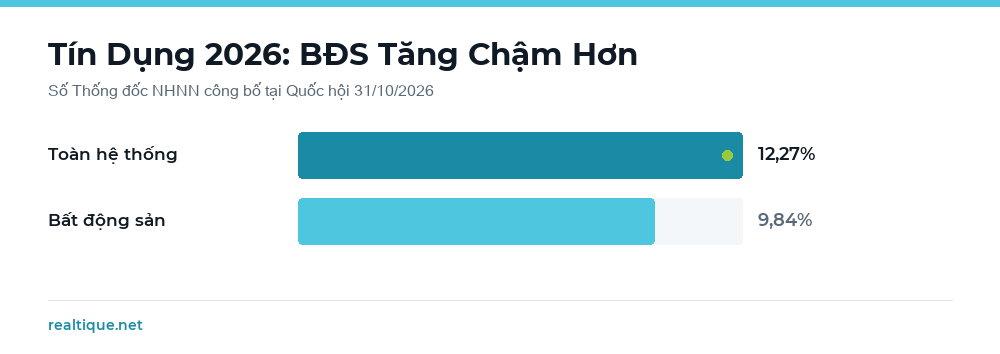
Graphic: Realtique · Data: State Bank of Vietnam, Governor’s remarks to the National Assembly, 31 October 2026
“Below the overall rate” is not the same as a shut-off. Property credit still grew by almost 10% — money is still flowing into the sector, just more slowly than into the rest of the economy. At the same time, 77.44% of all outstanding credit went to production and business. The accurate reading is controlled to grow more slowly than the average, not an outright freeze. For a buyer, the practical consequence is that loan applications are still being approved, but to tighter standards — and nothing in these numbers supports expecting banks to open up sharply for real estate in the near term.
Mind the baseline before you quote the numbers. The 12.27% credit figure is reported as being measured against end-2025. The two interest-rate figures (+1.42 and +0.99 points) were given without a stated baseline. Read alongside the credit figure for the same period, they are most likely cumulative year-to-date moves rather than October alone. That is Realtique’s reading — the authority did not explain further — so treat them with that caveat rather than quoting them as a single month’s change.
Why this does not contradict the 19 October directive. The 19 October 2026 Update above records the State Bank ordering deposit rates down by at least 0.5 points. The +1.42 point figure describes ground already covered; the directive aims at the stretch ahead. If it works, part of that increase should unwind over the closing months of the year — but as of the Governor’s remarks there was no data confirming it had, so do not treat it as already done.
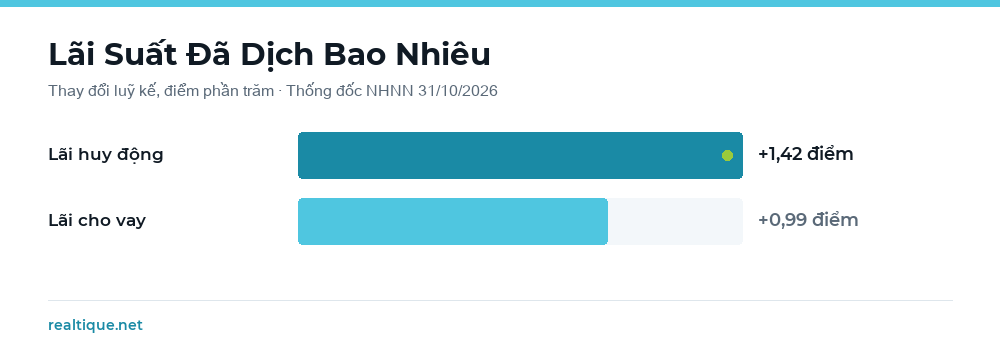
Graphic: Realtique · Data: State Bank of Vietnam, Governor’s remarks to the National Assembly, 31 October 2026 · the comparison baseline was not stated in the remarks
The deposit-to-lending spread is narrowing, and that cuts both ways. Deposit rates rose 1.42 points while lending rates rose only 0.99, meaning banks are absorbing part of their higher funding cost instead of passing all of it to borrowers. That is why mortgage rates have not climbed in step with deposit rates. The flip side: a thinner margin leaves less room for banks to cut lending rates on their own initiative — a deep cut is unlikely unless funding costs fall first.
A social-housing refinancing facility is being designed, with no parameters yet. The Governor said the State Bank is building a refinancing package for social-housing lending at the Prime Minister’s direction. No size, interest rate or start date has been announced, so it is not yet something any buyer can plan around. Note too that foreign nationals are not eligible for social housing, so if the facility does launch it would reach this group only indirectly, through supply and rental pricing in the affected areas.
For overseas Vietnamese and foreign buyers: how should you read this?
Most overseas Vietnamese and foreign buyers in Vietnam pay from their own funds or borrow in their home country, so domestic lending rates do not set their cost directly. What these figures do set is the purchasing power of domestic buyers — which drives the absorption rate and price level of the very project you are weighing. Property credit growing more slowly than the overall rate usually comes with slower secondary liquidity, which means more time to negotiate and to complete legal checks rather than having to decide quickly. For ownership caps and eligibility, see our guide to the 30% foreign ownership quota.
Sources: Báo Điện tử Chính phủ 31/10/2026 · Báo Đấu Thầu 31/10/2026 · CafeF 31/10/2026 · Viettimes 31/10/2026 · BNews 31/10/2026 · Công Thương 31/10/2026 (the social-housing refinancing facility currently appears in one source only). These are figures given in a National Assembly debate, not a full statistical report, and the baseline for the two interest-rate figures was not stated. This article is market information, not financial or credit advice.
The Smart Move: Choose Projects With Strong Payment Support
When bank credit is expensive, the most valuable thing a developer can offer is not a headline discount — it is a payment policy that keeps your cash in your pocket for longer. Several current projects do exactly that. The mechanisms to look for:
- Low staged payments until handover. Some developers let you pay as little as ~10% of the value and spread the rest in small instalments until you receive the home — so you are not carrying a large mortgage while the project is still being built.
- Grace period on principal and interest. The developer partners with a bank to waive or subsidise principal and interest for a defined window, delaying the point at which the full monthly payment kicks in.
- Interest-rate support. A fixed promotional rate underwritten for longer than the usual promo, or an outright subsidy for a set number of months.
- Discounts for early / fast payment. If you do have cash and want to avoid borrowing altogether, fast-payment discounts can be substantial — effectively a guaranteed return versus paying 10%+ interest.
These policies are not marketing fluff in a high-rate year — they are worth real money. A grace period that delays your first full payment, or interest support that shaves several points off the rate for two years, can be worth far more than a 2–3% price cut.
Rung Phuong – Eco Retreat Long An
Pay only ~10% until handover, with principal-and-interest grace and fast-payment discounts — a clear example of buyer-friendly structuring.
Explore →Beachtro Tower – Blanca City
The last long-term-ownership apartment tower at Sun Group’s Blanca City, with a staged payment schedule built for buyers watching cash flow.
Explore →Masteri Park Place – The Global City
A flagship Masterise address in The Global City — the kind of established location where payment policy and long-term value both work in the buyer’s favour.
Explore →A Checklist For Buying While Rates Are High
- Budget on the post-promo rate, not the teaser. Ask your bank what the floating rate would be today and model your payment on that number.
- Compare the payment schedule, not just the price. A project with a grace period and 10%-until-handover terms can be cheaper to carry than a “discounted” project with a front-loaded schedule.
- Keep a buffer. Aim to keep your total monthly instalment comfortably within your income so a rate reset does not stretch you.
- Consider fast-payment discounts if you have cash. Avoiding a 10%+ loan is itself a strong, risk-free return.
- Prioritise location and legal status. Rates move in cycles; a well-located, legally clean asset holds value through them. The property you choose matters more than the month you buy.
- Factor in your rental yield after costs. If you plan to lease the home, model the after-tax rent against your financing cost. (See our guide to rental income tax in Vietnam 2026.)
Frequently Asked Questions
Will interest rates come down in 2026?
Market commentary generally expects rates to stay elevated across 2026 rather than fall quickly. Plan for borrowing to remain relatively expensive in the near term. Update, 17 September 2026: the Fed has just raised rates to 3.75–4.00% and still leans toward further hikes, which makes a domestic rate cut before mid-2027 even less likely. Update, 15 October 2026: US CPI rose 3.7% year-on-year in September, and markets now see roughly 40–45% odds of another Fed hike at the 27–28 October meeting. Update, 19 October 2026: the State Bank (Official Letter 9608/NHNN-CSTT) ordered deposit rates on six-month-plus terms cut by at least 0.5 points and business lending rates cut by 1.5–2 points; home loans are not a priority sector, so any fall in mortgage rates is likely to be slow, via floating-rate resets. Update, 29 October 2026: the Fed held at 3.75–4% (10–2, two votes for a hike) and markets still lean towards a December hike — domestic mortgage rates are unlikely to fall quickly even though deposit rates have been cut.
Does the 1.5–2 point rate-cut directive apply to home loans?
Not on the evidence so far. Official Letter 9608/NHNN-CSTT (18 October 2026) and the announcements from BIDV, Vietcombank, Agribank and ACB up to 19 October all target production, business and priority sectors; none names home loans. If you are borrowing, ask your bank directly whether your loan qualifies. The more visible effect is on deposit rates (six-month-plus terms down at least 0.5 points) and, with a lag, on floating home-loan rates at their next reset where the reference rate is tied to deposit rates.
What is a realistic home-loan rate right now?
Promotional fixed rates of roughly 6–7.5% for the first 6–24 months, then a floating rate that often lands around 9–11.5% a year.
Should I wait for rates to fall before buying?
Timing rates is difficult and a good asset can appreciate while you wait. Many buyers instead choose a project with a strong payment policy so their cash outlay stays low until rates ease.
Do developer payment supports really save money?
Yes. A grace period or multi-year interest subsidy on a large loan can be worth far more than a small price discount — often tens of millions of dong a year.
Can foreigners get a mortgage in Vietnam?
Financing options for foreign buyers are more limited than for citizens; many overseas buyers pay in stages using a developer’s schedule. A Realtique advisor can walk you through what applies to your case.
Is 9.84% real-estate credit growth a tightening or a loosening?
According to figures the State Bank Governor gave the National Assembly on 31 October 2026, real-estate credit still grew 9.84% — the sector is still receiving new funding, not being shut off. But that is below the 12.27% growth rate for credit across the economy, and 77.44% of the more than VND 20,879,000 billion in outstanding credit went to production and business. The accurate description is therefore “controlled to grow more slowly than the average”, not an outright freeze. For a buyer, it means loan applications are still approved but to tighter standards — so do not build a financing plan on the expectation that banks will open up sharply for real estate in the short term.
This article is general market commentary, not personalised financial advice. Rates and policies change — confirm current terms with the relevant bank or developer, and consult a qualified advisor for your situation.
Compare payment policies before you commit
Leave your details and a Realtique advisor will map projects with grace periods and developer interest support against your budget — a callback within two business hours, no obligation.
Hotline: +84 866 810 689

KC Pham
KC Pham is the CEO of Realtique, advising local and international buyers on how financing, payment policy and project selection fit together in Vietnam’s current market.