
Savings, Gold, Stocks or a Rental Apartment? Investing in Vietnam in 2026 After the Deposit-Rate Cut Order
Short answer: at the rates posted in mid-October 2026, a 12-month bank deposit still pays the most cash — roughly 5.9–7.1% a year. A buy-to-let apartment in Ho Chi Minh City yields about 3.3–3.4% gross and roughly 2–3% after costs, while gold and stocks pay no fixed income and are both below their 2026 starting levels (SJC gold bars about −6.3%, the VN-Index −4.4%). But the State Bank of Vietnam’s Official Letter 9608/NHNN-CSTT of 18 October 2026 orders banks to cut deposit rates for terms of six months or longer by at least 0.5 percentage points, so the gap is narrowing.
Realtique’s reading of the 15–19 October bank rate surveys, the 19 October SJC gold price, the 16 October VN-Index close and REFI / Batdongsan.com.vn rental-yield data: VND 5 billion placed in each option for one year at today’s rates would earn about VND 270–355 million in deposit interest, about VND 136–145 million in rent after costs, and an outcome for gold and stocks that depends entirely on price. Which is “better” depends on how long you can leave the money and what you need it to do — this guide puts all four on one table.
Four Ways to Invest in Vietnam — Data to 19 Oct 2026
Table of Contents
Quick Comparison: Four Options Side by Side (Data as of 15–19 October 2026)
The table puts the four options against the same six tests. Figures are posted rates or the latest closing prices before 19 October 2026; sources are given in each section below.
| Test | 12-month bank deposit | SJC gold bars | Stocks (VN-Index) | Rental apartment in HCMC |
|---|---|---|---|---|
| Yield / price change | 5.9–7.1% a year, fixed in advance (before the ≥0.5 pt cut) | No income; selling price −6.3% year to date (19 Oct) | Dividends vary; index −4.4% year to date (16 Oct) | ~3.3–3.4% gross; ~2–3% net of costs |
| Main risks | Lower rate on rollover; inflation; deposit insurance capped at VND 350 million per person per bank | World price and exchange rate; SJC trades ~VND 12 million/tael above the converted world price | High volatility; foreign funds are net sellers | Vacancy, running costs, project legal status, asset price |
| Liquidity | High — early withdrawal usually earns only the demand rate | High, but you lose a ~VND 3 million/tael buy–sell spread | High — sell within the session | Low — a sale usually takes months |
| Minimum ticket | Low | ~VND 143 million per tael (smaller bars exist) | Low | Usually several billion VND per unit |
| Tax / fees | Deposit interest is exempt from personal income tax | 0.1% tax on gold-bar transfers is in the law but not yet collected | 0.1% of each sale + 5% on cash dividends + brokerage | 0.5% registration fee on purchase; rental tax above VND 1 billion a year; 2% of the price on sale |
| Effort | Almost none | Low (safe storage) | High — needs monitoring | Medium to high: tenants, repairs, tax filing |
In one line: only the deposit pays a known return. Gold and stocks are price bets. A rental apartment combines income with asset-price exposure — but today its income is lower than a deposit’s, and this guide does not hide that.
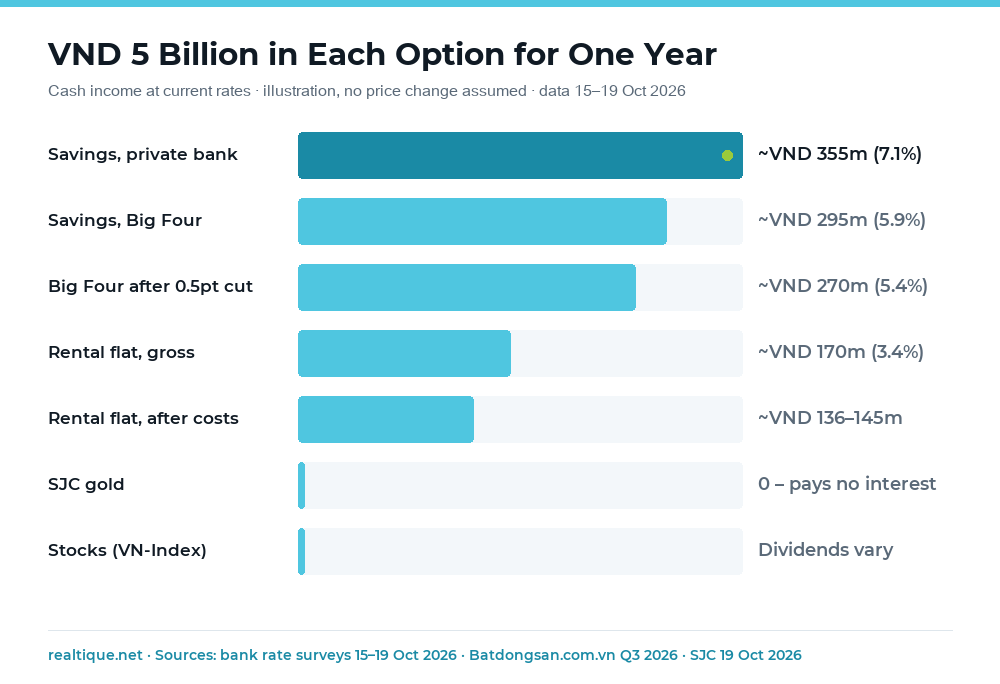
Graphic: Realtique · Data: posted deposit rates 15–19 Oct 2026 (CafeF, VietnamNet, 24hmoney surveys), Batdongsan.com.vn Q3 2026 rental yield, SJC price 19 Oct 2026. Illustration; no price change assumed.
Bank Deposits: Still the Highest Cash Yield — but the State Bank Has Ordered Cuts
On 18 October 2026 the State Bank of Vietnam issued Official Letter 9608/NHNN-CSTT: banks must cut posted deposit rates by at least 0.5 percentage points for terms of six months or more, stop competing on deposit rates, and lower lending rates for production, business and priority sectors by 1.5–2 points. Banks that do not comply may see their remaining 2026 credit-growth quota reviewed, a smaller 2027 quota, or tighter safety ratios (Government News, VnExpress 18 Oct; CafeF, Dân trí 19 Oct 2026).
| Bank | 12-month rate (% a year) | Channel | Source, date |
|---|---|---|---|
| Vietcombank, BIDV, VietinBank | 5.9 | Counter | 24hmoney 19 Oct; Thị trường Tài chính Tiền tệ 1 Oct |
| Agribank | 6.8 | Online | CafeF survey 15–18 Oct; VietnamNet 19 Oct |
| VPBank | 7.1 | Online | CafeF 19 Oct; VietnamNet 19 Oct |
| Techcombank | 6.75 | Online | CafeF 19 Oct; VietnamNet 19 Oct |
| SHB | 6.5 | Online | CafeF 19 Oct; VietnamNet 19 Oct |
| MB | 6.3 | Online | CafeF 19 Oct; 24hmoney 19 Oct |
| LPBank (after its 19 Oct cut) | 6.7 | Online | VietnamNet, Dân trí 19 Oct |
These rates were recorded before, or on the first day of, the 9608 cuts. On 19 October LPBank cut by 0.5–0.6 points and VietBank by 0.5 points for terms of six months or longer; no Big Four bank had announced a deposit cut by that afternoon. Online rates for the Big Four differ between surveys (5.9–6.8%), so check with the bank before you deposit.
Three things to know: (1) bank deposit interest earned by individuals is exempt from personal income tax; (2) deposit insurance now covers up to VND 350 million per person per bank (principal plus interest) from 13 July 2026 under Circular 05/2026/TT-NHNN; (3) the main risk today is reinvestment risk — a deposit that matures next year will roll over at a lower rate. Realtique covered that trap in What to invest in for 2026. Mortgages are not among the loans the State Bank asked banks to cut by 1.5–2 points; what that means for buyers is in loan interest rates in Vietnam 2026.
Gold: No Income, and SJC Bars Are Down About 6% This Year
SJC gold bars ended 2025 at VND 150.8 million per tael (buying) and 152.8 million (selling) (Người Lao Động 1 Jan 2026; webgia 31 Dec 2025). Around midday on 19 October 2026 SJC cut its price by VND 0.5 million to 140.1–143.1 million (VTV, webgia 19 Oct). On the selling price, gold bars are down about 6.3% this year. World gold closed 2025 near USD 4,320 an ounce and closed 16 October 2026 near USD 4,165 (pricegold.net; Fortune 16 Oct) — down about 3.6%.
Two hidden costs: the SJC buy–sell spread is about VND 3 million per tael (VND 2 million in January), so a round trip costs about 2.1%; and SJC bars trade about VND 12 million per tael above the converted world price (VietnamPlus, VOH 19 Oct 2026) — a premium that can shrink at any time. Looking back: VND 5 billion of gold bars bought on 1 January 2026 (about 32.7 taels at 152.8 million) and sold at midday on 19 October (buying price 140.1 million) would be worth about VND 4.58 billion — a loss of roughly 8.3% including the spread.
Tax: Personal Income Tax Law No. 109/2025/QH15 (in force 1 July 2026) introduces a 0.1% tax on the transfer value of gold bars, but the government has not yet set the threshold or start date, so it is not being collected (Người Lao Động; Phụ nữ & Gia đình 1 Jul 2026). Gold works as a hedge, not as an income source.
Stocks: Upgraded by FTSE Russell, Yet the VN-Index Is Down 4.4% Year to Date
FTSE Russell reclassified Vietnam as a Secondary Emerging market from 21 September 2026 (VietnamPlus 21 Sep; Conventus Law 25 Sep 2026). The upgrade did not lift prices straight away: the VN-Index ended September at 1,768.62, down 3.47% on the month (VFS 1 Oct; Thị trường Tài chính Tiền tệ 7 Oct) and closed 16 October 2026 at 1,705.91 (Stockbiz 16 Oct; VietnamPlus 18 Oct). Against the end-2025 close of 1,784.49 (Thời báo Tài chính Việt Nam 31 Dec 2025; Nhân Dân), the index is down about 4.4% year to date.
Foreign money is still leaving: foreign investors were net sellers of about VND 95,000 billion from January to the end of September (VFS), more than 100,000 billion after the first week of October and about 115,500 billion by 16 October (CafeF 8 and 19 Oct). Valuations are lower: a market P/E of about 12x at end-September (VNDIRECT) and 13x in mid-October, against a five-year average of about 15.3x (Shinhan 15 Oct 2026).
Costs: 0.1% personal income tax on every sale and 5% on cash dividends, plus brokerage fees. Stocks have no fixed yield — the only regular income is dividends, which vary by company. Foreign investors trade through a securities trading code, and returns are in VND.
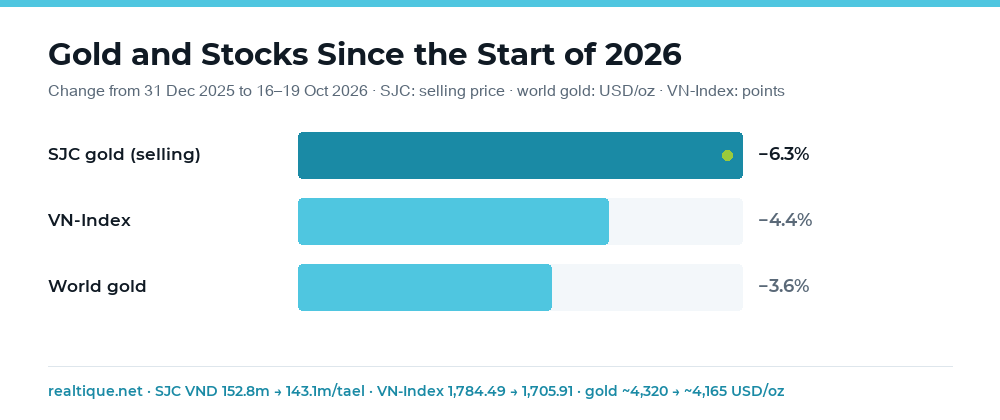
Graphic: Realtique · Data: SJC selling price (31 Dec 2025 and 19 Oct 2026), world gold (pricegold.net, 31 Dec 2025 and 16 Oct 2026), VN-Index (HOSE, 31 Dec 2025 and 16 Oct 2026).
Buy-to-Let Apartments in HCMC: 3–4% Gross, Roughly 2–3% Net
The gross rental yield (a year’s rent divided by the purchase price) on Ho Chi Minh City apartments is about 3.3–3.4%: 3.30% in Q2 2026 according to REFI (CafeBiz 29 Aug 2026) and 3.4% in Q3 2026 for the former HCMC area according to Batdongsan.com.vn (updated 15 Oct 2026). Numbeo (crowd-sourced, updated 15 Oct 2026) shows 2.93% in the centre and 4.01% outside it; Global Property Guide reports 4.16%, but from Q3 2025 data. All of these are based on asking prices and asking rents, not transactions.
To get from gross to net, deduct vacancy between leases, the building management fee (in HCMC’s high-end projects roughly VND 12,000 to almost 40,000 per m² a month — examples surveyed by Thanh Niên, 10 Aug 2026), repairs, furnishing and agency fees. An LPS Securities analyst puts these costs at about 15–20% of rent and says occupancy must reach 80–85% (CafeF 14 Oct 2026); Global Property Guide estimates net yields 1.5–2 points below gross. In practice net yields usually land at about 2–3% a year.
Realtique’s leasing fee: one month’s rent for a 12-month lease, charged only after both sides have signed and the tenant has paid the first rent; with an exclusive mandate, our property management fee is reduced to zero — see what we charge landlords.
Rental income tax in 2026 is based on total rental revenue across all your units: up to VND 1 billion a year there is no VAT or personal income tax, but you must still file; above VND 1 billion you pay 5% VAT on the whole amount and 5% personal income tax on the part above 1 billion (for VND 1.2 billion: 60 million + 10 million = 70 million). The 2026 filing and payment deadline is 31 January 2027. Details: rental income tax in Vietnam 2026.
What about capital growth? CBRE puts Q3 2026 primary apartment prices in HCMC (post-merger boundaries) at about VND 75 million per m², just 1% higher than a year earlier, and secondary prices at about VND 60 million per m², flat year on year (VTV 15 Oct; CafeLand, VOV 17 Oct 2026). Realtique assumes no price growth in the illustration below; quarterly asking-price trends are in our Q3 2026 HCMC market report. Budget a 0.5% registration fee on purchase and 2% personal income tax on the sale price when you sell.
Illustrative photo: Rawpixel · CC0 1.0 (Realtique image kit)
Illustration: VND 5 Billion in Each Option for One Year at Today’s Rates
This table uses only today’s rates, yields and prices and assumes no rise or fall in gold, stock or apartment prices. It illustrates cash flow; it is not a return forecast.
| Option | Assumption (current level) | Cash received in one year | Keep in mind |
|---|---|---|---|
| 12-month deposit — large private bank (online) | 6.3–7.1%; ~5.8–6.6% after a 0.5 pt cut | ~VND 315–355m (~290–330m after the cut) | No income tax; deposit insurance up to VND 350m per person per bank |
| 12-month deposit — Big Four (counter) | 5.9%; ~5.4% after a 0.5 pt cut | ~VND 270–295m | Early withdrawal usually earns only the demand rate |
| SJC gold bars | Buy at 143.1m, sell back at 140.1m per tael (19 Oct) | VND 0 | ~34.9 taels; selling straight away loses ~VND 105m (−2.1%) to the spread; the year’s result depends entirely on price |
| Stocks tracking the VN-Index | No fixed yield | Dividends vary by company | 0.1% tax on sale ≈ VND 5m; VND 5bn tracking the index from 1 Jan to 16 Oct 2026 would now be ~VND 4.78bn |
| VND 5bn rental apartment in HCMC | 3.4% gross yield; costs at 15–20% of rent | ~VND 170m gross; ~136–145m after costs; ~125–132m with one empty month | Below the VND 1bn threshold → no VAT or income tax, but you must file; 0.5% registration fee (~VND 25m) on purchase; selling takes months |
Reading the table: on cash alone over the next 12 months, the deposit wins clearly — even after a 0.5-point cut, a Big Four rate (~5.4%) is nearly double the net rental yield (~2.7–2.9%). An apartment only closes that gap if the property’s value and rent rise over time — which this table deliberately does not assume.
What Changes If You Are a Foreigner or Việt Kiều
- Property: foreign individuals may buy apartments only in projects on the approved foreign-ownership list, capped at 30% of the units in each building, for up to 50 years (renewable once). Việt Kiều who still hold Vietnamese nationality buy as citizens. See Can foreigners buy property in Vietnam?
- Rental income: foreign owners may lease out their apartment; rental income is declared under a personal tax code with the same VND 1 billion annual threshold. One-off purchase and sale costs are in property taxes and fees for foreign buyers.
- Money in and out: bring purchase funds in through proper bank channels so that sale proceeds and profits can later be repatriated — see transferring money to Vietnam and repatriating profits.
- Deposits, gold and stocks all pay out in VND, so an investor who thinks in USD, EUR, KRW or JPY also carries exchange-rate risk on every option in this table.
Which Option Fits Whom? Realtique’s Straight Answer
- Bank deposit — money you need within 12–24 months, emergency funds, and anyone who cannot accept a nominal loss. Expect lower rates on rollover after Letter 9608.
- Gold — a small hedge held for years, not an income source. Think twice while SJC bars trade about VND 12 million per tael above the world price.
- Stocks — investors with time to follow the market and the stomach for large short-term swings. Valuations are below the five-year average, but foreign funds are still selling after the upgrade.
- Rental apartment — long-term money (in Realtique’s view, five years or more), buyers who want a real asset they can live in or pass on, and who accept low liquidity and a cash yield below today’s deposit rates. Choosing a location with genuine tenant demand — expatriate professionals and families — matters more than choosing the cheapest unit.
Straight answer: for money needed within one to two years, a deposit remains the most sensible choice even as rates fall. Gold and stocks are bets on price, and both are below their 2026 starting levels. A rental apartment does not beat a deposit on first-year cash flow (2–3% net versus 5.4–7.1%); it makes sense for long-term money, with every cost counted. Most investors with VND 5 billion or more spread across several options rather than choosing one.
Frequently Asked Questions
Is it better to keep money in a Vietnamese bank deposit or buy gold right now?
If you need certain income, a deposit: 12-month rates are about 5.9–7.1% a year (surveys of 15–19 October 2026, before the cuts ordered by Official Letter 9608) and deposit interest is exempt from personal income tax. Gold pays nothing; SJC gold bars are down about 6.3% on the selling price from the start of 2026 to 19 October, with a buy–sell spread of about VND 3 million per tael. Gold is a small hedge, not a substitute for a deposit.
What does the State Bank’s Official Letter 9608 change for deposit rates?
Issued on 18 October 2026, it requires banks to cut posted deposit rates by at least 0.5 percentage points for terms of six months or longer, stop competing on deposit rates and cut business lending rates by 1.5–2 points; banks that do not comply may have their credit-growth quotas reviewed. If today’s 5.9–7.1% falls by the full 0.5 points, 12-month rates would sit around 5.4–6.6%. LPBank and VietBank cut on 19 October.
What rental yield can I expect from an apartment in Ho Chi Minh City?
About 3.3–3.4% gross a year (REFI Q2 2026; Batdongsan.com.vn Q3 2026), usually about 2–3% net after building fees, repairs and vacancy. That is below current deposit rates; buyers of rental apartments are usually after a long-term real asset and rents that rise over time, not a first-year income higher than the bank’s.
Do I pay tax on rental income in Vietnam?
In 2026, if total rental revenue across all your units is VND 1 billion a year or less, there is no VAT or personal income tax, but you must still file. Above that you pay 5% VAT on all revenue and 5% personal income tax on the part above VND 1 billion — VND 70 million on revenue of 1.2 billion, for example. The deadline for 2026 is 31 January 2027.
Can foreigners invest in a rental apartment in Vietnam?
Yes, within limits. Foreign individuals may buy apartments in projects on the approved foreign-ownership list, up to 30% of the units in each building, for up to 50 years (renewable), and may lease them out; rental income is declared under a personal tax code with the same VND 1 billion threshold. Việt Kiều who hold Vietnamese nationality buy as citizens.
⚠️ Note: This article is for information only and is not investment or financial advice. Deposit rates were surveyed on 15–19 October 2026, before most banks applied the cuts required by Official Letter 9608, and change daily; gold and VN-Index figures are the prices on the dates stated; rental yields are averages of asking prices and asking rents, not transactions. The VND 5 billion illustration assumes no change in asset prices. Past performance does not guarantee future results — confirm with your bank, broker and tax adviser before deciding.
Weighing a rental apartment against keeping your money on deposit?
Tell Realtique your budget and how long you plan to hold. We will work out the realistic rental cash flow of specific apartments — after building fees, vacancy and tax — so you can compare it with deposit rates before you decide.
💬 WhatsApp: +84 866 810 689
📞 Hotline: +84 866 810 689