
High Loan Interest Rates in Vietnam (2026): What Home Buyers Should Do
Borrowing to buy a home in Vietnam is more expensive in 2026 than it was a year ago. After the low-rate window that followed the pandemic, banks have re-priced upward: many lenders now quote home-loan rates of roughly 9–11.5% a year once the introductory promotion ends, with promotional fixed rates of about 6–7.5% for the first 6–24 months. Deposit rates have climbed too — commonly 7–8% for a 12-month term, and higher at some banks — which is what pushes lending rates up. This guide explains why rates are elevated, what it actually costs a buyer, and the practical moves that matter most when money is expensive.
Vietnam Loan Rates At A Glance
Table of Contents
What Is Happening To Interest Rates
The headline is simple: the cheap-money period is over for now. Through late 2025 and into 2026, several commercial banks lifted their average lending rates by more than a percentage point as funding costs rose. Public reporting on the market has noted individual lenders whose average lending rate moved up sharply over a few quarters, and business loans in the 7.5–9% range. For a homebuyer, the number that bites is the floating rate after the promotional period — that is where most loans settle for the bulk of their life.
Two features of Vietnamese mortgages make this especially important to understand:
- The teaser rate is temporary. A loan advertised at 6.5% is usually fixed for only the first 6–24 months. After that it floats at a reference rate plus a margin — often landing in the 10–11.5% band in the current environment.
- The reset can be a shock. Buyers who budget around the promotional payment can be caught out when the rate resets. Planning for the post-promo rate from day one is the safer approach.
Why Rates Are Staying High Through 2026
Several forces are keeping the cost of credit up, and none of them reverses overnight:
- Competition for capital. Banks need deposits to lend, and to attract savers they must offer competitive deposit rates. Higher deposit rates feed straight through to lending rates.
- Heavy funding demand. Vietnam is financing a large pipeline of infrastructure — metro lines, ring roads, expressways and airports — alongside strong corporate credit demand. When the economy wants to borrow a lot, the price of borrowing rises.
- A high global rate backdrop. Vietnam does not set rates in isolation; elevated rates in major economies limit how far domestic rates can fall without pressuring the exchange rate.
- Inflation management. Keeping real rates positive is part of protecting the currency and price stability.
Market commentary generally expects rates to remain elevated across 2026 rather than fall quickly. For a buyer, the sensible planning assumption is that borrowing stays expensive for the near term — and to structure the purchase accordingly.
What High Rates Actually Cost A Buyer
Consider a VND 2 billion loan over 20 years — a realistic amount for a mid-market apartment:
During the promo year (~6.5%) → roughly VND 15 million a month
After it resets (~10.5%) → roughly VND 20 million a month
The jump → about VND 5 million more every month for the rest of the loan
That VND 5 million a month is roughly VND 60 million a year — and it lasts for years. It dwarfs many of the small discounts buyers negotiate on price. In a high-rate environment, the structure of your financing and payment schedule can matter more than the sticker price.
August 2026 Update: Mortgage Rates Sit at 12–14%, Some Floating Loans Touch 16%
August 2026 data confirms the scenario described above: borrowing costs have not eased. According to the Dat Xanh Services Economics – Finance – Real Estate Research Institute (DXS-FERI), property loan rates are commonly 12–14% per year, and some floating-rate loans have reached 15–16%. DXS-FERI expects rates to stay elevated through the final six months of 2026.
An early-August survey shows the gap between the advertised teaser rate and what borrowers actually pay is widening — the second number is the one that matters:
- VIB: 9.5–12% fixed depending on the lock-in period; once the promotional window ends the loan resets under bank policy and can move to 12–14%.
- OCB: 10.75% if fixed for the first 6 months, or 11.5% if fixed for 12 months; afterwards priced off the 13-month base rate plus a margin of 3.25–3.5%, which can exceed 14% when the base rate is high.
- VPBank: advertised from 4.6%, but surveyed effective rates range 6.9–12.3% depending on loan conditions and tenor.
Social housing sits on a separate track — 6.5% for the first five years and 7.5% for the following ten, for loans drawn between 1 July and 31 December 2026 — but that programme does not apply to commercial apartments, and foreign buyers cannot access it.
How to read this as a buyer. The figure that decides your payment from year two onward is not the promotional rate but the margin added to the bank’s base rate after the fixed period ends. When comparing projects, test the developer’s grace-period or interest-support policy against a 14–16% floating scenario rather than against the first-year teaser. Foreign buyers should also remember that onshore mortgage access is limited in practice, which makes developer payment schedules the more relevant lever.
August 2026 Update: Buyers Draw the Line at 9%, and Rates May Stay High Into 2027
Two further data points sharpen the picture above — one from the borrower side, one from the forecast side. Both push the conclusion past the “through 2026” horizon.
1. Buyers have set their own ceiling: 9% a year
A Batdongsan.com.vn survey puts hard numbers on the pain threshold:
• 84% of respondents are willing to borrow to buy a home.
• 81% will only borrow if the rate is below 9% a year.
• 91% will only borrow less than 50% of the property value.
Against actual market pricing — commonly 11–13% a year, rising to 14–15% once the grace period ends — the gap between what buyers accept and what banks offer is two to six percentage points. That arithmetic, not weak demand, is what is slowing transactions.
The most telling figure is the 91%. The market is shifting toward equity-funded purchases: most buyers want to borrow less than half the price. On a VND 5 billion apartment that means having VND 2.5 billion or more in cash — and the binding question stops being “what is the rate?” and becomes “is the payment schedule stretched enough for me to assemble the equity?”
2. A newer forecast: elevated rates possibly through Q2 2027
This article originally set the horizon at “high through 2026,” following DXS-FERI. An August 2026 forecast from Dinh Minh Tuan of Batdongsan.com.vn extends it: rates are unlikely to fall in the short term and may hold at elevated levels through the second quarter of 2027. Four drivers are cited: accelerating credit growth, exchange-rate pressure, inflation, and banks’ own funding needs.
Some lenders do advertise below the market average as of August 2026 — TPBank at 10.95%, OCB at 10.78%, BVBank at 10.45%. These are headline rates: the fixed period and the post-promotional margin still decide what you actually pay, exactly as the comparison above shows.
3. What this changes about choosing a property
If elevated rates really do run into mid-2027, then “wait for rates to fall” means waiting roughly three more quarters while primary prices in central districts keep climbing. That pushes the focus onto three things: (1) favour projects with stretched payment schedules or long principal grace periods; (2) model your cash flow against a floating rate of 14–15%, not the first-year promotional rate; and (3) keep borrowing under 50% of the property value, as most buyers now do.
Sources: Batdongsan.com.vn survey (Tien Phong, 27 July 2026) · Vietstock (3 August 2026) · DXS-FERI. Rate forecasts can change with monetary policy — see the note at the end of this article.
Please note: these are surveyed rates as of August 2026 and vary by bank, borrower profile and timing. This section is not financial or credit advice — ask your lender for a full amortisation schedule before signing.
17 September 2026 Update: The Fed's First Hike Since 2023 — Three New Numbers Pointing the Same Way
Three weeks after the 22 August update, three new data sets — one from the US, two from Vietnam — have landed, and all three push in the same direction: money stays expensive for longer.
1. The Fed raised rates for the first time since July 2023. On 16 September the FOMC lifted the federal funds target by 25 basis points to 3.75–4.00% on a 12–0 vote; Chair Kevin Warsh said inflation “is too high and has been for too long.” The dot plot shows 16 of 18 officials expect at least one more hike in 2026 (twelve see +25 bp, four see +50 bp), none for 2027, and gradual cuts only from 2028. Bonds reacted at once: the 2-year yield touched 4.73%, the 10-year closed near 5.01% — its highest since 2007; the dollar index rose 0.65% and gold and silver fell about US$100/oz (Bloomberg, CNBC, Yahoo Finance, 16 Sep).
What it means for Vietnam. On the morning of 17 September the State Bank’s central rate rose to 25,632 VND/USD, with Vietcombank and BIDV quoting 25,805–26,185 (+30 dong); Techcombank had already lifted its top base lending rate to 13% a year from 15 September (Bnews, 17 Sep). Transmission runs exchange rate → interbank liquidity → deposit rates → lending rates, over months rather than days (Dan Tri, 12 Sep). The key point: while the Fed leans toward further hikes, the State Bank has almost no room to cut without paying for it in the currency — so the “elevated until mid-2027” call in the section above gets firmer, not weaker.
2. Developers: debt growing fast, bonds priced at 11.4%. S&I Ratings (VnExpress 12 Sep, CafeF 13 Sep) reports that listed developers’ borrowings rose by VND 60,897 billion in one quarter to VND 360,240 billion (+20.3% q/q), taking debt-to-equity to 0.72x, the highest in 15 quarters; Vinhomes accounted for roughly 82% of the increase. Property-sector bond issuance hit VND 102,400 billion in Q2 (+228% y/y, 44% of the whole market), with Vingroup, Masterise and Sun Group making up 83.9%; the average coupon was 11.4%, typically 12.5–13.5%. Maturities in 2027 are forecast at VND 156,521 billion (+16%), and 28 bond lots totalling VND 28,558 billion were already late in 2026. Why a buyer should care: developers are borrowing at roughly the same rate as a mortgage, so a “24–36-month principal-and-interest holiday” is the developer carrying an 11–13% cost on your behalf — more valuable while rates stay high, and more reason to check the balance sheet of whoever is carrying it.
3. Buyers: demand cooling, resale prices slipping. Searches to buy apartments in Ho Chi Minh City fell 14% in August, primary absorption was only about 11%, and resale prices at several “hot” projects dropped 1–6% in Q3 versus Q2 (VnExpress 15 Sep, citing Batdongsan.com.vn). This is the mechanical result of the gap between the 9% buyers will accept and the 12–14% the market charges — demand has not disappeared, it is waiting.
What the three numbers change in practice:
- Lock the longest fixed period you can get (24–36 months) rather than a 6–12-month teaser, because the earliest plausible rate-cut window has slid into the second half of 2027.
- Borrow under 50% of value, as 91% of surveyed buyers now intend to; on a VND 5 billion apartment that is VND 2.5 billion of equity.
- Negotiate harder on resales: a documented 1–6% decline is a real anchor, especially in projects that ran hot in 2025.
- Foreign and Viet Kieu buyers holding US dollars: the same apartment costs fewer dollars than it did two weeks ago — the exchange rate is doing part of the discounting for you.
Caveat: rate forecasts are the views of the sources cited, not commitments; if the Fed stops after this hike, pressure on the dong and on domestic rates will be lighter than the scenario above. For the wider capital-flow picture see our FDI in Vietnam real estate 2026 update.
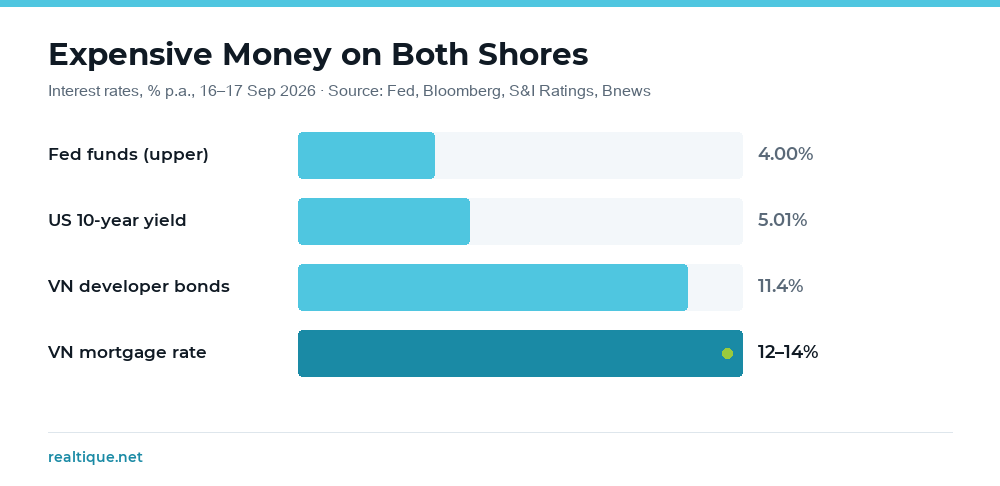
Graphic: Realtique · Data: Fed and Bloomberg 16 Sep 2026, S&I Ratings (Q2 2026), Bnews 17 Sep 2026
The Smart Move: Choose Projects With Strong Payment Support
When bank credit is expensive, the most valuable thing a developer can offer is not a headline discount — it is a payment policy that keeps your cash in your pocket for longer. Several current projects do exactly that. The mechanisms to look for:
- Low staged payments until handover. Some developers let you pay as little as ~10% of the value and spread the rest in small instalments until you receive the home — so you are not carrying a large mortgage while the project is still being built.
- Grace period on principal and interest. The developer partners with a bank to waive or subsidise principal and interest for a defined window, delaying the point at which the full monthly payment kicks in.
- Interest-rate support. A fixed promotional rate underwritten for longer than the usual promo, or an outright subsidy for a set number of months.
- Discounts for early / fast payment. If you do have cash and want to avoid borrowing altogether, fast-payment discounts can be substantial — effectively a guaranteed return versus paying 10%+ interest.
These policies are not marketing fluff in a high-rate year — they are worth real money. A grace period that delays your first full payment, or interest support that shaves several points off the rate for two years, can be worth far more than a 2–3% price cut.
Rung Phuong – Eco Retreat Long An
Pay only ~10% until handover, with principal-and-interest grace and fast-payment discounts — a clear example of buyer-friendly structuring.
Explore →Beachtro Tower – Blanca City
The last long-term-ownership apartment tower at Sun Group’s Blanca City, with a staged payment schedule built for buyers watching cash flow.
Explore →Masteri Park Place – The Global City
A flagship Masterise address in The Global City — the kind of established location where payment policy and long-term value both work in the buyer’s favour.
Explore →A Checklist For Buying While Rates Are High
- Budget on the post-promo rate, not the teaser. Ask your bank what the floating rate would be today and model your payment on that number.
- Compare the payment schedule, not just the price. A project with a grace period and 10%-until-handover terms can be cheaper to carry than a “discounted” project with a front-loaded schedule.
- Keep a buffer. Aim to keep your total monthly instalment comfortably within your income so a rate reset does not stretch you.
- Consider fast-payment discounts if you have cash. Avoiding a 10%+ loan is itself a strong, risk-free return.
- Prioritise location and legal status. Rates move in cycles; a well-located, legally clean asset holds value through them. The property you choose matters more than the month you buy.
- Factor in your rental yield after costs. If you plan to lease the home, model the after-tax rent against your financing cost. (See our guide to rental income tax in Vietnam 2026.)
Frequently Asked Questions
Will interest rates come down in 2026?
Market commentary generally expects rates to stay elevated across 2026 rather than fall quickly. Plan for borrowing to remain relatively expensive in the near term. Update, 17 September 2026: the Fed has just raised rates to 3.75–4.00% and still leans toward further hikes, which makes a domestic rate cut before mid-2027 even less likely.
What is a realistic home-loan rate right now?
Promotional fixed rates of roughly 6–7.5% for the first 6–24 months, then a floating rate that often lands around 9–11.5% a year.
Should I wait for rates to fall before buying?
Timing rates is difficult and a good asset can appreciate while you wait. Many buyers instead choose a project with a strong payment policy so their cash outlay stays low until rates ease.
Do developer payment supports really save money?
Yes. A grace period or multi-year interest subsidy on a large loan can be worth far more than a small price discount — often tens of millions of dong a year.
Can foreigners get a mortgage in Vietnam?
Financing options for foreign buyers are more limited than for citizens; many overseas buyers pay in stages using a developer’s schedule. A Realtique advisor can walk you through what applies to your case.
This article is general market commentary, not personalised financial advice. Rates and policies change — confirm current terms with the relevant bank or developer, and consult a qualified advisor for your situation.
Compare payment policies before you commit
Leave your details and a Realtique advisor will map projects with grace periods and developer interest support against your budget — a callback within two business hours, no obligation.
Hotline: +84 866 810 689

KC Pham
KC Pham is the CEO of Realtique, advising local and international buyers on how financing, payment policy and project selection fit together in Vietnam’s current market.