
FDI Floods Vietnam Real Estate 2026: USD 5.2 Billion and What It Means for Buyers
Foreign investors are backing Vietnam with record money — and real estate is one of their favourite destinations. In the first eight months of 2026, Vietnam attracted USD 40.63 billion in registered foreign direct investment (FDI), up 55.4% year-on-year, according to the General Statistics Office. Of that, USD 5.32 billion flowed into real estate — 15.7% of newly registered and adjusted capital and the second-largest sector after manufacturing. Disbursed FDI nationwide reached USD 17.25 billion, the highest for any eight-month period in five years. This guide explains what those numbers mean, why global capital is choosing Vietnam, and what it signals for an individual home buyer.
Foreign Capital Into Vietnam At A Glance
Table of Contents
What The Numbers Are Telling Us
FDI is one of the clearest votes of confidence a country can receive: it is real money, committed for years, by investors who study a market closely before wiring capital. Three figures stand out from the seven-month data:
- Real estate is the #2 sector. USD 5.32 billion of registered FDI went into property — second only to manufacturing and processing, which still holds the top spot. Foreign capital is treating Vietnamese real estate as a core allocation, not a side bet.
- Disbursement, not just pledges. USD 17.25 billion was actually disbursed nationwide, up 12% and the highest eight-month figure in five years. Money is being deployed on the ground, not merely announced.
- Deal-making is accelerating. Capital-contribution and share-purchase transactions jumped 50.1% in value, a sign that investors are actively buying into Vietnamese companies and projects.
Put simply: the smart, patient money is moving toward Vietnam, and a meaningful share of it is choosing property.
The Gap Between Registered Capital and Money Actually Deployed
One figure gets far less attention than headline registered capital, and it matters more: FDI actually disbursed into real estate business activity in the first eight months of 2026 was roughly USD 1.29 billion — about 7.5% of all FDI disbursed nationwide.
Put the two side by side:
- Real estate took 15.7% of newly registered and adjusted capital (USD 5.32 billion).
- But only 7.5% of disbursed capital (roughly USD 1.29 billion).
⚠️ Do not confuse this with the USD 17.25 billion cited above — that is disbursement across the entire economy; the USD 1.29 billion is the real estate sector’s share of it.
What it means. Foreign capital in Vietnamese real estate currently leans more toward commitment than toward money on the ground. That is mechanically reasonable: a property project registered today can take years to fully disburse, because it still has to clear land procedures, planning approval and construction permits — unlike a manufacturing plant, which deploys far faster.
How an individual buyer should read it. Registered capital tells you what foreign money believes; disbursed capital tells you how far it has actually gone. When a specific project is marketed to you as “foreign-backed”, the question worth asking is not how much was registered, but how much has been disbursed — and whether the site is actually moving.
2 September 2026 Update: South Korea Overtakes Singapore, and 64% of New Capital Lands in the North
A Savills Vietnam report released on 2 September 2026 adds two layers the eight-month figures above do not cover: who the money is coming from, and which region it is landing in.
For the first half of 2026, registered FDI reached about USD 28.4 billion. Manufacturing took roughly 65%, real estate about 19%, with the balance spread across other sectors. That real estate share lines up with General Statistics Office data reported on 31 August: roughly USD 5.1 billion of newly registered and adjusted capital into real estate, or 18% of the total. Two independent sources, one picture.
The headline change: South Korea has overtaken Singapore
South Korea became Vietnam’s largest source of foreign investment in the first half of 2026, displacing Singapore, which had led for the previous two years. This is more than a change of ranking. Singaporean capital into Vietnam has long skewed financial and real-estate led — funds, holding structures, township projects. Korean capital skews toward manufacturing and supply chains — electronics, components, precision engineering. When the leader shifts from the first group to the second, the property demand that travels with it shifts too: less project-level dealmaking, more worker and expert housing, serviced apartments, factories and logistics space.
And the new money is landing in the north
The northern region accounted for roughly 64% of registered FDI in the first half of 2026. That figure deserves careful reading, because at first glance it seems to contradict the fact that the south still holds about 57% of the country’s total ready-built warehouse and factory supply.
The two numbers do not actually conflict — they measure different things: 57% is accumulated past stock; 64% is near-term forward capital flow. For a foreign buyer looking at southern Vietnam, the practical reading is:
- The present advantage still sits with the south — the industrial ecosystem is already built, and rental demand is proven rather than projected.
- What to watch is the rate of new job creation. If new capital keeps tilting north for several years, rental demand growth along some southern industrial corridors may slow relative to the past cycle.
- The practical consequence: do not buy a rental apartment on the strength of a national-level story about FDI flowing into Vietnam. Ask for the numbers of the specific industrial park and the specific project you are considering.
One caveat worth stating plainly: a shift in the largest source country does not mean Singaporean capital is leaving. It means the composition of incoming demand is changing at the margin, and the margin is where new supply gets built.
Sources: Savills Vietnam via Nhip song thi truong / CafeF, 2 September 2026; cross-checked against General Statistics Office (Ministry of Finance) data via VnExpress, 31 August 2026. The interpretation of how Korean and Singaporean capital differ in composition is Realtique analysis, not a conclusion stated in the original report.
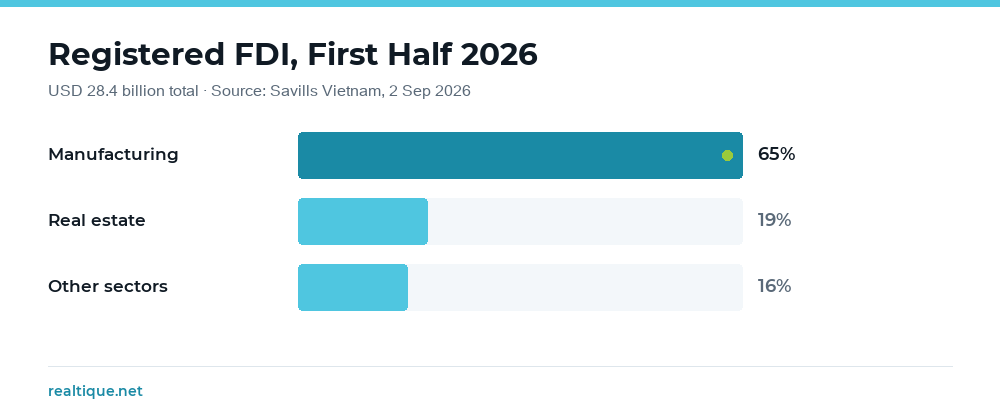
Graphic: Realtique · Data: Savills Vietnam, first half 2026
3 September 2026 Update: The Eight-Month Numbers — and Why “Korea Overtakes Singapore” Does Not Contradict “Singapore Leads”
On 3 September 2026 the Statistics Office (Ministry of Finance) released the eight-month figures — the most recent set at the time of this update. These are the numbers that now supersede the seven-month set cited in the sections above.
- Total registered FDI: USD 40.63 billion, up 55.4% year-on-year. Within that, newly registered capital was USD 21.72 billion across 2,771 projects (up 96.8%), adjusted capital USD 12.21 billion (up 14.7%), and capital contributions and share purchases USD 6.7 billion (up 50.1%).
- Disbursed FDI: USD 17.25 billion, up 12% — the strongest eight-month disbursement in five years.
- Real estate holds second place on both tables: USD 5.32 billion registered (15.7% of newly registered and adjusted capital) and USD 1.29 billion actually disbursed (7.5% of total disbursement). Manufacturing and processing leads both; on disbursed capital it takes 82.6%.
So what about the “South Korea overtakes Singapore” point in the section above? The eight-month table puts Singapore first at USD 7.62 billion, or 35.1% of newly registered capital, with South Korea second at USD 5.67 billion (26.1%), Hong Kong SAR at USD 2.96 billion (13.6%), mainland China at USD 1.93 billion (8.9%) and Japan at USD 1.42 billion (6.5%).
The two rankings do not contradict each other — they measure different things over different periods. The Savills figure refers to total registered capital in the first half of 2026, which includes adjusted capital and share purchases; the table here counts newly registered capital over eight months only. Our reading: Singapore dominates capital that establishes brand-new projects, while “total capital” league tables flip more easily because adjustments and M&A swing sharply with individual deals. When you compare two FDI rankings, the first question is always which components each one adds up.
One smaller observation, to be read with care: setting the seven-month set against the eight-month set, disbursed real estate capital moved up faster than newly registered real estate capital during August. That is a subtraction between two cumulative figures performed by Realtique, and the seven-month number is itself rounded — so treat it as a single month’s signal, not an established trend. What is worth watching in the next releases is whether the gap between registered and disbursed capital in real estate genuinely narrows.
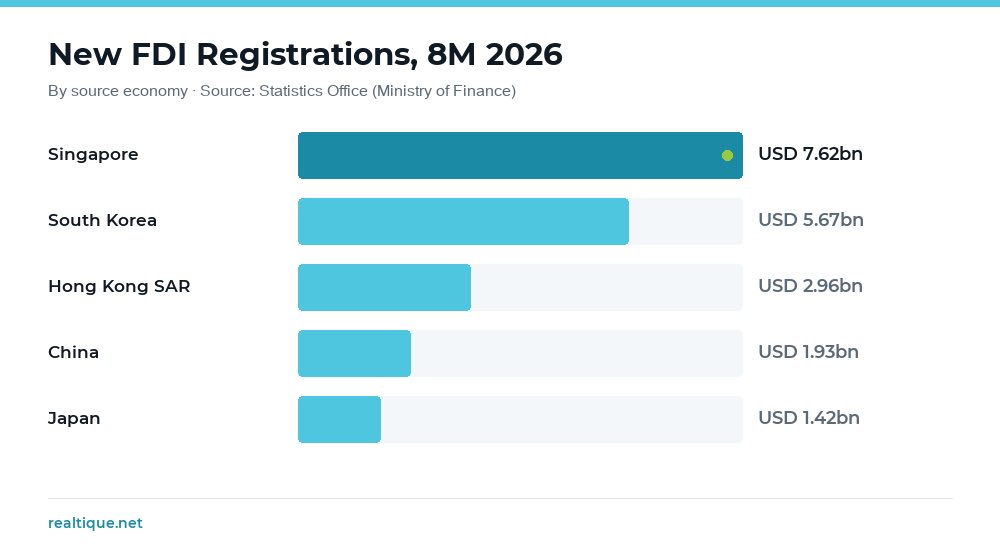
Graphic: Realtique · Data: Statistics Office (Ministry of Finance), first eight months of 2026
Why Global Capital Is Choosing Vietnam Real Estate
Record inflows do not happen by accident. Several structural forces are drawing foreign capital into the property market:
- Manufacturing pulls housing with it. The bulk of FDI still goes into factories and industrial parks. Those plants need workers, and workers need homes, schools and services — which is why residential and township projects near industrial corridors are in demand.
- Infrastructure is being built at scale. Metro lines, ring roads, expressways and airports are opening up new districts and satellite cities, lifting land value along each corridor.
- Legal reform improved confidence. The 2024 Land, Housing and Real Estate Business laws clarified rules for ownership, project eligibility and overseas buyers — making Vietnam easier for institutions to underwrite.
- Urbanisation and a young population. A large, young, urbanising middle class underpins long-run housing demand that global investors want exposure to.
What It Means For An Individual Buyer
You are not a sovereign fund — but the same signal that draws institutions is useful to you:
- Validation of the market. When disciplined foreign capital commits at record levels, it lowers the risk that you are buying into a market the world is walking away from. You are positioning alongside it, not against it.
- Follow the corridors. Capital concentrates where infrastructure and industry are heading — the east of Ho Chi Minh City, the satellite belt toward Long An and Binh Duong, and coastal growth hubs. Buying in these paths of growth is how individuals ride the same wave.
- Quality and legal status matter more than ever. Institutions buy well-located, legally clean assets from credible developers. Applying the same filter protects your own capital.
- Think in years, not months. FDI is patient money. The buyers who do best treat property the same way — a multi-year hold in a growth location, not a quick flip.
For a fuller read on the market backdrop, see our Vietnam real estate market 2026 outlook, and if you are financing a purchase, our note on high loan interest rates in 2026.
Masteri Park Place – The Global City
A flagship Masterise address in The Global City — an international-standard township in the east of Ho Chi Minh City, exactly the kind of location global capital targets.
Explore →Palm River – Palm City
The final riverfront phase of an established township in the eastern growth corridor — a proven, well-connected location for long-term value.
Explore →Beachtro Tower – Blanca City
The last long-term-ownership tower at Sun Group’s Blanca City, riding Vietnam’s coastal tourism and infrastructure boom.
Explore →Eco Retreat Long An
A 220-hectare Ecopark township on the Long An satellite belt — the residential growth story that follows industrial and infrastructure investment.
Explore →How To Position Yourself
- Choose the corridor first, the unit second. Start with where infrastructure and capital are heading, then pick the project and unit within it.
- Insist on credible developers and clean legal status. The same discipline institutions apply protects you from projects that stall.
- Match the horizon to the thesis. Growth-corridor plays reward patience; plan a multi-year hold.
- Mind your financing. With bank rates still elevated, favour projects whose payment policy protects your cash flow while you hold.
- Get local, independent advice. Foreign-ownership quotas, eligibility and paperwork differ by project — confirm the specifics before you commit.
Frequently Asked Questions
How much FDI went into Vietnamese real estate in 2026?
In the first eight months of 2026, real estate attracted about USD 5.32 billion of registered FDI — 15.7% of newly registered and adjusted capital and the second-largest sector.
Is real estate the top sector for FDI?
No — it ranks second, after manufacturing and processing. But it is clearly a core destination for foreign capital.
Does strong FDI mean I should buy now?
Record FDI is a confidence signal, not a personal buy order. It supports the case for a well-located, long-term purchase, but your decision should still rest on your budget, financing and goals.
Can foreigners buy the projects attracting this capital?
It depends on the project and the foreign-ownership quota. Some developments are open to foreign buyers; others use long-term lease structures. A Realtique advisor can confirm what applies.
Where is the capital concentrated?
Around manufacturing and infrastructure — the east of Ho Chi Minh City, the satellite belt toward Long An and Binh Duong, and coastal growth hubs.
This article is general market commentary, not personalised investment advice. Figures are drawn from official statistics as reported; confirm current data and project specifics before making a decision, and consult a qualified advisor.
Invest where the capital is going
Leave your details and a Realtique advisor will show you the projects and growth corridors drawing serious foreign capital — a callback within two business hours, no obligation.
Hotline: +84 866 810 689

Grace Le
Grace Le is a Branch Manager at Realtique with deep experience advising bilingual and overseas buyers on where foreign capital and long-term value meet in Vietnam.