

Vietnam Macro Week in Review (Oct 13–19, 2026): Central Bank Orders Rate Cuts, Vietnam Sends Final US Trade Deal Text
Short answer: two stories from the week of 13–19 October 2026 touch home buyers and landlords in Vietnam directly. First, the State Bank of Vietnam’s Official Letter 9608/NHNN-CSTT of 18 October tells banks to cut posted deposit rates on terms of six months or more by at least 0.5 percentage points a year and to lower lending rates by 1.5–2 points for production, business and priority sectors. Second, Vietnam has sent the final text of its reciprocal trade agreement to Washington (14 October), although nothing has been signed. Abroad, US inflation rose to 3.7% in September, China’s GDP grew 4.5% in the third quarter and Singapore left monetary policy unchanged; at home, the VN-Index ended the week at 1,705.91, about 110 points below where it stood when the FTSE Russell upgrade took effect.
Realtique’s reading of the central bank letter and the bank announcements published by midday on 19 October: none of them puts home loans in the group getting the 1.5–2 point cut. The one certain effect for people holding cash is lower deposit rates. Below are seven stories, each with sourced and dated numbers, what it means for buyers and landlords in Vietnam, and how to answer when a client asks. This is the first issue of Vietnam Macro Week in Review, published every Monday morning.
Vietnam Macro Week in Review — Oct 13–19, 2026
Table of Contents
The State Bank Orders Deposit Rates Down at Least 0.5 Points — Home Loans Are Not on the Rate-Cut List
Official Letter 9608/NHNN-CSTT of 18 October 2026 asks banks to cut posted deposit rates on terms of six months or longer by at least 0.5 percentage points a year, to stop competing on deposit rates, and to concentrate lending-rate cuts of 1.5–2 points on production, business and priority sectors. Banks that do not comply may have their remaining 2026 credit quota reviewed, receive a lower 2027 quota, or be required to hold safety ratios above the legal minimum.
On the morning of 19 October, Governor Pham Duc An met the leaders of 46 commercial banks: cuts are not to be applied across the board, they should target the right borrowers, and they should be considered for both existing and new loans. As of the end of the previous week, system credit was up 11.44% and deposits 11.22%. Agribank, Vietcombank, BIDV, ACB and several other banks announced lending-rate packages, mostly for business borrowers — the bank-by-bank detail is in the “19 October 2026 Update” of our Vietnam loan interest rates 2026 guide.
What it means for buyers and landlords in Vietnam: Savers will see lower six- to twelve-month deposit rates over the coming weeks, so the “keep it in the bank or buy a rental flat” question returns and the gap between deposit rates and rental yields narrows. Anyone with or about to take a mortgage should not assume a 1.5–2 point cut: Letter 9608 and the packages announced up to 19 October do not mention home loans, and at the 19 October meeting the central bank repeated that it will keep real estate credit under tight control, opening room only for certain segments in line with government policy.
💬 When a client asks
Client asks: “The news says banks cut rates by 2%. Is my mortgage cheaper now?”
Suggested answer: Not necessarily. The 1.5–2 point cuts target business and priority-sector lending; as of 19 October no bank had announced a matching package for home loans. Ask your bank for the floating rate that applies after the promotional period in your own contract and budget on that figure — treat any cut as a bonus.
Sources: Vietnam Government News 18/10 · CafeF 19/10 (credit quotas) · Znews 19/10 (46 banks) · CafeF 19/10 (meeting outcome) · CafeF 19/10 (bank rate cuts)
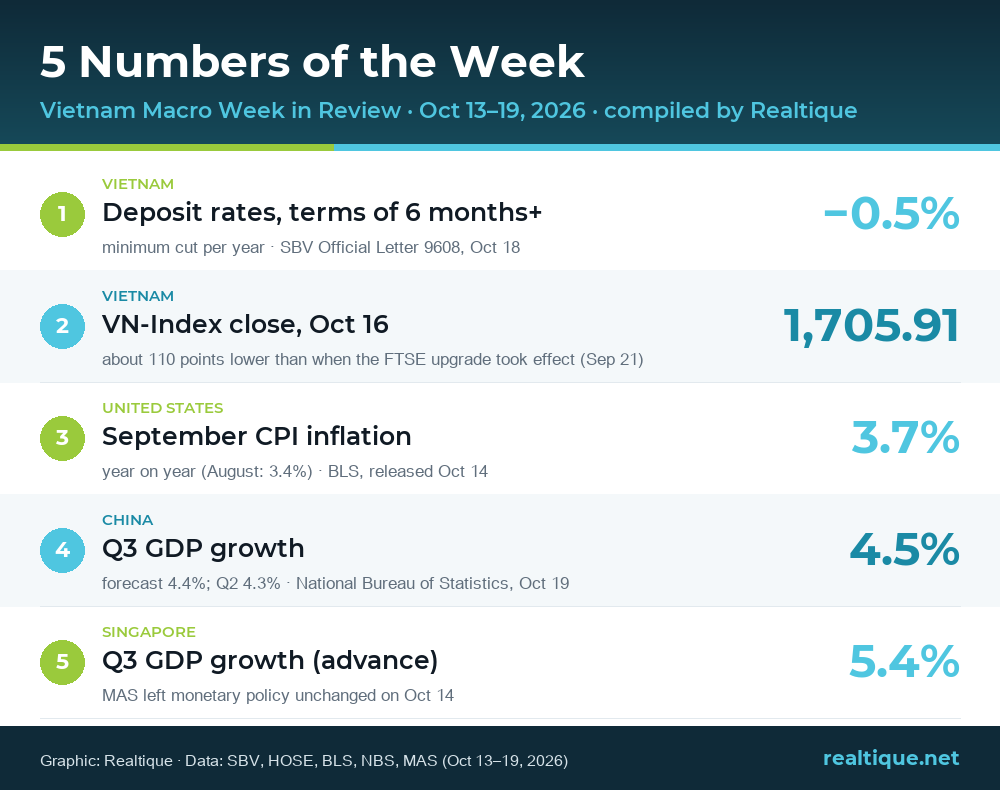
Graphic: Realtique · Data: State Bank of Vietnam (Letter 9608, Oct 18), HOSE (Oct 16), BLS (Oct 14), China NBS (Oct 19), MAS (Oct 14)
The VN-Index One Month After the Upgrade: 1,705.91 Points and Nearly USD 1 Billion in Foreign Selling
On 16 October the VN-Index rose 0.45% to 1,705.91, ending a seven-session losing streak, yet it still lost 29.18 points (−1.68%) over the week of 12–16 October. Between 21 September 2026, when FTSE Russell’s upgrade of Vietnam took effect, and 18 October, foreign investors were net sellers of about VND 24.8 trillion (nearly USD 1 billion) in 19 of 20 sessions while the index shed almost 110 points (about 6%); year to date, foreign net selling exceeds VND 116 trillion. Passive money tracking FTSE indices is being phased in through the end of 2027; Dragon Capital chairman Dominic Scriven attributes the selling mainly to global capital moving into US markets.
What it means for buyers and landlords in Vietnam: An index upgrade plays out over years, not sessions — the first month shows it does not pull foreign money in on its own. For housing, keep the two markets apart: foreign money on the stock exchange is not the same as foreigners buying apartments (capped at 30% of units per building, held for up to 50 years), so foreign stock selling says nothing about foreigners leaving property. What the two markets share is tight domestic liquidity under high interest rates — the backdrop covered in our Ho Chi Minh City property market Q3 2026 report.
💬 When a client asks
Client asks: “Stocks fell after the upgrade. Should I move money from shares into property?”
Suggested answer: Realtique does not recommend buying or selling shares. The two serve different goals: shares are liquid but swing with capital flows; a rental apartment is less liquid but pays monthly rent. Decide by your holding period and cash-flow needs, not by one month of market moves.
Sources: Bao Dau Tu 16/10 · Vietstock 16/10 · Markettimes 18/10 · Investing.com Vietnam 19/10

Illustration: Negative Space · Wikimedia Commons · CC0 1.0 (Realtique image kit)
Vietnam–US Reciprocal Trade Agreement: Final Text Sent to Washington, Not Yet Signed
The framework was announced on 26 October 2025 on the sidelines of the ASEAN Summit, alongside Vietnam Airlines’ order for 50 Boeing aircraft worth more than USD 8 billion. On 7 October 2026 Vietnam’s Ministry of Industry and Trade said the two sides had “basically completed” almost all of the negotiating content after seven formal rounds since April 2025, with only technical points left. On 14 October, at the Vietnam–US Business Summit in Hanoi, Standing Deputy Prime Minister Pham Gia Tuc said Vietnam had sent the final text to the US side and the deal could be signed soon if both sides agree. Washington sounded more cautious: a Commerce Department official said only that he was “hopeful” the two countries would keep working together, and stressed the size of the US trade deficit with Vietnam. US Bureau of Economic Analysis (BEA) figures put that deficit at USD 54.2 billion in Q1 2026 and USD 61.2 billion in Q2 2026.
What it means for buyers and landlords in Vietnam: A signed deal would give exporters and foreign direct investors more predictable tariffs. Property feels it through demand for factories, offices and rental apartments for expatriate staff in east Ho Chi Minh City, former Binh Duong and Dong Nai — an effect that arrives over several quarters with FDI, not the day after a signing ceremony. For the FDI picture, see FDI in Vietnam real estate 2026.
💬 When a client asks
Client asks: “Once the deal is signed, will homes near industrial parks jump in price?”
Suggested answer: It is not signed yet: Vietnam has sent the final text and Washington has not confirmed a date. If it is signed, the main benefit is FDI firms expanding with more confidence, which lifts rental demand from expatriate staff over several quarters. Buying purely on the expectation of a signing ceremony is not a plan.
Sources: White House 26/10/2025 · Viet Nam News 26/10/2025 · VietnamPlus 07/10 · VTV 08/10 · Reuters 14/10 · The Leader 15/10 · BEA (US trade data)
United States: September CPI at 3.7%, 10-Year Yield Near 5.1% — Markets Lean Toward a Fed Hold on Oct 27–28
The Bureau of Labor Statistics reported on 14 October that September CPI rose 0.6% on the month and 3.7% on the year (August: 3.4%), with core CPI at 2.6%. Right after the release, CME FedWatch briefly priced a 41.5% chance of a hike at the 27–28 October meeting, before odds fell back as Fed officials signalled they could wait; by 19 October markets leaned roughly 84–87% toward holding the 3.75–4.00% range set at the 16 September hike. The US 10-year Treasury yield held around 5.08–5.09% on 15–16 October.
What it means for buyers and landlords in Vietnam: High dollar rates keep the US dollar strong and put pressure on the dong; this week Vietnam moved the other way by cutting domestic rates, so the VND–USD rate gap narrows and the exchange rate is the variable to watch over the next few months. Mortgage rates in Vietnam follow domestic funding costs more than the Fed. For overseas Vietnamese and foreign buyers sending money in, the exchange rate changes how many dong arrive — but it should not be the main reason to buy.
💬 When a client asks
Client asks: “The Fed might hike again. Should I wait before buying?”
Suggested answer: Nobody times the bottom of a rate cycle. Cash buyers often negotiate best on the resale market while rates are high; if you need a loan, budget repayments at today’s floating rate and only proceed if the cash flow works at that level. The 27–28 October Fed meeting is the next checkpoint we will cover.
Sources: BLS 14/10 · Yahoo Finance 14/10 · Yahoo Finance 15/10 (FedWatch) · Tradingpedia 19/10 · CNBC 15/10 · Trading Economics 16/10
China: Q3 GDP Grows 4.5%, New-Home Prices Rise in Only 17 of 70 Cities
China’s National Bureau of Statistics reported on 19 October that third-quarter GDP grew 4.5% year on year, above the 4.4% analysts expected and the 4.3% of Q2; growth for the first nine months was 4.6%, inside the 4.5–5% target. September new-home prices rose month on month in 17 of 70 cities. Property development investment fell 19.9% year on year in January–August.
What it means for buyers and landlords in Vietnam: China’s growth is export-led while its housing market stays weak. Two things to watch for Vietnam: manufacturers adding capacity outside China, Vietnam included, keeps supporting demand for industrial land and expatriate housing; and private investors from mainland China, Taiwan and Hong Kong are still looking for assets abroad, but more cautiously. Vietnam’s rules for foreign home buyers are unchanged by this news — see the 30% foreign ownership quota explained.
💬 When a client asks
Client asks: “Chinese home prices have fallen for years. Will Vietnam follow?”
Suggested answer: The two markets are built differently: China has a large oversupply after years of fast construction, while new apartment supply in Ho Chi Minh City has been limited in recent years and primary prices remain high. Vietnam’s risks sit in each project’s legal status and in borrowers’ cash flow — check those rather than extrapolating from China.
Sources: Xinhua 19/10 (GDP) · Seoul Economic Daily 19/10 · Xinhua 19/10 (home prices) · Eastern Herald 18/10 · SteelOrbis (citing NBS) · Mysteel (citing NBS)
Singapore: MAS Holds Policy Steady, Q3 GDP Up 5.4%
On 14 October the Monetary Authority of Singapore kept the slope, width and centre of the S$NEER policy band unchanged after two slight tightenings earlier this year, and forecast 2026 core inflation at 1.5–2.0%. Advance estimates put third-quarter GDP growth at 5.4% year on year. Earlier, URA’s flash estimate on 1 October showed private home prices up 1.4% quarter on quarter in Q3 — landed homes +2.8%, non-landed +0.9%, and the Core Central Region −0.1%; full figures are due on 23 October.
What it means for buyers and landlords in Vietnam: Singapore is one of the largest sources of FDI into Vietnam and the home market of a group of Realtique’s foreign clients. 5.4% growth and a currency kept on a strengthening path give outbound investors a supportive backdrop. By comparison, prime central Singapore apartments were flat in Q3, so the sensible question for a Singapore buyer looking at Ho Chi Minh City is rental yield and ownership rights, not price appreciation.
💬 When a client asks
Client asks: “If I’m Singaporean and buy an apartment in Ho Chi Minh City, how long can I own it?”
Suggested answer: Foreign individuals can own for up to 50 years, renewable, only in projects on the approved list and within the 30%-of-units-per-building cap. Realtique checks the list and the remaining quota in the exact building before a client pays a deposit.
Sources: MAS 14/10 · The Star 14/10 · Tradingpedia 14/10 · URA 01/10 · EdgeProp 01/10
Tesla's Roadster Hovers Over Five Cars, Shares Still Fall 2.13%: Markets Pay for Cash Flow, Not Demos
On the evening of 15 October (US time) Tesla showed its new Roadster at SpaceX’s test site in McGregor, Texas: using a compressed-air thrust system, the car lifted off and cleared five cars parked side by side. On 16 October Tesla shares closed down 2.13% at USD 354.72. Production is planned for 2028, and Elon Musk himself said he is not sure the car moves the needle much on revenue. Tesla reports third-quarter results on 21 October after the close.
What it means for buyers and landlords in Vietnam: A spectacular demo that is at least two years from revenue did not hold the share price; investors turned to the earnings report instead. The same logic applies to property: an apartment’s lasting value lies in real cash flow — rent actually collected, handover on schedule, legal paperwork done — not in a launch event or a rendering.
💬 When a client asks
Client asks: “Tesla flew a car and the stock still fell — what does that have to do with buying a home?”
Suggested answer: Markets pay for what produces cash flow, not for the show. When you look at a project, ask three questions: when is handover, how far along is the legal process, and what does a comparable unit actually rent for in that area — that is what creates long-term value.
Sources: Motley Fool 16/10 · Seoul Economic Daily 18/10 · 24/7 Wall St. 16/10 · Tesla (Q3 results date)
Frequently Asked Questions
What is Vietnam Macro Week in Review and when is it published?
It is Realtique’s weekly round-up of the 5–7 macro stories that matter to home buyers and landlords in Vietnam — interest rates, stocks, trade, and the US, Chinese and Singapore economies — published every Monday morning in five languages. Every number is backed by at least two dated sources.
Does Official Letter 9608/NHNN-CSTT lower mortgage rates in Vietnam?
The letter asks for lending-rate cuts of 1.5–2 points for production, business and priority sectors and does not mention home loans. Up to 19 October, the announced packages were mainly for business borrowers. Existing mortgage holders should ask their bank directly about their own loan.
Deposit rates are falling — should I move savings into a rental apartment?
That is a personal financial decision and Realtique does not give investment advice. A fair comparison sets the post-cut deposit rate against the net rental yield of a specific unit (after management fees, rental tax and vacancy), and accounts for an apartment being far less liquid than a deposit.
How does this week’s news affect foreigners and overseas Vietnamese?
Mainly through the exchange rate: high US rates keep the dollar strong while Vietnam cuts rates, which changes how many dong arrive when you transfer money. Ownership rules are unchanged: foreigners may own up to 30% of the units in a building for up to 50 years; overseas Vietnamese who keep Vietnamese citizenship buy as domestic citizens.
What dates should I watch next week?
Tesla’s Q3 results on 21 October, Singapore’s full Q3 housing data on 23 October, the Fed meeting on 27–28 October, and the 12-month deposit rates of the big Vietnamese banks after Letter 9608. We will cover them in the next issue.
⚠️ Note: This round-up draws on public reports from 13–19 October 2026; every number is linked to a dated source, and market data (yields, FedWatch odds, stock indices) change daily. The “What it means” and “When a client asks” sections are Realtique’s view and are not investment or financial advice, nor a recommendation to buy or sell shares; Realtique does not forecast prices. The Vietnam–US trade agreement has not been signed.
High Loan Interest Rates in Vietnam (2026): What Home Buyers Should Do (updated Oct 19)
Read more →FDI in Vietnam Real Estate 2026: What It Means for Buyers
Read more →Ho Chi Minh City Property Market Q3 2026
Read more →Ho Chi Minh City Urban Planning to 2030: What Foreign Investors Should Know
Read more →Weighing a bank deposit against a rental apartment?
Tell Realtique the area and budget you have in mind. We put together actual rents, management fees, rental tax and vacancy for specific units so you can compare them with post-cut deposit rates yourself — without relying on price growth.
📞 Hotline: +84 866 810 689

KC Pham
KC Pham advises foreign buyers and overseas Vietnamese on Ho Chi Minh City apartments — setting real rental income against deposit rates and checking legal status and foreign quota before a client commits.