

Vietnam’s 30% Foreign Ownership Quota Explained (2026)
Vietnam welcomes foreign property buyers — but not without limit. The single most important rule shaping what you can actually buy is the foreign-ownership quota. Understanding how it works can be the difference between securing your unit and being turned away at the last minute. This guide explains Vietnam’s 30% foreign-ownership quota for 2026, part of our property buying process series.
Table of Contents
What Is the 30% Foreign-Ownership Quota?
By law, foreigners may collectively own no more than 30% of the total apartment units in any single condominium building. For landed property (villas, townhouses) within a project, the cap is even tighter — up to 10% of the homes in that project (with an absolute ceiling per administrative ward). The rule exists to keep the majority of Vietnamese housing in the hands of Vietnamese citizens.
How It Works, Building by Building
The quota is applied per building, not per buyer. So a single tower might have, say, 300 units — meaning up to 90 can be foreign-owned. Once those 90 are sold to foreigners, the tower is closed to further foreign buyers, even if units remain for sale to Vietnamese citizens. Different towers in the same development each have their own 30% allocation.
Landed Homes: The 10% Rule
If you are eyeing a villa or townhouse, the ceiling is much lower — around 10% of the landed homes in a licensed project, capped further at the ward level. In practice this makes eligible landed homes scarce for foreigners, which is why the vast majority buy apartments. If land matters to you, Vietnamese-origin buyers have wider options — see our Viet Kieu guide.
Why Popular Projects Fill Their Quota Fast
In sought-after developments — riverfront towers in Thu Thiem, branded residences, projects near the metro — foreign demand is high and the 30% allocation can be reserved quickly, sometimes soon after launch. That means the specific unit you want may already be counted against the foreign cap by the time you enquire. Early action, and a well-connected agent, are decisive.
How to Check Quota Availability
You cannot rely on a listing alone — you must verify, for the exact unit, whether the building still has foreign quota remaining. This is confirmed with the developer or through an agent who tracks allocations. Always confirm quota status before paying any deposit; signing for a unit that cannot be transferred to a foreigner is a costly, avoidable mistake.
September 2026 Update: The Register Behind the Quota — and Three Developers Fined for Not Filing It
There is a piece of the quota machinery most buyers never hear about, and 2026 has now put it on the front page three times.
Under Vietnamese law, a seller must notify the provincial housing authority — the Department of Construction — within three working days of signing a sale and purchase agreement with a foreign buyer, by both email and formal letter, giving the buyer’s name and the address of the unit sold. The department publishes this on its portal. That filing is not paperwork for paperwork’s sake: it is the only ledger that records how much of a building’s 30% foreign allocation has actually been consumed.
In 2026, the Ho Chi Minh City People’s Committee has penalised three developers for skipping exactly that step:
| Date | Developer / Project | Units | Fine |
|---|---|---|---|
| 19 May 2026 | CapitaLand – Vista Co. Ltd · The Vista An Phu | 87 | VND 280 million |
| 12 Aug 2026 | City Garden JSC · City Garden | 148 | VND 280 million |
| 7 Sep 2026 | Son Kim Land · Gateway Thao Dien | 136 | not disclosed |
Legal basis in the disclosed cases: Decree 16/2022/ND-CP, Article 64. The Son Kim penalty was issued as Decision No. 5252/QD-XPHC. Across the three projects that is 371 apartments — a total calculated by Realtique, not an officially published figure.
What this does and does not mean for you
First, the reassuring part. In all three cases the authorities found a reporting failure only — not a breach of the 30% cap, and not a sale to an ineligible buyer. Son Kim Land publicly stated that the matter concerned reporting and administrative procedure, and that customers’ lawful ownership rights are unaffected. So there is no basis to conclude those 371 owners are at risk.
The exposure sits somewhere less obvious: with the next buyer.
- An incomplete ledger produces an optimistic number. When you ask how many foreign slots a tower has left, the answer traces back to that register. If sales were never filed, the remaining allocation can look larger than it truly is.
- The person who signs past the cap is the one with the problem. The 30% ceiling applies per building, not per project. Earlier buyers keep their position; the contract signed beyond the limit is the one that struggles at certificate stage.
- Brand is not a control. All three are established developers with well-regarded luxury projects. That did not prevent the lapse.
Practical step: ask the developer to warrant the three-working-day filing as a clause in your SPA, and request a copy of the letter actually sent to the Department of Construction. It costs nothing to ask before you deposit, and it converts a verbal assurance into a document. See also our 2026 guide to whether foreigners can buy property in Vietnam.
Policy context: the 30% figure is being re-examined
On 9 September 2026, Prime Minister Le Minh Hung chaired a meeting on three linked bills — the amended Land Law, Housing Law and Real Estate Business Law — instructing ministries to submit final drafts to the Government before 11 September 2026, with National Assembly consideration expected at the session late in 2026. Earlier, on 19 August 2026, Minister of Home Affairs Nguyen Tien Hai told a group discussion that allowing foreigners up to 30% of a building is “too large” and asked for the provisions to be redrafted more tightly.
Please read that as direction of travel, not as law. These are drafting-stage opinions; until the National Assembly passes the amendments, the 30%-per-building and 250-landed-homes-per-ward ceilings stand as they are. Update 17 September 2026: the 13 September draft of the amended Housing Law now drops the landed-home category altogether and keeps only apartments at 30% per building, with a transition clause for homes already owned or contracted — see our September update. But if you are weighing a unit inside a foreign allocation, it is a reason not to let the decision drift — and a reason to understand the long-term lease (LTLA) route as a fallback. The Vietnamese-language companion to this article is here.
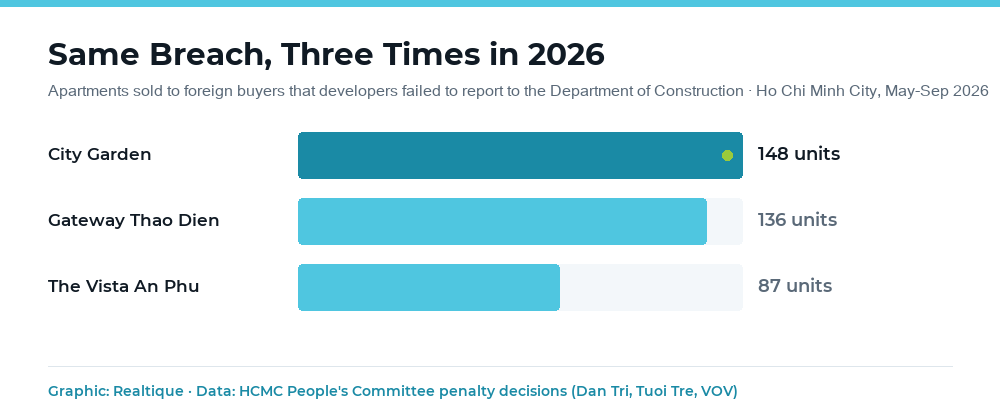
Graphic: Realtique · Data: Ho Chi Minh City People’s Committee penalty decisions, compiled from Dan Tri, Tuoi Tre and VOV, 5–10 September 2026

What Happens If the Quota Is Full?
If a building has reached its 30% foreign cap, foreigners can no longer buy there — you would need to look at another tower or project with remaining allocation. In some cases a unit becomes available again when a foreign owner sells to a Vietnamese buyer (freeing quota) or vice versa, but this is unpredictable. The practical answer is to widen your search to projects with confirmed availability. See what foreigners can buy for the full picture.
Quota Plus the 50-Year Leasehold
Remember that the quota and the ownership term are two separate rules. Even within the 30% allocation, foreign buyers own on a renewable 50-year leasehold (versus freehold for citizens). Both should be factored into your investment horizon and any inheritance planning.
Tips for Foreign Buyers
- Act early on desirable launches — foreign allocation goes first.
- Verify the exact unit’s quota in writing before any deposit.
- Keep alternatives ready in case your first choice is capped.
- Work with an agent who tracks allocations across projects.
Where Viet Kieu can own — Ho Chi Minh City to the coast
The 30% quota fills fastest in the projects now selling. Reserve early:
Your status sets the ownership type: a Viet Kieu with Vietnamese residency or citizenship owns freehold, like a local (any project below). A Viet Kieu who is a foreign national buys within the 30% foreign quota or via long-term lease (the first three groups).
District 1 — Ho Chi Minh City
- One Central Saigon — Ritz-Carlton branded, foreign quota available
District 2 — East of Ho Chi Minh City
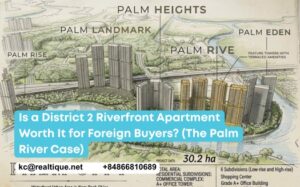
- BOOKINGPalm River — riverside, booking stage since 09/2026 (foreign quota not yet confirmed)
- SELLINGThe Global City — foreign quota available
- SELLINGGladia Heights by Keppel Land — foreign quota available
- RESALEDiamond Island — handed over, buy from current owners
- RESALEThao Dien Green — foreign-quota unit, resale
Coastal (foreign-eligible)
- Nobu Residences (Da Nang) — long-term lease resort
- Mandarin Oriental (Da Nang) — freehold for Vietnamese residents; long-term lease for non-residents
✓ Also yours freehold — if you hold Vietnamese residency or citizenship
These sell to domestic buyers (no foreign quota), but a Viet Kieu with residency owns them freehold, like a local:
- SELLINGBeachtro Tower — Blanca City, Vung Tau (final sea-view tower)
- SELLINGRung Phuong — Eco Retreat, Long An (low-rise, education hub)
- Haus Coastal — Quang Ngai (94ha coastal township)
Not sure which fits your status? Confirm your eligibility and live availability with a Realtique advisor — contact us or email [email protected].
Frequently Asked Questions
1. What is Vietnam’s foreign-ownership quota?
Up to 30% of units in an apartment building, and ~10% of landed homes in a project, may be foreign-owned.
2. Is the quota per building or per project?
Per building for apartments — each tower has its own 30% allocation.
3. How do I know if a unit is still within quota?
Confirm with the developer or your agent before depositing. See can foreigners buy property in Vietnam.
4. Can the quota change?
The 30%/10% framework has been stable; always verify current rules for your specific project.
5. Are overseas Vietnamese counted in the foreign quota?
No — Viet Kieu who still hold Vietnamese nationality are generally treated as citizens and are not counted against the 30% foreign cap, so they can access units and buildings that are closed to foreigners.
6. Does the quota apply to renting, or only buying?
Only to ownership. Anyone can rent; the 30% cap governs how many units foreigners can own in a building.
7. What happens if the developer never reports my purchase to the Department of Construction?
The filing duty sits with the seller, not with you, and in all three Ho Chi Minh City penalty cases of 2026 (The Vista An Phu, 87 units; City Garden, 148 units; Gateway Thao Dien, 136 units) the authorities found only a reporting breach — no cap was exceeded and no ineligible buyer was involved, so existing owners were not found to be at risk. The practical danger falls on later buyers: if sales go unfiled, the published record of remaining foreign slots in that building can overstate what is actually left, and a contract signed beyond the 30% ceiling is the one that runs into trouble at certificate stage. Ask for the filing to be warranted in your SPA and request a copy of the letter sent.
Does the Quota Apply to Overseas Vietnamese (Viet Kieu)?
One more nuance many investors miss: the 30% quota applies to foreigners — not to overseas Vietnamese (Viet Kieu) who still hold Vietnamese nationality. Those buyers are generally treated like domestic citizens and are not counted against the foreign cap, giving them access to units and projects closed to foreigners. If you are of Vietnamese origin, this distinction can dramatically widen your options — see our Viet Kieu property guide for how nationality status changes what you can buy.
The Quota and Off-the-Plan Launches
At a new project launch, developers allocate a foreign tranche within the 30% cap and often sell it in early phases. Buying off-the-plan (before completion) is usually where the best foreign availability and pricing sit — but it also means the allocation disappears fastest. If a launch is on your radar, register interest early and have your funding and paperwork ready, because by handover the foreign quota in the best towers is typically long gone.
A Worked Example: The Quota in Action
Imagine a riverfront tower with 400 apartments. Under the 30% rule, up to 120 units can be foreign-owned. At launch, international demand is strong and those 120 are reserved within the first few sales phases. A buyer who enquires three months later finds the tower is closed to foreigners — even though dozens of units are still openly for sale to Vietnamese citizens. Their options: choose a different tower in the same development (with its own fresh 120-unit allocation), or a different project entirely. This is exactly why timing and quota-tracking decide whether you get the unit you want.
Buying From Another Foreigner (Secondary Market)
Foreigners can also buy an eligible apartment resold by another foreign owner — the unit is already counted within the building’s 30% allocation, so the transfer keeps it in foreign hands. This secondary route can open access to buildings that are otherwise ‘full’ on the primary market. The trade-off is that resale inventory is limited and pricing is set by individual sellers. A good agent monitors both primary allocations and foreign-owned resale listings so you see every legitimate way in.
Quick Recap: Foreign Limits by Property Type
| Property type | Foreign limit | Notes |
|---|---|---|
| Apartment / condo | Up to 30% of units per building | Most common route for foreigners |
| Landed home (villa/townhouse) in a project | ~10% of homes, capped per ward | Scarce — few eligible for foreigners |
| Raw land / land-use rights | Not permitted | Reserved for Vietnamese citizens |
| Resale outside eligible projects | Not permitted | Foreign ownership tied to qualifying projects |
Bottom line: for foreign investors, apartments in eligible projects are the practical path — always confirming the specific building still has room within its 30% cap before you commit.
How Realtique Helps
Realtique tracks foreign-quota availability across Ho Chi Minh City’s projects, so we can tell you upfront whether the unit you want can actually be foreign-owned — before you spend a dong. We then guide the full purchase to your pink book. One English-speaking team, complete transparency.
Need to Check Foreign Quota? Ask Realtique
Realtique guides international investors end to end — eligibility, quota, due diligence, legal transfer and the pink book.
Start today. Leave your name and email — a Realtique specialist will reach out. Or email [email protected].

KC and the Realtique team guide international investors through buying property in Vietnam — safely and in full compliance, from eligibility to the pink book.