

Vietnam Macro Week in Review (Oct 19–25, 2026): Big Four Cut Deposit Rates to 5.4%, US 10-Year Slips Below 5% Before the Fed, Gold Loses 4%
Short answer: in the week of 19–25 October 2026, the story that touched savers and home buyers in Vietnam most directly was that all four state-owned banks cut their 12-month counter deposit rate to 5.4% a year (Vietcombank and Agribank from 20 October; BIDV and VietinBank from 21 October), and by 23 October 22 banks had announced deposit-rate cuts following the State Bank’s instruction. Lending rates followed at Agribank (up to 2.5 points) and Techcombank (up to 2 points), but no bank has yet named home loans. Abroad, the US 10-year Treasury yield ended the week at 5.00% — below 5% for the first time in four weeks — ahead of the 27–28 October Fed meeting, which markets price at roughly 90% for a hold; gold lost 4% on the week to USD 3,994 an ounce; the Bank of Korea held at 3.00% while Seoul apartment prices rose for an 89th straight week; Singapore’s URA confirmed a 1.4% Q3 price rise; Tesla reported Q3 profit down 43%.
Realtique’s reading of the banks’ rate tables and the State Bank data released on the evening of 22 October: the average 6–12-month deposit rate in September was still 8.1% a year and the average lending rate 10.9% — so this week’s half-point cut is a first step, not a return to last year’s levels. Below are seven stories, each with sourced and dated numbers, what it means for buyers and landlords in Vietnam, and how to answer when a client asks. This is the second issue of Vietnam Macro Week in Review (issue 1: Oct 13–19, 2026), published every Monday morning.
Vietnam Macro Week in Review — Oct 19–25, 2026
Table of Contents
The Big Four Cut 12-Month Deposit Rates to 5.4%, 22 Banks Lower Deposit Rates — Home Loans Still Not Named
Following Official Letter 9608/NHNN-CSTT (18 October), which asked banks to cut deposit rates on terms of six months or more by at least 0.5 points, Vietcombank and Agribank lowered their 12-month counter rate from 5.9% to 5.4% from 20 October; BIDV and VietinBank followed from 21 October (12–18-month terms from 5.9% to 5.4%). By 23 October, 22 banks had announced deposit-rate cuts; PGBank and Saigonbank joined that day (−0.5 pt). Techcombank trimmed 0.1–0.5 points from 22 October, leaving its 12-month online rate at 6.65%; VPBank (7.1%) and Sacombank (7%) remain among the highest at 12 months.
On lending: Agribank cut lending rates by up to 2.5 points on existing loans, earmarked VND 70 trillion for SMEs and over VND 500 trillion of packages priced 2–2.5 points lower, at an estimated cost of about VND 2 trillion in revenue (22 October); Techcombank cut lending rates by up to 2 points (22 October). State Bank data released on the evening of 22 October: deposit rates had risen for 11 straight months since October 2025 (the pace slowing from 0.3 to 0.1 point a month); the average 6–12-month rate in September was 8.1% (5.5% a year earlier) and the average lending rate 10.9%, almost 2 points above end-2025. On 24 October the HCMC Real Estate Association (HoREA) asked the Prime Minister and the State Bank to have banks “share part of their profits”, repeating its call for a 1.5–2 point cut in lending rates on existing loans — an association view, with no response yet.
What it means for buyers and landlords in Vietnam: Depositors at the Big Four saw their 12-month rate fall half a point within the week; private banks are cutting more slowly and remain well above (6.65–7.1%). Anyone with or about to take a mortgage should not assume lending rates have fallen: the announced packages target production and business, and the system-wide average lending rate is still 10.9%. The gap between a 5.4% deposit and a 3–4% net rental yield has narrowed by one notch — the full comparison is in our four-asset comparison for 2026; lending rates are tracked in loan interest rates 2026.
💬 When a client asks
Client asks: “The Big Four cut rates — so is it savings at 5.4% or a rental apartment now?”
Suggested answer: Don’t decide on one week. 5.4% is the counter rate at four state-owned banks; many private banks still pay 6.5–7%. Put the rate you actually receive next to the net rental yield of a specific unit (after management fees, tax and vacancy) and add liquidity to the comparison; Realtique builds that table unit by unit.
Sources: Vietnam Government News 22/10 (Agribank) · Vietnam Government News 22/10 (Techcombank) · CafeF 21/10 (BIDV, VietinBank) · Doi Song & Phap Luat 23/10 (Big Four 5.4%, 22 banks) · VietNamNet 23/10 (PGBank, Saigonbank) · VnExpress 23/10 (SBV: 11 months, 8.1%, 10.9%) · CafeF 25/10 (HoREA)
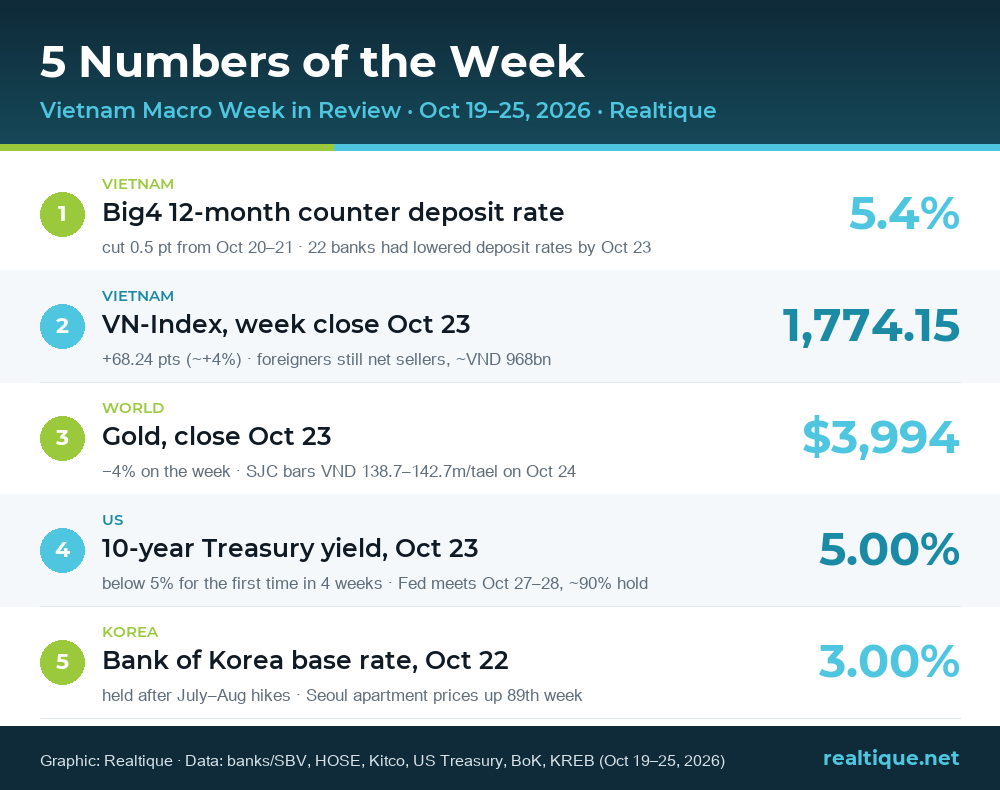
Graphic: Realtique · Data: banks/State Bank of Vietnam (Oct 20–23), HOSE (Oct 23), Kitco (Oct 23), US Treasury (Oct 23), Bank of Korea (Oct 22), KREB (Oct 19)
The VN-Index Gains 68 Points to 1,774.15 — Foreigners Still Net Sellers of Nearly VND 1 Trillion
In the trading week of 19–23 October the VN-Index rose 68.24 points (about +4%) from 1,705.91 to 1,774.15, ending the previous weeks’ decline, with money concentrated in large caps and banks. Foreign investors were net sellers of about VND 968 billion on HOSE (nearly VND 969 billion market-wide), buying for two mid-week sessions before selling again on Friday; they sold ACB for a 23rd straight session and bought TCB. Year to date, foreign net selling is close to VND 120 trillion.
What it means for buyers and landlords in Vietnam: The market recovered as deposit rates peaked and domestic money returned, but foreign capital has not come back after the FTSE upgrade (effective 21 September). For housing, the two markets remain separate: foreign money on the exchange and foreigners buying apartments (30% quota per tower, 50 years) are different flows; what they share is slightly easier domestic liquidity as deposit rates fall — the backdrop analysed in our Ho Chi Minh City Q3 2026 market report.
💬 When a client asks
Client asks: “Stocks rose 4% in a week — why buy property?”
Suggested answer: Realtique does not recommend buying or selling shares. One week is not a trend: the index had lost more than 100 points the month before. Compare the two on real cash flow and holding period — a rental apartment pays monthly rent and moves slowly, shares are liquid but swing with capital flows.
Sources: Tuoi Tre 24/10 · Dan Viet 24/10 · Hanoi Online 24/10
Gold Loses 4% on the Week to $3,994, SJC Slips Below VND 142 Million — the Domestic Premium Is Still VND 16 Million a Tael
Gold closed on 23 October at USD 3,994 an ounce (−$28 on the day), its lowest since mid-July and down about 4% on the week, as US yields near 5% and Brent at $115–116 a barrel lifted expectations of further Fed tightening, and as asset liquidation followed the tech sell-off. In Vietnam, SJC quoted gold bars at VND 138.7–142.7 million a tael on the morning of 24 October (−VND 300,000), rings at 135–139 million; the world price converts to about VND 125.5 million, so the premium remains ~VND 16 million a tael. Kitco’s survey of 17 Wall Street analysts for 26–30 October: 41% expect a fall, 24% a rise, 35% sideways; nearest resistance $4,065–4,075 (Marc Chandler, Bannockburn).
What it means for buyers and landlords in Vietnam: Gold fell because of US rates and oil, not because of Vietnam; a VND 16 million premium is a very large round-trip cost for anyone holding gold short term. For those weighing gold against a rental apartment, this week showed that the “defensive” asset can lose 4% in five days — our four-asset comparison separates the defensive role from the cash-flow role.
💬 When a client asks
Client asks: “Gold is falling — should I sell it and buy an apartment?”
Suggested answer: Don’t switch assets on one week. If the gold is your defensive money, let it do that job; for the part meant to produce cash flow, compare net rental yield with the 5.4% deposit rate, and remember the VND 16 million premium is a hidden fee when you sell gold domestically.
Sources: VnExpress 24/10 (SJC) · VnExpress 24/10 (gold, FedWatch) · VnExpress 26/10 (Kitco survey)
US: the 10-Year Yield Slips to 5.00%, Markets Price a ~90% Fed Hold on Oct 27–28 — the Dong Stands Still
The US 10-year Treasury yield closed 23 October at 5.00% (CNBC 4.999%, Kiplinger 5.001%; FRED shows 4.96% on 22 October) — down about 8 basis points on the week and below 5% for the first time in four weeks, from 5.25% early in the month; the 2-year was 4.69%, the 30-year 5.31%. The dollar index (DXY) ended the week around 101.75 (−0.2%). Ahead of the Fed’s 27–28 October meeting, CME FedWatch prices roughly 90–92% for a hold at 3.75–4.00% (BMO via CNBC 22 October: 90.6%; VnExpress 24 October: 91–92%) and about 78–80% for a December hike; this meeting carries no economic projections (no dot plot), so markets will read the statement and the press conference. The same week, President Trump signed an order removing the 50% tariff on certain Canadian farm and forestry goods (effective 30 October). In Vietnam, the central rate on 24–25 October was VND 25,627 per USD, with Vietcombank quoting 25,610–26,020, unchanged from the previous session.
What it means for buyers and landlords in Vietnam: High US rates keep the dollar strong while Vietnam is actively cutting — the VND–USD rate differential is narrowing, so the exchange rate is the variable to watch over the next few months, even though it stood still this week. For mortgage borrowers, Vietnamese lending rates follow domestic funding costs; for overseas Vietnamese and foreign buyers remitting money, the exchange rate changes the dong amount received but should not be the main reason to commit. FDI into real estate against a backdrop of shifting US tariffs: FDI 2026.
💬 When a client asks
Client asks: “If the Fed doesn’t cut, is it too early to buy in Vietnam?”
Suggested answer: Vietnamese lending rates are set by domestic policy and are being pushed down; what links to the Fed is the exchange rate, not your mortgage rate. If you are bringing dollars in, wait for the 28 October decision before fixing your transfer date; if you are buying in dong, budget on today’s floating rate.
Sources: CNBC 23/10 · Kiplinger 23/10 · ETF Trends 23/10 · Stocktwits (week of Oct 20–24) · CNBC 22/10 (BMO, FedWatch) · VnExpress 24/10 (FedWatch) · VOV 25/10 (exchange rate)

Illustration: Negative Space · Wikimedia Commons · CC0 1.0 (Realtique image kit)
Korea: the BoK Holds at 3.00% After Two Hikes, Seoul Apartment Prices Rise an 89th Week — Supply Is the Hard Problem
On 22 October the Bank of Korea held its base rate at 3.00% after back-to-back hikes in July and August 2026, to assess the effect of tightening and risks from the Middle East conflict; 18 of 20 economists surveyed on 18 October expect a hike in November. The same day the Korea Real Estate Board (KREB) reported Seoul apartment prices up 0.13% in the third week of October (to 19 October) — an 89th consecutive weekly rise, but 0.03 point slower than the week before; the three Gangnam districts fell (Gangnam −0.31%, Seocho −0.32%, Songpa −0.13%) under tax pressure, while districts north of the Han River rose about 0.3%. Listings for sale in Seoul reached 78,323 (25 October), up 29.7% since the 3 August tax-reform announcement; the average new mortgage rate at the five big banks was 4.936% in September. According to the Vietnam News Agency, at a 23 October hearing the chairman of Korea Land & Housing said housing starts in the capital region over the past three years were only one-half to one-third of earlier levels and supply would expand substantially over the next three years.
What it means for buyers and landlords in Vietnam: Koreans are one of Realtique’s largest foreign client groups. At home, a 3% rate may still rise, Seoul prices have climbed for almost two years and supply is short — so the sensible question for a Korean client looking at Ho Chi Minh City is rental yield and ownership rights, not price appreciation. Vietnam’s foreign-ownership rules are unchanged: 30% quota, 50 years, approved-project list.
💬 When a client asks
Client asks: “A Korean client asks: Seoul prices keep rising — why buy in Vietnam?”
Suggested answer: Don’t compare price growth — compare cash flow and rights. In Ho Chi Minh City, an apartment let to foreign professionals pays monthly rent in dollar-equivalent terms, with 50-year renewable ownership inside the 30% per-tower quota; Realtique checks the remaining foreign quota of the exact tower before a client pays a deposit.
Sources: Bank of Korea 22/10 · Seoul Economic Daily 22/10 · SBS 22/10 (KREB) · Seoul Economic Daily 26/10 · Tuoi Tre/VNA 24/10
Singapore: URA Confirms Q3 Prices +1.4%, Rents +1.3%, Vacancy 7.2% — China Holds the LPR for a 17th Month
On 23 October URA released final Q3 2026 statistics: the private residential price index rose 1.4% quarter on quarter (Q2: 0.5%), averaging 0.9% a quarter over nine months; landed +2.9%, non-landed +1.0% — the Core Central Region +0.3% (the 1 October flash had −0.1%), the Rest of Central Region 0.0%, the Outside Central Region +2.3%. Rents rose 1.3% (Q2: 0.7%). Developers launched 1,140 units and sold 1,183 (Q2: 2,141); vacancy rose to 7.2% (Q2: 6.4%); unsold units with planning approval stood at 20,300 and the pipeline at 44,738. In China, on 20 October the PBoC left the one-year loan prime rate at 3.0% and the five-year at 3.5% — unchanged for a 17th month, after 4.5% Q3 GDP growth reduced the case for near-term easing.
What it means for buyers and landlords in Vietnam: Singapore is a major source of FDI into Vietnam and the home market of a group of Realtique’s clients; prices there keep rising steadily but vacancy is up to 7.2% and primary sales nearly halved — a Singaporean used to reading net yield will ask exactly that question of Ho Chi Minh City. China is holding record-low rates without easing further: the trend of companies placing factories in Vietnam remains the base for industrial-park demand and expatriate housing.
💬 When a client asks
Client asks: “For a Singaporean, how does a Ho Chi Minh City apartment compare with a condo at home?”
Suggested answer: The legal and tax frameworks differ: in Vietnam a foreigner owns for up to 50 years (renewable) in a project on the approved list within the 30% per-tower quota, with no ABSD-style additional stamp duty. Realtique builds a net-yield table unit by unit so a client can set it against 7.2% vacancy in Singapore.
Sources: URA 23/10 · TheFinance.sg 24/10 · Trading Economics 20/10 (LPR) · NST/Reuters 20/10 (LPR)
Tesla Q3: Revenue Flat at $28 Billion, Profit Down 43% — the Market Pays for Earnings, Not for the Story
After the close on 21 October, Tesla reported Q3 2026: revenue $28.05 billion, flat year on year and in line with the $28.06 billion consensus; net income $787 million, down 43%; operating income $718 million (−56%), a 2.6% operating margin; R&D up 69% to $2.76 billion on AI and the Optimus robot; adjusted EPS of $0.48 beat the $0.45 forecast; free cash flow $1.53 billion (vs $3.99 billion a year earlier); cash $45.4 billion; deliveries 486,532 (−2.1%). The robotaxi fleet operates in six cities, ten times larger than a month earlier; 2026 capex guidance was lowered to about $20 billion and will keep rising for several years. Shares fell more than 3% right after the report (MarketBeat, 22 October).
What it means for buyers and landlords in Vietnam: A company with the biggest future story in the market still got marked down when profit fell and costs grew faster than revenue. The logic applies directly to real estate: the durable value of an apartment lies in real cash flow — rent collected, legal status completed, handover progress — not in titles or renderings; this week Realtique applied exactly that reading to a new branded-residence project on Highway 13 (see today’s companion article).
💬 When a client asks
Client asks: “Tesla spends on AI and profit falls — what has that to do with my home purchase?”
Suggested answer: It is about how value is priced: markets pay for today’s earnings and discount tomorrow’s story. When you look at a project, ask three questions — when is handover, what stage is the legal paperwork at, what is the achieved rent nearby — and pay for those three answers.
Sources: Electrek 21/10 · MarketBeat 22/10
Frequently Asked Questions
What is the Big Four’s 12-month deposit rate now?
From 20–21 October 2026, Vietcombank, Agribank, BIDV and VietinBank all quote 5.4% a year for 12-month counter deposits (down from 5.9%), and 5.5% for 24 months. Many private banks still pay 6.5–7.1%; by 23 October, 22 banks had cut deposit rates following the State Bank’s instruction.
Are mortgage rates falling with this round of cuts?
No bank has announced a package specifically for home loans; Agribank (up to 2.5 points) and Techcombank (up to 2 points) cut rates on existing loans and for production and business. According to the State Bank, the average lending rate in September was 10.9% a year. Existing borrowers should ask their bank directly about their own loan.
Will the Fed raise rates on 27–28 October, and what does it mean for Vietnam?
Markets price roughly 90–92% for the Fed to hold at 3.75–4.00% and 78–80% for a hike in December. The main channel to Vietnam is the exchange rate (a strong dollar when US rates are high), not mortgage rates; the central rate stood at VND 25,627 per USD last week.
Gold fell 4% in a week — should I move into property?
That is a personal financial decision; Realtique does not give investment advice. A sensible comparison separates the gold that plays a defensive role from the money meant to produce cash flow, compares net rental yield with the 5.4% deposit rate, and counts the VND 16 million per tael gap between domestic and world gold prices as a round-trip cost.
What should I watch next week?
The Fed decision on 28 October (2 pm US Eastern); US September PCE and preliminary Q3 GDP on 29 October; Vietnam’s National Assembly debating the amended Land Law in plenary on 29 October; full-scale construction of the Ben Thanh – Can Gio metro from 30 October; and private banks’ deposit rates after the Big Four cuts. Realtique will cover them in the next issue.
⚠️ Note: This article compiles public information from 19–25 October 2026; every figure carries a source and publication date, and market data (yields, FedWatch probabilities, stock indices, gold prices) change daily. The “What it means” and “When a client asks” sections are Realtique’s view, not investment or financial advice, and not a recommendation to buy or sell shares or gold; Realtique does not forecast prices.
Vietnam Macro Week in Review #1 (Oct 13–19, 2026): Central Bank Orders Rate Cuts
Read more →Savings, Gold, Stocks or a Rental Apartment? Investing in Vietnam in 2026 (updated Oct 21–22)
Read more →High Loan Interest Rates in Vietnam (2026): What Home Buyers Should Do
Read more →Ho Chi Minh City Property Market Q3 2026
Read more →Weighing a 5.4% deposit against a rental apartment?
Send Realtique the area and budget you have in mind. We put together achieved rent, management fees, rental tax and vacancy for each unit so you can set it against post-cut deposit rates yourself — without relying on price appreciation.
📞 Hotline: +84 866 810 689

KC Pham
KC Pham advises foreign buyers and overseas Vietnamese on Ho Chi Minh City apartments — setting real rental income against deposit rates and checking legal status and foreign quota before a client commits.