
HCMC’s 2 September 2026 Construction Pipeline: 16 Projects, VND 249,422 Billion — and Which Corridors Actually Move Property
For the 2 September 2026 National Day, Ho Chi Minh City plans to break ground on 11 projects and open 5 more, a pipeline worth roughly VND 249,422.7 billion — about US$9.5 billion. The list runs from urban rail and ring roads to national highway widening, social housing and inner-city renewal. This article sets out the pipeline with the cost of each project, then does the part most coverage skips: separating which corridors actually affect property, in which districts and in which segment — rather than compressing all of it into a single "infrastructure boom" headline.
The 2 September 2026 Pipeline — Key Facts
Table of Contents
What Is Actually in the Pipeline?
According to announcements in mid-August 2026, the city is accelerating approvals so that 16 works can be started or opened for the 81st National Day. The split: 11 projects breaking ground — 5 transport, 1 technical infrastructure and 5 housing — plus 5 projects being opened to use.
The transport group alone carries roughly VND 158,776 billion, the bulk of the pipeline’s value and the part with the clearest read-through to property along specific corridors.
A note on the totals: outlets have published different figures — some cite around VND 165,000 billion, others VND 249,422.7 billion. Cross-checking, the smaller figure covers the headline mega-projects reported separately, while VND 249,422.7 billion is the total across all 16 works. This article uses the latter and states each project’s cost below so the difference is visible rather than hidden.
The Pipeline, Project by Project
Below are the works named with a specific investment figure. Some items in the group of 16 had not been detailed at the time of writing — in particular the full list of the 5 projects being opened, where sources so far give a count but not names.
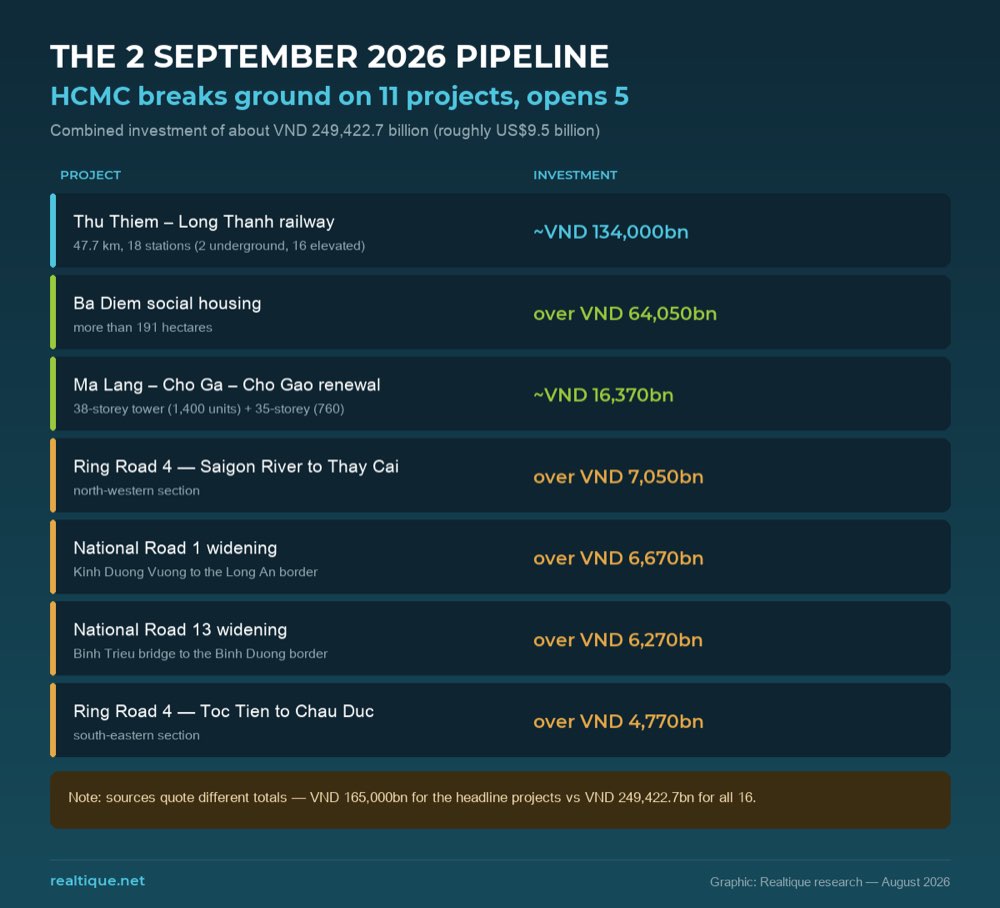
Graphic: Realtique research, compiled from city announcements and press reports, August 2026.
The Largest Item: Thu Thiem – Long Thanh Railway (~VND 134,000 Billion)
More than half the pipeline’s value sits in a single line connecting Thu Thiem with Long Thanh International Airport: 47.7 km with 18 stations (2 underground, 16 elevated), at roughly VND 134,000 billion.
⚠️ A caveat on that number: this line has previously been reported at around VND 175,000 billion. The VND 134,000 billion figure appears in the 2 September pipeline announcement. The two reflect different scopes of what is being costed and have not been reconciled publicly — so treat both as estimates rather than a settled figure.
For international buyers this is the corridor that matters most, because it links the core of Thu Thiem — where the city’s luxury apartment supply is concentrated — to an airport scheduled to begin commercial operations on 1 December 2026. We cover the line’s route, milestones and open questions in a dedicated article.
Ring Road 4 and the National Highway Corridors
The road group comprises four named projects:
- Ring Road 4 — Saigon River to Thay Cai canal: over VND 7,050 billion, the north-western section.
- Ring Road 4 — Toc Tien to Chau Duc bridge: over VND 4,770 billion, the south-eastern section running toward the port cluster.
- National Road 1 widening: over VND 6,670 billion, from Kinh Duong Vuong to the Long An border.
- National Road 13 widening: over VND 6,270 billion, from Binh Trieu bridge to the Binh Duong border.
National Road 22 has also been named among the gateway routes being accelerated.
What these share: they are congestion-relief and inter-provincial links. Their effect lands mainly on land plots, townhouses and industrial property along the alignment — not directly on central luxury apartment values.
Housing and Urban Renewal Take a Larger Share Than Expected
An easily missed detail: 5 of the 11 groundbreakings are housing projects, and they are large.
- Ba Diem social housing: over VND 64,050 billion across more than 191 hectares — the second-largest item in the entire pipeline, behind only the railway.
- Ma Lang – Cho Ga – Cho Gao urban renewal: about VND 16,370 billion, comprising a 38-storey complex of roughly 1,400 units and a 35-storey complex of around 760 units.
For anyone tracking supply, this signals where the city is directing capital: heavily toward social housing and the redevelopment of older residential quarters. That stock does not compete directly with the luxury segment, but it shapes the overall supply picture and the outer-city districts where these projects sit.
Which Corridors Genuinely Affect Property — and Which Segment?
This is where the story is most often overstated. A VND 249,422.7 billion pipeline sounds like "the whole city reprices", but infrastructure only affects the areas it actually runs through, and only the segment that exists there. Read across four corridors:
- East (Thu Thiem to Long Thanh): Thu Thiem, An Khanh and the eastern corridor. The only line in this pipeline that touches luxury apartments directly, and it compounds with the International Financial Centre and the planned Thu Thiem TOD interchange.
- North (National Road 13): Thu Duc and Binh Thanh along the route, plus the Binh Duong fringe. Mainly townhouses and mid-market apartments.
- West (National Road 1 and Ring Road 4 north-west): the western districts and the Long An fringe. Predominantly land plots and affordable housing.
- South-east (Ring Road 4, Toc Tien – Chau Duc): toward Phu My and the Cai Mep – Thi Vai port cluster. This is an industrial and logistics property story, not a residential one.
Put plainly: if you are weighing an apartment in the eastern corridor, exactly one project in this pipeline is directly relevant to you. The other three are good news for the market broadly, but they are not a reason to pay more for a central apartment.
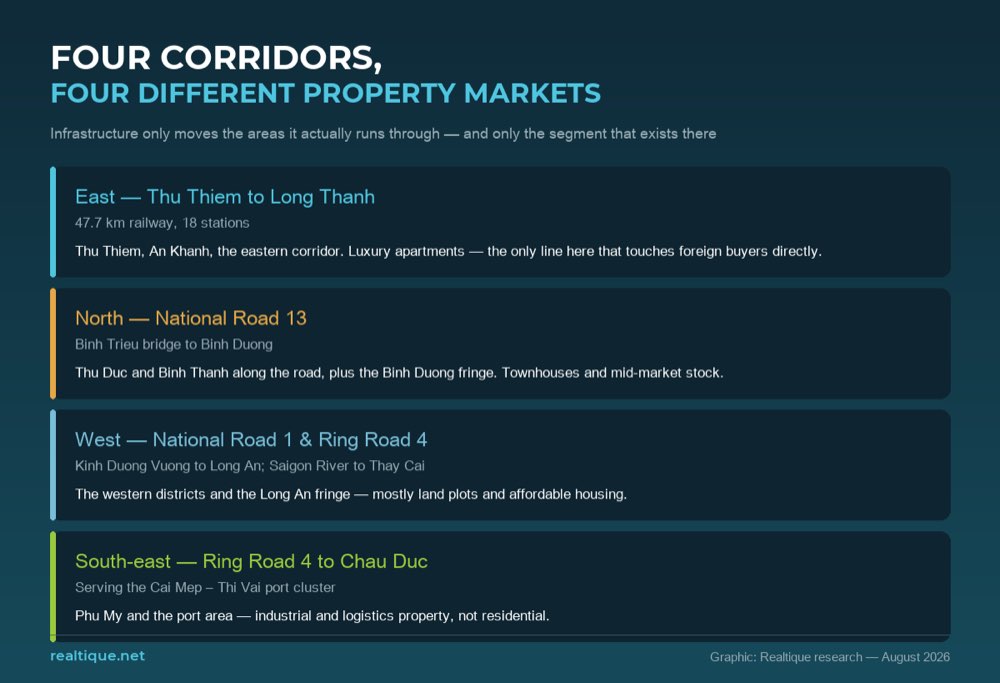
Graphic: Realtique research, compiled from city announcements and press reports, August 2026.
A Caution on Reading Groundbreakings
A recurring pattern in local marketing material is to cite a groundbreaking date as though the project were about to open. Three things worth holding onto:
- A pipeline is a plan, not an outcome. The dates here are expectations as at the August 2026 announcement and can move. There is precedent for projects listed for a national holiday slipping afterwards.
- For urban rail, the gap between groundbreaking and operation is measured in years, not quarters. The value infrastructure delivers is priced in gradually as construction progresses, not in a step change on the day work starts.
- Check that the specific development sits on the corridor at all. Distance to an approved station or interchange is what matters — not whether a project happens to share a district with a headline scheme.
When assessing a specific unit, we compare its location against approved alignments and station positions, rather than using the name of a public works project as a selling point.
Frequently Asked Questions
How many projects is HCMC starting on 2 September 2026?
Announcements in mid-August 2026 indicate 11 projects breaking ground and 5 being opened — 16 works in total, worth approximately VND 249,422.7 billion. Of the 11 groundbreakings, 5 are transport projects, 1 is technical infrastructure and 5 are housing developments.
What is the largest project in the pipeline?
The Thu Thiem – Long Thanh railway, at roughly VND 134,000 billion, running 47.7 km with 18 stations (2 underground, 16 elevated). Note that this line has also been reported at around VND 175,000 billion previously; the two figures reflect different costing scopes and have not been publicly reconciled.
Which sections of Ring Road 4 are starting?
Two sections are named: Saigon River to Thay Cai canal (over VND 7,050 billion, north-west) and Toc Tien to Chau Duc bridge (over VND 4,770 billion, south-east toward the port cluster). These are individual sections, not the full ring road.
Will these groundbreakings push apartment prices up immediately?
That is not a reasonable expectation. Infrastructure affects only the areas a route actually serves and the segment present there, and for urban rail the gap between groundbreaking and operation runs to years. Prices typically reflect construction progress gradually rather than stepping up on the day work begins.
Which project in this pipeline matters most to a foreign buyer?
The Thu Thiem – Long Thanh railway is the only item that touches the areas where luxury apartment supply — and most foreign-eligible stock — is concentrated, since it links central Thu Thiem to Long Thanh airport. The other three corridors mainly affect townhouses, land plots and industrial property.
⚠️ Please note: every date and figure here reflects plans as announced in August 2026 and may be revised. Sources currently quote different totals (VND 165,000 billion for the headline mega-projects versus VND 249,422.7 billion for all 16 works), and the full list of the 5 projects being opened has not been published in detail. This article is not investment advice — speak to a Realtique advisor to assess a specific property against these plans.
Vietnam’s International Financial Centre in HCMC: The 898-Hectare Boundary
Read more →What Is TOD? Transit-Oriented Development & Thu Thiem Mega Station Explained
Read more →Thu Thiem, Ho Chi Minh City’s New CBD: A Foreign Buyer’s Guide (2026)
Read more →Thu Thiem vs The Global City: Where Should Foreign Investors Buy? (2026)
Read more →Is the property you are considering actually on one of these corridors?
Realtique checks a development’s position against approved alignments and station locations, instead of using a public works headline as a selling point.

KC Pham
KC Pham advises foreign buyers and overseas Vietnamese on prime residential property in Ho Chi Minh City, with a focus on the eastern corridor around Thu Thiem.