
1010 Private Club (1010 Origin) at Haus Da Lat: Vietnam’s First Members’ Club, Opening November 2026
Table of Contents

Haus Da Lat is the founding chapter of 1010 — Vietnam’s first private members’ club, named after the year 1010 when the capital moved to Thang Long, and operated to the standards of Copper Beech — the London hospitality company founded by Matt Hobbs whose credentials, by its own account, include advising and leading projects for Annabel’s and Soho House. For the 68 owners of Sky Villas and Sky Mansions, membership is the hardest part of the asset to price — and the easiest to misunderstand. This article separates three things: what the club is, how membership works for Haus owners, and why Realtique treats it as the layer of value that “cannot be copied”.
Sources: developer material issued by The One Destination to distribution partners (January–May 2025, layout brochure February 2025) and Realtique’s first-hand notes from the Haus Community Summit – Back to School (9–10 September 2026), where Sweco, Kengo Kuma & Associates, 1508 London and 1010 taught in person, plus the developer’s October 2026 materials for distribution partners on 1010 Origin’s architecture, interiors and the wider 1010 network. Prices are not published online — contact Realtique for the current unit list. Foreign nationals are not eligible; overseas Vietnamese who hold Vietnamese citizenship buy on the same terms as residents.
Updated 16 October 2026: 1010 Origin is now expected to open in November 2026, per the developer’s latest materials (earlier recruitment notices said October); added 1010’s “living legacy” philosophy, how the club’s service differs from a hotel’s, 1010 Origin’s architecture by KKAA and interiors by 1508 London, the plan for 1010 Hanoi and Ho Chi Minh City and a timeline of the London clubs, and corrected the details on Copper Beech and Alex Haddock’s title, based on the developer’s October 2026 materials introducing 1010 Origin to distribution partners.
Updated 6 October 2026: the club is launching as 1010 Origin — the first chapter of the 1010 network, created and operated by Copper Beech. According to the club’s own recruitment announcements, 1010 at Haus Da Lat is expected to open in October 2026 (updated 16 October 2026: the developer’s latest materials now say November 2026). Below you will also find Realtique’s interview with Alex Haddock, managing director of 1010, on the question most people ask: who gets to be a member.
- 0:31 — The club is for neither residents nor hotel guests as such, but for an “ecosystem” of selected, like-minded individuals who are building the future of Vietnam.
- 1:07 — Anyone in Vietnam is welcome to apply; applications are hand-picked.
- 1:11 — 1010 intends to build a network of clubs, and the first is in the Da Lat highlands because of the city’s history and heritage.
- 1:29 — The club is a separate entity from the residences; only hand-picked residents will have access. Membership numbers have not been announced.
- 2:02 — Walk past on a Friday night and you have to be a member to enter; members may bring guests, who can then apply themselves.
- 2:25 — Haddock moved from London to Vietnam with his wife and daughter and splits his time between Hanoi and Da Lat — and is “100%” confident in the model here.
Four hundred years of clubs: from a London coffee house to 1010
At the Haus Community Summit, 1010’s representative opened with the question “When almost everything can be bought, what is truly valuable?” — then walked through 400 years of clubs: Pasqua Rosée’s coffee house, opened in 1652 as London’s first (another coffee house, Lloyd’s, later grew into the Lloyd’s of London insurance market); White’s (1693), Boodle’s, the Garrick, Annabel’s, the Groucho, Soho House, Carriage House (2022). The common thread: a club does not sell seats, it sells being known. A hotel serves guests; a club knows its members. Good service responds; great service anticipates.
1010 is Vietnam’s first social club. Its founding chapter is “in the pine forest of the highlands” — Haus Da Lat. According to 1010’s October 2026 materials for distribution partners, 1010 Origin is the first club in the network and its founding chapter, where the first members come together and the culture and standards for every later club are set. 1010 Hanoi, the flagship chapter, is planned for Q2 2027, and 1010 Ho Chi Minh City, the enterprise chapter, for Q4 2027. The launch event, “Haus Private Club — The First”, was held on 9 May 2025 at the Independence Palace in Ho Chi Minh City, by invitation only: close to 250 guests, more than 15 hosts and ten business leaders from across Asia flown in to sit with guests, wines chosen by a wine master and shipped from France, no photography.
Timeline: the London clubs that shaped the model
From coffee house to members’ club, following the timeline in 1010’s materials (founding years as commonly recorded):
| Year | Club | What it added |
|---|---|---|
| 1652 | Pasqua Rosée’s coffee house | London’s first coffee house; a penny bought a seat, so coffee houses became known as “Penny Universities”, where merchants, lawyers, scientists and writers traded ideas |
| 1693 | White’s | Began as a chocolate house and became a private club; membership rested on invitation, trust and reputation, and money alone did not open the door |
| 1762 | Boodle’s | Named after its head waiter, Edward Boodle; a discreet meeting place for politicians, economists and writers |
| 1764 | Brooks’s | The gathering place of the Whigs in British politics |
| 1831 | The Garrick | Named after the actor David Garrick; a home for literature and the stage |
| 1963 | Annabel’s | Music, dancing and the glamour of 1960s London |
| 1985 | The Groucho Club | A Soho club for the creative industries that admitted men and women equally |
| 1995 | Soho House | From a few rooms above a Soho restaurant to an international network: “a sense of belonging can travel” |
| 2017 | The Ned | Inside the former Midland Bank headquarters: a hotel, public restaurants and a private members’ club under one roof |
Beyond London, the materials also cite Carriage House (Palm Beach, USA, 2022): “the greatest luxury is to be known by name”. The common thread, in 1010’s words: money alone does not make a member; admission is the community’s decision.
Five standards: Recognition · Discretion · Anticipation · Consistency · Judgment
The representative summarised the operating standard in five words: Recognition (knowing the member — name, habits, seat), Discretion (what happens in the club stays in the club), Anticipation (needs met before they are voiced), Consistency (the same every time), Judgment (knowing when to do nothing). His line: “Nothing feels arranged, but every element has been considered.” For Haus residents this standard applies to the building itself, because Copper Beech also operates Haus Residences.
Two lines worth keeping from 1010’s own materials: “A building can be copied. A space can be copied. But the people inside it cannot. That is the difference between a physical asset and an icon.” And: membership is the one thing that “keeps building on itself and grows deeper with every year of belonging” — a point about belonging, not a promise of financial value.
How membership works for Haus Da Lat owners
| Question | Developer’s answer (Feb–May 2025) |
|---|---|
| Who receives membership immediately? | The first 24 owners — 8 Sky Villas + 16 Sky Mansions — receive Private Club membership with no joining fee (May 2025 condition: deposit and paperwork completed before 13 May 2025 and attendance at The First) |
| Later owners? | Submit a profile and letter of intent; if approved, no annual fee either |
| Annual fee? | Haus Private Club charges no annual fee; entry is by invitation, member referral and Private Team approval only |
| If I sell the home? | Membership is tied to ownership of a Haus Residence — selling the home ends the membership; the new owner applies from scratch |
| Opening? | 1010 Origin in Da Lat is the network’s first club; 1010 Hanoi is planned for Q2 2027 and 1010 Ho Chi Minh City for Q4 2027 (1010 materials, October 2026). Update, 16 October 2026: 1010 Origin in Da Lat is expected to open in November 2026 (per the developer’s 1010 Origin materials) |
Read the line “selling the home ends the membership” carefully: it is both a restriction and a protection. The card cannot be traded with the apartment, so the community is not diluted as assets change hands — but a resale buyer must know they do not automatically inherit membership.
Read alongside our interview with Alex Haddock (September 2026): 1010 runs separately from the residences’ management and admits members by application — anyone in Vietnam can apply, and the maximum membership has not been announced. For Haus Da Lat owners the advantage is the developer’s policy: the first 24 owners are promised membership, with no annual fee.
A members' club versus an ordinary "clubhouse"
Most condominiums have a “clubhouse”: a lounge, a gym, a meeting room — physical amenities every resident uses. A members’ club on the 1010 model differs in three ways. First, the door is people, not a resident card: members are invited, referred and approved; owners have priority but still go through a profile. Second, the network extends beyond the building: 1010 Origin in Da Lat is the first club in a network that shares one membership card — 1010 Hanoi is planned for Q2 2027 and 1010 Ho Chi Minh City for Q4 2027 — alongside the international network Copper Beech brings; once those clubs open, a member on business in another city will still have a “home”. Third, an operator who knows each member to the five standards above, rather than reception staff on shifts. For The First, the developer asked distributors for guest profiles (age, profession, interests) so that Copper Beech could match international guests with similar backgrounds — evidence that the community is edited, not spontaneous.
Why the club is the value that "cannot be copied"
In the four-layer framework Realtique brought back from the Summit — infrastructure nobody sees, architecture that yields to nature, designers who lived on the land, a community that cannot be copied — the club answers the fourth layer. Another developer can hire Kengo Kuma, buy 1508 London interiors, sign with IHG. What cannot be bought is 68 selected people and the way they meet: international business leaders flown to Vietnam for its events, hosts studying each guest’s profile, and a place for those meetings to repeat weekly in the pine forest. For an owner-occupier that is quality of life; for a holder of the asset it is a moat against imitation.
Realtique’s caveat: the club’s value only appears once the club is actually operating. Buyers should ask for the real opening date of the Da Lat chapter, the list of member-only facilities in the complex, and the membership clauses in the contract — and not price it in before seeing it work. For overseas Vietnamese, membership does not depend on residency; eligibility to buy does — see the buyer’s guide, the floor plans and the complete project guide.
What the club means for an owner living abroad
For overseas Vietnamese owners, three practical points. Reciprocity: 1010 Origin in Da Lat is the network’s first club. According to 1010’s October 2026 materials, 1010 Hanoi (the flagship chapter) is planned for Q2 2027 and 1010 Ho Chi Minh City (the enterprise chapter) for Q4 2027, and one membership card is designed to open every club in the network. Until those clubs open, the network is Da Lat alone; once they do, a Haus Da Lat member visiting Vietnam for business would also have a base in the two largest cities — ask for the reciprocal-access terms in writing. Use while away: membership is personal and tied to ownership, so it does not pass to a tenant if you let the unit; check whether family members are covered and whether guests can be hosted in your absence. Approval: owners beyond the first 24 submit a profile and a letter of intent; Realtique helps prepare both, in Vietnamese or English, and can present them to the Private Team on your behalf. The broader point is that the club turns a second home you visit a few weeks a year into a standing social address in Vietnam — for many diaspora families that is the reason to choose a managed residence in central Da Lat over a stand-alone villa that sits empty between visits.
One more detail from the developer’s brief for The First is worth noting: hosts studied every guest’s profile in advance, staff were trained for five days to remember names and seats, and every bottle was opened and checked by a wine master from London before service. That level of preparation for a single evening is the standard the Da Lat chapter is expected to run to every day — and it is the standard against which owners should judge the club once it opens, not the renders.
Inside 1010 Origin: architecture by KKAA, interiors by 1508 London
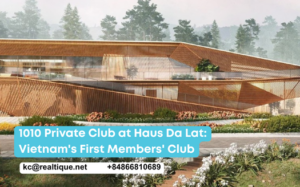
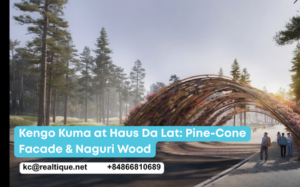
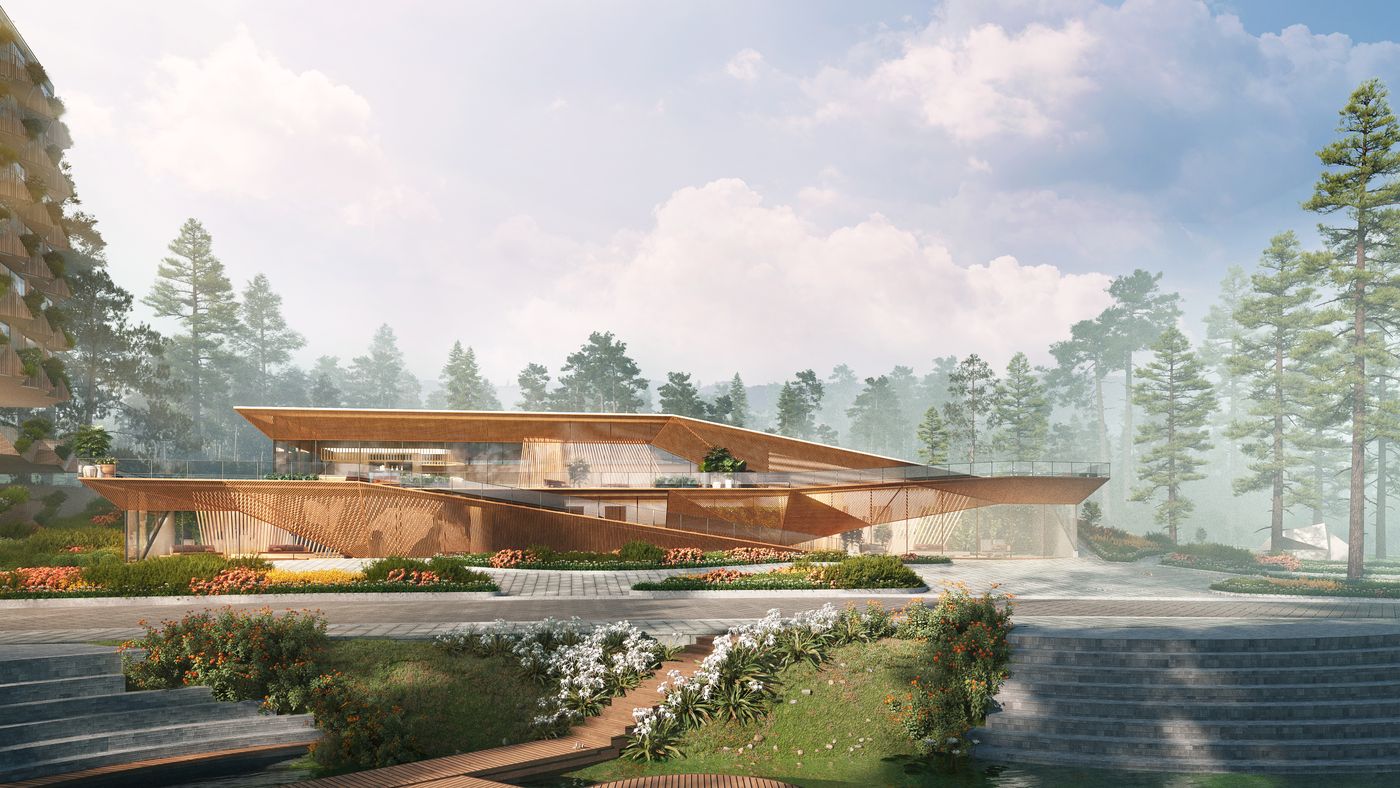
According to the design documents the developer shared with distribution partners, the 1010 Origin clubhouse is a two-storey building among the pines beside the Haus Residences, designed by Kengo Kuma & Associates (KKAA). The massing starts from the ground itself: a green roof that reads as a piece of the hillside lifted up, a building that seems to rise off the ground along the curve of the forest, and eaves and decks wrapped in criss-crossing timber louvres. One corner opens out like an embrace, with steps leading up to the green roof. Four ideas drive the architecture and landscape: the pine cone, the pine forest, the colour of flowers and Da Lat’s waterscape.
The spaces shown in the developer’s renderings:
- The entrance: a stone-paved forecourt leading to a glass lobby under the timber roof.
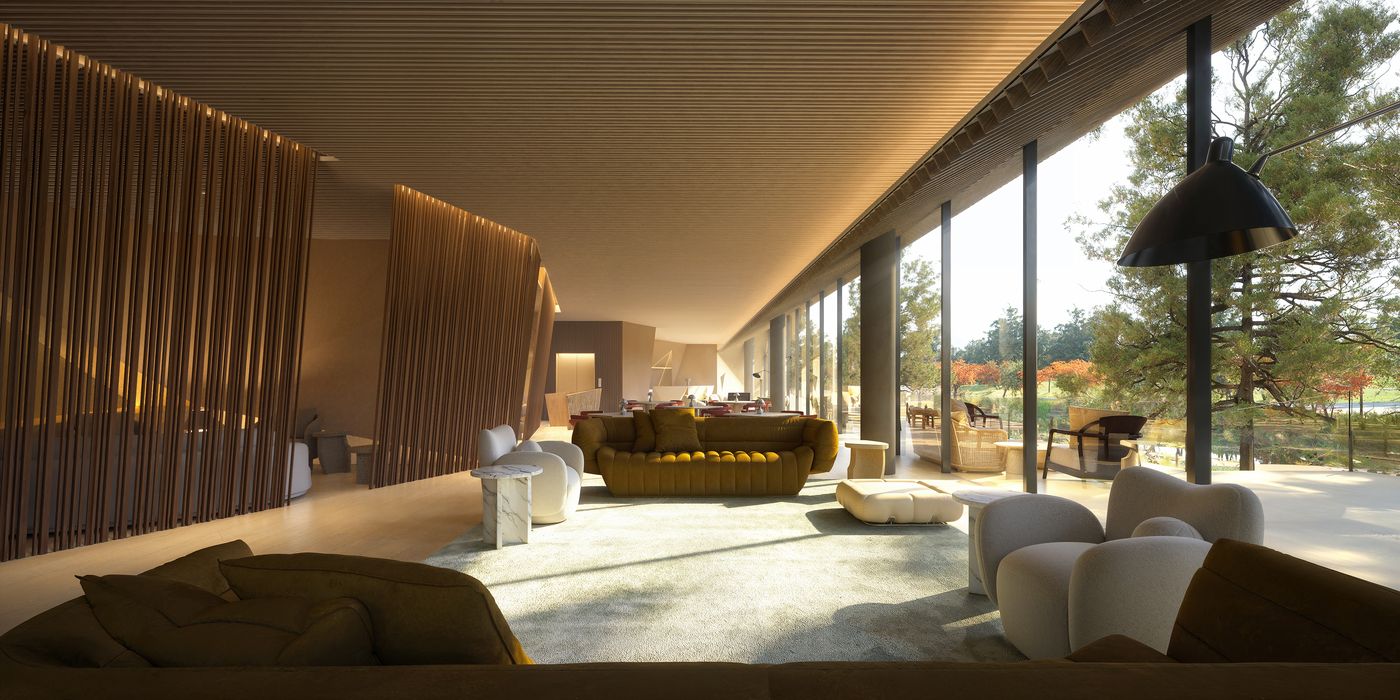
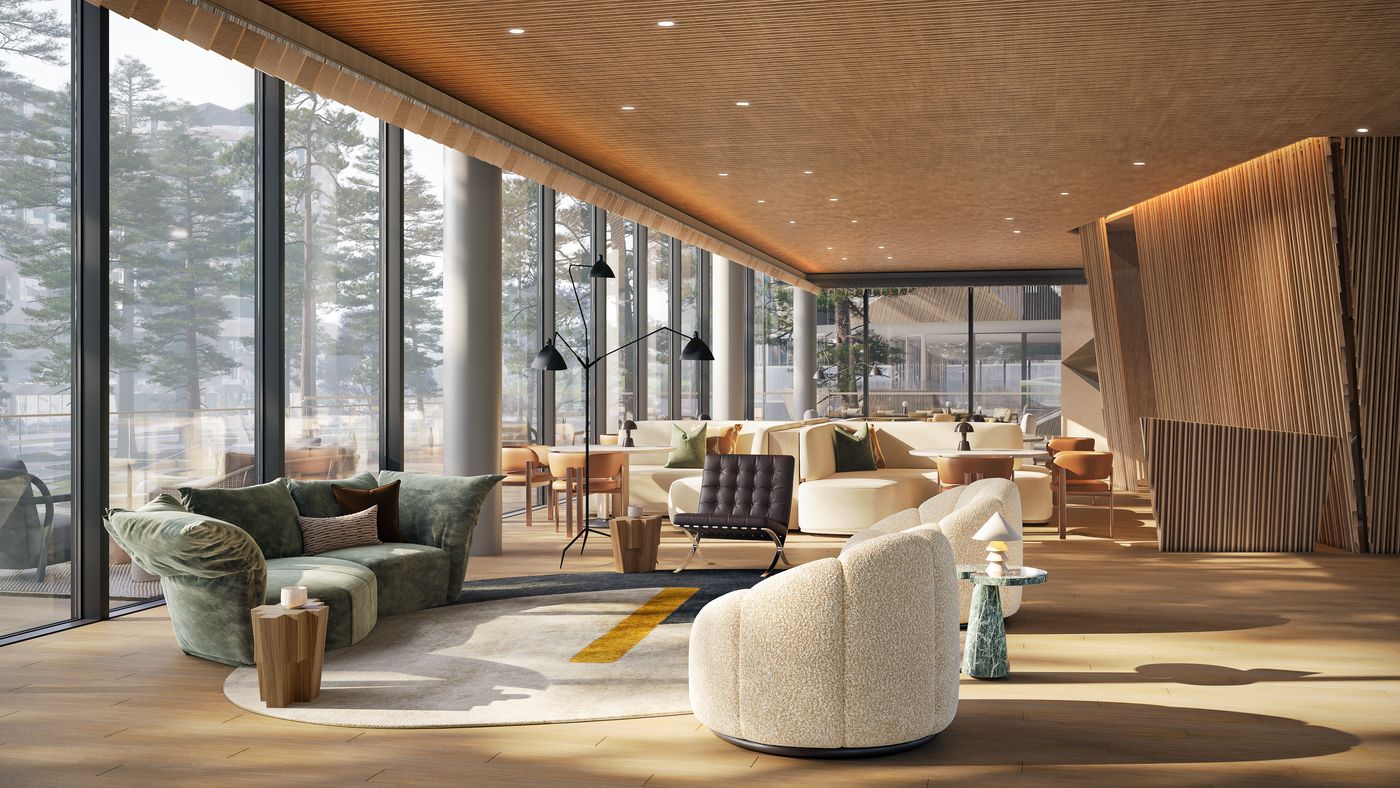
- Reception and lounge: a slatted timber ceiling and full-height glass facing the forest.
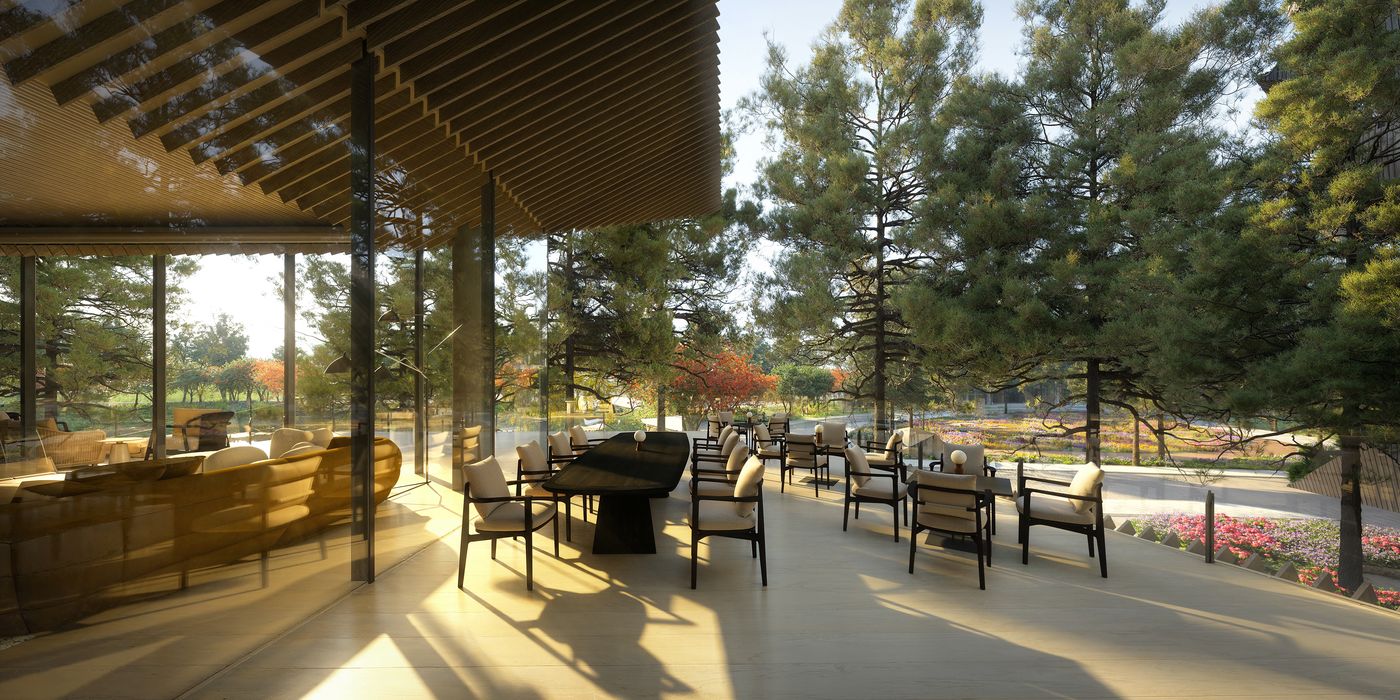
- Dining area and a terrace under timber louvres, looking out to the pines and flower gardens.
- The upper-floor living room, where “the rhythm of the wood changes throughout the space”.
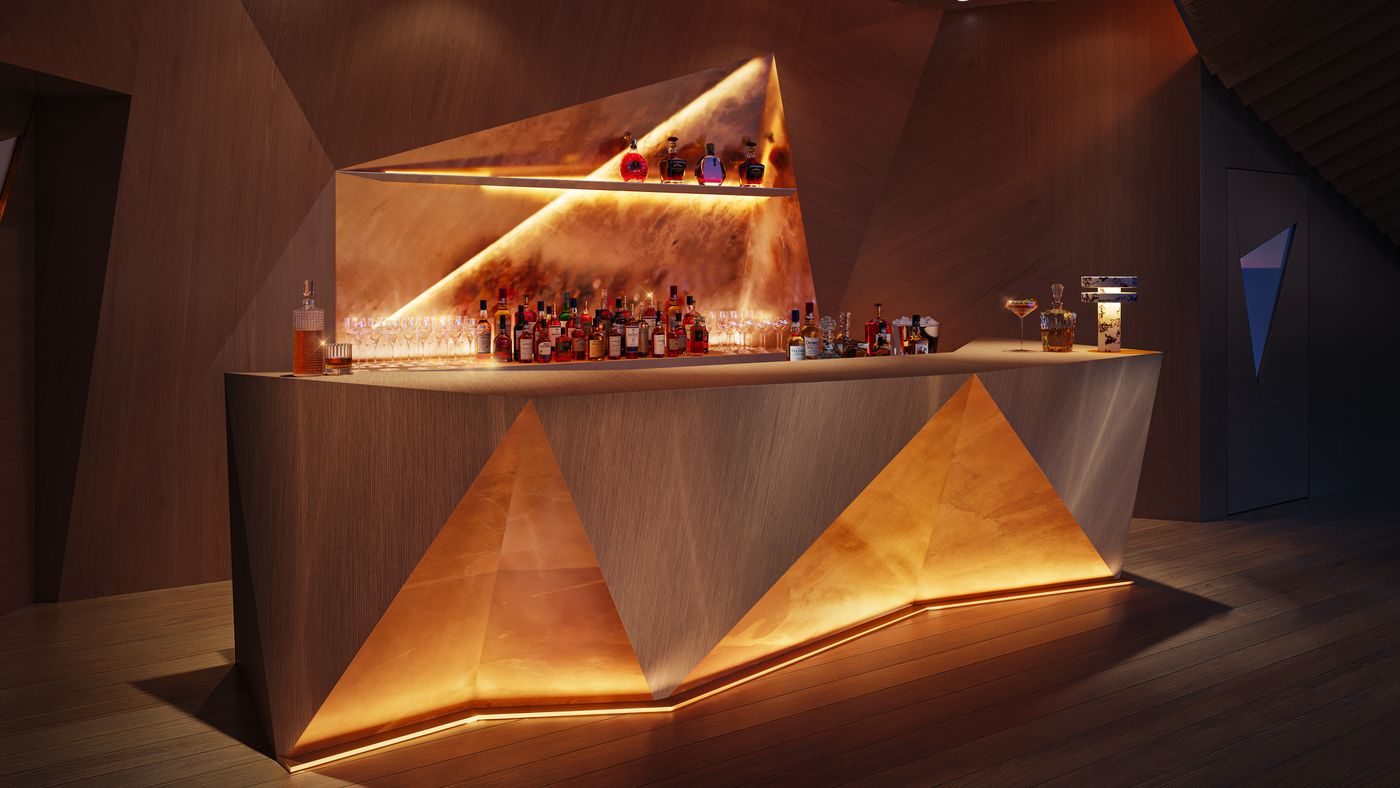
- A private room inspired by origami: folded timber walls with glowing copper surfaces set into the folds; the bar is a folded timber block too.
- A waiting hall and exhibition space lined with hand-adzed naguri timber, a Japanese technique that leaves a faceted, scale-like surface.
- Oak flooring on the upper floor.
In KKAA’s 2025 basic design, the upper floor has a living room of about 120 m² and an outdoor deck of 222 m² that holds around 100 people. Its screens use kobadate, a Japanese technique in which many slender timber battens are set on edge and repeated across a surface, forming a filter that divides space while letting light pass through. The whole system uses just three batten sizes, arranged in a non-repeating sequence so that it looks random: open enough to see one another, private enough for a quiet conversation.
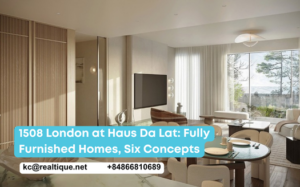
Interiors are by 1508 London, under the concept “Maison de Mémoire” (House of Memory), also called “Story of Icons”. Rather than designing every piece from scratch, the idea is to furnish the club with iconic pieces by classic designers: each chair, lamp and cabinet is a chapter in design history, so the club becomes a living design museum, somewhere to live in rather than just look at. The mood pairs French modernism, an echo of Da Lat’s French villas, with Vietnamese roots; the rooms are meant “not to impress, but to evoke”.
Images: artist’s impressions from the design documents; the finished design may change.
Living legacy, and why a members’ club is not a hotel
In its October 2026 materials introducing 1010 Origin to distribution partners, the developer summed up the club in one line: “a members’ community with a distinctly Vietnamese identity, for the people building, creating and contributing to the country’s next chapter.” 1010 is not positioned as a golf club, a fine-dining room or a five-star hotel, but as a private social space whose value comes from the people inside it.
The philosophy is called living legacy, and it has two ideas: members share one root — Vietnam and its culture — whatever their field; and heritage is something to be continued in daily life rather than stored or displayed, so the club is a place where members build and hand on their own legacy. The name follows the same logic: 1010, pronounced “Ten Ten”, is the year the capital moved to Thang Long, the start of a new chapter. Structurally, 1010 is a network rather than a venue — one membership card opens every club in the 1010 ecosystem, each with its own city’s character but the same standards. In Da Lat, 1010 Origin is described as an open living room in the pine forest, with private rooms for confidential conversations, dining, and space for contemporary art.
| A hotel or ordinary venue | 1010 | |
|---|---|---|
| Relationship | Serves customers; short transactions | Knows and accompanies members, across cities and generations |
| Needs | Meets the requests guests make | Anticipates wishes before a member speaks |
| Service | Scripted, standardised, uniform | Attentive, adjusted to each person in each moment |
| Problems | Solved when they arise | Removed at the root, before the member notices |
The club compresses this into one standard: a member should never have to ask twice. Behind it sit a member-preference system (CRM), staff trained to a written service code, and a plan for each return visit — a proactive welcome, a familiar corner, the usual drink, and a scent designed for the club. The other half is conduct, which the club compares to a family code: members’ identities, images and habits are never disclosed, names are not called out in shared spaces, a well-known member is treated like any other, and staff know when to appear and when to step back. Detailed admission criteria are set by the members themselves and shared only with applicants.
For Haus Da Lat buyers, the practical point is that the first owners are 1010 Origin’s founding members — under the developer’s policy, the first 24 owners receive membership — while new members are referred and approved by the club together with those founding members; people outside the residents’ community can also apply. Realtique walks buyers through how this applies to a specific unit before any deposit.
Five things a member never has to ask for
1010’s materials illustrate the service style with five things a member should never need to ask for. They are examples of a style, not a list of guaranteed services:
- A driver already waiting before your flight lands.
- A private table kept ready for an important meeting.
- A favourite bottle of wine kept under your name.
- A familiar scent on every visit; the club even has candles bearing the 1010 logo.
- Worthwhile introductions that happen naturally.
The aim is that every courtesy feels natural, as if nothing had been arranged. Behind it are three tools Copper Beech describes for the club model: an AI-assisted concierge with data analysis to understand members and guide the club’s development; a dedicated membership liaison for each member, balancing warmth and discretion; and growth through word of mouth rather than mass advertising. Alex Haddock, managing director of 1010, puts the ambition this way: 1010 is not simply bringing one more club to Vietnam, but setting a new standard for belonging, membership and the art of hospitality.
Frequently asked questions
What is 1010 Origin and when does it open?
1010 Origin is the name of the first chapter of 1010 — the private members’ club created and operated by Copper Beech — located at Haus Da Lat. According to the developer’s October 2026 materials on 1010 Origin, 1010 in Da Lat is expected to open in November 2026.
Who can become a member of 1010?
According to Alex Haddock, managing director of 1010, anyone in Vietnam can apply and applications are hand-picked. The club runs separately from the Haus residences and only selected residents have access — per the developer, the first 24 owners receive membership. Members may bring guests.
What is 1010?
1010 is Vietnam’s first private members’ club, named after the year 1010 when the capital moved to Thang Long, and operated to Copper Beech standards. Its founding chapter is at Haus Da Lat.
Do Haus Da Lat owners pay a club fee?
According to the developer, the first 24 owners (8 Sky Villas + 16 Sky Mansions) receive membership with no joining fee; later owners apply and, if approved, also pay no annual fee. Haus Private Club charges no annual fee.
If I sell my Haus Da Lat apartment, does the membership transfer?
No. Membership is tied to ownership of a Haus Residence; on resale the seller’s membership ends and the new owner must submit a profile and letter of intent for approval from the start.
Who is Copper Beech?
Copper Beech is a London-based luxury hospitality and lifestyle development company founded and led by Matt Hobbs. According to its own credentials, it has advised and led projects for Annabel’s, Soho House, Scott’s, Kensington Roof Gardens, Grosvenor Estates and Oman’s sovereign wealth fund, with projects in nine places including New York, Miami, Barbados, the UK, Ibiza, Budapest, Egypt, the UAE and Sri Lanka; Haus Da Lat is its first project in Vietnam. Copper Beech created the 1010 network and, according to the developer, operates Haus Residences and the club to five standards: Recognition, Discretion, Anticipation, Consistency and Judgment.
What does “living legacy” mean at 1010?
It is the club’s philosophy, with two ideas: members share a Vietnamese root, and heritage should be continued in daily life rather than stored away — the club is a place for members to build and pass on their own legacy. The name 1010 comes from the year the capital moved to Thang Long.
How is service at 1010 different from a five-star hotel?
A hotel responds to a guest’s requests stay by stay; 1010 records each member’s habits and preferences to anticipate needs, under the standard that a member should never have to ask twice, and keeps strict discretion — for example, members’ names are never called out in shared spaces. One membership card works at every club in the 1010 network.
What does the 1010 Origin clubhouse look like, and who designed it?
According to the design documents, it is a two-storey building among the pines designed by Kengo Kuma & Associates: a green roof that reads as lifted ground, criss-crossing timber louvres, an origami-inspired private room with copper surfaces and an exhibition hall lined with hand-adzed naguri timber. In the 2025 basic design the upper floor has a living room of about 120 m² and a 222 m² outdoor deck for around 100 people. Interiors are by 1508 London under the “Maison de Mémoire” concept, built around iconic furniture by classic designers.
When will 1010 open clubs in Hanoi and Ho Chi Minh City?
According to 1010’s October 2026 materials, 1010 Origin in Da Lat is the first club and the founding chapter, where the first members come together and the culture for the whole network is set. 1010 Hanoi, the flagship chapter, is planned for Q2 2027 and 1010 Ho Chi Minh City, the enterprise chapter, for Q4 2027. One membership card is designed to open every club in the network.
Is there a reception desk in the Haus Residences lobby?
No. According to the developer, Haus Residences has no lobby reception so that coming home never feels like walking into a hotel or meeting strangers. Instead, residents use the Haus app, available 24/7, and the Haus Private Concierge team, a model advised by Copper Beech: the service stays in the background when it is not needed and appears as soon as a resident calls.
- Haus Da Lat 2026: Vietnam's First ESG Residential Complex on Xuan Huong Lake — 68 Sky Villas & Sky Mansions by Kengo Kuma
- Haus Da Lat Floor Plans: 68 Sky Villas & Sky Mansions — Sizes, Orientation and Views of Every 1–4BR Layout
- Haus Da Lat Buyer's Guide 2026: Freehold Title, Payment Schedule, 65% Loan with 30-Month Interest Support, and Who Can Buy
- 1508 London at Haus Da Lat: Fully Furnished Homes and Six "Characters" — Ray, Dew, Mist, Elysian, Haven, Lumen
Get the Haus Da Lat unit list, floor plans & payment terms
Leave your name and email and a Realtique advisor will come back within two working hours with available units, per-unit floor plans, the payment schedule and how overseas Vietnamese can hold title. Hotline / WhatsApp: 0866 810 689