
SHMA Thailand — Landscape as Living Infrastructure at Haus Coastal Quang Ngai
Table of Contents
Most master-planned developments treat landscape as decoration — pretty trees lining roads, ornamental ponds, a few benches under shade. SHMA, the Thai studio leading Haus Coastal Quang Ngai‘s landscape design, treats it as living infrastructure: a system that does work, not just looks good.
This is why HAUS chose SHMA over Vietnamese alternatives. The cost was higher; the philosophical alignment was non-negotiable.
Who Is SHMA?
SHMA is a Bangkok-based landscape architecture studio widely regarded across Asia as one of the pioneers of landscape-as-infrastructure. Their portfolio spans urban parks, riverfront regeneration, and coastal city projects across Thailand, Vietnam, Indonesia, and the Philippines.
SHMA’s signature: landscape that performs functions traditionally assigned to gray infrastructure — water management, flood control, biodiversity preservation, microclimate regulation — while remaining beautiful and usable.
At Haus Coastal, SHMA designs the complete landscape system: mangrove forests, bioswales, biological lakes, riverside walkways, interior gardens of each villa subdivision, and the soft hedging that defines each villa’s perimeter.
Landscape as Living Infrastructure — What It Means
Traditional landscape design starts with a master plan, drops in greenery in remaining space, and calls it done. SHMA’s approach inverts this:
- Mangrove forests are not decoration — they’re flood mitigation infrastructure that absorbs storm surge, filters pollutants, and provides habitat for native wildlife
- Bioswales replace conventional storm drains — vegetation-lined channels absorb and filter rainwater, reducing runoff peak and recharging groundwater
- Biological lakes provide passive cooling — large water surfaces reduce ambient temperatures by 2-4°C in surrounding microclimates
- Soft hedging defines property boundaries without walls — preserving visual continuity and biodiversity corridors
Each element does work. Removing any of them would force a more expensive gray-infrastructure substitute.
The 9-Meter Sidewalk Innovation
SHMA’s most visible contribution at Haus Coastal is the 9-meter sidewalk on the mangrove-forest side of Coastal Avenue.
For context: Vietnamese coastal city standard sidewalks are 1.5-3 meters wide — sufficient for two-way pedestrian flow but offering no experiential value. SHMA’s 9-meter sidewalk is a continuous landscape experience: native planting, seating zones, shade canopy, mangrove-edge viewing points.
The economic logic: a 9-meter sidewalk along the entire main boulevard costs significantly more than a standard sidewalk. But it transforms the boulevard from a transit route into a daily amenity that residents use voluntarily. Property values along Coastal Avenue benefit measurably from this design choice.
Mangrove Forest Preservation — 8 Hectares
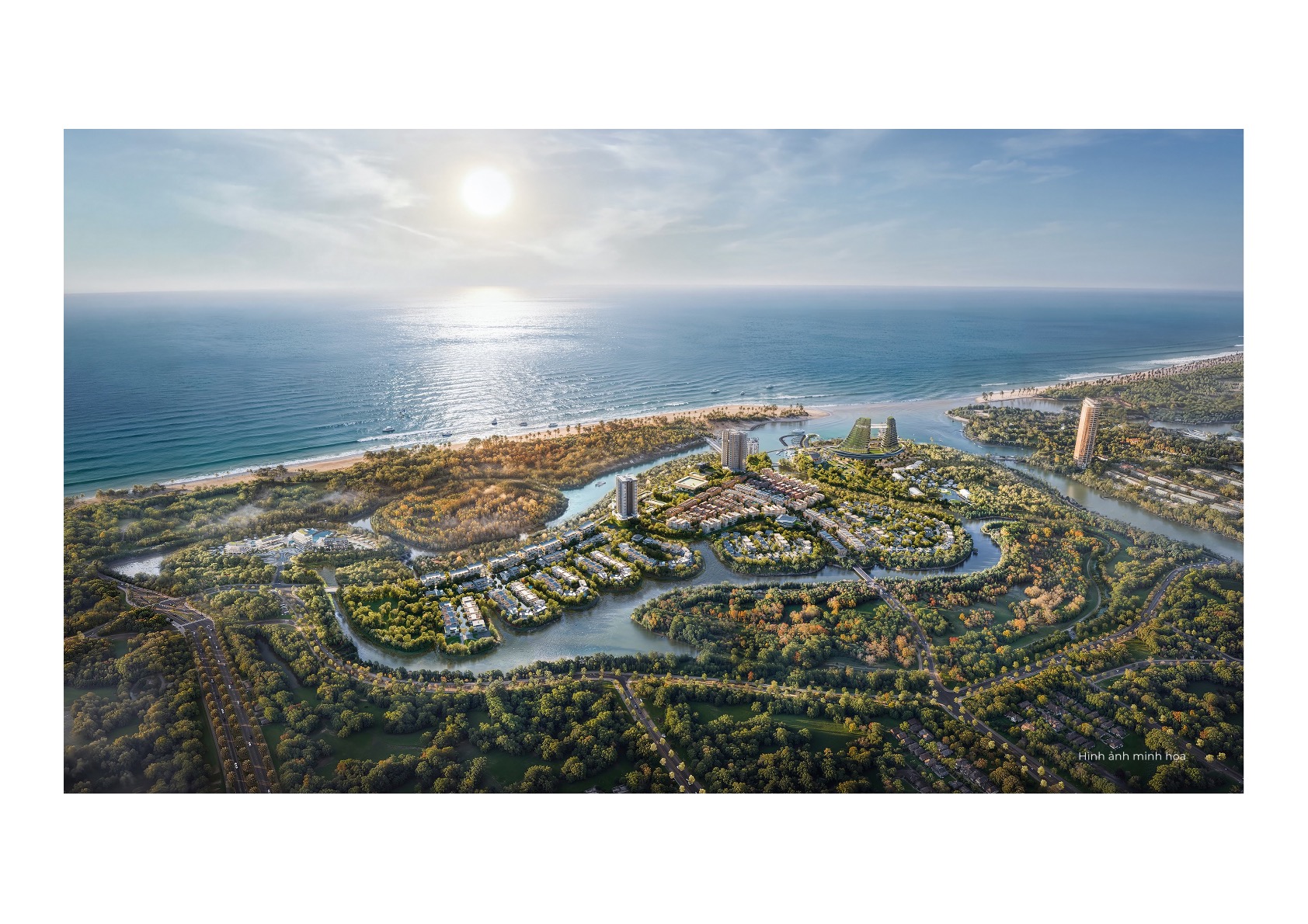
Haus Coastal Quang Ngai preserves 80,000 square meters (8 hectares) of native mangrove forest within the development boundary. SHMA designed the preservation strategy:
- Buffer zones prevent residential encroachment
- Elevated boardwalks allow human access without ecological disturbance
- Existing mangrove species are protected; supplementary native plantings restore degraded edges
- Tidal flow is preserved through engineered weirs that maintain natural cycles
This is rare. Most Vietnamese coastal developers clear mangrove for buildable land. HAUS chose to keep the mangrove as a permanent community asset — visible from many home windows, integrated into the daily resident experience.
Interior Gardens & Soft Hedging
Every villa subdivision at Haus Coastal includes SHMA-designed interior gardens. These are not afterthoughts — they’re calibrated for:
- Microclimate cooling — strategically placed trees reduce indoor cooling load by 10-15%
- Privacy without walls — soft hedging (typically 1.8-2.2m height) provides visual separation between adjacent properties without the harsh aesthetic of concrete walls
- Aesthetic continuity — same species palette across all subdivisions maintains visual unity of the development
Homeowners may not change SHMA-specified plantings or hedge species — this preserves the development’s coherent landscape character over time. This is a constraint, but most buyers welcome it as a guarantee against neighbors’ poor landscape choices reducing their own property value.
~ 30 AMENITIES
AMENITY DESIGN ACROSS 5 LIVING-EXPERIENCE LAYERS
- Mangrove Conservation Park
- Riverside Park
- Firefly Garden
- Biological Discovery Park
- Coastal & Riverside Walkways
- Sports Park
- Wellness & Healthcare Center
- Coastal Plaza
- Floating Market Plaza
- Family Park
- Fishing-Village Park
- K-12 International School
- Forest-Adventure Playground
- Biological Discovery Park
- 5-Star Resort
- Marina
- Shopping Street & F&B
- Design Exhibition Center
- Sunset Viewing Point
Why This Matters for Buyers
SHMA’s involvement has three concrete buyer benefits:
- Climate resilience without engineering ugliness — flood mitigation works, but you see mangroves and gardens, not concrete drainage channels
- Aesthetic continuity protects property values — the streetscape ages well because the landscape system was designed for 20-30 year maturation
- Microclimate benefits reduce operating costs — passive cooling from large water surfaces and shade canopy reduces air conditioning demand year-round
SHMA charges premium fees. HAUS paid them. The resulting landscape system is a measurable asset, not a cost line.
Update from the Haus Community Summit, September 2026: 12 Hectares of Mangrove and Reading the Land Back to 1898
Source for this section: Realtique’s first-hand notes from the Haus Community Summit – Back to School (09–10 September 2026, Ho Chi Minh City), where the design partners of the Haus ecosystem taught in person. Figures are as presented by the speakers and by Haus, not legal documents — prices and timelines must still be checked against official paperwork before any transaction.
At the Summit, Haus devoted a segment to how Shma approached Coastal Quang Ngai. The starting point was not a drawing but the history of the estuary from 1898 to 2025: how the currents shifted, where sediment settled, which native vegetation belongs here. From that, three decisions were announced:
- A mangrove reserve of roughly 12 hectares designed by Shma — instead of maximising the land bank. Note: the May 2026 training material used in this article cites 8 hectares of mangrove park inside the project boundary; the 12-hectare figure is Haus’s newer announcement at the Summit. Realtique keeps both until official documents settle it.
- The mangrove ecosystem is brought inside the residential area, not only kept along the protective corridor outside — mangrove species appear in the community landscape itself.
- Bioswales at the foot of every landscaped hill — the “landscape is infrastructure” principle Shma applied when converting a roughly 35,000 m² concrete depot into an urban forest with more than 1,400 native trees (the example Haus presented), now repeated at Coastal Quang Ngai: rainwater filters through sand layers before entering the shared drainage network.
The Asia’s Best Landscape Planning category awarded to Coastal Quang Ngai at the Asia Architecture Design Awards 2026 recognises exactly this work. Haus also replayed the day distribution partners planted a few hundred mangrove trees on site — a small act, but ESG by action rather than slogan. See also the responsible-lighting brief for the mangrove in the complete overview.
Get the Haus Coastal Quang Ngai Brief from Realtique
Latest pricing, payment policy, available units, legal status — our consultants respond within 2 business hours.
Vietnamese citizens and Việt Kiều (overseas Vietnamese) with eligible documentation can purchase. International readers — talk to us about Central Vietnam market context.