
Vietnam Apartment Tenure & Resolution 21: Does “Expiry” Mean Losing Your Home?
Since late July 2026, buyers across Vietnam have been asking the same worried question: “Are apartments now only owned for 50 years — so I lose everything after a few decades?”. The trigger is Resolution 21-NQ/TW, issued on 28 July 2026, which sets the direction to amend the Land Law and attach a usage tenure to newly built apartments. This guide explains what Resolution 21 says, the difference between a “50-year” and a “freehold-style” apartment, what it means for foreign buyers, and the key point: why “expiry” does not mean losing your home.
Resolution 21 & Apartment Tenure
Mục lục
What Resolution 21 Says About Apartments
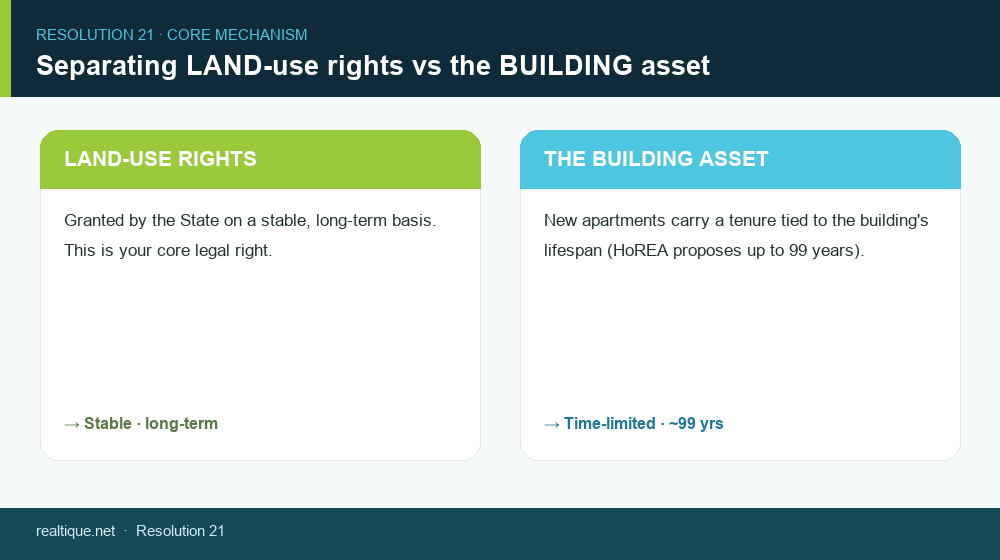
On 28 July 2026, the Party Central Committee issued Resolution 21-NQ/TW on the direction for amending the Land Law and related laws, replacing Resolution 18 of 2022. The core idea is a clear separation:
- Land-use rights for residential land are still granted by the State on a stable, long-term basis, ensuring legal certainty.
- The asset on the land — a newly built apartment building — carries a usage tenure based on the building’s lifespan.
The Ho Chi Minh City Real Estate Association (HoREA) has proposed a maximum tenure of no more than 99 years, in line with international practice (like Singapore’s HDB apartments). The resolution also directs greater transparency in planning, legal status and land prices, and a common land-price table with adjustment coefficients. This is a broad direction; the specifics will be set when the Land Law is amended.
"50-Year" vs "Freehold-Style" Apartments
This is the most misunderstood part. Hearing “50-year apartment”, many assume they will be evicted and lose everything after 50 years. In reality, “50 years” refers to the building’s usable lifespan, not your rights to the land.
What Happens When the Tenure Ends?
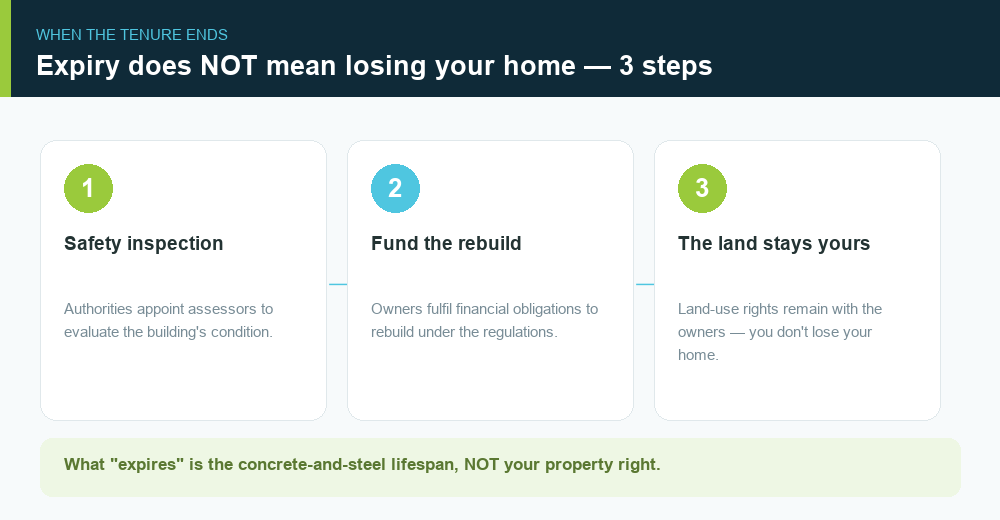
The question that keeps people up at night. The short answer: expiry is not losing your home.
Under the direction, when the design tenure ends or the building shows deterioration, the authorities appoint assessors to run a safety inspection. Owners are then entitled to fulfil financial obligations to rebuild the apartment under the regulations. In other words, the land still belongs to the owners; what “expires” is the lifespan of the concrete and steel, not your property right.
This mechanism is the answer to a problem stuck for years: countless half-century-old collective housing blocks in Hanoi and Ho Chi Minh City are badly degraded yet impossible to redevelop, because a few dissenting households can stall an entire project.
Does It Affect What You Already Own?
Under the current direction, tenure applies to apartments built in the future. Units with a stable, long-term land-use title that you already own are not retroactively affected. And again: Resolution 21 is still a direction — the exact tenure and the end-of-life financial mechanism are yet to be set through the amendment of the Land Law and Housing Law. There is no basis for a panic sell-off.
What It Means For Foreign Buyers
For foreign buyers, this is less alarming than the headlines suggest. Foreigners in Vietnam already commonly hold apartments on a 50-year renewable leasehold, within the 30% foreign-ownership cap per project. A building-lifespan tenure is therefore familiar territory, and Resolution 21 actually nudges Vietnam closer to international norms — think Singapore’s 99-year HDB flats or leasehold in Hong Kong and London.
For the rules that apply to you, see our guides on whether foreigners can buy property in Vietnam and the 30% foreign-ownership quota.
How It Changes The Way You Buy
According to Dr. Nguyen Tri Hieu, if the direction becomes reality, time becomes a valuation variable: an apartment with 20 years of lifespan left is clearly worth less than one with 50. Apartments stop being treated as an asset that “only goes up”, and return to their real nature — something to live in or to generate rental cash flow.
In that world, the most durable value belongs to well-connected locations — near metro lines and infrastructure, the logic of transit-oriented development. Read more: what TOD is & the Thu Thiem Mega Station, Thu Thiem vs The Global City, and if you are financing a purchase, our note on high loan interest rates in 2026.
Resolution 21 Is Also Changing How Land Prices Are Calculated
Beyond apartment tenure, Resolution 21 also signals moving away from real-time market-based land pricing toward a unified land price table plus an adjustment coefficient (the “K factor”). Ho Chi Minh City has already rolled this model out ahead of the rest of the country: the 2026 land price table (under Resolution 87/2025/NQ-HĐND) took effect 1 January 2026, and the K coefficient has applied since 1 July 2026, calculated as K = K1 × K2 × K3 — for high-rise projects, K2 ranges from 1 to 1.70 depending on floor-area ratio.
For buyers and sellers, the K coefficient is simply a multiplier applied to the base land price table when calculating land-related financial obligations (land use fees, transfer tax) for a specific project type — instead of rewriting the entire price table every time the market moves. This is still national-level policy direction; other provinces will roll out their own timelines once the Land Law amendment is finalized.
Frequently Asked Questions
Does Resolution 21 turn my apartment into time-limited ownership?
No. Under the direction, tenure applies to newly built apartments in the future. A long-term land-use title you already hold is not revoked. This is still a policy direction; details will be set when the Land Law is amended.
If the tenure ends, do I lose my home?
Expiry does not mean losing your home. When the building’s tenure ends or it deteriorates, authorities run a safety inspection and owners may fulfil financial obligations to rebuild under the regulations. The land-use rights stay with the owners.
What is the difference between a 50-year and a freehold-style apartment?
“50 years” refers to the building’s usable lifespan (often because the project land is leased for a fixed term), while a freehold-style title is tied to stable, long-term land-use rights with no stated term. A building tenure does not mean losing your rights to the land.
Does this change anything for foreign buyers?
Foreign buyers already commonly hold apartments on a 50-year renewable leasehold within the 30% foreign-ownership cap, so a building tenure is familiar. Resolution 21 actually moves Vietnam closer to international practice, similar to Singapore’s 99-year HDB apartments.
Should I buy an apartment now?
Shift the question from “buy and wait for price growth” to “is it good to live in, does it generate rent, is the legal status clean, and is it near strong transport links?”. For owner-occupiers and rental investors, a well-located unit remains a sound choice.
This is general policy commentary, not investment or legal advice. Resolution 21 is a Party direction; specifics (exact tenure, end-of-life financial mechanism) will be set through the amendment of the Land Law and related laws. Sources: Chinhphu.vn, LuatVietnam, HoREA.
What is the land price adjustment coefficient (K factor)?
It’s a multiplier — K1×K2×K3 — applied to the base land price table when calculating land financial obligations for a specific project type. For example, Ho Chi Minh City applies K2 of 1 to 1.70 for high-rise projects. It lets the price table keep pace with market moves without rewriting the whole table.
Is your apartment freehold or time-limited?
Leave your details and a Realtique advisor will check the legal status, tenure and rental-income potential of any apartment for you — a callback within two business hours, no obligation.
Hotline: +84 866 810 689

Grace Le
Grace Le is a Branch Manager at Realtique, guiding overseas and bilingual buyers through Vietnam’s ownership rules, legal due diligence and long-term value.