
What Is a Branded Residence? Where Vietnam Ranks in 2026 — and Why Three Reports Disagree
Short answer: a branded residence is a home that carries the name of a hotel or lifestyle brand — Ritz-Carlton, Marriott, Accor, Nobu — where that brand helps design the project and usually runs the services for residents to hotel standards. In Vietnam, most projects of this kind sit alongside a hotel of the same brand.
On 14 October 2026, the first The Brand Standard report by UK consultancy Global Branded Residences (GBR) ranked Vietnam third in the world by number of branded units (as reported by VnExpress). Earlier in the year Savills ranked Vietnam fourth, and in July C9 Hotelworks called it Asia’s number-one market. This guide explains what each of those numbers counts, where Vietnam’s branded homes are, and which ones foreigners can buy.
Branded Residences in Vietnam — 3 Reports, 3 Rankings
Table of Contents
What Is a Branded Residence?
A branded residence is a housing project whose developer signs an agreement with a hotel or lifestyle brand to use its name, its design standards and — most importantly — its operating services. Buyers are not only paying for the home; they are paying for a promise that the lobby, concierge, housekeeping, security and amenities will be run to the standard of the hotel that shares the name.
Three signs separate a genuine branded residence from a project with a borrowed name:
- A brand agreement between the developer and the hotel group (Marriott, Accor, IHG, Ritz-Carlton, Banyan…), with a fixed term and termination conditions.
- The brand runs or supervises operations — it does more than lend a logo to the façade.
- It usually sits with a hotel of the same brand: according to C9 Hotelworks, 83% of branded residence projects in Vietnam are attached to a hotel, 13% are in mixed-use complexes and only 4% stand alone.
For Ho Chi Minh City prices, our guide to luxury apartments in Ho Chi Minh City 2026 looks at why branded apartments in the centre are forecast to pass VND 1 billion per square metre. This article takes a different angle: where Vietnam sits on the world map of branded residences, and why each report gives it a different rank.
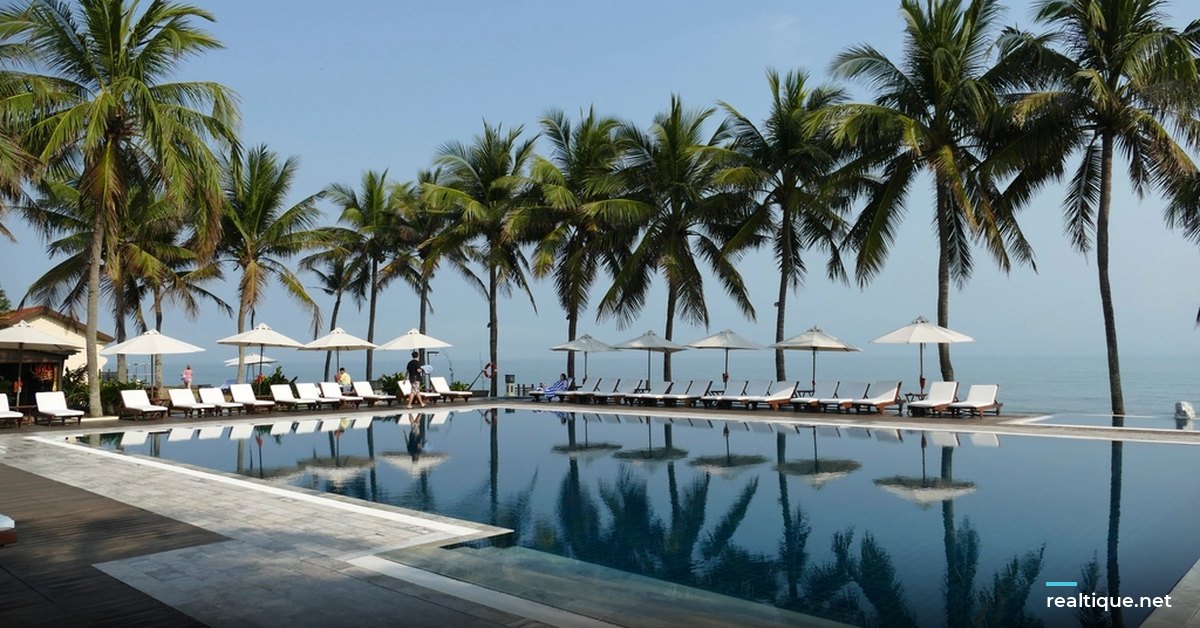
Illustrative photo: Rawpixel · CC0 1.0 (Realtique image kit, not a specific project)
New Report, 14 October 2026: Vietnam Ranks Third Worldwide by Units
According to VnExpress on 14 October 2026, the first The Brand Standard report by Global Branded Residences (GBR) — a UK consultancy founded in 2023 by Riyan Itani, formerly head of Savills’ global residential development consultancy — counts 16,135 branded units across 68 projects in Vietnam (completed and in development), placing it third in the world behind the UAE (84,972 units) and the United States (71,592 units).
| Indicator (GBR) | Vietnam |
|---|---|
| Total units / projects | 16,135 units · 68 projects — 3rd worldwide by units |
| Completed projects | 19, mostly in coastal destinations |
| Projects not yet completed or handed over | 49 — 6th worldwide for future supply (after the UAE, US, Mexico, Brazil and Saudi Arabia) |
| Within Asia–Pacific | 2nd by number of projects, after Thailand (73) and ahead of India (61) |
| Largest operator | Accor — 23 projects, 7,854 units (almost half of all units) |
| Largest single project in Asia–Pacific | Mercure Residences Ha Long — 2,259 units |
Two details stand out. First, more than 70% of the projects (49 of 68) are not yet complete — so much of Vietnam’s ranking is supply under construction, not product already in operation. Second, Accor alone (Fairmont, Sofitel, Mercure, Novotel) accounts for almost half of the units, and a single Mercure project in Ha Long contributes 2,259 — so the ranking by units is pulled up by a few very large projects in the upper-mid segment, not only by ultra-luxury.
At the time of writing these figures come from one Vietnamese news source (VnExpress citing the GBR report); Realtique will cross-check them when the full report is more widely published.
Third, Fourth or Number One in Asia? Three Reports Counting Three Different Things
Anyone reading property news in 2026 will meet at least three different rankings for the same market. None of them is wrong — they use different denominators:
| Report | Released | Counts | Scope | Vietnam |
|---|---|---|---|---|
| GBR — The Brand Standard | Oct 2026 | Units (completed + in development) | Global | 3rd · 16,135 units / 68 projects |
| Savills — Branded Residences 2025–2026 | Late 2025 (reported Mar 2026) | Projects | Global | 4th (after the US, Saudi Arabia, Mexico) · 50+ projects, 34 international brands |
| C9 Hotelworks — Asia Branded Residences Market Review 2026 | Jul 2026 | Market value | Asia | No. 1 in Asia · ~VND 211,200 billion (~US$8 billion), 20% of Asia |
Why they differ:
- Units or projects: Vietnam has a few very large projects (such as Mercure Residences Ha Long), so it ranks higher by units than by number of projects.
- Future supply or launched stock only: C9 puts Vietnam first in Asia when unlaunched projects are included (15,762 units, 47 projects), but on launched stock alone Thailand is slightly ahead (13,124 against 12,592 units).
- Different cut-off dates: Savills published at the end of 2025, C9 in mid-2026 and GBR in October 2026 — new projects announced in between are added along the way.
The practical reading for buyers: a “number X in the world” headline describes the size of the industry, not the quality of any one project. What all three reports agree on is that Vietnam has become one of the largest branded residence markets, and that most of its supply is still ahead.
Where Are Vietnam’s Branded Residences?
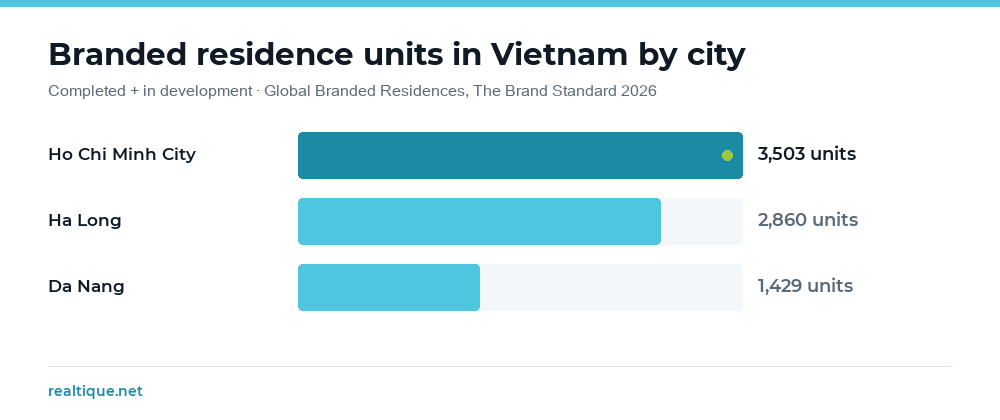
On GBR’s count, Ho Chi Minh City leads with 3,503 units, followed by Ha Long with 2,860 and Da Nang with 1,429. Look only at completed projects, though, and the map tilts firmly to the coast: Da Nang 8 projects, Phu Quoc 7, Hoi An 6, Ha Long 5. In other words, the branded homes already operating in Vietnam are mostly resort product, while urban branded residences — Ho Chi Minh City above all — are largely still being built.
In Ho Chi Minh City, VnExpress reports that a project operated under The Ritz-Carlton Residences brand has reached a selling price of VND 1 billion per square metre — in line with the scenario our Ho Chi Minh City luxury apartment guide set out in August.
Graphic: Realtique · Data: Global Branded Residences, The Brand Standard 2026 (VnExpress, 14 October 2026)
Why the City-by-City Numbers Don’t Match Between Reports
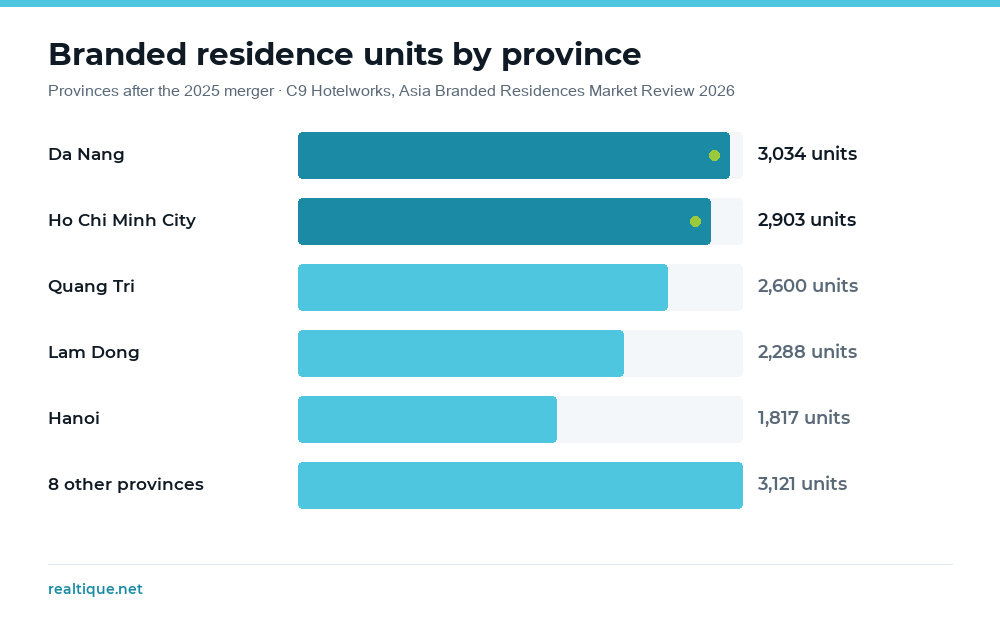
Put the two reports side by side and C9’s Da Nang (3,034 units) is twice GBR’s Da Nang (1,429 units), while C9 lists places such as Quang Tri (2,600) and Lam Dong (2,288) that GBR does not name. Realtique’s reading (not yet confirmed by either firm):
- C9 counts by province after the 2025 mergers: the new Da Nang includes the former Quang Nam (with Hoi An), the new Quang Tri includes the former Quang Binh, and the new Lam Dong includes the former Binh Thuan.
- GBR counts by city or destination: Hoi An, Ha Long and Phu Quoc are listed separately from their provinces.
This is the kind of reshuffle common after Vietnam’s 2025 provincial mergers: neither number is wrong, the two firms simply draw the boundaries differently. When comparing two places, make sure both figures come from the same report. The provincial figures in C9’s report add up to that report’s own total of 15,762 units.
Graphic: Realtique · Data: C9 Hotelworks, Asia Branded Residences Market Review 2026 (eHotelier, 20 July 2026)
Can Foreigners Buy a Branded Residence in Vietnam?
The answer depends on the type of property, not on the brand:
| Type | Typical examples | Foreign buyers |
|---|---|---|
| Branded apartment in a commercial housing project (urban) | Hotel-branded apartments in Ho Chi Minh City and Hanoi | Can hold title if the project is on the list open to foreign ownership; up to 30% of units per building; 50-year term, renewable |
| Hotel-attached resort villa or condo | Coastal projects in Da Nang, Hoi An, Phu Quoc, Ha Long | Usually not “housing” under the Housing Law; often sold through a long-term lease or a project-specific legal structure |
For example, Nobu Residences Danang sells to foreign buyers through a long-term lease agreement rather than a pink book, and hotel-branded villas such as Mandarin Oriental Da Nang have their own legal structure. Because 83% of Vietnam’s branded projects are attached to hotels (C9), most of the supply behind the “third in the world” headline falls into the second group — foreign buyers need to read the contract rather than assume a title certificate.
Overseas Vietnamese who still hold Vietnamese citizenship buy as domestic citizens and do not count towards the 30% quota; people of Vietnamese origin with foreign citizenship only are treated as foreigners. The full sequence from reservation to title is in our step-by-step property buying guide.
Before You Buy a Branded Unit: Five Questions to Ask
- How long does the brand agreement run, and what happens if it ends? The brand name is part of the price you pay; if the agreement expires or is terminated, the name and the services can go with it.
- Who operates the building, what are the service charges and how do they rise? Hotel-standard operating fees are usually well above ordinary condominium management fees.
- Residential land or commercial-service land? This decides whether the unit carries a long-term title, a fixed-term title or only a lease right.
- Who runs the rental programme and how is revenue shared? How many years of guaranteed returns, and who stands behind that guarantee.
- Construction progress and developer track record. 49 of the 68 projects in GBR’s count are not yet complete — an off-plan branded unit carries the same delivery risk as any other project.
Frequently Asked Questions
What is a branded residence?
A branded residence is a housing project tied to a hotel or lifestyle brand, where the brand helps design the project and usually runs services for residents to hotel standards. In Vietnam, about 83% of such projects sit alongside a hotel of the same brand (C9 Hotelworks).
Where does Vietnam rank for branded residences?
It depends on how they are counted. The Brand Standard report by Global Branded Residences (reported by VnExpress on 14 October 2026) ranks Vietnam third in the world by units, with 16,135 units across 68 projects; Savills ranks it fourth by number of projects; C9 Hotelworks ranks Vietnam first in Asia by value, at about US$8 billion.
Where are branded residences located in Vietnam?
On GBR’s count, Ho Chi Minh City has the most units (3,503), followed by Ha Long (2,860) and Da Nang (1,429). Completed projects are mainly on the coast: Da Nang 8, Phu Quoc 7, Hoi An 6 and Ha Long 5 projects.
Can foreigners buy branded residences in Vietnam?
Yes for branded apartments in commercial housing projects that are on the list open to foreign ownership — up to 30% of units per building, for a 50-year renewable term. Hotel-attached resort villas and condos are usually not housing under the Housing Law and are often sold through long-term leases, so each project must be checked.
What should I check before buying a branded residence?
Five points: the term and termination conditions of the brand agreement; the operator and service charges; the land type (residential or commercial-service); the rental programme and who guarantees any return; and the developer’s progress and track record.
⚠️ Note: GBR figures are taken from VnExpress on 14 October 2026 (a single Vietnamese news source at the time of writing); Savills and C9 Hotelworks figures come from announcements of those reports (Viet Nam News, 18 March 2026; eHotelier, 20 July 2026). Each report uses its own method and cut-off date, so the numbers cannot be added up or compared directly. The explanation of provincial differences is Realtique’s reading. This article is not legal or investment advice — the legal structure of each branded project must be checked before paying a deposit.
Luxury Apartments in Ho Chi Minh City 2026: Price Tiers, Branded Residences and the 30% Rule
Read more →Vietnam’s 30% Foreign Ownership Quota Explained (2026)
Read more →Nobu Residences Danang Price & Legal: Long-Term Lease for Foreign Buyers
Read more →The Property Buying Process in Vietnam: A Step-by-Step Guide (2026)
Read more →Considering a branded residence in Vietnam?
Send Realtique the project name. We will read the brand agreement, the land type and the rental programme with you, check whether a foreign buyer can hold title, and compare the price with other branded projects nearby before you pay a deposit.
📞 Hotline: +84 866 810 689

KC Pham
KC Pham advises investors, overseas Vietnamese and foreign buyers on branded apartments in Ho Chi Minh City and hotel-branded villas in Da Nang: reading the brand agreement, telling residential land from commercial-service land, and modelling the rental programme before any deposit is paid.