
International University Township Opens to Foreign Buyers
On 18 November 2026 Ho Chi Minh City added the residential areas of the International University Township in Xuan Thoi Son commune to the list of housing projects that foreign organisations and individuals may own. The 880-hectare scheme is developed by Berjaya Vietnam International University Township JSC, a Vingroup member company.
Realtique noted the announcement landed in the same week Knight Frank published its read on who is actually buying homes in Vietnam. Put side by side, the two tell you the eligible-project list is growing faster than foreign buyers are using up the quota that already exists.
One More Project Opens, and the National Picture
Table of Contents
A New Name on the Eligible List
Under the 18 November announcement, the residential components of the International University Township now sit on the city’s foreign-ownership list. The detailed breakdown of which products qualify will be published by the city and the Department of Construction.
This is the latest in a run of additions through 2026. An earlier round added five projects in Thao Dien, Truong Thanh and other districts, taking the list to roughly 170 projects.
Source: VnExpress, Nguoi Quan Sat, 18–19 November 2026.
880 Hectares on the North-West Edge
The township sits in Xuan Thoi Son commune on the northern approach to Ho Chi Minh City, linked to National Highway 22, Ring Road 3 and the HCMC–Moc Bai expressway.
| Metric | Figure |
|---|---|
| Total area | close to 880 ha |
| Residential land | about 436 ha |
| Total investment | around VND 59,000 billion (about USD 2.3 billion) |
| Planned population | about 135,000 residents and 60,000 students |
| Groundbreaking | 29 April 2026 |
| Expected operation | from early 2035 |
The master plan is a knowledge-city model combining education, research, retail and housing. The product mix runs from villas and townhouses through resettlement housing to apartments and social housing. The 2035 operating date is a target and may move.
Listed Does Not Mean Available
Being on the list does not make every unit in a project sellable to foreign buyers. Social housing and resettlement housing fall outside it, and every transaction still has to fit within the ownership caps.
Three limits are worth checking before any deposit on a listed project.
The 30% cap per building. Foreign organisations and individuals may own at most 30% of the apartments in a single residential tower. How fast that allowance fills varies sharply from tower to tower.
250 landed homes. For landed property the cap is 250 units within an area the size of a ward — a figure that matters in a scheme with this many villas and townhouses.
A 50-year term. Individual foreign owners hold for up to 50 years from the date the ownership certificate is issued, with one extension available for consideration.
Who Is Buying in Vietnam
Knight Frank’s Vietnam Real Estate Investment Guide 2026 counts 6,188 apartments bought by foreigners in Vietnam as of October 2026, compiled from Ministry of Construction disclosures and project-level surveys.
South Koreans lead with 48%, followed by mainland China at 31%. Hong Kong and Taiwan together account for 10%, Singapore 2% and other countries 9%. North-east Asia alone therefore makes up 89% of all apartments bought by foreigners.
The pattern follows capital flows. South Korea leads cumulative registered FDI at USD 102.7 billion as of August, while Singapore led newly registered capital over the first ten months with more than USD 9.5 billion. Housing demand follows the managers, specialists and families who come with that money.
Source: Knight Frank and the Foreign Investment Agency, via VnExpress, 18 November 2026.
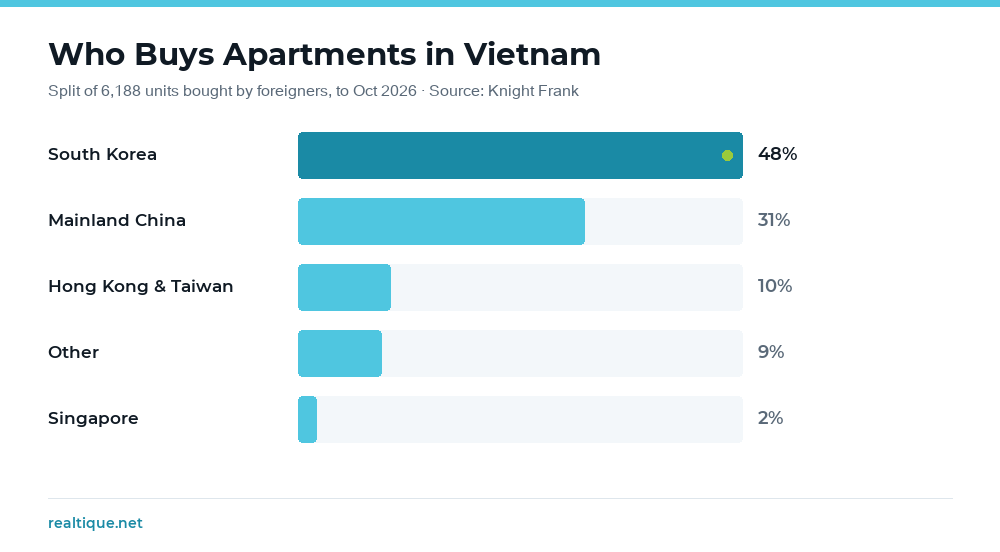
Graphic: Realtique · Data: Knight Frank, to October 2026
Only 21% of the Quota Is Used
In Ho Chi Minh City, the Department of Construction list covering June 2025 to October 2026 holds 158 eligible projects with a combined cap of 15,841 apartments.
Of those, 3,297 units are under signed sale contracts, around 21% of the cap. Only 316 units have received an ownership certificate — 9.6% of the units already sold.
That gap between contracts signed and titles issued is the most telling number in the set. It says the bottleneck in the foreign-buyer market is completing ownership paperwork, not a shortage of projects to choose from.
Foreign buyers concentrate in apartments. Villas, shophouses and townhouses stay rare for them because of legal limits, ownership ratios and the larger ticket size.
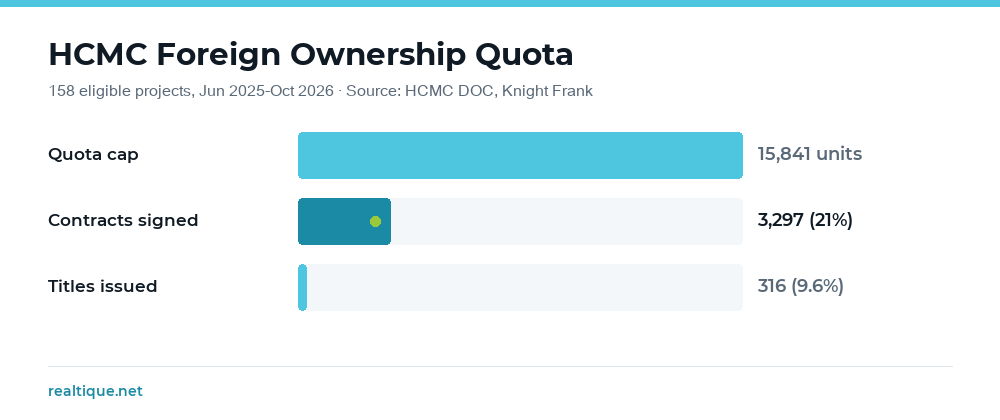
Graphic: Realtique · Data: HCMC Department of Construction and Knight Frank, Jun 2025–Oct 2026
Vietnam Ranks Fourth in the Region
Knight Frank’s survey of six South-East Asian markets places Vietnam fourth for how easy it is for foreigners to buy, behind Thailand, Malaysia and Singapore but ahead of Cambodia and Indonesia.
| Market | Barrier score (out of 50) |
|---|---|
| Thailand | 17 |
| Malaysia | 21.5 |
| Singapore | 22 |
| Vietnam | 28.5 |
A higher score means a higher barrier. Within Vietnam’s score, ownership rights weigh heaviest at 7.5 out of 10, followed by build quality at 6.5 and legal framework and transparency at 6 each.
Transaction cost runs the other way and is a clear advantage: 4 barrier points against Singapore’s 9.5 and Indonesia’s 7. For anyone comparing several markets, that is why Vietnam still works despite the shorter ownership term.
What to Watch Next
For the International University Township, the near milestone is the Department of Construction publishing the detailed list of qualifying sub-zones and remaining quota. Until that appears, no specific product in the scheme can be described as available to foreign buyers.
For capital that has to work within a few years, 2035 is too far out. Completed and near-completion projects already on the list remain where rental income actually exists.
The practical next step is to check three numbers on any tower under consideration: foreign allowance remaining, achieved rents in that micro-market, and the management fee. Those decide the yield far more than the headline that a project joined the list.
Frequently Asked Questions
Can foreigners buy the villas and townhouses in this project?
In principle yes, but the ceiling is far tighter than for apartments: a maximum of 250 landed homes within an area the size of a ward. In a scheme of close to 880 hectares with a large landed component, that allowance fills quickly, so the remaining count has to be checked at the moment of purchase.
What happens when the 50-year term expires?
One extension is available for consideration. If it is not granted, the owner can sell or gift the property before expiry, and a domestic buyer takes it on long-term tenure. There is little precedent yet because the first 50-year terms have not matured, so holding-period planning should assume the term matters.
Do overseas Vietnamese count against the 30% quota?
Vietnamese nationals living abroad who still hold Vietnamese citizenship buy on the same terms as residents: no 30% quota, no 50-year limit. People of Vietnamese origin who have given up citizenship are treated as foreign buyers. Citizenship documents decide this, not country of residence.
Why have only 9.6% of sold units received a certificate?
The Knight Frank figures record the gap without attributing causes case by case. In practice most units on the list are still under construction or recently handed over, so certification has not begun, while the rest wait on per-tower quota confirmation. The useful question for a buyer is the certification record of that specific tower.
The township opens in 2035 — what is buyable now?
No sales launch date for its housing has been announced. Capital that needs income in the near term belongs in the completed projects among HCMC’s 158 listed schemes, where achieved rents and management fees already exist as real numbers to build a yield calculation on.
⚠️ Note: List information follows the Ho Chi Minh City People’s Committee announcement of 18 November 2026; the detailed schedule of qualifying products will be published separately by the Department of Construction. Market-share and quota figures come from Knight Frank’s Vietnam Real Estate Investment Guide 2026, current to October 2026. The 2035 operating date is a target and may change. This article is not investment or legal advice.
Want to know which towers still have foreign allowance left?
Send Realtique your budget and holding horizon. We come back with the projects that still have foreign quota available, the rents actually being achieved in each area, the management fee for each tower, and what we can see of their certification record.
📞 Hotline: +84 866 810 689

KC Pham
KC Pham advises foreign buyers and overseas Vietnamese on Ho Chi Minh City apartments — setting real rental income against deposit rates and checking legal status and foreign quota before a client commits.