
Vinhomes Green Paradise Can Gio Location & Infrastructure: 13 Minutes to District 1
Mục lục
The single biggest driver of Vinhomes Green Paradise Can Gio‘s potential is not the land itself but the wave of infrastructure turning Can Gio from an isolated coastal district into a new growth pole of Ho Chi Minh City. This article analyses the project’s location and each major infrastructure project reshaping the region’s connectivity map.
Where Is Vinhomes Green Paradise Can Gio?
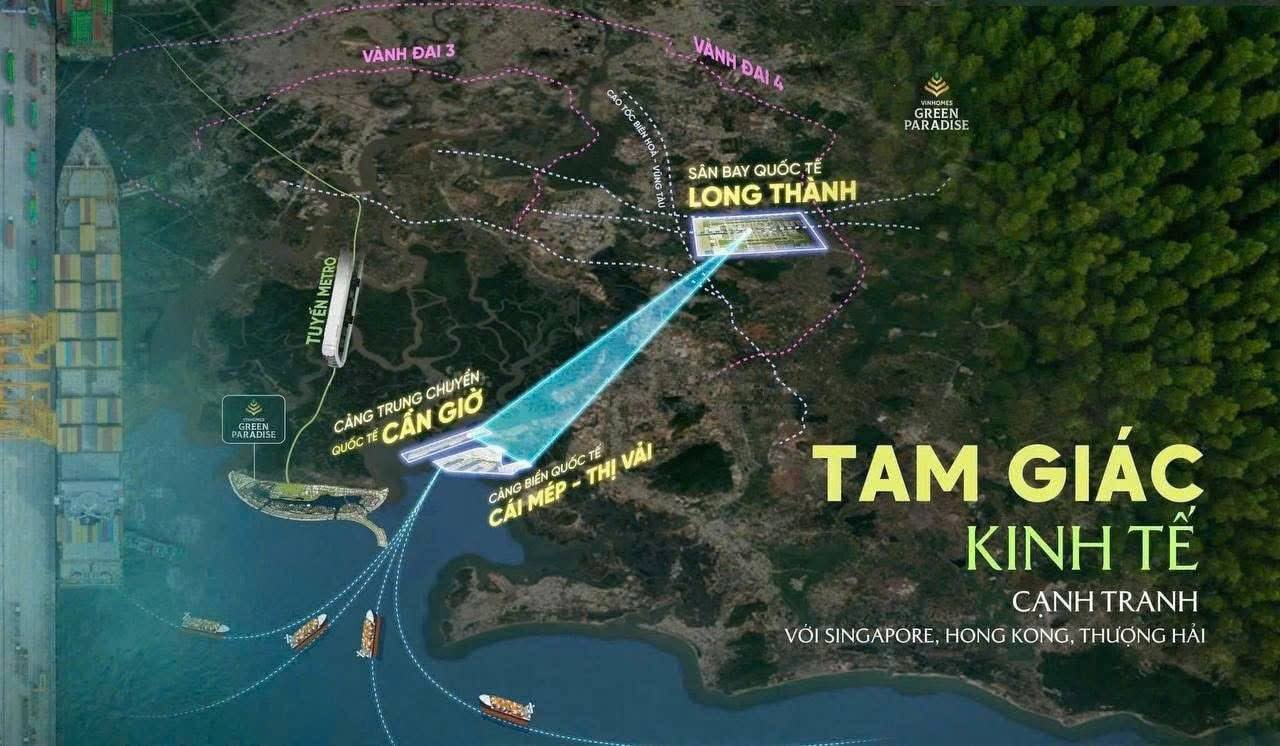
The project sits on the Can Gio coast — the only coastal district of Ho Chi Minh City — around 50 km from District 1 by existing roads, separated only by the Soai Rap river. Behind it lies the 75,000-hectare Rung Sac mangrove biosphere; in front, the East Sea, facing Vung Tau roughly 14 km away.
This “close yet far” gap is exactly why transport infrastructure is the key: once new links complete, actual travel time to the centre will shorten dramatically, lifting regional property values with it.
The Ben Thanh – Can Gio Metro
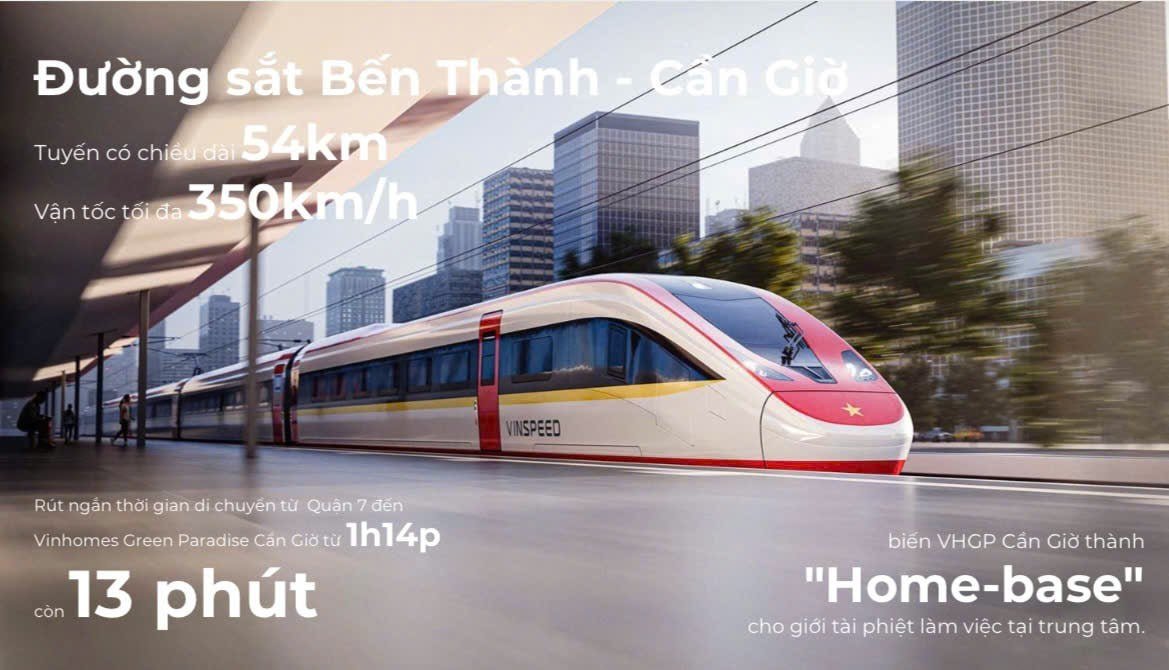
Per public announcements, Vingroup has proposed investing in a high-speed urban rail line connecting Ben Thanh (District 1) with Can Gio. As a privately proposed project, it aims to cut travel time to the centre to around 13 minutes. If delivered on plan, this line would fundamentally reset how the market prices Can Gio real estate — from “weekend resort” to “everyday city”.
The Can Gio Bridge & the Can Gio – Vung Tau Sea Bridge
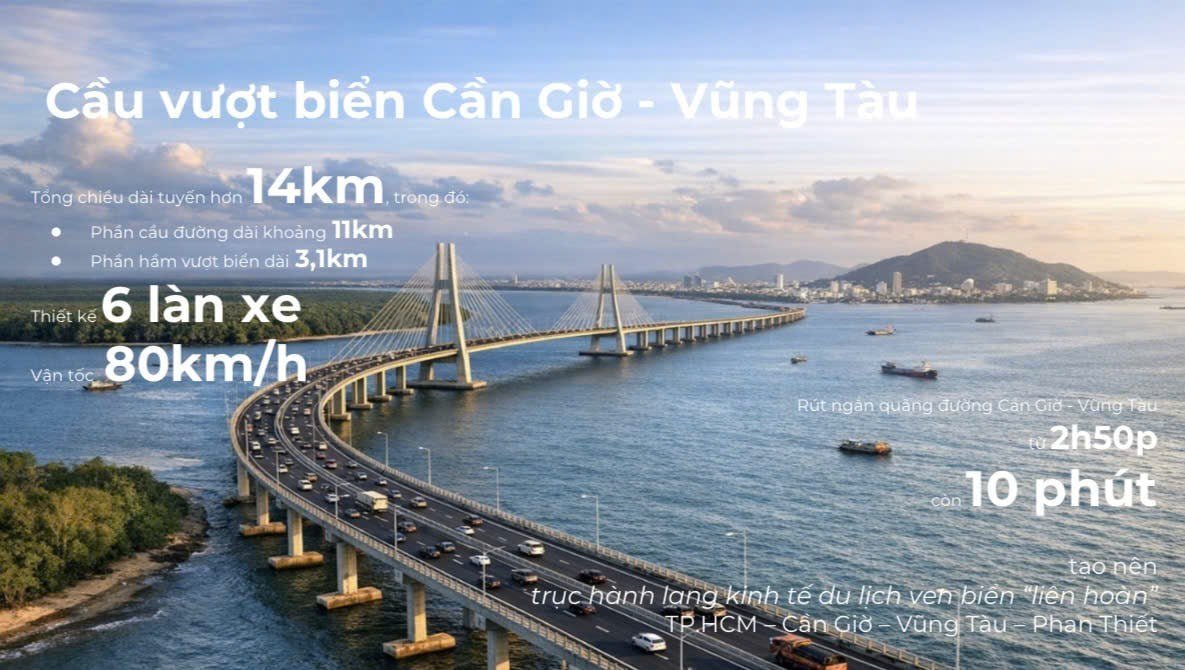
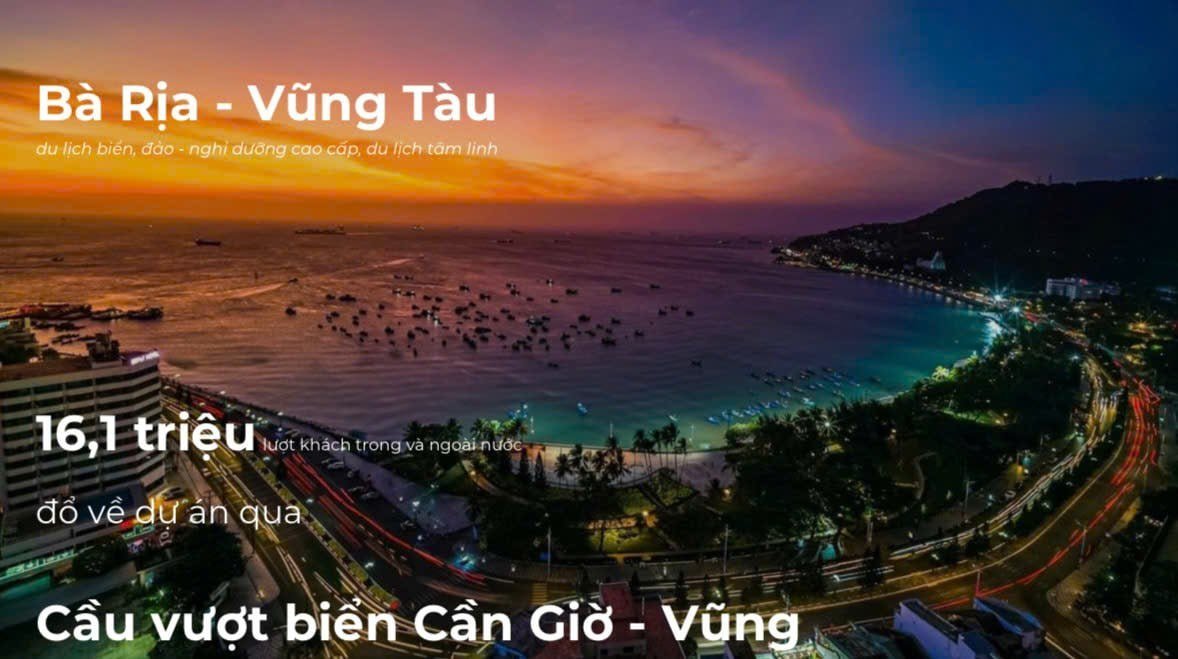
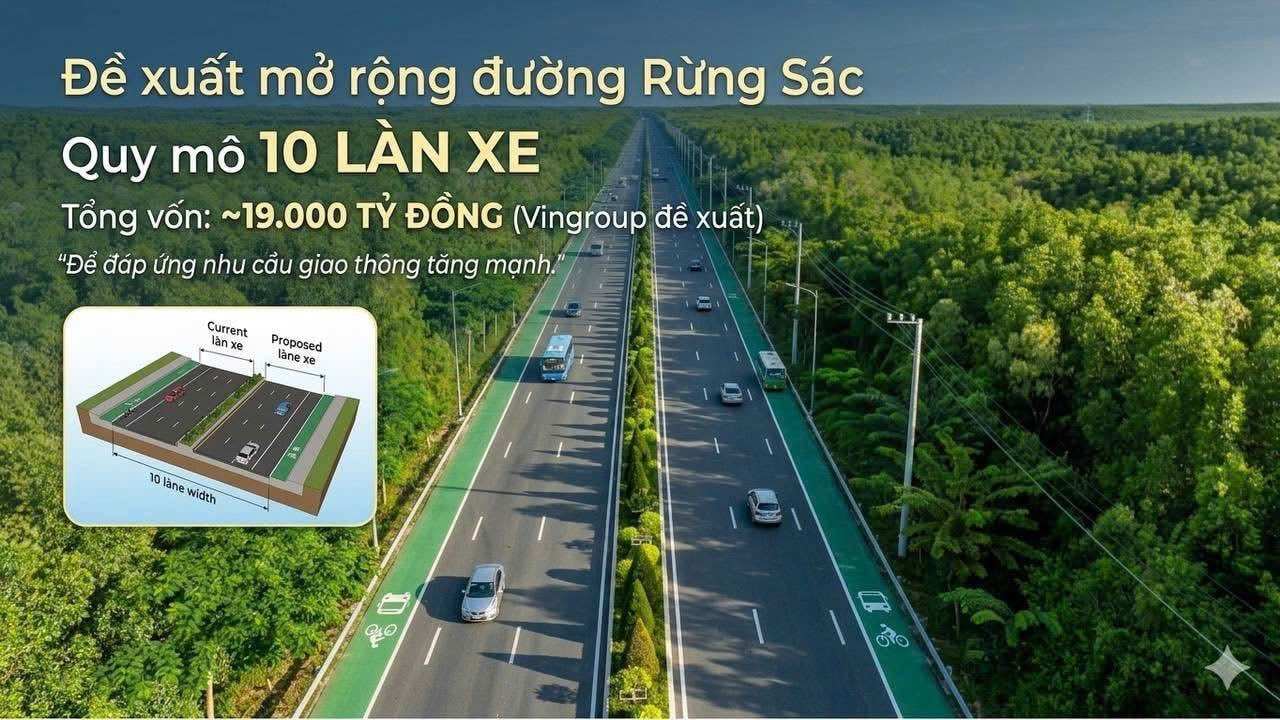
The Can Gio bridge is planned to replace the Binh Khanh ferry, linking Can Gio directly to the Nha Be area and the city centre, with a landing point near Zone B. In parallel, the Can Gio – Vung Tau sea-crossing bridge — around 14 km long, reported as the largest sea bridge in Vietnam — would shorten the distance between the two biggest resort-beach hubs in the south.
Together with the metro, these two bridges form a connectivity “tripod” for Can Gio.
Update, 29 September 2026: ground was broken on the Can Gio Bridge on 15 January 2026 — about 6.3 km long, six lanes, announced total investment above VND 13,200 billion, with construction planned for 2026–2029. How the bridge and the Ben Luc – Long Thanh expressway fit together is covered in the update just below.
Expressway, Long Thanh Airport & the Can Gio Super-Port
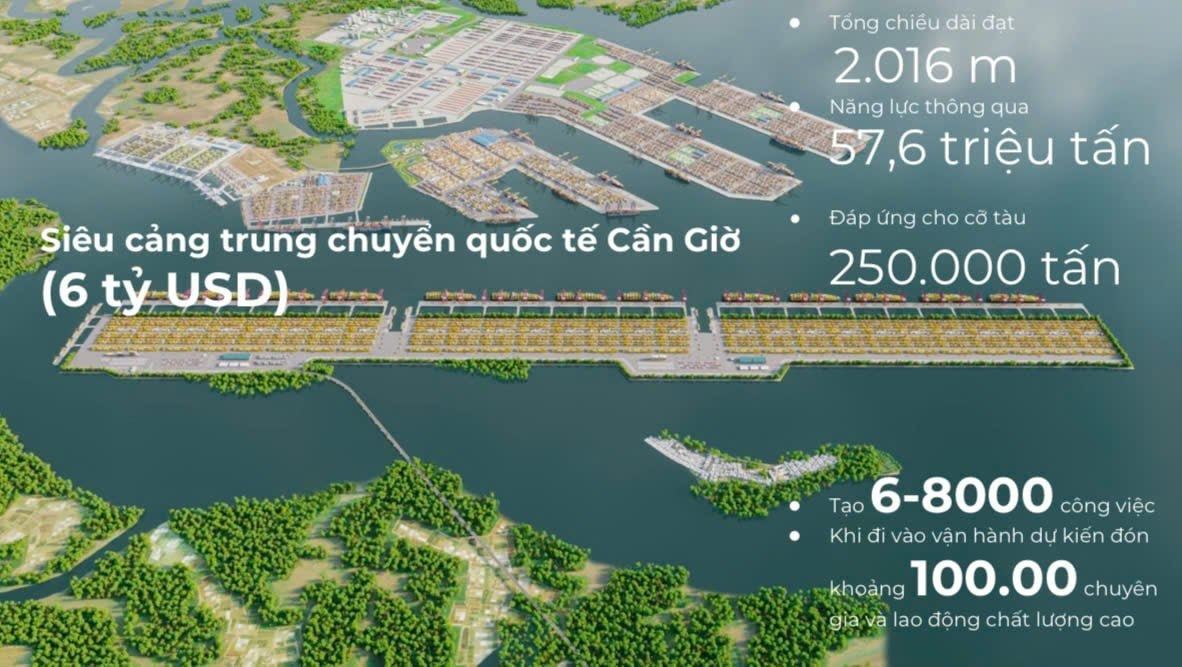
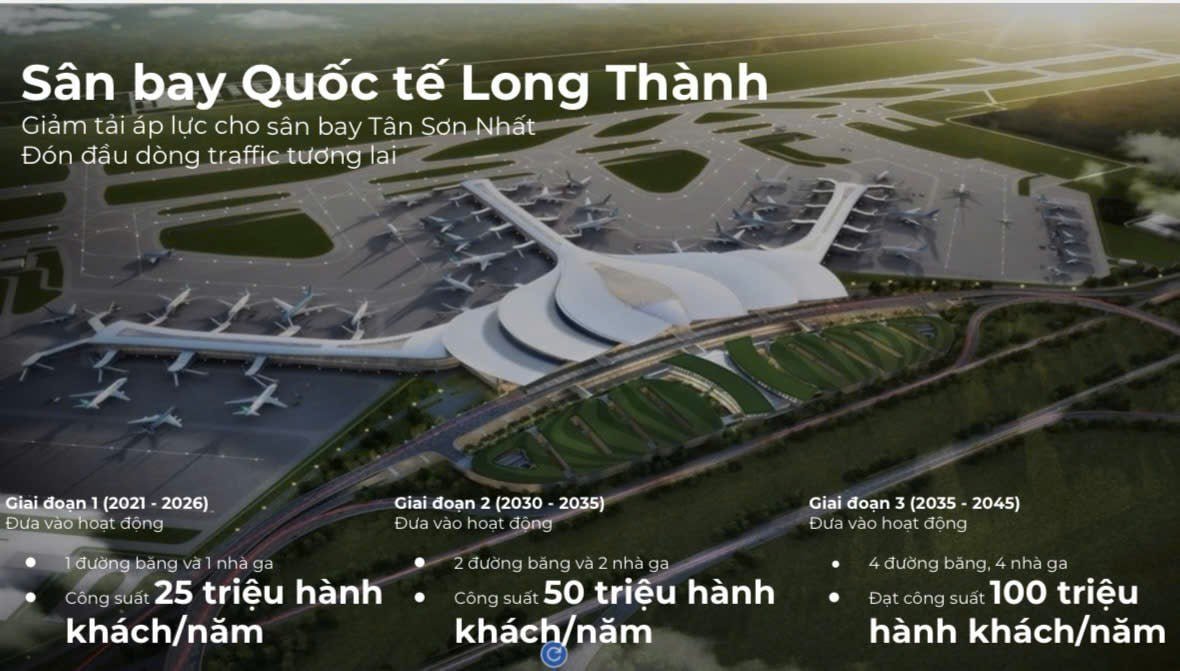
At the regional scale, the Ben Luc – Long Thanh expressway connects Ring Road 3 and Long Thanh International Airport — Vietnam’s largest airport under construction — placing Can Gio on the international aviation axis. Meanwhile, the Can Gio international transshipment super-port, about 14 km from the project, is expected to become a major transshipment hub, anchoring the HCMC – Long Thanh – Can Gio economic triangle.
August 2026 update: the port now has an approved investor consortium — VIMC, Saigon Port and Terminal Investment Limited (part of shipping line MSC) — with total investment of roughly VND 128,872 billion across 571 hectares. However, construction has not yet begun; the current target is Q4 2026. For the full timeline, ownership structure and an honest read on how much the port actually affects local property values, see Can Gio Mega Port: Has It Broken Ground?
Update, 1 October 2026: The Ben Luc – Long Thanh Expressway Is Now Open End to End — What It Means for Can Gio
The news: under the plan of expressway operator VEC, the 57.8 km Ben Luc – Long Thanh expressway opened end to end to all vehicles at midnight on 1 October 2026 (the night of 30 September), with tolling from the same moment, following load tests on Phuoc Khanh Bridge from 25 to 29 September (Dan Tri, 28 Sep; VTV, 28 Sep). The project — begun in 2014 — was originally budgeted at roughly VND 31,300 billion, since adjusted to about VND 29,587 billion (VnExpress, 1 Oct). It crosses Can Gio on two cable-stayed spans, Binh Khanh and Phuoc Khanh, whose 55 m navigational clearance is among the highest in Vietnam, before running on through Nhon Trach to Long Thanh International Airport and the Cai Mep – Thi Vai port cluster.
What buyers at Vinhomes Green Paradise should know: the expressway passes through Binh Khanh commune, but Can Gio does not yet have its own on/off ramp — residents still reach the city via a single road, Rung Sac (Dan Tri, 12 Sep). The dedicated link is the Rung Sac interchange: a diamond-type junction on about 21.44 ha, budgeted at roughly VND 2,970 billion from the city (about VND 994 billion for compensation and resettlement, about VND 1,568 billion for construction), scheduled for 2025–2028, with a stub reserved for the future Can Gio Bridge (Nguoi Lao Dong, 18 Jun; Dan Tri, 12 Sep). Binh Khanh commune published its compensation plan on 20 September (Tuoi Tre, Thanh Nien).
Read it as a three-step sequence: (1) 30 September 2026 — the expressway spine opened from the west to Long Thanh airport (VTV cites the My Yen – Long Thanh run falling from about two hours to 40–45 minutes); (2) 2026–2029 — the Can Gio Bridge (ground broken 15 January 2026, announced total investment above VND 13,200 billion) replaces the Binh Khanh ferry; (3) by 2028 — the Rung Sac interchange puts Can Gio directly onto the expressway. The 30 September opening is the first piece of the chain rather than the last; the project’s full “one drive to Long Thanh airport” advantage arrives when steps 2 and 3 are done — which is exactly the window today’s buyers are positioning for.
Update, 1 October 2026: the full route has been in service since midnight on 1 October, with electronic non-stop tolling (ETC) at VND 2,000 per standard vehicle per km — roughly VND 111,700 end to end for cars under 12 seats up to about VND 446,800 for heavy trucks and containers; motorbikes are not allowed; maximum 90 km/h, 80 km/h on some sections (Dan Tri, 30 Sep; VnExpress, 1 Oct). The Tan Hiep interchange at the eastern end (the link to the Bien Hoa – Vung Tau expressway) is not yet open (concerns over the slope of bridge N12); on 4 October Standing Deputy Prime Minister Phạm Gia Túc agreed to put it into operation during October 2026, with no exact date announced (Tuoi Tre, 4 Oct; VnExpress, 5 Oct). Speed limits run 60–90 km/h by section; in force 7–8 crosswinds, drivers on the Binh Khanh and Phuoc Khanh bridges are advised to slow below 60 km/h (Dan Tri, 28 Sep).
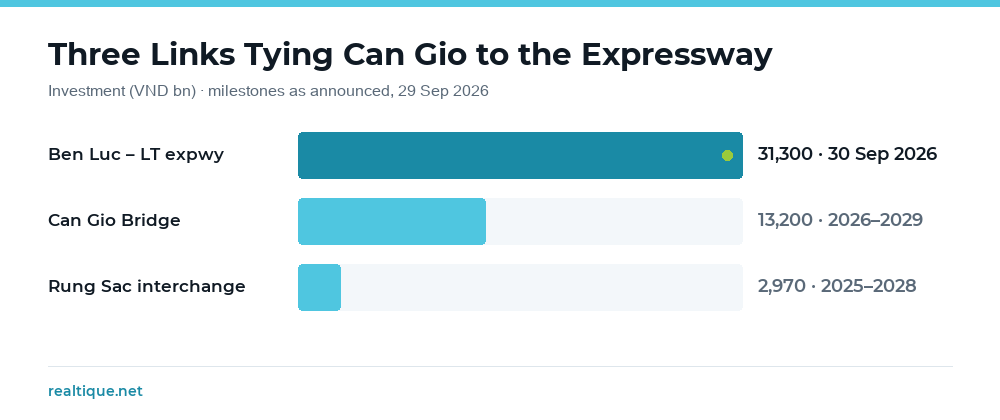
Graphic: Realtique · Data: VnExpress 24 Sep & Dan Tri 28 Sep 2026 (expressway); Tuoi Tre, Thanh Nien 15 Jan 2026 (Can Gio Bridge); Nguoi Lao Dong 18 Jun & Dan Tri 12 Sep 2026 (Rung Sac interchange).
Key Infrastructure Summary
| Infrastructure | Role | Status (per announcements) |
|---|---|---|
| Ben Thanh – Can Gio metro | ~13 min to District 1 | Proposed for investment |
| Can Gio bridge | Replaces Binh Khanh ferry | Ground broken 15 Jan 2026 · built 2026–2029 |
| Can Gio – Vung Tau sea bridge | Links two resort-beach hubs | In planning |
| Ben Luc – Long Thanh expressway | Links Ring Road 3 & Long Thanh | Open end to end since 1 Oct 2026 |
| Rung Sac interchange | Can Gio’s on/off ramp to the expressway | Compensation Sep 2026 · delivery 2025–2028 |
| Long Thanh International Airport | International aviation gateway | Under construction |
| Can Gio super-port | Regional logistics hub | Planning / proposed |
Note on information & pricing: Prices, policies and timelines in this article are indicative, compiled from developer materials at the time of writing and subject to change with each sales phase. Please contact Realtique at +84 866 810 689 for the latest price list and policy for each specific unit.
How Infrastructure Affects Property Value
For suburban real estate, infrastructure is the single most important variable. Market history shows land prices typically rise in three waves: at planning announcement, at groundbreaking, and at operation. Can Gio is at the early stage of this cycle, with many projects at the announcement–preparation stage.
That implies a long runway for appreciation, but also calls for a medium-to-long-term holding horizon and stable finances, since infrastructure delivery depends on factors beyond the project. This is why investors should work with an advisor to track each milestone closely.
Frequently Asked Questions
How long to District 1 from the project?
Per announcements, the Ben Thanh – Can Gio metro aims to cut travel time to around 13 minutes when operational.
Has the Can Gio bridge started?
Ground was broken on 15 January 2026 — about 6.3 km, six lanes, announced total investment above VND 13,200 billion, with construction planned for 2026–2029. Check the latest construction milestone when you decide to buy.
Now that the Ben Luc – Long Thanh expressway is open, can I get onto it from Can Gio?
Not directly yet. The expressway has been open end to end since midnight on 1 October 2026 and passes through Binh Khanh commune, but Can Gio’s on/off ramp is the Rung Sac interchange — about VND 2,970 billion, scheduled for 2025–2028. Until then, traffic from the project still uses Rung Sac road.
Is the infrastructure guaranteed on schedule?
Large transport projects always carry timeline risk, so invest with a medium-to-long-term view.
Why Can Gio Is HCMC's 'Final Piece'
For decades, Can Gio stood largely outside Ho Chi Minh City’s urbanisation because of a geographic barrier: reaching it meant crossing the Binh Khanh ferry, a slow, weather-dependent journey. That very isolation preserved a large, almost untouched coastal land bank — extremely rare for a district of a near-10-million-person metropolis.
Once the connectivity barrier is solved, this “large land bank, close to centre” advantage is instantly activated. This is basic investment logic: property values rise most where connectivity barriers are removed, turning a “far” area into a “near” one. Can Gio is right at that transition point.
Before & After the Infrastructure Completes
| Criterion | Today | After infrastructure completes |
|---|---|---|
| Connectivity to centre | Ferry, weather-dependent | Metro ~13 min, direct bridge |
| Product positioning | Weekend resort | Everyday urban living |
| Buyer pool | Long-horizon investors | Expands to end-users, tourism |
The comparison captures the nature of the opportunity: investors buy at the “today” stage to capture the value of the “after” stage. This requires faith in the infrastructure timeline and the ability to hold long enough.
Risks to Note When Investing on Infrastructure
Investing ahead of infrastructure offers attractive margins but is not without risk. First, timeline risk: large transport projects can slip against plan for many reasons. Second, liquidity risk: in the early phase the secondary market is thin, so reselling takes time. Third, leverage risk: over-borrowing while infrastructure lags can push cash-flow pressure beyond capacity.
The right principles for Can Gio are therefore: choose positions and products with solid intrinsic value, use leverage safely, and set a medium-to-long-term holding horizon. Realtique advisors always model the cash-flow scenario against each infrastructure milestone so you can decide on a sound basis.
Reading the Infrastructure Timeline Like an Investor
Seasoned investors do not treat every announced project equally. A useful lens is to sort infrastructure by how firm the commitment is: works already under construction (such as the Ben Luc – Long Thanh expressway) carry the least timeline risk, projects at groundbreaking preparation (such as the Can Gio bridge) carry moderate risk, and those still at proposal stage (such as the privately proposed metro) carry the most. Pricing that already reflects the most speculative items leaves less upside; pricing that reflects only the firmest items leaves more.
The disciplined approach is to underwrite the purchase on the infrastructure you are most confident about, and treat the rest as optionality. If the base case works on the firm links alone, the speculative links become upside rather than a requirement. That framing keeps an investor safe if any single project slips.
Can Gio Within HCMC's Southward Expansion
Developing Can Gio is not merely a single project’s story; it sits within Ho Chi Minh City’s broader push to expand its urban footprint toward the sea. A large metropolis needs new growth engines, and the southern coastal belt — with its land bank and potential for tourism, seaports and logistics — is a natural direction. Seen in this regional-planning context, the connectivity projects linking Can Gio carry strategic weight rather than standing alone.
For investors, understanding this macro backdrop supports a long-term, level-headed assessment: Can Gio’s value is tied to the urbanisation of the whole region, not to any single project in isolation. That is why many forward-looking investors view the current stage as a strategic accumulation window rather than a short-term trade.
The Broader Case for Coastal Growth Corridors
Across Asia, some of the most durable real-estate value has been created along coastal growth corridors that combine a major-city anchor, a new airport, deep-water port capacity and a resort draw. Can Gio is positioned at the intersection of exactly these ingredients: the Ho Chi Minh City anchor, the Long Thanh airport gateway, the Cai Mep – Thi Vai and proposed Can Gio port capacity, and a large-scale tourism destination in Vinhomes Green Paradise itself. When these elements mature together, they tend to reinforce one another — port and airport traffic support commerce and employment, while the resort draw supports hospitality and second-home demand.
For a buyer, the practical implication is to view Can Gio not as an isolated bet on one bridge or one line, but as a stake in a corridor whose several components each add resilience. Even if one element is delayed, the others continue to build the case. That diversification of catalysts is part of what makes the location thesis more robust than a typical single-driver suburban play — provided the buyer holds through the multi-year build-out and sizes leverage conservatively.
Related Articles
Learn more about Vinhomes Green Paradise Can Gio:
- Overview: Vinhomes Green Paradise Can Gio 2026: Complete Guide to the 2,870ha Coastal Mega-City
- Vinhomes Green Paradise Can Gio Amenities: VinWonders 122ha, Tiger Woods Golf & Sea Lagoon
- Vinh Ngoc (Zone B) Product Types at Vinhomes Green Paradise: Townhouses, Shophouses & Villas
- Vinhomes Green Paradise Can Gio Price List 2026 + 5-Year Interest Support Policy
- Vinhomes Green Paradise Can Gio Apartments: The Option Open to Foreign Buyers

KC Pham
KC Pham is the CEO of Realtique, advising local and international clients on Vietnam’s most exclusive properties.
Get the latest Vinhomes Green Paradise Can Gio information
Leave your details and a Realtique advisor will call you back within 2 working hours — latest pricing, payment policy, and available units.
📞 Hotline: 0866 810 689