
Can Gio Mega Port: Has It Broken Ground? (August 2026 Status)
If you follow Vietnamese property news, you have seen the headline: a US$5 billion mega port at Can Gio, on Ho Chi Minh City’s coastline. What most English-language coverage gets wrong is the tense. A great deal of it still says construction “will start on 30 April 2026” — a date that passed more than four months ago. Here is the accurate position as of 14 September 2026: the project has an approved investor consortium and a signed investment decision, the joint venture company exists, and ground has not been broken. The target has just been narrowed: on 12 September the chairman of the city People’s Committee instructed the consortium to break ground in October 2026, replacing the earlier “Q4 2026” guidance.
Can Gio International Transshipment Port
Table of Contents
Has Can Gio Port Started Construction? The September 2026 Position
No. As of 14 September 2026 the project is still completing pre-construction procedures. Nothing is being built on site yet.
The confusion comes from three separate milestones that are frequently reported as one:
- 11 April 2026 — investor approved. The Ho Chi Minh City People’s Committee approved the investor consortium led by Vietnam Maritime Corporation (VIMC), with total investment of approximately VND 128,873 billion.
- 28 April 2026 — investment decision handed over. Around the 30 April national holiday, the city broke ground on a batch of major projects and separately handed over the investment decision for Can Gio port. The port itself did not break ground that day. This is the single most misreported fact about the project.
- Now — procedural stage. The consortium of VIMC, Saigon Port and MSC’s Terminal Investment Limited has incorporated a joint venture company and is working through land handover and the remaining permits.
On the start date: through August, city leadership only said “Q4 2026”. On 12 September 2026 the chairman’s formal conclusion narrowed that to October 2026, instructing the consortium to complete every remaining procedure so that ground can be broken within the month (details in the update below). It is still an instruction, not a scheduled ceremony.
Where Can Gio Port Actually Stands
These five milestones are routinely reported as one. Separated out, it is clear how far the project has come — and what is still missing.
12 September 2026 Update: The City Sets an October Deadline — and Three Items That Matter More Than the Ceremony
On 12 September 2026 the Office of the Ho Chi Minh City People’s Committee issued the conclusions of chairman Nguyen Van Duoc from a progress meeting on the port, reported by Tuoi Tre (12 September) and Bao Dau Tu (13 September). The instruction to the investor consortium is explicit: complete all remaining procedures, files and conditions so that the Can Gio International Transshipment Port breaks ground in October 2026. The Department of Finance is to review every outstanding step with the investor; the Department of Construction is to review the connecting transport infrastructure.
For anyone tracking the project, the significant change is not the word “groundbreaking” — that remains a plan — but the width of the window: from a full quarter (October to December) down to a single month. That usually means the paperwork is close to the end. The caveats in the section “How to read this timeline” still apply: an instruction is not a permit, and ceremonies drift by days — Ring Road 4 broke ground on the morning of 29 August rather than on the 2 September holiday it was pegged to.
Three items in the same conclusion will decide whether the port can actually operate by 2030:
- A 3 km access road from Phuoc An to the port site. Departments were told to finish the investment procedures so this road can start in September 2026 and open in 2027. Without it there is no land access to the construction site.
- Shipping channel depth. The city will ask the Ministry of Construction to dredge and maintain the Cai Mep – Thi Vai channel at 16–18 m (Tuoi Tre also cites a 9.5 m target for the Soai Rap channel). A port designed for 250,000 DWT vessels only makes sense if the channel can carry them.
- A rail link to the Cai Mep – Can Gio port cluster. Study stage only — no alignment, no funding. This is the furthest away of the three.
Read it alongside a second decision the same week: on 13 September the People’s Committee told 12 build-transfer (BT) investors — among them Masterise Infrastructure Can Gio (the Can Gio bridge), Masterise Infrastructure Phu My (Phu My 2 bridge), Sun Group’s Vung Tau entity, Dai Quang Minh, Khang Dien and the Can Gio Tourism Urban joint venture — to speed up feasibility studies, designs, cost estimates and draft PPP contracts, with the Department of Construction to finish implementing the Urban Development Management Law by 20 September. In other words, all three pieces of Can Gio’s infrastructure are being pushed in the same month: the port (October target), the Can Gio bridge (BT, the land-swap mechanism explained in Prime Land Isn’t Sold on the Open Market) and the Can Gio – Vung Tau sea crossing, which has already started.
What this means if you are looking at Can Gio property. The conclusion of this article does not change: residential values follow roads and bridges, not the port itself (see the property section below). What changes is the tempo — for the first time, all three projects have administrative deadlines inside the same 30–60 day window. For Vinhomes Green Paradise, the thing to watch in the coming weeks is not the port ceremony but whether the 3 km Phuoc An road really starts in September — it would be the first piece of this chain that is visible on the ground.
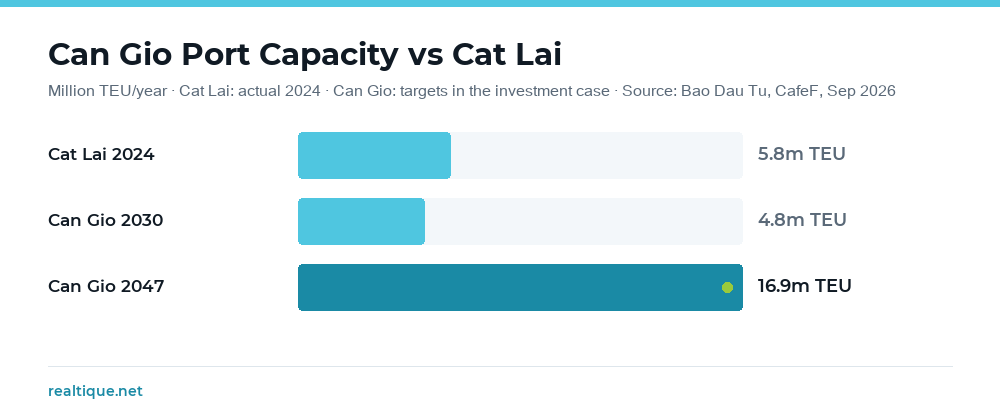
Graphic: Realtique · Data: Bao Dau Tu 13 Sep 2026, CafeF 14 Sep 2026 (Cat Lai: 2024 throughput per CafeF). Can Gio figures are targets from the investment case, not delivered results.
What the Project Actually Is: Location, Scale, Capacity
The port sits at the mouth of the Cai Mep – Thi Vai river system in Can Gio, Ho Chi Minh City. The location is the entire rationale for the project: it is one of very few points in Vietnam with the channel depth and proximity to international shipping lanes needed to receive the largest mother vessels — something existing inland terminals such as Cat Lai cannot do.
- Footprint: approximately 571 hectares.
- Vessel size: container ships up to 250,000 DWT.
- Berth length: a main quay line of roughly 7–7.5 km at full build-out; the first-phase berth runs over 2 km.
- Capacity: around 4.8 million TEU by 2030, with a long-range vision of roughly 13 berths and 16.9 million TEU by about 2047.
- Operating term: 50 years from the date of the in-principle investment decision.
Build-out is phased over roughly two decades. The number of phases has been reported differently across announcements, so it is safer to read this as a long-dated, phased programme than to anchor on a specific phase count.
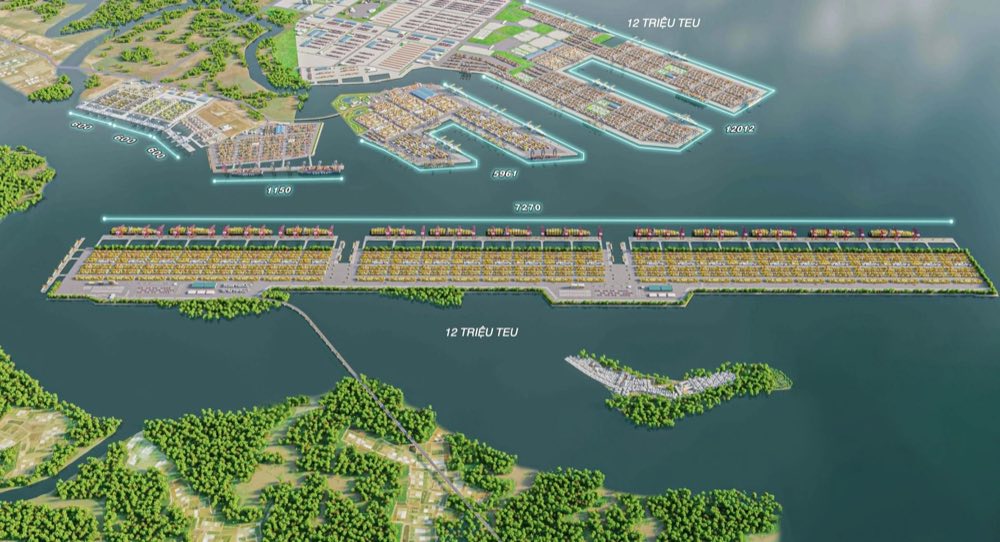
Rendering of Can Gio International Transshipment Port. Rendering: Portcoast.
US$5 Billion or VND 50,000 Billion? Both Figures Are Correct
Two very different capital figures circulate for this project, and they are not contradictory — they measure different things.
VND 128,872 billion (close to US$5 billion) is the total investment value of the project under the April 2026 investor approval. This is the figure to use when describing project scale.
“Over VND 50,000 billion” appears in the earlier in-principle approval, phrased as “not lower than VND 50,000 billion” — in other words a floor, not a total. In later announcements the same number attaches to a minimum disbursement commitment of VND 50,000 billion over the first ten years.
One is total capital; the other is a minimum spend commitment in the early period. If a source presents them as competing estimates, that source has misread the documents.
Who Is Building It — and Why MSC's Role Matters
The investor consortium has three members:
- Vietnam Maritime Corporation (VIMC) — consortium leader.
- Saigon Port JSC.
- Terminal Investment Limited (TIL) — part of MSC, one of the world’s largest container shipping lines, holding 49% of the venture.
For an investor, the shareholding split matters less than who the foreign partner is. A transshipment port is only worth building if carriers commit cargo to it. Having MSC participate as an equity owner rather than merely a prospective customer materially reduces the classic failure mode for projects of this type: a finished terminal that no line calls at.
At designed capacity, the project is projected to generate roughly VND 34,000–40,000 billion in annual revenue. That is a figure from the published financial case, not a demonstrated result.
What This Means for Can Gio Property — Honestly
This is where marketing tends to outrun evidence, so it is worth separating two very different effects.
The direct effect is narrower than people assume. A container terminal does not generate demand for high-end coastal residences next to it. It generates logistics, warehousing and haulage employment, which supports housing demand in the affordable-to-mid segment, typically at some distance from the terminal itself. If someone is selling you a luxury unit primarily because it is “near the mega port”, that is a weak argument.
The indirect effect is the one that counts. The port is a large part of why connective infrastructure to Can Gio is being accelerated — the access road programme, the Can Gio bridge, and the broader planning intent to turn Can Gio from a peripheral district into a genuine growth pole for Ho Chi Minh City. It is that connectivity, not the terminal, that changes property values, because it converts Can Gio from a weekend destination into a place where living and long-stay use are realistic.
For large-scale developments in the area such as Vinhomes Green Paradise (2,870ha), the investment case should therefore be read along the connectivity and urbanisation timeline rather than proximity to the port. Two pieces worth reading first are the full overview of the 2,870ha coastal township and the location and infrastructure breakdown, which sets out each road and bridge with its actual status.
A Note for Foreign Buyers Watching Can Gio
Two points that specifically affect international buyers.
Ownership eligibility is project-specific, not area-specific. Whether a foreign national can buy in Can Gio depends on the individual development being on the approved list and having quota remaining — not on Can Gio’s status as a district. Infrastructure news changes neither. Always verify eligibility and remaining quota at the specific project before committing.
Match your holding period to the infrastructure, not the headline. Ports and bridges of this scale move on decade timescales. Between an approval and a functioning piece of connective infrastructure, several years typically pass. Capital that needs to exit in two or three years is poorly matched to this story, however sound the story itself is.
The Realtique view: Can Gio port is a credible long-term thesis — large committed capital, a global carrier inside the ownership structure, and a clear place in the city’s planning framework. It is not, however, a reason to transact this quarter. For clients looking at Can Gio, we consistently advise tracking connective infrastructure milestones and the legal status of the specific development, rather than port news.
Frequently Asked Questions
Has construction started on Can Gio port?
Not yet. As of 14 September 2026 the investor consortium has been approved (April 2026) and has formed a joint venture company, but nothing is under construction on site. On 12 September 2026 the city chairman instructed the consortium to break ground in October 2026, replacing the earlier Q4 2026 guidance — still an instruction, not a scheduled ceremony date.
Where is Can Gio International Transshipment Port?
It is located at the mouth of the Cai Mep – Thi Vai river system in Can Gio, Ho Chi Minh City. The site sits close to international shipping lanes and has the channel depth to handle container vessels of up to 250,000 DWT.
How much is the Can Gio port project worth?
Total investment is approximately VND 128,872 billion, or close to US$5 billion. The frequently quoted “over VND 50,000 billion” is a floor set in the in-principle approval and corresponds to a minimum disbursement commitment over the first ten years — not the total project value.
Who is investing in Can Gio port?
A consortium led by Vietnam Maritime Corporation (VIMC), together with Saigon Port JSC and Terminal Investment Limited (TIL), part of the global shipping line MSC, which holds 49%.
Will the port increase Can Gio property prices?
The terminal’s direct effect on residential values is limited and concentrated in the segment serving logistics employment. The meaningful driver is the connective infrastructure being accelerated alongside it — access roads, the Can Gio bridge and the city’s planning intent for the district — because that is what changes travel times and everyday usability.
⚠️ Please note: timelines in this article — particularly the October 2026 groundbreaking target set on 12 September 2026 — are plans and stated intentions from authorities and may change as procedures progress. Capacity, berth counts and revenue figures come from the published investment case and are projections, not delivered results. This article is market information, not investment advice. Foreign-ownership eligibility must be verified at the individual project level.
Vinhomes Green Paradise Can Gio 2026: Complete Guide to the 2,870ha Coastal Township
Read more →Vinhomes Green Paradise Can Gio Location & Infrastructure: 13 Minutes to District 1
Read more →Prime Land Isn’t Sold on the Open Market: The Can Gio Bridge Land-Swap
Read more →Ho Chi Minh City Urban Planning to 2030: What Foreign Investors Should Know
Read more →Considering Can Gio?
Leave your details and a Realtique advisor will send you infrastructure progress updates for Can Gio plus current availability and foreign-ownership quota at projects in the area.
📞 Hotline: +84 866 810 689

Grace Le
Grace Le advises international buyers on Ho Chi Minh City real estate, with a focus on how infrastructure timelines translate into realistic investment horizons.