
Vietnam’s New Housing Law Opens Apartments to Short-Term Rentals
Vietnam’s National Assembly passed the amended Housing Law on 21 November 2026, and one line in it matters to anyone who owns, or plans to buy, a city apartment as a rental: units may now be let for living or for accommodation. Realtique noted that the change only takes effect on 1 July 2027, so the next seven months still run on the old, stricter rules.
Table of contents
What the Law Actually Changes
The 2023 Housing Law banned using apartments for anything other than living, and many building management boards read that as a ban on nightly guests. The amendment keeps the ban but adds an exception for units let for living or for accommodation.
The final text dropped the word “short-term”, which gives owners room to host guests for a night, a week or a few months. Vietnam’s Residence Law treats a stay of under 30 days as accommodation, which covers most tourists and business travellers.
The government wants 1.5 million tourist rooms nationwide by 2030, and apartments in Ho Chi Minh City, Hanoi and Da Nang are expected to supply part of that.
Sources: Tuoi Tre, Nhan Dan (22 Nov 2026).
Until July 2027, Old Rules Apply
Decree 339/2026, in force since 26 August 2026, fines individuals VND 100–130 million (roughly USD 4,000–5,000) for using an apartment for non-residential purposes, and the unit must go back to residential use.
A listing on Airbnb is not proof of a breach on its own. Inspectors look at how the unit is used: length of stay, guest turnover, services offered and the approved use of the unit.
Ho Chi Minh City has already relaxed its 2025 ban. Under Decision 19/2026, effective since 25 April 2026, an apartment can host tourists if it is registered as a tourist accommodation establishment, guests are declared to the police and the use matches the approved design.
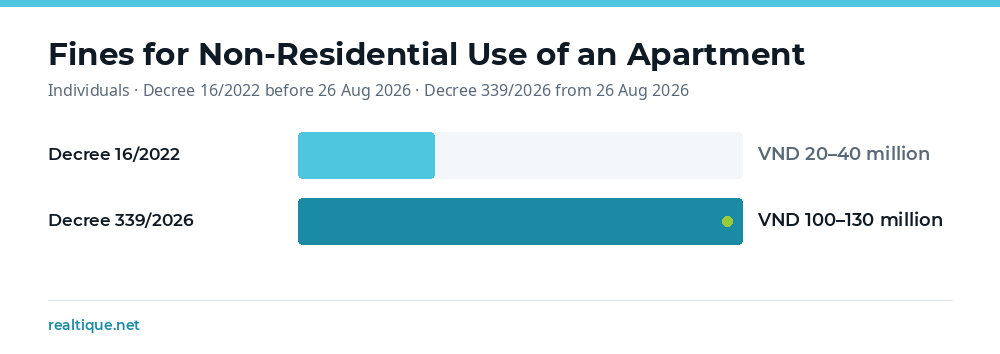
Graphic: Realtique · Data: Decree 16/2022/ND-CP, Decree 339/2026/ND-CP
What Foreign Owners Should Know
Foreigners who legally own an apartment in Vietnam can already lease it out, provided rental income is declared and taxed. The amended law keeps the foreign ownership cap at 30% of units per building and the 50-year ownership term, renewable once.
The detail still missing is the implementing decree. It should set which buildings qualify, fire safety requirements and how guests are managed, and the building’s own house rules will carry more weight once residents’ meetings get a clearer role.
For Viet Kieu with Vietnamese citizenship, the ownership rules are the same as for local buyers, so the questions that matter are the building rules and tax registration.
Choosing a Rental-Ready Apartment
If rental income is part of your plan, check three things before you sign: the approved use of the unit, whether house rules limit short stays, and the service charge for units run as rentals. A well-priced unit in a building that restricts guests will struggle to hit the occupancy you modelled.
Building managers expect fewer short-stay units once licensing kicks in, with more professional operators running the ones that remain. Owners who self-manage should budget for tax, registration, insurance and higher management fees from day one.
Frequently Asked Questions
When can apartments in Vietnam be used for short-term rentals?
The amended Housing Law, passed on 21 November 2026, takes effect on 1 July 2027. From that date apartments may be let for living or for accommodation.
Can I run an Airbnb in a Vietnam apartment right now?
It carries risk. Until July 2027, using an apartment for non-residential purposes can draw a fine of VND 100–130 million for individuals under Decree 339/2026. In Ho Chi Minh City, Decision 19/2026 allows tourist apartments that register as accommodation establishments.
Can foreigners rent out an apartment they own in Vietnam?
Yes. Foreign individuals who legally own an apartment may lease it, and must declare and pay tax on the rental income.
Does the new law change the 30% foreign ownership cap?
No. Foreign buyers can hold up to 30% of the units in each apartment building, for up to 50 years with one renewal.
Do neighbours need to approve short-term rentals?
The law does not say so explicitly. Conditions such as qualifying buildings, fire safety and guest management are expected in an implementing decree and in each building’s house rules.
⚠️ Note: The full text of the amended Housing Law and its implementing decree have not yet been published. This article is based on the law as passed on 21 November 2026 and the rules currently in force; detailed conditions may change once guidance is issued.
Buying an apartment to rent out?
Send us the project you are looking at. Realtique will check the approved use, building rules and running costs to estimate a realistic yield.
📞 Hotline / WhatsApp: +84 866 810 689

Grace Le
Grace Le works with foreign buyers, overseas Vietnamese and investors on Ho Chi Minh City apartments — checking real rental income, management fees and vacancy for each unit before a client commits.