
Vietnam’s New Real Estate Law Bans Off-Plan Booking Fees
Vietnam’s National Assembly passed an amended Real Estate Business Law on 21 November 2026, taking effect on 1 July 2027. For anyone buying an off-plan apartment, the headline change is a ban on booking fees, goodwill fees and any other payment taken before a project is legally cleared for sale. Realtique noted that the payment ceilings buyers already know, 5% deposit, 30% first instalment, 70% before handover and 95% before the title deed, carry over into the new law.
Table of contents
What Parliament passed
The law passed with 471 of 479 delegates present voting in favour. It runs to 10 chapters and 63 articles, 20 fewer than the 2023 version, and takes effect alongside the amended Housing Law and Land Law on 1 July 2027.
Until then, contracts signed in Vietnam remain governed by the 2023 law. If you are reserving a unit at a launch in the coming months, the new protections do not apply to you yet.
Sources: Vietnam Government News, Tuoi Tre, VnExpress (21 Nov 2026).
How off-plan payments are capped
Vietnam has long limited how much a developer can collect before handing over keys, and the new law keeps that structure. The deposit can only be taken once the project is cleared for sale and counts towards the first instalment.
| Stage | Ceiling | Notes |
|---|---|---|
| Deposit | 5% of price | Only once the project is legally cleared for sale |
| First instalment | 30% of contract | Includes the deposit |
| Later instalments | Tied to construction | Cannot run ahead of the build |
| Before handover | 70% of contract | 50% where the seller is a qualifying foreign-invested company |
| Before title deed | 95% of contract | Final 5% due when the certificate is issued |
Sources: Vietnam Government News, Tuoi Tre, CafeF, VnExpress.
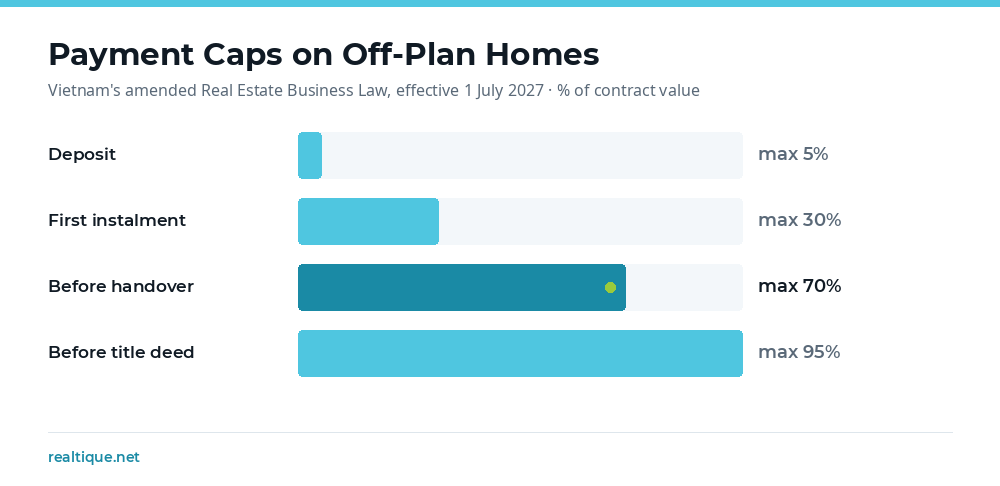
Graphic: Realtique · Data: amended Real Estate Business Law, passed 21 November 2026
The end of the booking fee
Launch-day booking fees have been a fixture of Vietnam’s new-build market, often paid weeks before a project has its sales permits. The new law bans any payment taken to secure a future contract while the property is not yet eligible for sale, whatever it is called: booking money, goodwill fee or priority fee.
The government described the rule as a way to stop disguised fundraising at the source, including through deposits and reservations. For overseas buyers, who often commit remotely and rely on an agent’s word, it removes one of the hardest payments to recover when a project stalls.
Sources: VnExpress, Tuoi Tre (21 Nov 2026).
What it means for foreign buyers
Foreigners can buy apartments in projects on a city’s approved foreign-ownership list, and those purchases follow the same payment ceilings. Where the developer is a qualifying foreign-invested company, which covers several premium names in Ho Chi Minh City, the cap before handover drops to 50%.
Who can buy what is set by the Housing Law, which was amended on the same day. The final text has not been published in full, so the clauses on foreign ownership are worth waiting for before committing to anything other than an apartment.
Sources: Tuoi Tre, CafeF (21 Nov 2026).
More disclosure, tighter brokerage rules
Developers must publish a project’s legal status, ownership restrictions, disputes, mortgages and sample contract on the national housing and property information system as well as their own websites, and keep it current. Brokerages must check a project’s legal file before listing it, operate as registered companies and employ at least one certified broker.
Sources: Tuoi Tre, CafeF, Vietnam Government News.
What to do before July 2027
Before sending money to any launch, ask for written confirmation that the project is cleared for sale and check the contract’s schedule against the 30%, 70% and 95% ceilings. Keep the final 5% until your pink book is issued, and confirm the project is on the foreign-ownership list if you are buying on a foreign passport.
Frequently Asked Questions
When does Vietnam’s new Real Estate Business Law take effect?
It was passed on 21 November 2026 and takes effect on 1 July 2027. Until then the 2023 Real Estate Business Law applies.
How much deposit can a developer take on an off-plan apartment?
Up to 5% of the sale price, and only once the project is legally cleared for sale. The deposit counts towards the first instalment of up to 30%.
Are booking fees allowed under the new law?
No. Developers may not collect any payment to secure a future contract while the property is not yet eligible for sale, including booking, goodwill or priority fees.
Can foreigners buy property in Vietnam under the new rules?
Foreigners can buy apartments in projects on the approved foreign-ownership list. Ownership rules sit in the amended Housing Law passed on the same day, whose final text is still to be published.
How much must be paid before handover?
No more than 70% of the contract value, or 50% if the seller is a qualifying foreign-invested company. No more than 95% can be collected before the title certificate is issued.
⚠️ Note: This article is based on information published on 21 November 2026, the day the law was passed. The official gazetted text may differ in detail; check it before signing a contract.
Want a second look at a payment schedule?
Send us the sales policy or sample contract and we will check it against the legal ceilings and the project’s foreign-ownership status.
📞 Hotline: +84 866 810 689

KC Pham
KC Pham advises foreign buyers and overseas Vietnamese on Ho Chi Minh City apartments — setting real rental income against deposit rates and checking legal status and foreign quota before a client commits.