
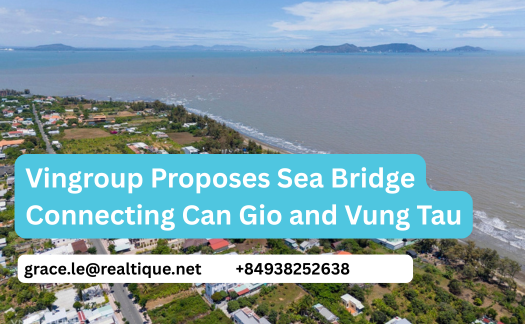
Vingroup Proposes Sea Bridge Connecting Can Gio and Vung Tau
The Can Gio – Vung Tau sea crossing broke ground on 1 July 2026: roughly 14 km, over VND 93 trillion, including Vietnam’s first immersed undersea tunnel. This page was first published in October 2025, when the route was still a proposal at an indicative 15 km — the original reporting is kept further down as a record.
Table of Contents
August 2026 Update: No Longer a Proposal — It Broke Ground on 1 July 2026
This page was first published in October 2025, when the sea crossing was still a proposal. That is no longer the case. The Can Gio – Vung Tau route formally broke ground on 1 July 2026, with total investment of over VND 93 trillion, delivered as a public-private partnership under a BT contract by Vingroup and affiliated companies. The reporting further down this page is kept as a record of how the project was first put forward.
The reason the confusion persists is worth naming: most of what circulates about this project is design renderings — the lotus-shaped tunnel portals — rather than site photography. Those renderings were released before groundbreaking and keep being reshared afterwards, which makes an eight-week-old milestone read like an upcoming one. Check the publication date before drawing any conclusion about progress.
The Vietnamese-language analysis of scale, timeline and risk is here: đường vượt biển Cần Giờ – Vũng Tàu.
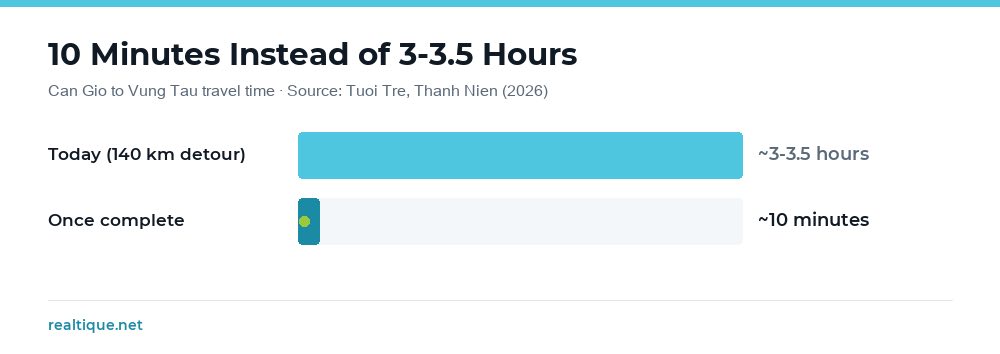
Graphic: Realtique · Data: Tuoi Tre (26 June 2026), Thanh Nien (1 July 2026)
What Is Actually Being Built: ~14 km, a 3.85 km Undersea Tunnel, 6 Lanes
Tuoi Tre puts the whole route at about 14.06 km, comprising approach roads, interchanges and an over-water section of roughly 8.01 km. Thanh Nien gives a total of about 14.6 km, with more than 8 km of sea bridge and 3.85 km of immersed tunnel. The route is designed for 6 lanes at 80 km/h.
⚠️ The two sources disagree on the decimal (14.06 versus 14.6 km). The gap is small and most likely comes from where each counts the start and end points, or from rounding in editing. We are keeping both figures rather than picking one and presenting it as settled. For a buyer, the number worth remembering is roughly 14 km, of which about 8 km crosses water.
The distinguishing feature is not the length but the tunnel. This is Vietnam’s first immersed tunnel laid beneath the sea floor — steel-encased reinforced concrete, sitting at roughly -28.45 m, and engineered to keep about 10 m of clearance above the planned shipping channel. In plain terms, it is built so that the navigation channel can still be deepened later — close to a precondition in an area tied to the country’s transshipment ambitions. See also our status check on the Can Gio mega port.
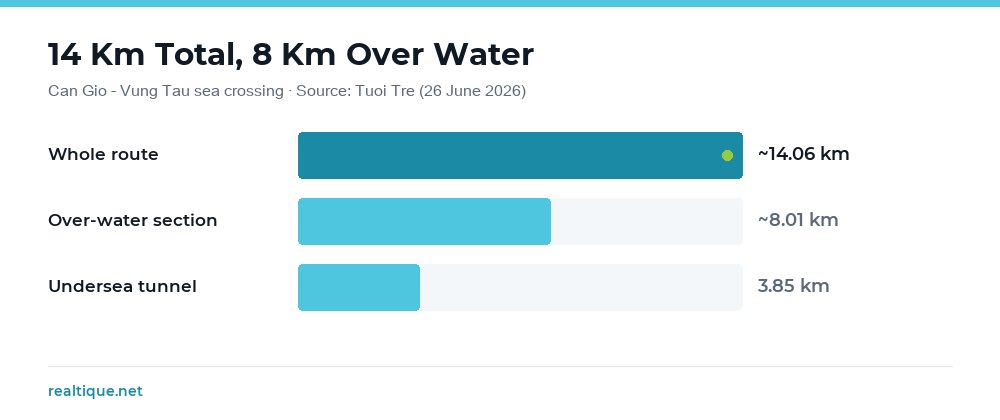
Graphic: Realtique · Data: Tuoi Tre (26 June 2026). ⚠️ Thanh Nien reports a total of ~14.6 km — the sources differ on the decimal.
The Route Starts Inside Vinhomes Green Paradise
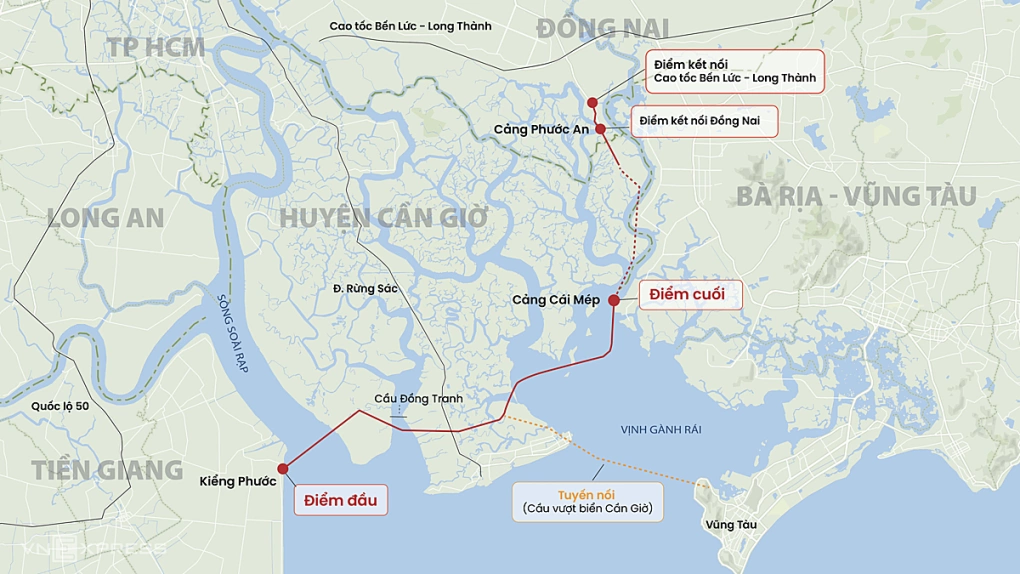
This is the detail that matters most to buyers and gets mentioned least. The route’s starting point is the Can Thanh – Long Hoa boulevard, inside the Vinhomes Green Paradise area in Can Gio; it ends at the junction with 30 Thang 4 Street in Rach Dua ward, Vung Tau.
So the road does not merely pass near Can Gio — it begins at the largest sea-reclamation township under construction there, and the route’s developer sits in the same corporate group as the township. Which is why the two schedules should be tracked together rather than separately. Full project detail: Vinhomes Green Paradise Can Gio.
Ten Minutes Instead of Three Hours — What That Actually Changes
Today the road journey between Can Gio and Vung Tau detours about 140 km and takes 3-3.5 hours. Once the crossing opens, it falls to roughly 10 minutes.
The real change is not the minutes. It is that two coastal markets that have never competed — Can Gio and Vung Tau — land inside the same shortlist for the same buyer. Someone weighing a holiday home in Vung Tau gains Can Gio as an option, and the reverse holds too. Competition rises, but so does liquidity on both sides, because the buyer pool widens.
⚠️ One caution worth stating plainly: prices move ahead of construction. Groundbreaking has already passed, which means the easy expectation has largely been absorbed. What value remains is attached to harder milestones — tunnel completion, span closure, opening to traffic. Those are what to watch, not renderings.
Who Is Building It, and Three Risks Worth Pricing In
The project is delivered by Vingroup and affiliated companies at over VND 93 trillion, as a PPP under a BT contract. Three risks belong in any calculation:
- Site handover. The stated schedule is roughly three years from site handover and commencement — the clock does not start at groundbreaking. Delays in handover move everything.
- An untried structure. An immersed undersea tunnel is a first for Vietnam. First-of-type structures carry a wider schedule band than work that has been repeated many times.
- The BT model. Payment via land funds or transfer arrangements ties progress to procedures off the construction site, more so than a straightforward public-investment project.
None of these suggests the project is troubled. They are simply reasons not to convert a groundbreaking date into an opening date when modelling cash flow.
Foreign Buyers and Overseas Vietnamese
Can Gio has become one of the most-asked-about areas among overseas Vietnamese and foreign buyers, largely because the infrastructure picture has changed so fast in twelve months. The ownership rules have not changed with it. Foreign buyers purchase apartments under a 30% cap applied per tower, and that cap belongs to a specific project — it is not something you can infer from the size of a township.
For overseas Vietnamese who still hold Vietnamese nationality, ownership rights are broadly the same as for citizens under the 2024 Land Law, effective 1 January 2025. Those of Vietnamese origin without nationality have a narrower scope.
What to verify before committing is not the road but the paperwork on the unit itself: whether the project is legally cleared to sell, whether foreign room remains, and which contract type you are actually signing. Our step-by-step walkthrough is here: the property buying process in Vietnam.
Frequently Asked Questions
Has the Can Gio – Vung Tau sea crossing been built yet?
It broke ground on 1 July 2026 and is under construction. Anything describing it as a proposal, including earlier reporting on this page, predates that date. Completion is guided at roughly three years from site handover, so the route is not open to traffic.
How long is the route and what does it cost?
Total investment is over VND 93 trillion. On length the sources still differ slightly: Tuoi Tre reports about 14.06 km, Thanh Nien about 14.6 km. Roughly 8 km crosses water, including a 3.85 km immersed tunnel. The road is designed for 6 lanes at 80 km/h.
How long will the drive take once it opens?
About 10 minutes, against 3-3.5 hours today, because the current road route detours roughly 140 km around Ganh Rai Bay.
Where does the route start and end?
It starts at the Can Thanh – Long Hoa boulevard inside the Vinhomes Green Paradise area in Can Gio, and ends at the junction with 30 Thang 4 Street in Rach Dua ward, Vung Tau.
Does this change what foreigners can buy in Can Gio?
No. The 30% foreign-ownership cap applies per tower in each specific project and is unaffected by infrastructure planning. A project that is already at its cap stays at its cap.
Vingroup Proposes Sea Bridge Linking Can Gio and Vung Tau
HCMC — Vingroup has proposed studying the construction of a sea-crossing road over 15 km long, connecting Can Gio District and Ba Ria–Vung Tau Province, to enhance regional connectivity and promote economic growth.
In its proposal submitted to HCMC Chairman Nguyen Van Duoc, Vingroup stated that following the planned merger of Ba Ria–Vung Tau into Ho Chi Minh City, developing a direct route between the coastal areas of Can Gio and Vung Tau has become essential.
This region holds a strategic position for marine economy, seaport logistics, tourism, and ecological urban development but currently relies mainly on ferries and indirect routes. Vingroup has asked for approval to conduct research and potentially invest in the sea-crossing project under a build–transfer (BT) model.
The idea of building a sea bridge between the two areas has been previously suggested by residents and several related agencies.
A Visionary Infrastructure for Southern Expansion
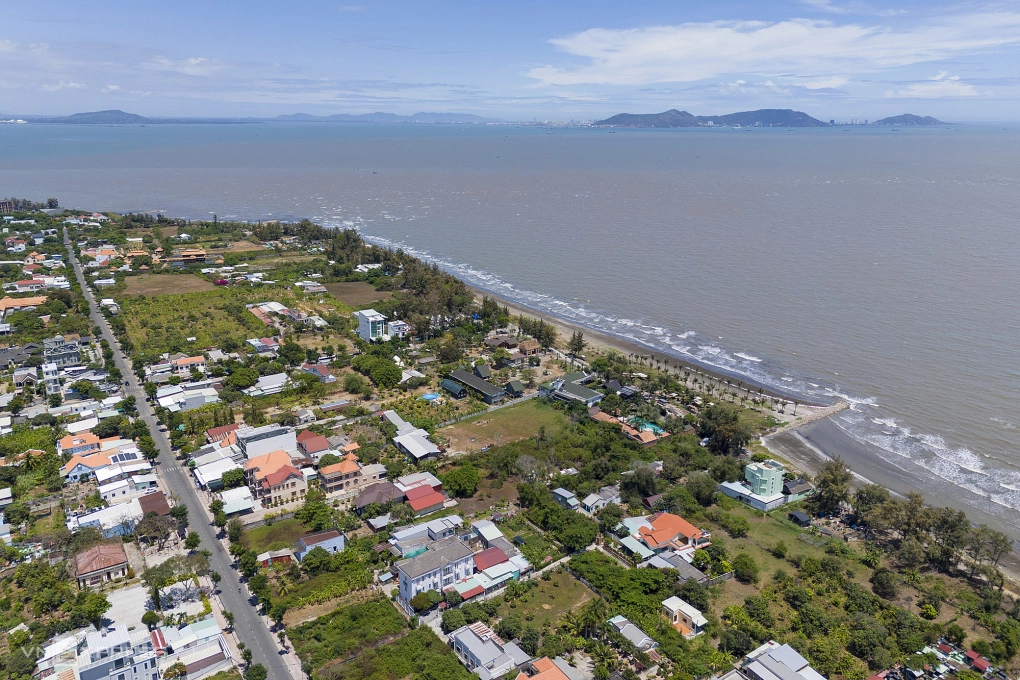
Can Gio lies about 15 km from Vung Tau across the Ganh Rai Bay. At present, travel between the two areas is primarily by ferry, operating from 6 a.m. to 10 p.m. daily, with a fare of 70,000 VND per trip.
Vingroup is currently developing the 2,870-hectare Can Gio marine urban area, designed to accommodate nearly 230,000 residents. The group has also proposed investing in a metro line connecting Can Gio to central Ho Chi Minh City, estimated at over USD 4 billion.
Thinking about investing in Vietnam’s real estate market?
🏘️ Let Realtique guide you with expert insights, trusted advice, and tailored property options for overseas investors.