
Vietnam’s Land Law Amendment 2026: 0.2% Idle-Land Tax, Recovery After 60 Months, Land-Price Tables Every 3 Years — What Landholders, Viet Kieu and Foreign Buyers Need to Know
Short answer: On 22 and 23 October 2026 Vietnam’s Government put two texts before the National Assembly that go straight at people who hold land without using it. The draft amended Land Law cuts the 2024 law from 16 chapters and 260 articles to 13 chapters and 112 articles, writes the concept of “idle land” into statute for the first time, makes developers who are slow to put project land to use pay a progressive annual surcharge and lose the land if it is still unused after 60 months, and moves the official land-price table and its adjustment coefficient (K) to a three-year cycle set by provincial People’s Councils, dropping “specific land prices” altogether. A day later the Finance Minister tabled a bill amending three tax laws, including a 0.2% annual rate on idle land, land not put to use and land slow to be put to use under Article 7 of the Non-Agricultural Land-Use Tax Law, with no quota relief; if passed on 20 November, the tax applies from 2027. Plenary debate is set for 29 October (Land Law) and 6 November (tax bill), with votes expected on 20–21 November 2026 (VnExpress, 22 Oct 2026; Tuoi Tre, 23 Oct 2026; Government News Portal, 23 Oct 2026).
Realtique’s reading of the submissions, the review committee’s report and the 22–23 October group debates: the number to watch is not 0.2% — that is exactly the rate already charged on encroached land — but three questions the draft leaves open: what counts as idle land, from which date the clock runs, and whether a lawfully owned residential plot that an individual has not yet built on is caught. Deputies asked all three on the afternoon of 23 October, and Prime Minister Le Minh Hung told two ministries to answer them before the vote. This article explains today’s tax schedule, the six Land Law changes that touch a buyer’s wallet, the deputies’ “2 billion – 20 billion – 100 billion” arithmetic, and then answers separately for Realtique’s three client groups: holders of unbuilt plots and villa land · overseas Vietnamese · foreign buyers. Both texts are drafts and may change; this is not legal advice. A Vietnamese version of this analysis is here.
Vietnam Land Law Amendment & Idle-Land Tax — Status 24 Oct 2026
Table of Contents
Two Bills in Two Days: The Land Law Amendment (22 Oct) and the 0.2% Idle-Land Tax (23 Oct)
The two texts were tabled at different sessions by different ministers, but they aim at the same behaviour: holding land without putting it to use. The table below collects the milestones confirmed by at least two sources.
| Text | Tabled by · when | What touches landholders | Next steps |
|---|---|---|---|
| Draft amended Land Law | Justice Minister Hoang Thanh Tung, on behalf of the Prime Minister · morning of 22 Oct 2026 | 13 chapters, 112 articles (148 fewer); statutory concept of “idle land”; progressive surcharge on slow project land and recovery after 60 months; land-price table + coefficient K every 3 years; “specific land price” abolished; plot ID numbers and electronic title certificates | Plenary 29 Oct · vote 21 Nov 2026 |
| Bill amending three tax laws (CIT, PIT, Non-Agricultural Land-Use Tax) | Finance Minister Ngo Van Tuan · morning of 23 Oct 2026 | Article 7: 0.2% on idle land, land not put to use and land slow to be put to use, no quota relief; Article 9: new exemptions for education land and in-quota residential land of ethnic-minority households | Group debate 23 Oct · plenary 6 Nov · vote 20 Nov; effective from 2027 if passed |
Both bills were reviewed by the Economic and Financial Committee chaired by Phan Van Mai. On the tax bill the committee agrees the law is needed but flags four gaps: (1) no definition of land “slow to be put to use” or “not put to use”; (2) no carve-out for force majeure or approved phased projects; (3) a risk of charging two financial obligations on the same plot, because the draft Land Law also introduces a progressive surcharge; (4) the 0.2% rate must not lower the burden of land already taxed at 0.15%. The policy basis cited is Resolution 21-NQ/TW on land-use efficiency (Tuoi Tre, 23 Oct 2026; Government News Portal, 23 Oct 2026; VnExpress, 23 Oct 2026).
One timing point matters more than it looks. The tax law, if passed, takes effect from 2027; the Land Law amendment, according to the Prime Minister at the 22 October group session, is expected to take effect from 2028. Deputy To Huy Vu (Hanoi) spelled out the consequence: if the two laws do not start together, “on 1 January 2027 there will be a tax rate without a taxable object” — the definition of idle land sits in the Land Law, the rate sits in the tax law (Tuoi Tre, 23 Oct (group session)).
What the 0.2% Idle-Land Tax Is — Next to the Schedule Already in Force
Vietnam’s non-agricultural land-use tax (Law 48/2010/QH12, in force since 2012) is calculated as taxable area × price per m² in the official land-price table × rate; the taxable price is fixed for five-year cycles. For residential land the rate is progressive against the local residential land-allocation quota:
| Land type / area band | Current rate | Proposal of 23 Oct 2026 |
|---|---|---|
| Residential land within quota | 0.03%/yr | Unchanged |
| Area over quota, up to 3× | 0.07%/yr | Unchanged |
| Area over quota, more than 3× | 0.15%/yr | Unchanged |
| Land used for the wrong purpose or not used as required | 0.15%/yr | Committee: burden on this group must not fall |
| Encroached land | 0.2%/yr | Unchanged |
| Idle land, land not put to use, land slow to be put to use | — (no separate concept) | 0.2%/yr, no quota relief |
What does “no quota relief” mean? For ordinary residential land only the area above quota pays 0.07–0.15%; the in-quota part pays 0.03%. For land classed as idle, the whole area pays 0.2% — roughly seven times the in-quota rate. That is why some deputies call it the “seven-fold tax”, even though the absolute amount is still small against land values.
Realtique’s illustration (hypothetical, to show the scale): a 100 m² residential plot in an area priced at VND 60 million/m² in the official table has a taxable value of VND 6 billion. Within quota, today’s tax is about VND 1.8 million a year (0.03%); classed as idle under the proposal, about VND 12 million a year (0.2%). Official table prices usually sit below market prices, so the real figure depends on each province’s table — Ho Chi Minh City uses a table adjusted at the end of 2024 and would move to a three-year cycle if the Land Law amendment passes. This is an illustration, not the tax on any specific plot.
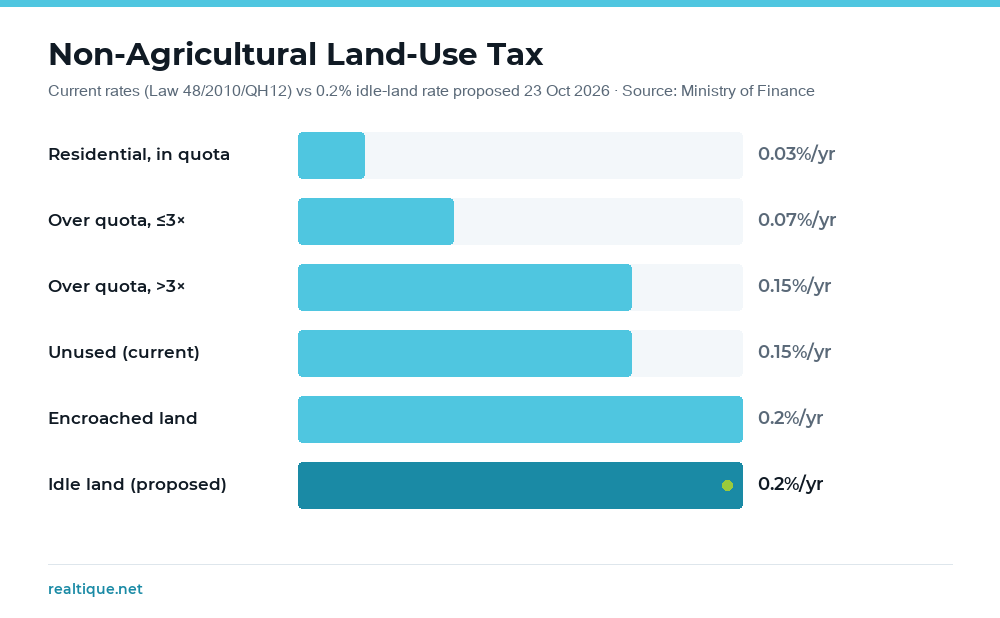
Graphic: Realtique · Data: Non-Agricultural Land-Use Tax Law 48/2010/QH12 (Article 7) and the Ministry of Finance submission to the National Assembly, 23 Oct 2026 (Tuoi Tre, VnExpress, Government News Portal).
The 112-Article Land Law: Six Changes That Touch a Buyer’s Wallet
The draft follows Resolution 21-NQ/TW and the Government’s conclusions in Resolution 278/NQ-CP (18 Sep 2026). Of dozens of amendments, Realtique picks six that directly affect the cost and rights of people buying or holding land (VnExpress, 22 Oct 2026; Tuoi Tre, 22 Oct 2026; Government News Portal, 22 Oct 2026):
| # | Change | Draft provision | What it means for landholders |
|---|---|---|---|
| 1 | Land-price table every 3 years | Land-price table and adjustment coefficient (K) decided by provincial People’s Councils every three years (currently annually); may be revised when infrastructure, zoning, boundaries or street names change | Land-use fees, taxes, auction reserve prices and compensation all key off this table → fewer annual shocks, but each revision can be a big step up |
| 2 | “Specific land price” abolished | Removes specific land prices and the valuation consultancies that set them; the State decides land prices on four principles (honest, objective, public, transparent) | Projects no longer wait for a bespoke valuation — faster legal timelines, but developers’ land cost tracks table × K |
| 3 | Statutory “idle land” | First time in law: land allocated or leased but not used continuously for a defined period | The hook for the 0.2% tax; the detailed criteria still wait for a decree |
| 4 | Progressive surcharge + 60-month recovery | Project land not or slowly put to use: an extra payment on top of land-use fees or rent, progressive and rising each year; after 60 months the State recovers the land | Falls on developers → cost pushed into prices, or stalled projects forced to launch; buyers under contract at slow projects should re-read schedule clauses |
| 5 | Agricultural land idle for 24 months | Not used continuously for more than 24 months, already fined and still unused → recovered | Investors banking garden and peri-urban land while waiting for rezoning carry the biggest risk |
| 6 | Plot ID numbers, electronic certificates | Every plot gets a unique nationwide identifier; paper and electronic certificates carry equal legal value; agencies may not ask citizens to resupply data already in the database | Overseas Vietnamese and remote owners manage assets from abroad more easily; transfers and mortgages need less paperwork |
Two further points were raised at the 22 October group session but not settled: Article 22(3) leaves “restricted land-access areas” entirely to the Government — one deputy asked for statutory criteria and mandatory opinions from the Ministries of National Defence and Public Security whenever foreign-invested entities or overseas Vietnamese use land in such areas; and Article 72 on compensation for land recovery — a deputy proposed a minimum compensation ratio of 100%, set by the People’s Council rather than the People’s Committee. The review committee stressed that recovery for public purposes must be “truly necessary”, with safeguards against abuse (Government News Portal, 22 Oct 2026; Tuoi Tre, 22 Oct 2026).
Why Deputies Say 0.2% “Has No Teeth” — The 2 Billion, 20 Billion, 100 Billion Arithmetic
The group session on the afternoon of 23 October 2026 is where the tax bill was dissected. Realtique groups the comments on three axes — rate, definition and overlap — because those three will decide what a landholder actually pays (Tuoi Tre, 23 Oct (group session); VnExpress, 23 Oct (group session); Tuoi Tre, 23 Oct (Prime Minister)):
- Too light against the gain from holding — deputy Le Hoang Anh (Gia Lai) took a project site worth VND 1,000 billion in the official table: 0.2% tax is VND 2 billion a year; if land prices rise just 10% in a year the gain is VND 100 billion; and the first-year surcharge under the draft decree is VND 20 billion, ten times the tax. He noted 0.2% “equals the rate for encroached land, so it is not commensurate with the conduct”, cited the official review showing the 0.2% rate on encroached land “has not materially affected land-holding behaviour”, and proposed a progressive rate by years idle, in a band of 0.2% to 2%, with the Standing Committee setting each year’s level.
- No definition, no start date — deputy Doan Thu Ha (Lang Son) asked whether the tax runs from the day use stops, from an expiry date, or from the day an authority declares the land idle, and warned against letting people think “paying a bit more tax lets you keep holding land indefinitely”. Deputy Nguyen Thi Viet Nga (Hai Phong) asked the law to distinguish delays caused by the developer from delays caused by state procedures, late hand-over or approved phasing — and asked directly whether lawfully owned residential land that households or individuals have not yet built on is in scope.
- Overlap with the Land Law and with bank bad debt — deputy To Huy Vu (Hanoi, chairman of Agribank) warned of double charging against the Land Law’s progressive surcharge and asked for a carve-out for property that credit institutions and VAMC are selling as collateral, since those plots are “waiting to be sold, not hoarded”. Deputy Tran Hoang Ngan (Ho Chi Minh City) raised people who bought land but cannot yet afford to build, asked that land idle for objective reasons not be taxed, and asked how long land must sit idle before the tax bites.
Prime Minister Le Minh Hung’s response the same afternoon: he agreed with the deputies and instructed the Ministry of Finance and the Ministry of Agriculture and Environment to define “what idle land and land not put to use are”, to separate subjects, timing and rates so there is no overlap with the Land Law, and to make the rule easy to apply. In other words, the text voted on 20 November will very likely differ from the one tabled on 23 October on exactly those three points.
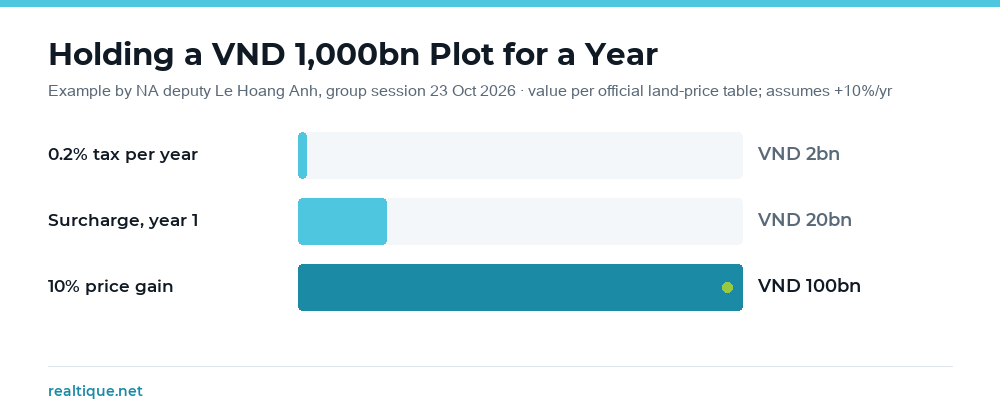
Graphic: Realtique · Data: worked example by National Assembly deputy Le Hoang Anh (Gia Lai) at the 23 Oct 2026 group session, as reported by Tuoi Tre; the VND 20bn surcharge is the figure he cited from a draft decree, not an enacted rate.
Holders of Unbuilt Plots and Villa Land: Three Scenarios to Prepare for Before 20 November
The clients who called Realtique most over the past two days were not apartment buyers but people holding project plots, unbuilt villa land or residential land bought to keep in Ho Chi Minh City and its fringe. Because the draft does not yet define idle land, the honest answer is: nobody knows for certain — but there are three scenarios, each with something to do now.
| Scenario | Content | Who is touched | What to do now |
|---|---|---|---|
| A — Narrow | The 0.2% applies only to project land allocated or leased to a developer that has not been developed (the way the draft Land Law describes the surcharge) | Developers; buyers only indirectly through prices and schedules | Re-read schedule and late-delivery penalty clauses; ask the developer which land-allocation decision starts the 60-month clock |
| B — Broad | Also applies to lawfully owned residential land of households and individuals left unbuilt beyond a set period (the question from deputies Viet Nga and Tran Hoang Ngan — still unanswered) | Holders of subdivided plots and titled villa lots in projects not yet built on | Recompute holding cost at current table price × 0.2%; check whether the 1/500 zoning plan sets a construction deadline |
| C — Progressive | Rate rises with years idle within a 0.2–2% band (deputy Le Hoang Anh’s proposal) | Anyone planning to hold 5–10 years for capital gain | Model the cost at 1–2% a year against the area’s realistic appreciation, not the 10% a year in the example |
Three things Realtique tells its own clients whichever scenario becomes law. First, every version of “idle land” is tied to continuous non-use for a period and to a finding by a competent authority — nobody is taxed silently; keeping building-permit applications, design contracts and boundary hand-over minutes is how you show land is “in the process of being put to use”. Second, the scarier number is not 0.2% but the progressive surcharge on developers: in the deputy’s example the first year already equals 2% of the table value — developers of projects stalled for years will have to launch or hand the land back, which is good for primary supply in 2027–2028, not bad. Third, a three-year price-table cycle means Ho Chi Minh City’s next revision may be one large step rather than several small ones; if you are about to pay land-use fees for a change of purpose or settle a land obligation, ask the tax office about the valuation date before the new law takes effect.
Overseas Vietnamese and Foreign Buyers: Who Is Exposed and Who Is Not
Both bills use the term “land user”, so the impact depends on whether you hold a land-use right or only own a home attached to land.
- Viet Kieu who still hold Vietnamese citizenship: as citizens they are allocated and transferred land like residents — so they pay the same non-agricultural land-use tax, including 0.2% if a plot is classed as idle. Their practical risk is not being in Vietnam to show the land is being put to use; the electronic certificates and plot IDs in the draft (point 6 above) are the tools for authorising, declaring and paying from abroad. See what Viet Kieu can own under the 2024 Land Law.
- People of Vietnamese origin without citizenship: under the current 2024 Land Law they may receive residential land-use rights in housing projects and in some other cases when permitted entry; once they are land users, the tax duty is the same. The point to watch in the new draft is Article 22(3) on “restricted land-access areas” — if the proposal to require Defence and Public Security opinions for foreign-invested entities and overseas Vietnamese is adopted, the list of restricted areas will decide what you can buy where.
- Foreign individuals: are not allocated land and hold no standalone land-use right — they own only apartments and houses in eligible projects, within the 30% quota per building and the 50-year term (see can foreigners buy property in Vietnam and the 30% quota explained). So the 0.2% idle-land tax does not apply to foreigners directly. The indirect effect runs through developers: a project slow to start pays the progressive surcharge or loses the land after 60 months — anyone who has reserved or signed at such a project should check the land-allocation decision and the committed schedule. For clients of Chinese nationality, Realtique usually arranges a Long Term Lease; that structure creates no land-use right and therefore no land-tax liability.
A question foreign clients keep asking: “If I buy an apartment and leave it empty, is that idle land?” Under every draft to 23 October, no — “idle land” is about land not put to use, not about a completed apartment left vacant. Policy on vacant homes belongs to a different file, the second-property tax, which has no draft law yet; today’s recurring taxes and fees for foreign owners are summarised in Vietnam property taxes and fees for foreign buyers.
Calendar to 21 November and What Could Still Change
Because both texts are drafts, Realtique logs the milestones so the article is updated on the day:
| Date | Event | What could change |
|---|---|---|
| 29 Oct 2026 | Plenary debate on the draft amended Land Law | Definition of idle land; progression of the surcharge; Article 22 restricted areas; Article 72 compensation |
| 6 Nov 2026 | Plenary debate on the bill amending three tax laws | Flat 0.2% or progressive 0.2–2%; carve-outs for force majeure, phased projects, bank/VAMC collateral; whether unbuilt individual plots are in scope |
| 20 Nov 2026 | Vote on the tax bill (expected) | If passed: effective from 2027 — but needs the Land Law to define the taxable object |
| 21 Nov 2026 | Vote on the amended Land Law, Housing Law and Real Estate Business Law | Land Law effective date expected 2028 (Prime Minister, 22 Oct) — may be aligned with the tax law |
Realtique will update this article after each milestone. At the same session the amended Housing Law (apartment tenure tied to the building’s design life) and the Real Estate Business Law (first payment capped at 30%, final 5% held in a guarantee account) are also voted on 21 November — off-plan buyers should read the three laws together, not separately. Financing context for anyone timing a purchase around these votes is in our note on Vietnam’s loan interest rates.
Frequently Asked Questions
When does Vietnam’s 0.2% idle-land tax start?
It is only a proposal in the bill amending the Non-Agricultural Land-Use Tax Law, tabled on 23 October 2026. If the National Assembly passes it on 20 November 2026 it takes effect from 2027; the rate, criteria and start date may still change after the plenary debate on 6 November.
I bought a residential plot but cannot afford to build yet — will I pay the idle-land tax?
There is no official answer yet. The 23 October draft does not define idle land, deputies asked exactly this question at the group session, and the Prime Minister instructed the Ministry of Finance and the Ministry of Agriculture and Environment to clarify. Today, in-quota residential land pays 0.03% a year.
Do Viet Kieu holding land in Vietnam pay this tax?
Viet Kieu who keep Vietnamese citizenship are land users like residents and pay the same schedule, including 0.2% if a plot is classed as idle. People of Vietnamese origin without citizenship who hold residential land-use rights under the 2024 Land Law have the same duty.
Does the idle-land tax affect foreigners who own apartments in Vietnam?
Not directly. Foreign individuals hold no standalone land-use right and only own apartments in eligible projects, so the 0.2% does not apply to them; a vacant apartment is not idle land. The indirect effect comes from developers of slow projects, who face the progressive surcharge or land recovery after 60 months.
What does a three-year land-price table change for taxes and land-use fees?
Under the draft Land Law, the land-price table and coefficient K are issued by provincial People’s Councils every three years instead of annually and are the basis for taxes, fees, land-use payments, auction reserve prices and compensation. Prices move less between years but each revision can jump, so the valuation date matters more.
⚠️ Legal note: This article summarises the submissions, the review committee’s report and reports of the 22–23 October 2026 group debates by Tuoi Tre, VnExpress and the Government News Portal; both texts are drafts and may change before the votes on 20–21 November 2026. Current rates are quoted from the Non-Agricultural Land-Use Tax Law 48/2010/QH12 (Article 7); the actual tax depends on each province’s land-price table and quota. Worked examples are Realtique’s or deputies’ illustrations. The author is a property advisor, not a lawyer — this is not legal or tax advice; please check with the tax office, the land registry or a lawyer for your specific case.
Holding a plot or villa land in Vietnam, or buying before the new law takes effect?
Send Realtique the plot or project you are looking at. We check the land-allocation decision, the committed schedule and the current price table to estimate your holding cost under each draft scenario, and tell you which contract clauses to fix before 21 November.
📞 Hotline: +84 866 810 689

KC Pham
KC Pham advises foreign buyers, overseas Vietnamese and investors on luxury apartments, villas and project land in Ho Chi Minh City — reading each changing legal text with clients, costing the real holding cost and pointing out which contract clauses to fix before signing.