
Saigon River Pedestrian Bridge After the Arch Closure: 7 Photos of the 3,400-Tonne “Nipa Leaf” Journey from Vung Tau to Bach Dang Wharf — and What Is Left Before Opening
Short answer: The pedestrian bridge across the Saigon River — linking Bach Dang Wharf park with the central square of Thu Thiem — closed its main arch on the morning of 21 October 2026. Work started at 5 am on the river’s slack tide, the span locked onto piers TC01–TC02 at 8 am, the ceremony at Bach Dang Wharf ran at 9:36 am, and the operation finished at 1 pm. The nipa-leaf steel arch is 187 m long and weighs 1,400 tonnes; with its 2,000-tonne support frame the 3,400-tonne assembly was load-tested on 12 October, launched at 2:15 am on 16 October at Dong Xuyen port in Vung Tau, and towed 124 km by river to the site (Government News Portal, 22 Oct 2026; VietnamPlus/VNA, 21 Oct 2026; VTC News, 21 Oct 2026).
Realtique’s reading of the week: the bridge is about 720 m long, 6–11 m wide and cost close to VND 1,000 billion, funded entirely by Nutifood, with construction started in late March 2025. This article does not repeat the schedule — that lives in “Saigon River pedestrian bridge: when will it open?” — but tells the story in seven photographs from Vietnam’s Government News Portal (each credited) plus one Realtique graphic: where the bridge was built, why the closure had to follow the tide, what still has to happen before the planned opening around Tet 2027, and what it changes for people living in or buying into Thu Thiem, foreign buyers included. A Vietnamese version is here.
Bach Dang – Thu Thiem Pedestrian Bridge — Status 24 Oct 2026
Table of Contents
Photo 1 — Morning of 21 October: The “Nipa Leaf” Drifts In Between Piers TC01 and TC02
The closure was scheduled by hydrology, not by the calendar. Engineers tracked tide data for months and compared earlier years to pick the slack-water window, when the current between two tidal phases is weakest. At about 3 am on 21 October the anchors were released and four tugs on the four corners pushed the barge into mid-river; at 5 am the barge was swung sideways into the gap between piers TC01 and TC02; at 8 am the span met its seats and welders started on the joints; at 9:36 am the ceremony was held at Bach Dang Wharf; by 1 pm the operation was complete (Government News Portal, 22 Oct 2026; VTC News, 21 Oct 2026; Dau Tu newspaper, 21 Oct 2026).
To bring the assembly down to design level the barge was ballasted with pumped-in water, with hydraulic jacks and SPMT transporters making the fine adjustments; alignment at the joints was controlled to the millimetre. Because the Saigon River is semi-diurnal, water pressure on the hull peaks exactly when the flow is blocked, so flow-simulation software was used in advance to plan how anchor cables, winches and ballast would be coordinated.
Attending were Deputy Chairman of the HCMC People’s Committee Hoang Nguyen Dinh, Director of the Department of Construction Tran Quang Lam, and the Party secretaries of Sai Gon ward (Bui Xuan Cuong) and An Khanh ward (Le Tran Kien). Truong Hung, Vice Chairman of Nutifood’s board, called it the key milestone after more than a year of work and repeated that the bridge is a gift to consumers and a new public space for the city (VTC News).
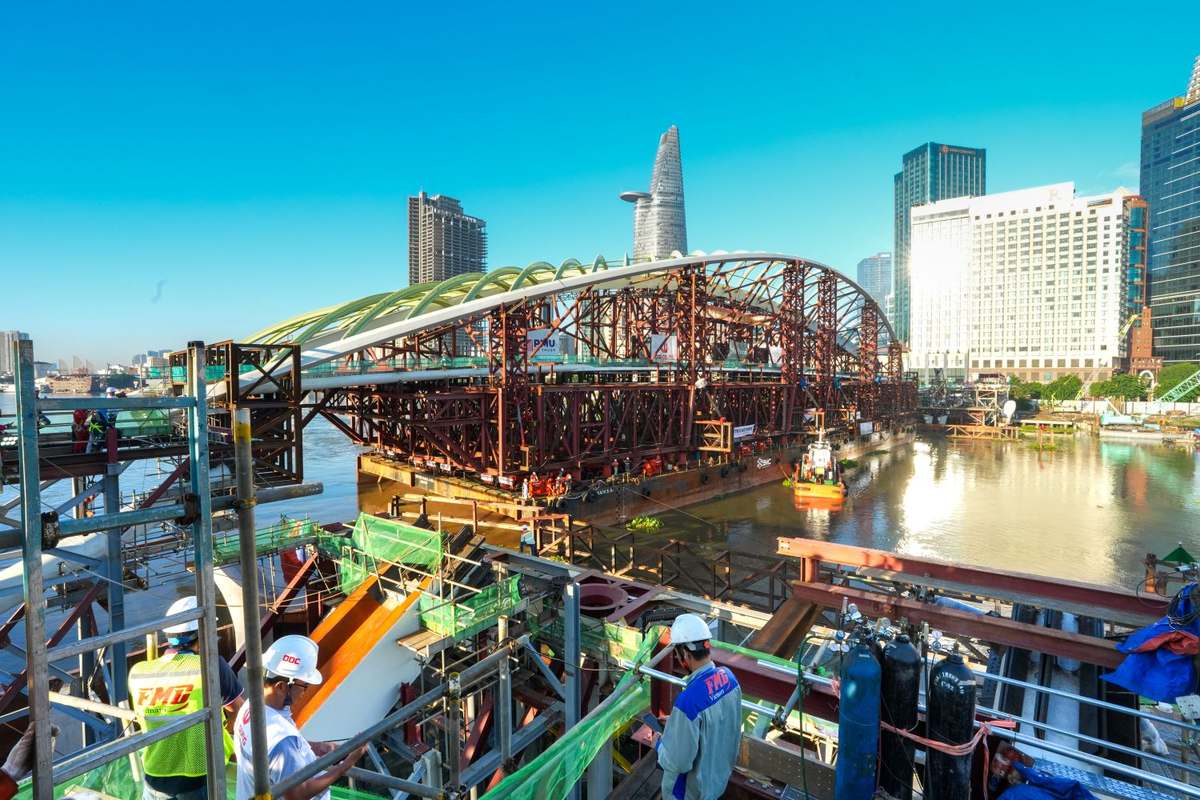
Photo 1 — Morning of 21 Oct 2026: the barge carrying the arch assembly is swung sideways into the gap between piers TC01 and TC02, in front of Bach Dang Wharf park. Photo: chinhphu.vn/LT (Government News Portal, used with attribution), article of 22 Oct 2026.
Photo 2 — The Nipa-Leaf Arch: Who Designed It, Who Built It
The shape is drawn from the nipa palm leaf — the plant that lines the waterways of the Mekong South — combined with a water-drop motif. The arch is not a decorative shell: it is the primary load-bearing structure, a three-dimensional curved steel frame whose 187 m main span crosses the river with no pier in the water, built as a cable-stayed arch. The Government News Portal calls it a “soft bridge” — a term for the frame’s ability to flex and deform under load, not a comment on its strength (Government News Portal, 22 Oct 2026; VietnamPlus/VNA, 21 Oct 2026).
| Role | Company | Note |
|---|---|---|
| Full funding | Nutifood | Close to VND 1,000 billion; project owner |
| Consulting and design | Joint venture Chodai – Kiso-Jiban Vietnam – Niwa | Chodai and Niwa are Japanese design firms |
| Project management | My Thuan PMU (Ministry of Construction) | |
| Approach spans and abutments (package XL01) | CC1 | Both approach ends finished before closure |
| Main bridge (package XL02) | Dat Phuong | Main structure, spiral stair, lifts, landscape pond and pump station essentially complete |
| Steel arch fabrication and erection | Dai Dung Group | Fabricated at Dong Xuyen port, Vung Tau |
Every load-bearing weld at height has to meet US standards and is checked by ultrasonic or radiographic testing. The second photo shows the arch finished in the yard before the load test — the first time anyone saw the “leaf” at full size.
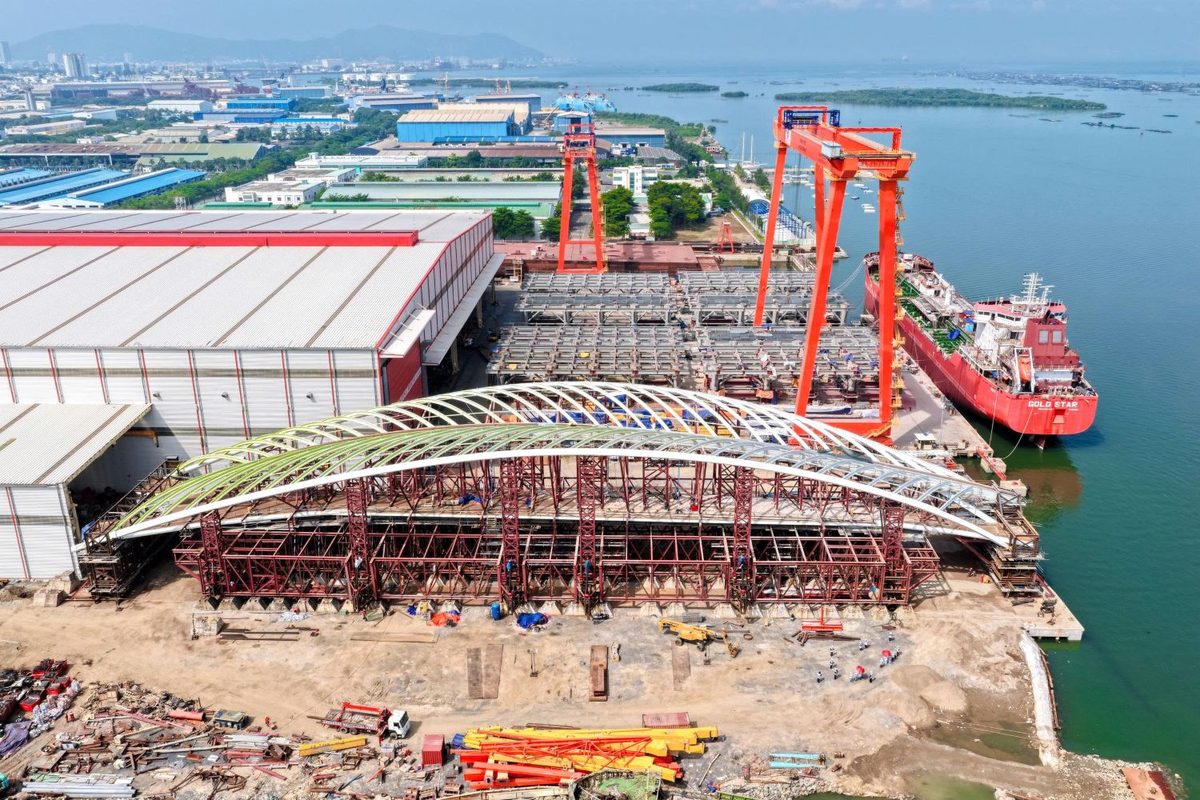
Photo 2 — The finished nipa-leaf arch at the fabrication yard, Dong Xuyen port (Vung Tau), before the 12 Oct 2026 load test. Photo: chinhphu.vn/LT (Government News Portal, used with attribution), article of 12 Oct 2026.
Photo 3 — The 3,400-Tonne Load Test in Vung Tau, 12 October
Before leaving Vung Tau the whole assembly — the 1,400-tonne arch plus its 2,000-tonne purpose-built frame — was lifted on banks of SPMT multi-axle transporters for a load test. The point was to test not just the arch but the frame that would carry it for the whole river journey: it had to hold the arch’s geometry while the barge rolled, while ballast was pumped, and while the span was lowered onto the piers. On 12 October Nutifood and the Department of Construction reported a successful test, with the project at about 90% (Government News Portal, 12 Oct 2026; VietnamPlus/VNA, 21 Oct 2026).
The third photo shows the scale of the exercise: dozens of SPMT axle lines in four groups under the frame’s main girders, each group self-levelling hydraulically to share the load. After the lift, crews re-measured the level at every point against the design file before clearing the launch.
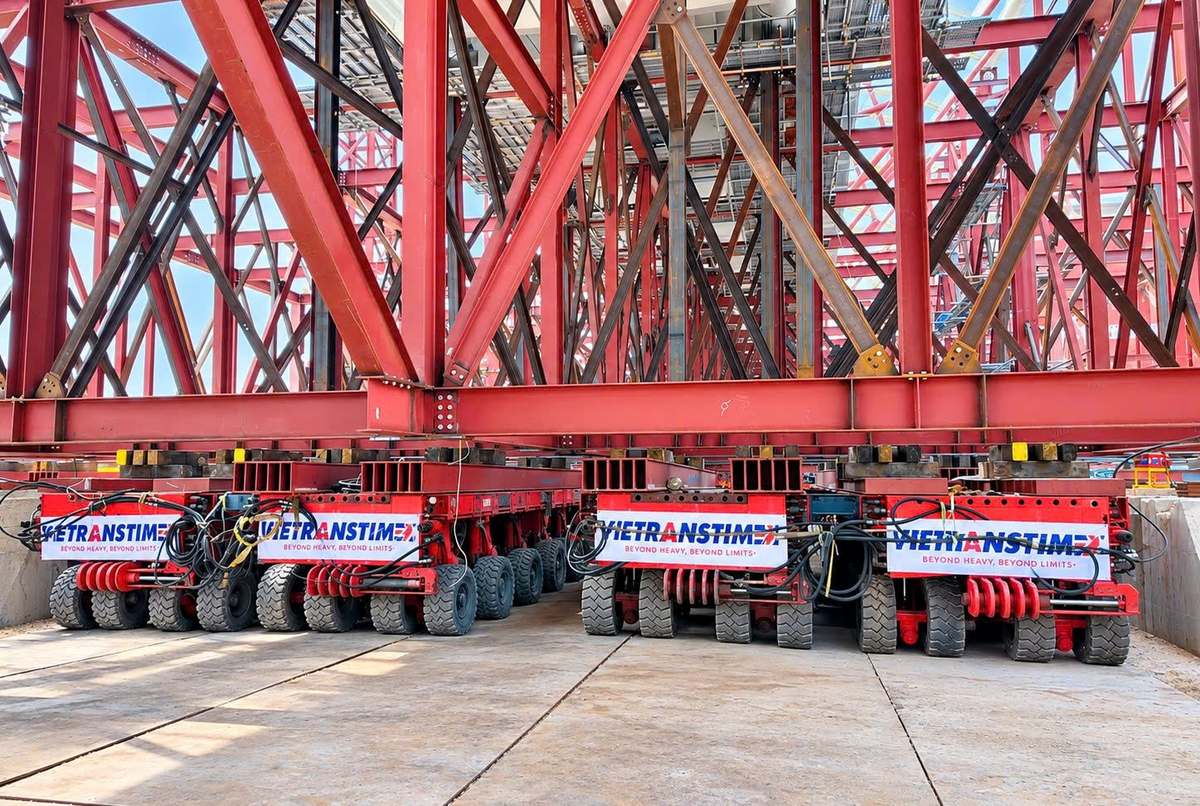
Photo 3 — Banks of SPMT multi-axle transporters slide under the support frame to lift the full 3,400-tonne assembly for the load test. Photo: chinhphu.vn/LT (Government News Portal, used with attribution), article of 12 Oct 2026.
Photo 4 — Launch Night: 2:15 am on 16 October at Dong Xuyen Port
The launch was done at night to catch the high tide and an empty port channel. At 2:15 am on 16 October 2026 the 3,400-tonne block was moved fully onto the barge at Dong Xuyen port in Vung Tau (Government News Portal, 16 Oct 2026). The tow then took about two days over 124 km of waterway up the Long Tau and Soai Rap rivers into the Saigon River, mooring off Bach Dang Wharf from 20 October; river traffic was restricted from 2 am to 6 pm on 21–22 October for the closure.
The fourth photo catches the floodlights on the white arch as the assembly left the yard — note that the arch was already fully painted before it travelled, so the remaining work at height after closure is mostly joints and inspection, not repainting the span.
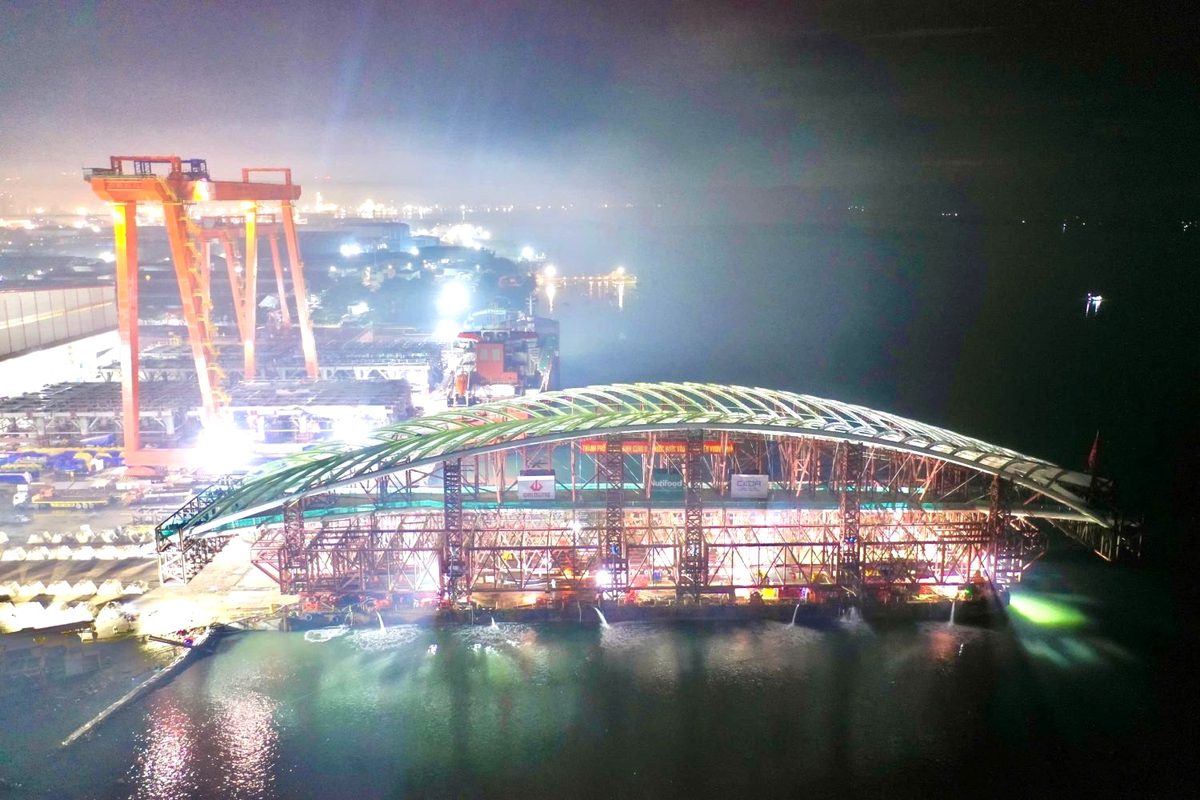
Photo 4 — Night of 15–16 Oct 2026: the assembly is moved onto the barge at Dong Xuyen port, completed at 2:15 am. Photo: chinhphu.vn/LT (Government News Portal, used with attribution), article of 16 Oct 2026.
Photo 5 — The 2,000-Tonne Support Frame: Heavier Than the Bridge Itself
Few people notice that of the 3,400 tonnes floated, the frame weighed more than the arch (2,000 versus 1,400 tonnes). It is temporary steel: it held the arch at its exact design shape and level during transport, then was released step by step once the arch sat on its two piers. Reports of 21–22 October describe the frame being lowered away during the afternoon after the 8 am seating, with the barge pulled out early that evening — in other words the bridge has been standing on its own since the night of 21 October.
The fifth photo looks up from below: the dense red trusses are the frame, the white surface above is the underside of the arch. Realtique cropped the original to remove the crowd posing for a souvenir photo underneath.
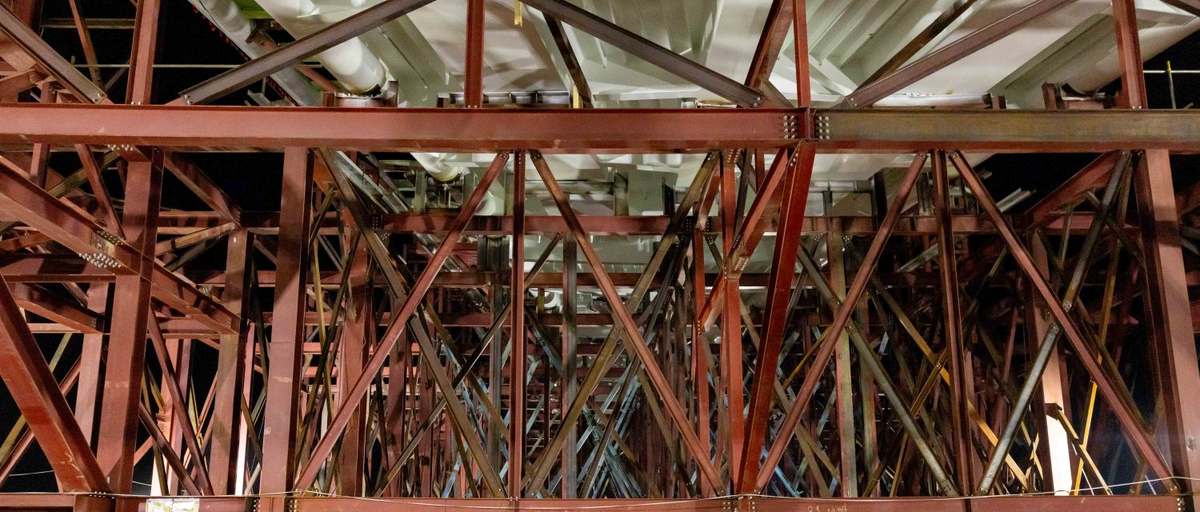
Photo 5 — The 2,000-tonne purpose-built support frame seen from below: the red trusses carried the arch for the whole 124 km tow. Photo: chinhphu.vn/LT (Government News Portal, used with attribution), article of 16 Oct 2026 (cropped by Realtique).
Photo 6 — The Bridge in Numbers, and What Is Left Before Opening
So clients do not have to memorise much, Realtique collects the figures confirmed by at least two sources:
| Item | Figure | Source |
|---|---|---|
| Total length incl. approaches | ~720 m | Nutifood; VietnamPlus, VTC 21 Oct |
| Main span (cable-stayed arch) | 187 m, no mid-river pier | Government News Portal 22 Oct; VietnamPlus |
| Deck width | 6–11 m (varies), steel girders | VietnamPlus; VTC |
| Navigation clearance | 80 m wide × 10 m high | VietnamPlus/VNA 21 Oct |
| Arch / frame / assembly | 1,400 / 2,000 / 3,400 t | VietnamPlus; Government News Portal 16 Oct |
| Tow distance | 124 km (Vung Tau → Bach Dang Wharf) | Dau Tu; Government News Portal |
| Cost / funding | Close to VND 1,000 billion, fully funded by Nutifood | Nutifood; multiple outlets 21 Oct |
| Ground-breaking / closure | Late March 2025 / 21 Oct 2026 | VietnamPlus; Government News Portal |
What is left? Per the Government News Portal on 22 October: survey of the overall geometry, camber, cable tension and joint quality against the design file; monitoring of deformation during finishing; measurement of acceleration and natural frequency to assess footfall vibration (steel footbridges are sensitive to it), plus a load test before acceptance. On the fit-out side VTC News lists the deck, railings, architectural details, lighting, escalators and lifts. The opening window is around Tet (Lunar New Year) 2027 according to Nutifood — no opening date has been announced, and Realtique treats it as a plan until the acceptance notice.
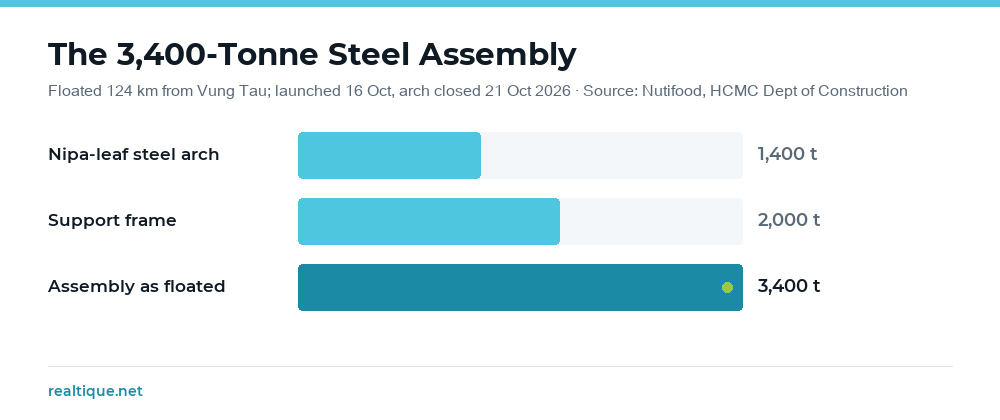
Graphic: Realtique · Data: Nutifood and the HCMC Department of Construction, as published 12–21 Oct 2026 (VietnamPlus/VNA, Government News Portal).
Photo 7 — What the Bridge Changes for Residents and Buyers in Thu Thiem
The last photo was taken at dusk before the closure: the arch moored mid-river with Bitexco and the towers of the former District 1 behind it. Once open, the bridge cuts the walk from Nguyen Hue pedestrian street to Thu Thiem’s central square to a few minutes, instead of the detour through the Thu Thiem tunnel or over Ba Son bridge.
- People living in or about to move into Thu Thiem (The Metropole, Empire City, Sala, The River…): the clearest change is walking into District 1 for dinner, work or the Bach Dang riverfront — and in the other direction, weekend visitors spilling onto Thu Thiem square. Rents for river-view units on lots 1-13 and 1-17 and along the crescent boulevard are expected to benefit first; Realtique has no figure yet and will update once post-opening deals are recorded.
- Foreign buyers and overseas Vietnamese: the bridge changes nothing in the legal frame — foreigners still buy only in eligible projects within the 30% quota per building — but it changes Thu Thiem’s resale and rental story with international tenants, who choose where to live by walking distance. Our Thu Thiem foreign buyer’s guide lists the projects with foreign quota currently on sale.
- Longer-horizon investors: on the same bank, Lotte Eco Smart City broke ground on 23 October on lot 2A opposite Bach Dang Wharf; further out sits Thu Thiem station of the high-speed railway and the Thu Thiem–Long Thanh metro. The footbridge is the smallest piece of that infrastructure chain, and the first to finish.
| Date | Event | Status |
|---|---|---|
| Late March 2025 | Ground-breaking | Done |
| 12 Oct 2026 | Load test of the 3,400 t assembly in Vung Tau | Done |
| 16 Oct 2026, 2:15 am | Launch onto barge; start of the 124 km tow | Done |
| 21 Oct 2026, 5 am–1 pm | Main-arch closure; ceremony 9:36 am at Bach Dang Wharf | Done |
| Q4 2026 | Vibration, joint and cable tests; deck, railings, lighting, escalators/lifts | In progress |
| Around Tet 2027 | Opening to the public (stated by Nutifood; no date yet) | Planned — may change |
Realtique will update this article when an official opening date is announced and night photos of the finished bridge are available.
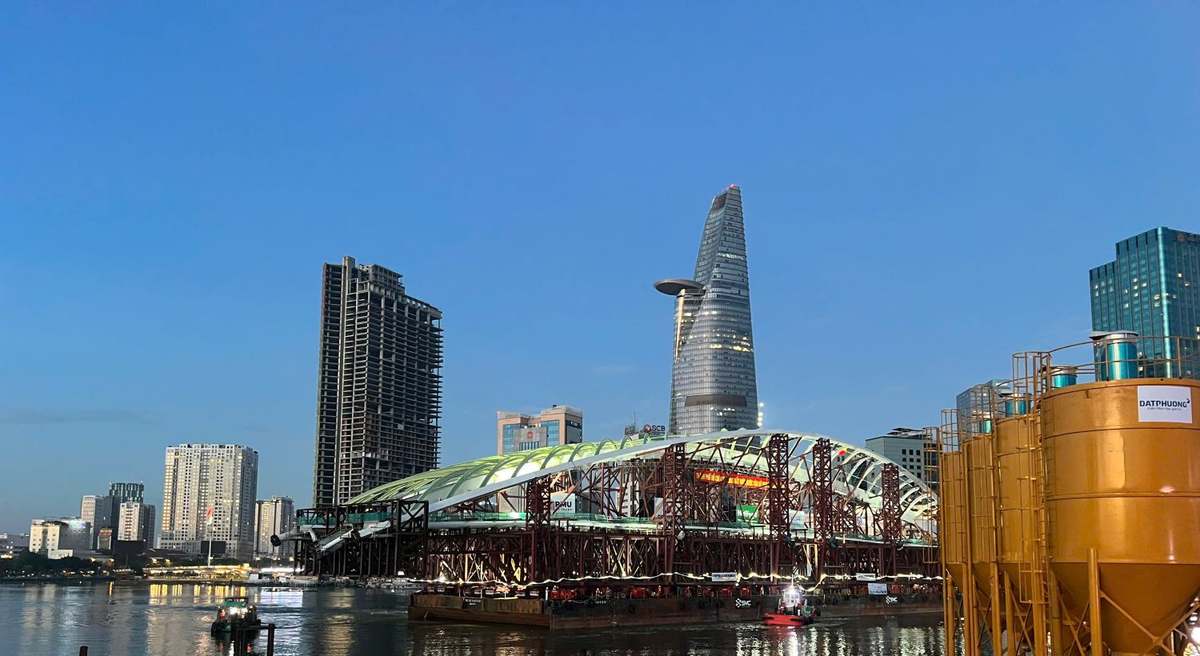
Photo 7 — Dusk on 20–21 Oct: the arch assembly moored mid-river, with Bitexco and the former District 1 skyline behind. Photo: chinhphu.vn/LT (Government News Portal, used with attribution), article of 22 Oct 2026 (cropped by Realtique).
Frequently Asked Questions
Has the Bach Dang – Thu Thiem pedestrian bridge been closed yet?
Yes. The main arch was closed on the morning of 21 October 2026, worked from 5 am to 1 pm on the Saigon River’s slack tide; the ceremony took place at 9:36 am at Bach Dang Wharf with HCMC Deputy Chairman Hoang Nguyen Dinh and Department of Construction Director Tran Quang Lam attending.
When can people walk across the Saigon River pedestrian bridge?
Nutifood has given an opening window around Tet (Lunar New Year) 2027; no opening date has been announced. Vibration, joint and cable-tension tests, the deck, railings, lighting, escalators and lifts still have to be completed. The date is a plan and may change.
How heavy is the nipa-leaf steel arch and where was it built?
The arch is 187 m long and weighs about 1,400 tonnes; Dai Dung Group fabricated it at Dong Xuyen port in Vung Tau. With its 2,000-tonne support frame the 3,400-tonne assembly was load-tested on 12 October, launched at 2:15 am on 16 October and towed 124 km to the Saigon River.
Where are the photos from, and may they be used?
The photographs come from three articles on Vietnam’s Government News Portal (chinhphu.vn/LT) dated 12, 16 and 22 October 2026 and are used with attribution under Realtique’s arrangement; the numbers graphic is Realtique’s own. Realtique does not use images from other newspapers.
Can foreigners buy apartments near the pedestrian bridge in Thu Thiem?
Yes, in projects the HCMC Department of Construction has declared eligible for foreign ownership and that still have quota under the 30%-per-building cap — currently including The Metropole and Empire City; overseas Vietnamese with citizenship buy as locals. The bridge does not change this legal frame.
⚠️ Note: The opening window around Tet 2027 was stated by Nutifood through the press on 21 October 2026; no official opening date exists, and the remaining works and test results may move it. Photographs: Vietnam Government News Portal (chinhphu.vn/LT), articles of 12, 16 and 22 October 2026, used with attribution; two frames were cropped by Realtique to remove crowds and a safety sign. Rental expectations are expectations, not recorded deals. This is not investment advice.
Looking for a Thu Thiem apartment you can walk from into District 1?
Send Realtique your budget and unit type. We will show which towers and lots sit within a 5–10 minute walk of the Thu Thiem bridgehead, check the remaining foreign quota and current rents, and help you decide whether to buy before or after the bridge opens.
📞 Hotline: +84 866 810 689

Grace Le
Grace Le advises foreign buyers, overseas Vietnamese and investors on luxury apartments in Thu Thiem and along the Saigon River — checking each lot’s legal file and foreign quota, and staying with clients from the first viewing to the signed contract.