
What Is TOD? Transit-Oriented Development & Thu Thiem Mega Station Explained
For decades, a railway station was simply a place where people arrived and departed. Today, in Tokyo, Hong Kong and Singapore, major stations have become the heart of entire urban ecosystems — places to live, work, shop, dine and relax without relying on a car. This is Transit-Oriented Development (TOD), and its latest generation — often called TOD 5.0 — turns a station into a destination. Vietnam is now embracing the same vision at Thu Thiem Station, planned as a future Mega Station in the east of Ho Chi Minh City. This guide explains what TOD is, why property around great stations tends to appreciate, and what Thu Thiem means for buyers.
Why A Railway Station Now Drives Property Value
Mục lục
What Is Transit-Oriented Development (TOD)?
Transit-Oriented Development (TOD) is a way of building a city around a public-transport station — typically a metro or rail hub — so that homes, offices, shops, schools and public space are concentrated within walking distance of it. The goal is a dense, walkable, mixed-use district where daily life happens around the station instead of around the car.
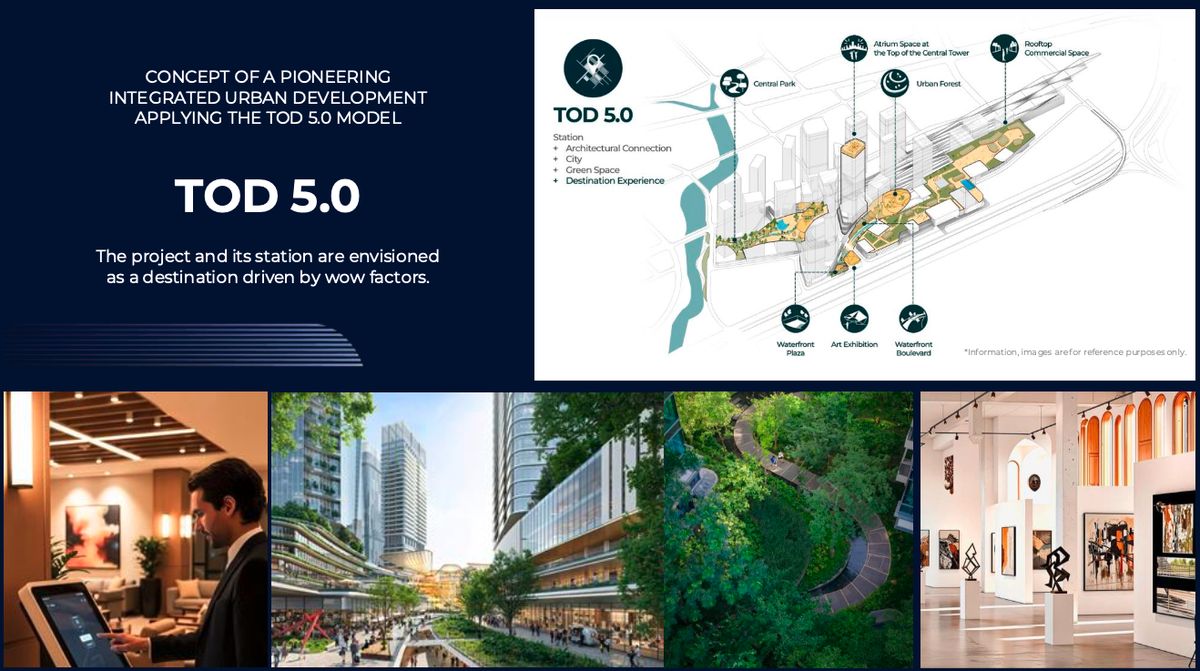
The idea is not new, but it has evolved. Early transit projects treated the station as pure infrastructure. The newest thinking — TOD 5.0 — treats the station as the centrepiece of a living neighbourhood, integrating residential towers, Grade-A offices, hotels, retail, parks and cultural space into one connected environment. A modern station is no longer just a place to pass through; it becomes a place to be.
The Five Generations Of TOD: From Train Stop To Destination
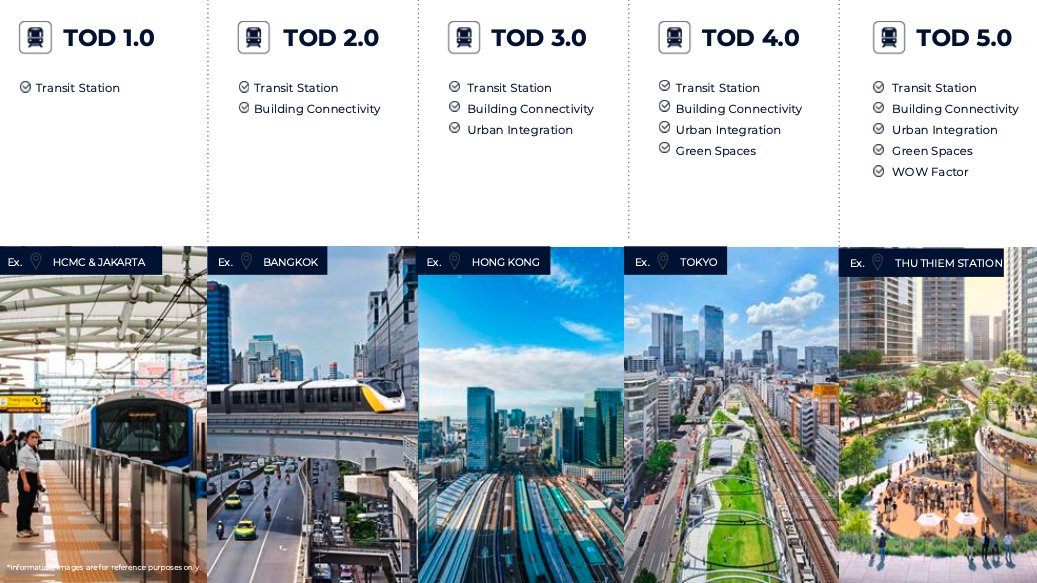
It helps to see TOD as a ladder of maturity. Each generation adds a new layer of value on top of the last:
- TOD 1.0 – Transit Station. A functioning stop where people board and alight. Example: early metro lines in Ho Chi Minh City and Jakarta.
- TOD 2.0 – Building Connectivity. The station links directly into surrounding buildings via walkways and concourses. Example: Bangkok.
- TOD 3.0 – Urban Integration. Offices, malls and homes are woven into the station itself. Example: Hong Kong.
- TOD 4.0 – Green Spaces. Parks, urban forests and public realm make the district liveable. Example: Tokyo.
- TOD 5.0 – The WOW Factor. The station becomes a destination in its own right — a place people travel to, not just through. This is the vision for Thu Thiem Station.
Why Property Around Great Stations Appreciates
Some of the world’s most successful urban districts — Roppongi Hills and Shibuya in Tokyo, or West Kowloon in Hong Kong — show how transport infrastructure can become the catalyst for long-term economic growth and real-estate value. The pattern is consistent:
- Connectivity concentrates demand. When a location links seamlessly to the airport, the CBD and the wider metro network, both businesses and residents want to be there — and are willing to pay for it.
- Foot traffic creates retail and office value. A station that moves large volumes of people daily supports shops, restaurants and Grade-A offices, which in turn lift the value of the homes above and around them.
- Scarcity at the core. Land at the exact heart of an integrated hub is finite. As the district matures, the best-located assets become some of the city’s most valuable.
- Successful real estate is rarely created by buildings alone. It is created by infrastructure, connectivity and the movement of people — the very ingredients a Mega Station brings together.
For how this is already playing out along Ho Chi Minh City’s metro network, see our note on HCMC metro and property value.
Thu Thiem Station: Ho Chi Minh City’s TOD 5.0 Mega Station
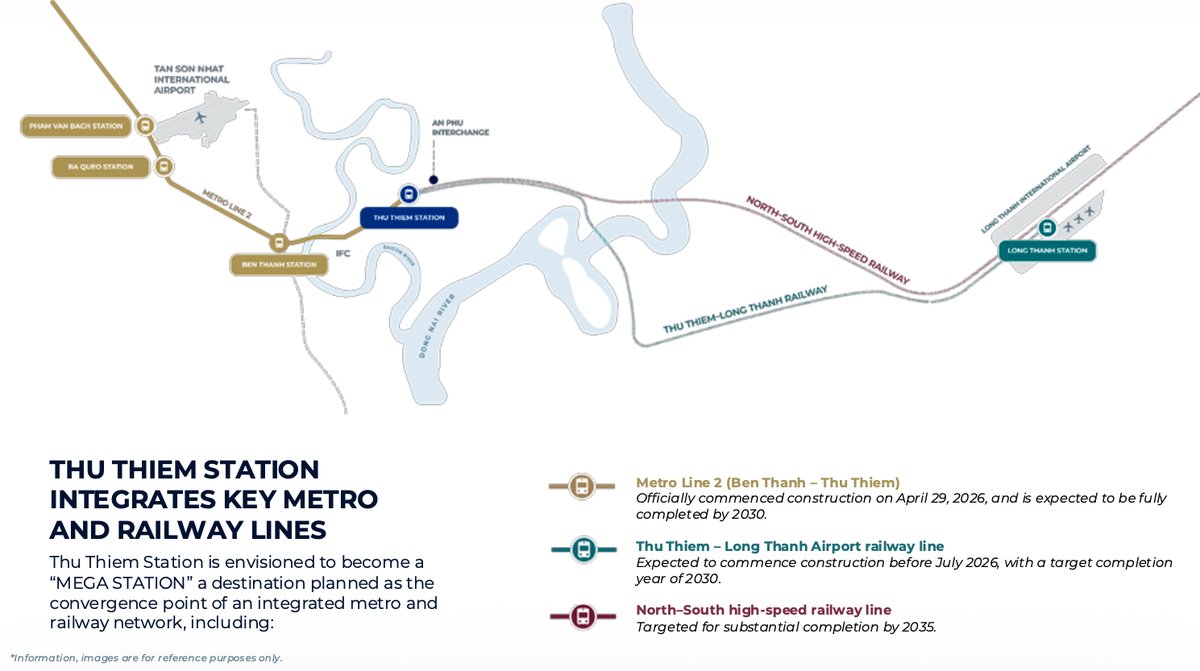
In Ho Chi Minh City, Thu Thiem Station has been planned as a future Mega Station — a convergence point for an integrated metro and railway network rather than a single transport line. According to published plans, it is envisioned to bring together:
- Metro Line 1 (Ben Thanh – Suoi Tien), which has been in operation since 2025, anchoring the eastern corridor.
- Metro Line 2 (Ben Thanh – Thu Thiem), with construction reported to have commenced in 2026 and completion targeted around 2030.
- The Thu Thiem – Long Thanh Airport railway, linking the district to the region’s new international airport.
- The North–South High-Speed Railway, targeted for substantial completion in the following decade.
Rather than functioning as a transport hub alone, the station is expected to sit at the centre of a new mixed-use district — residential, commercial, financial, hospitality and public space within one integrated ecosystem — inside Thu Thiem, the city’s emerging financial centre. Timelines for infrastructure are set by the authorities and can change; confirm current status before making decisions.
The Thu Thiem – Long Thanh line now has concrete numbers attached: a planned 47.7km route with 18 stations (2 underground, 16 elevated), a preliminary budget of roughly VND 175 trillion (~US$7 billion), with Dai Quang Minh (a THACO group company) tasked with the feasibility study. Reported groundbreaking targets have varied across press coverage (some cite mid-2026, others cite September 2026) — treat this as a directional timeline that can still shift rather than a confirmed date.
August 2026 Update: Which Lines Actually Connect at Thu Thiem Station?
Short answer: two separate lines meet at Thu Thiem Station. It is not one line running through. This is the most commonly confused point — some listing sites run headlines that merge the two into “Metro Line 2: Ben Thanh – Thu Thiem – Long Thanh”, which is simply wrong.
| Line | Alignment | Status, August 2026 | Relationship to Thu Thiem Station |
|---|---|---|---|
| HCMC Metro Line 2 (Ben Thanh – Tham Luong) | ~48 km in total, built in three phases. Phase 1 runs along Cach Mang Thang Tam and Truong Chinh | Phase 1 under construction: 11.3 km, 10 underground stations plus one elevated station and a depot, revised investment of VND 55,179 billion, started 15 January 2026, station works running line-wide from August 2026, completion expected in Q4 2030 | Only reaches it in phase 2 — the Ben Thanh → Thu Thiem segment (delivered alongside Tham Luong → An Suong, 9.4 km / 7 stations combined). Phase 3 extends northwest to Cu Chi (27.4 km / 24 stations) |
| Thu Thiem – Long Thanh line | Links central Ho Chi Minh City to Long Thanh airport | A separate project, still in investment preparation | Starts at Thu Thiem Station — which is why the station is an interchange hub, not because Line 2 “runs to the airport” |
Three points worth getting right:
- Does Line 2 serve Thu Thiem? Yes — but in phase 2, not the section currently being built. Phase 1 ends on the northwestern side and never crosses the river.
- Does it extend to Binh Duong? No. The northwestern terminus is Cu Chi, in phase 3. The confusion comes from Binh Duong also having a line numbered 2 — the Thu Dau Mot – HCMC metro — same number, entirely different line (see the Thu Dau Mot metro guide).
- Does it run to Long Thanh airport? No. That is the separate Thu Thiem – Long Thanh line. The two interchange at Thu Thiem Station.
Read those three points together and the station’s real value becomes clearer: its strength is not that one line passes through, but that several independent lines converge on a single hub — which is what a TOD mega station means. The timelines above remain at implementation stage and may be adjusted.
24 August Update: Dai Quang Minh Proposes a 246.44-Hectare TOD District at Thu Thiem Station
On 22 August 2026, Dai Quang Minh — a member of the Truong Hai (THACO) group — submitted a proposal to the Ho Chi Minh City People’s Committee to draw up master plans for three TOD districts totalling more than 660 hectares:
- A TOD district around Thu Thiem Station — roughly 246.44 ha, covering An Khanh and Binh Trung wards.
- The I/82a Tay Thanh block in Tay Thanh ward — roughly 148.92 ha.
- The exhibition centre and sports complex site in Tan Son Nhat ward — roughly 265.07 ha.
The proposal is tied to Metro Line 2 (the Ben Thanh – Tham Luong and Ben Thanh – Thu Thiem sections) and the Thu Thiem – Long Thanh rail line.
⚠️ Read this carefully: it is a developer’s request to prepare a master plan, not an approved plan. At the time of reporting, no formal response from the city had been published. Note too that the Thu Thiem Station area now carries at least two parallel proposals — SonKim Land previously pitched a “TOD 5.0” concept for the same area. For buyers, that signals how strongly the location is contested, but it does not mean boundaries or timelines are settled.
Source: Thanh Nien, 22 August 2026.
1 September Update: The Airport Line Is Not on the 2 September Groundbreaking List
Ho Chi Minh City has finalised its National Day construction list, and the Thu Thiem – Long Thanh airport railway is not on it. The city will break ground on nine projects and inaugurate four on 2 September 2026 — a shorter list than the 16 works named in mid-August. The reason given for the airport line: preparation is not complete.
What is actually starting: the Highway 13 widening (Binh Trieu bridge to the Binh Duong boundary, BOT); the Highway 1 widening (Kinh Duong Vuong to the Long An boundary, BOT); two sections of the Ring Road 4 expressway; a Binh Duong water-environment scheme; an AI-factory data centre at Tan Phu Trung Industrial Park; two social-housing projects (Tien Phuoc and Le Thanh Tan Tao); and two urban upgrade schemes (Ma Lang, and Cho Ga – Cho Gao).
Where the hold-up is. As of mid-August the project dossier was still not eligible for approval and was under appraisal by the HCMC Department of Construction, with the investor continuing to complete it. That is a paperwork constraint rather than a site constraint — but it also means the timing depends on approvals, and no new date has been announced. (Update: on 12 September the city moved the project onto an “urgent case” track — see below.)
What this changes for buyers — and what it does not. The interchange logic of Thu Thiem Station is unchanged: Line 1 is operating, Line 2 is proceeding, and the station remains the planned convergence point. What changes is how you should price the airport link: treat it as in preparation, with no confirmed start date, not as a 2026 delivery. If a sales pitch values a unit on the assumption that the airport line breaks ground this year, that assumption is currently unsupported.
Sources: Dan Tri (28 August 2026); Bao Xay Dung (13 August 2026).
3 September 2026 Update: A Metro Is Not a Magic Wand — and 355 km Is the Old Basket
Short answer: a metro line delivers access. Only TOD converts that access into value. And the “355 km” figure quoted across the market describes Ho Chi Minh City before the merger — not the city as it exists today.
On 3 September 2026, a market analysis published by CafeF/VTC News pushed back on an assumption most buyers treat as settled: that a metro line is automatically a magic wand for nearby property. Three voices quoted in the piece — Duong Thuy Dung, Executive Director of CBRE Vietnam; Kieu Xuan Phan of Nam Me Kong Group; and Nguyen Do Dzung, CEO of urban consultancy EnCity — converge on the same point: the price jump that appears when a line opens is largely driven by market expectation, not necessarily by a matching increase in day-to-day usability.
The concrete example cited: along the Ben Thanh – Suoi Tien line, one project rose 20% in the first year of operation. What sustains that kind of uplift is the ecosystem around the station — residential density, jobs, retail and services planned together — which is precisely the definition of TOD set out at the top of this article. The cleanest formulation from the piece: a metro creates accessibility; TOD is what turns accessibility into urban value.
355 km Is the Old Basket — the Merged City Plans About 1,000 km
The figure quoted most often is 7 lines / 355 km by 2035, at roughly US$40 billion, with a further 155 km in the following decade to reach 510 km. That target belongs to the Ho Chi Minh City Urban Railway Development Masterplan, drawn up under Politburo Conclusion 49 and subsequently National Assembly Resolution 188.
The part rarely spelled out: that masterplan was written for pre-merger Ho Chi Minh City. After the consolidation with Binh Duong and Ba Ria – Vung Tau, the planned urban rail network for the enlarged city runs to almost 1,000 km: 510 km across 12 lines in the former HCMC area, ~305 km across 12 lines in former Binh Duong, and 125 km across 3 lines in former Ba Ria – Vung Tau — with the whole network due to be reassessed under the new model and vision.
The practical consequence for a buyer: if the project you are looking at sits in former Binh Duong or former Ba Ria – Vung Tau, the section of network that actually serves it falls outside that 355 km figure. Reading “355 km by 2035” and concluding that the line nearest your building will be finished by 2035 is a leap the number does not support.
Three Questions That Replace “Is It Near a Metro?”
- Near which station, and how far along is that line? A station on an operating line, a station on a line that has only just been approved in principle, and a station that exists solely on a planning map are three very different assets in terms of timing risk.
- Is the land around the station genuinely being replanned as a TOD district? This is the difference between sitting next to a station and sitting inside a TOD district. The 246.44-hectare TOD proposal around Thu Thiem Station described in the section above is an example of that work — and it is itself still at the proposal stage.
- How much expectation is already in today’s price? If the metro story has been priced in for years, the remaining upside has to come from an ecosystem that actually materialises — not from the same announcement being repeated.
Worth watching: the Binh Duong – Suoi Tien metro line is described as expected to break ground in late 2026. That remains a projected milestone rather than a confirmed construction decision, so treat it as a possibility, not a schedule. Infrastructure timelines are set by the authorities and are subject to change.
What This Means for Foreign Buyers
For an overseas buyer, the timing-risk question matters more than it does for a local owner-occupier, because the holding period is usually defined in advance. Two practical implications: first, weight projects served by lines that are already operating or already under construction more heavily than those relying on map-stage lines. Second, remember that foreign ownership quotas are applied per building, so a well-located TOD tower can exhaust its foreign allocation long before the surrounding district matures — the access story and the availability story move on different clocks. A Realtique advisor can confirm the current quota position on any specific building.
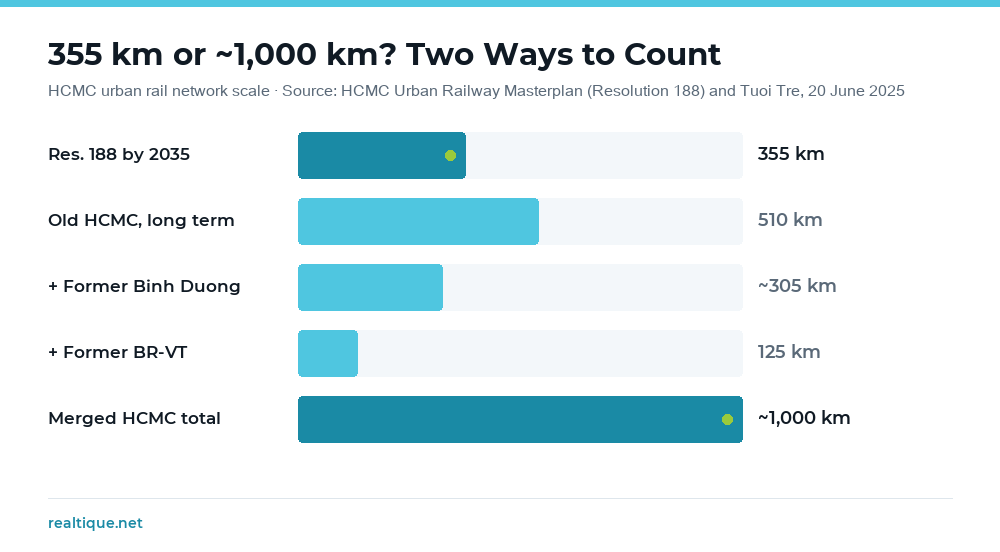
Graphic: Realtique · Data: HCMC Urban Railway Masterplan (Resolution 188) and Tuoi Tre, 20 June 2025
12 September 2026 Update: The City Fast-Tracks the Airport Line as an “Urgent Case” — Three Deadlines on 13 September
Two weeks after the airport line missed the 29 August groundbreaking batch, it has had its clearest procedural push of the year. On 12 September 2026 the Ho Chi Minh City People’s Committee issued a directive (signed by Vice Chairman Hoang Nguyen Dinh) to its departments and to Dai Quang Minh, the THACO-group company preparing the project, ordering the investment-preparation paperwork to be finished urgently. The new element is the route it takes: the city now proposes that the project’s investment policy be considered as an urgent case requiring immediate implementation — a shortened approval track rather than the standard sequence. Dan Tri also confirmed why the line slipped past 2 September: investment preparation had not kept pace with the schedule.
Three tasks, one deadline — 13 September 2026 (Tuoi Tre and Dan Tri, 12 September):
- The land to pay for the BT contract. The Department of Agriculture and Environment, working with Dai Quang Minh, must propose the list of land plots earmarked to pay the build-transfer contract. This is the knot that has been tied since June: roughly 36.2 of the line’s 47.7 km run through Dong Nai, so paying with Ho Chi Minh City land alone was judged not feasible. The two localities agreed on a mix of land plus state budget, and the city asked Dong Nai to put forward additional plots along the alignment.
- The People’s Council vote. The Department of Finance must draft the submission for the HCMC People’s Council to approve the investment plan at its next session, expected in September 2026.
- The Party committee submission and the technology review. The Department of Construction must draft the submission to the city’s Party bodies for the “urgent case” policy — and it must spell out who funds or supplies land for the works located in Dong Nai. The same department has to finish reviewing the technology option by 13 September.
Firmer technical numbers. Per Dai Quang Minh’s study as reported by Tuoi Tre: the line runs from Thu Thiem Station to the Cam Duong depot, about 46.5 km (earlier releases quoted 46.44–47.7 km depending on end-points); GoA4 automation, the highest European grade, capable of driverless operation; a design speed of 120 km/h, running at 80–110 km/h by section; and peak capacity of nearly 47,000 passengers per hour (over 23,400 per hour per direction). A China Railway Liuyuan Group – Hung Nghiep consortium was appointed on 19 August to appraise the feasibility study. On cost, VND 175,000+ billion remains the figure most outlets use; CafeF on 13 September quoted VND 134,000+ billion for phase 1 and a 2030 completion target.
How to read it. “Urgent case” is the name of a procedure, not a start date. As of 13 September there is still no new groundbreaking date; the nearest checkable milestone is the September 2026 People’s Council session — only after that approval can the BT contract be signed. For a buyer near Thu Thiem Station or along the Dong Nai corridor, two things matter more than any ceremony: (1) the list of land plots used to pay the contract — those are the sites that will be handed to the investor, i.e. the future project pipeline along the line; and (2) who pays for the Dong Nai section — the answer decides whether the full 47.7 km proceeds together or the city section starts first. Vietnamese-language detail is in our Thu Thiem – Long Thanh metro tracker; see also the Long Thanh airport city guide, the 29 August infrastructure batch and the Thu Thiem foreign buyer’s guide.
Sources: Tuoi Tre and Dan Tri (12 September 2026); CafeF (13 September 2026); HCMC–Dong Nai alignment consultation (June 2026, Tuoi Tre / VietnamNet).
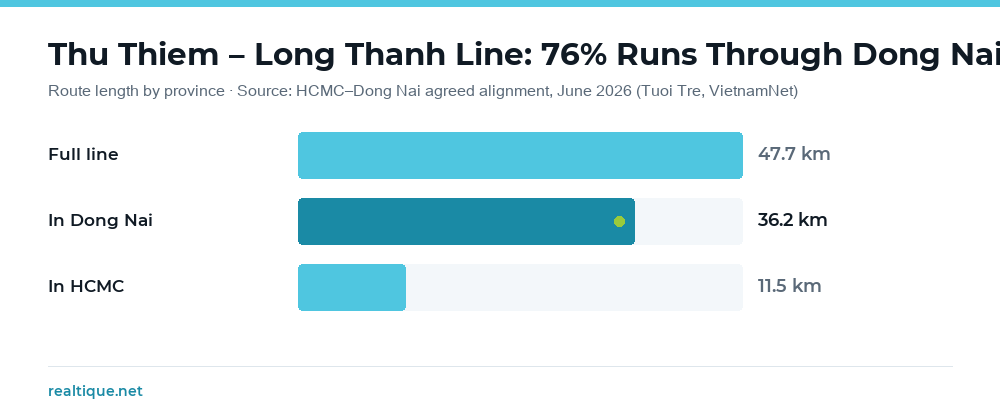
Graphic: Realtique · Data: HCMC–Dong Nai agreed alignment, June 2026 (Tuoi Tre, VietnamNet); the 76% share is Realtique’s own calculation from 36.2/47.7 km
Location: ‘The Magnet Of The City’
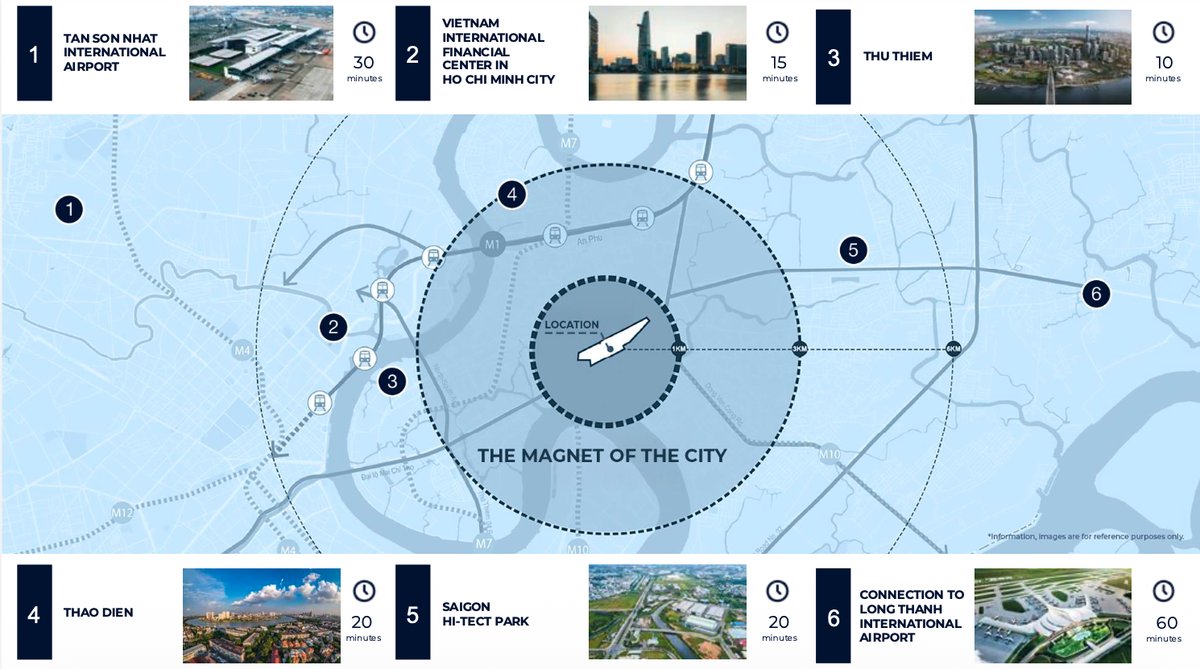
What makes the Thu Thiem area compelling is its position at the centre of the city’s road and rail network. From this location, indicative travel times reach the key nodes of Ho Chi Minh City:
- Thu Thiem & the new financial centre — roughly 10–15 minutes.
- Thao Dien and the established District 2 riverside — around 20 minutes.
- Saigon Hi-Tech Park in the eastern innovation belt — around 20 minutes.
- Tan Son Nhat International Airport — around 30 minutes.
- The future Long Thanh International Airport, via the planned rail link — around 60 minutes.
This is the connectivity that turns a district into what planners call “the magnet of the city.” For the bigger planning picture, see our guide to Ho Chi Minh City urban planning to 2030 and our Thu Thiem new-CBD buyer guide.
Thu Thiem vs The Global City
A side-by-side look at two eastern-corridor options — the CBD at Thu Thiem versus the value and payment terms of The Global City corridor.
Explore →Palm City – next to Thu Thiem
An established 30.2-hectare township on the doorstep of Thu Thiem — a proven, well-connected location in the eastern growth corridor.
Explore →Masteri Park Place – The Global City
A flagship Masterise address in The Global City — an international-standard township riding the same eastern-HCMC infrastructure wave.
Explore →What It Means For Buyers
- Buy the connectivity, not just the building. A great address at a TOD hub draws its value from the network around it — metro lines, the airport link and the CBD.
- Position early in the story. Value tends to build as each rail line and layer of the district comes online, not after everything is finished.
- Insist on credible developers and clean legal status. Integrated districts reward well-located, legally clean assets from developers who can deliver.
- Confirm foreign-ownership rules per project. Quotas and eligibility differ; some projects are open to foreign buyers, others use long-term lease structures.
- Think in years. TOD value is a multi-year story tied to infrastructure delivery — plan the hold accordingly.
Frequently Asked Questions
What is TOD (Transit-Oriented Development)?
TOD is an approach to urban development that concentrates homes, offices, shops and public space within walking distance of a public-transport station — creating a dense, walkable, mixed-use district built around the station rather than the car.
What is TOD 5.0?
TOD 5.0 is the most advanced generation of the model. Beyond connectivity, integration and green space, it adds a “wow factor” so the station itself becomes a destination — a place people travel to for living, working and leisure.
What is Thu Thiem Mega Station?
Thu Thiem Station is planned as a Mega Station in the east of Ho Chi Minh City — a convergence point for Metro Line 1, Metro Line 2, the Thu Thiem–Long Thanh airport railway and the North–South high-speed railway, at the heart of a new mixed-use district.
Why does property near a station gain value?
Connectivity concentrates demand and foot traffic, which supports retail and offices and lifts nearby home values. Land at the core of an integrated hub is scarce, so the best-located assets tend to appreciate over time.
Can foreigners buy property near Thu Thiem?
It depends on the specific project and its foreign-ownership quota. Some developments are open to foreign buyers; others use long-term lease structures. A Realtique advisor can confirm what applies.
This article is general market and planning commentary, not personalised investment advice. Infrastructure timelines are set by the authorities and may change; project renders are illustrative. Confirm current status and project specifics before making a decision.
Own within walking distance of the Mega Station
Leave your details and a Realtique advisor will show you the projects around Thu Thiem and the eastern growth corridor — a callback within two business hours, no obligation.
Hotline: +84 866 810 689

Grace Le
Grace Le is a Branch Manager at Realtique, advising bilingual and overseas buyers on where infrastructure, connectivity and long-term value meet in Ho Chi Minh City.