

Vietnam Macro Week in Review (Oct 26 – Nov 1, 2026): Two Fed Dissents Wanted a Hike, Gold Breaks Below $3,900, Power and Petrol Both Cheaper From 1 November
Short answer: two things from the week of 26 October to 1 November 2026 touch what a buyer in Vietnam actually pays. At home, from 1 November the average retail electricity tariff fell 2% and the special consumption tax on petrol went to 0% — a change that could take roughly VND 1,500–1,700 off a litre of petrol, against nine-month CPI already running at 4.52%, slightly above target. Abroad, the Fed held at 3.75–4% on 28 October, but both dissenting votes wanted a 0.25-point increase — a shift in expectations that makes “rates will fall sharply soon” a risky thing to plan around. Locally the VN-Index lost 32.53 points over the week with VND 2,692 billion of foreign net selling, and spot gold broke below $3,900/oz — its 2026 low — pulling SJC gold bars down about VND 2.7 million per tael.
Realtique’s reading of the Fed’s own 28 October statement, the Bank of Japan’s 30 October decision, Kitco and HOSE data and Vietnam Government Portal reporting: the pattern of the week is that domestic living costs were pushed down with tax and price tools, while the international rate environment leaned higher for longer. Seven stories below, each with a sourced figure and its date, what it means for buyers and landlords in Vietnam, and how to answer when a client asks. This is the third issue of Vietnam Macro Week in Review (previous: 19–25 October 2026), published every Monday morning.
Vietnam Macro Week in Review — 26 Oct – 1 Nov 2026
Table of Contents
The Fed Held at 3.75–4% — But Both Dissents Wanted a Hike, Not a Cut
On 28 October 2026 the Federal Open Market Committee kept its target range at 3.75–4.00% on a 10–2 vote. The notable part is not the decision but the direction of the two dissents: in the Fed’s own words, Lisa D. Cook and Beth M. Hammack voted against because they “preferred to raise the target range for the federal funds rate by 1/4 percentage point at this meeting” — not because they wanted a cut.
The language hardened too. Economic activity is described as “expanding at a strong pace” (an upgrade from “solid” in September), “inflation remains elevated”, and the Committee states flatly that it “will deliver price stability”. The meeting was chaired by Kevin Warsh. After it, futures markets priced the probability of a December increase at roughly 80–87.5% on the CME FedWatch tool — sources differ within that band, so read it as “most of the probability”, not a single figure.
What it means for buyers and landlords in Vietnam: Vietnamese dong lending rates are not pegged to the Fed, but a Fed that stays high for longer forces the State Bank of Vietnam to prioritise the exchange rate, and that narrows the room to cut domestically. The practical consequence for a buyer: drop “wait a few months and mortgage rates will fall sharply” from the plan. Current lending levels and how to size cash flow against them are in high loan interest rates in 2026; the comparison across asset classes is in savings vs gold vs stocks vs rental property.
💬 When a client asks
Client asks: “If the Fed isn’t cutting, will my mortgage rate in Vietnam go up?”
Suggested answer: Not automatically — dong lending rates are set by domestic funding conditions and the State Bank, not by the Fed. But a Fed that holds high for longer pressures the exchange rate, and defending the rate makes deep local cuts harder. The safe approach is to size your cash flow at today’s rate plus a margin, rather than on a scenario where rates fall.
Sources: FOMC statement, 28 October 2026 (Federal Reserve) · CNBC, 28 October · CNN, 28 October · Yahoo Finance, 28 October
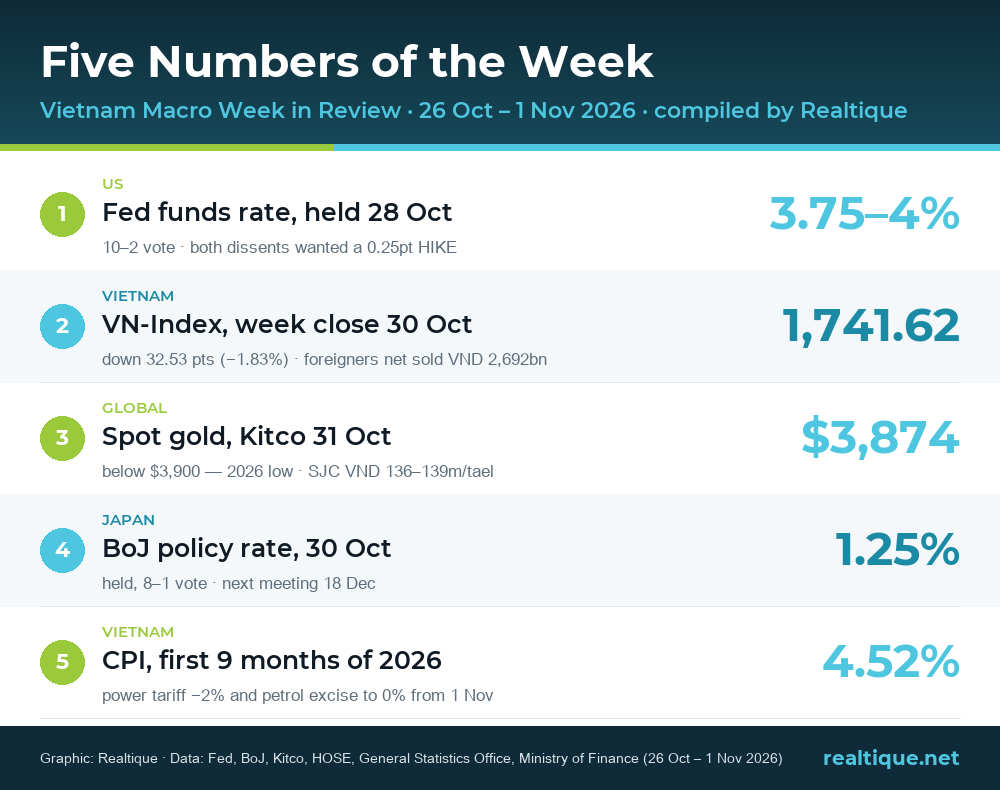
Graphic: Realtique · Data: Fed (28 Oct), Bank of Japan (30 Oct), Kitco (31 Oct), HOSE (30 Oct), General Statistics Office, Ministry of Finance
Bank of Japan Held at 1.25% on an 8–1 Vote — Clearing the Way for December
On 30 October 2026 the Bank of Japan kept its policy rate at 1.25% on an 8–1 vote, with board member Hajime Takata arguing for 1.5%. This is a pause after two consecutive 25 basis-point increases in June and September. Governor Ueda signalled that “the policy phase is changing”, and the published outlook still points to further increases and less accommodation. The next meeting is 18 December; the yen traded around 156–157 per US dollar. Sources differ by a point or two on the yen, so treat it as a range.
What it means for buyers and landlords in Vietnam: A persistently weak yen makes “buying Vietnamese property out of yen income” more expensive on conversion for Japanese clients — but the BoJ is clearly preparing another move, so that could reverse from December. This matters for the Japanese tenant and buyer base in Thao Dien, An Phu and Phu My Hung, and for Realtique’s Japanese-language site. Local supply and rent levels are set out in the Q3 2026 Ho Chi Minh City market report.
💬 When a client asks
Client asks: “The yen is weak — should your Japanese clients wait for a better rate before buying?”
Suggested answer: Waiting on the exchange rate means betting on a second variable on top of the property price. If the rent collected in dong already covers the cost of capital, the exchange rate changes when you fund, not whether the asset is good. Realtique does not forecast currencies; the sensible order is to lock the unit, price and legal status first, then pick the transfer date.
Sources: Bank of Japan holds at 1.25% — 30 October roundup · Kalkine, 30 October · Trading Economics — Japan Interest Rate
Gold Broke Below $3,900 to a 2026 Low — SJC Bars Fell VND 2.7 Million per Tael in a Week
Spot gold fell below $3,900/oz on 30 October — its lowest level of 2026 and roughly 30% below the January peak. On the afternoon of 31 October Kitco showed $3,874.40/oz, down $146.10 (−3.63%) in a single session, with the week down about 3%. Strong US economic data and expectations that the Fed will stay tight were the reasons cited.
In Vietnam, on 31 October the SJC gold bar selling price came down from VND 141.4 million to VND 139 million per tael (a VND 2.4 million drop on both sides); across the week it fell about VND 2.7 million per tael. On 1 November quotes sat around VND 136–139 million per tael. Converting the world price at Vietcombank’s 31 October selling rate gives roughly VND 121.4 million per tael — leaving a domestic-to-world gap of about VND 17.6 million per tael. Note: sources quote different SJC figures for the same moment (VND 138.4–141.4m versus 136–139m), so this article keeps each with its date rather than merging them.
What it means for buyers and landlords in Vietnam: Gold fell on US rates and US data, not on anything domestic. The number that matters for anyone thinking of switching is the ~VND 17.6 million per tael gap — a very large round-trip cost on a short hold. The week is also a reminder that the “defensive” asset can lose 3–4% in days; the split between a defensive holding and a cash-flow holding is set out in the four-channel comparison.
💬 When a client asks
Client asks: “Gold is falling hard — should I sell gold and buy a rental apartment?”
Suggested answer: Realtique does not give investment advice. If your gold is serving a defensive role, let it do that job. For the part you want generating income, compare the net rental yield of a specific unit — after management fees, rental tax and vacancy — against deposit rates, and subtract the roughly VND 17.6 million per tael gap as a cost of selling gold domestically.
Sources: vietnam.vn, 31 October (domestic and world gold) · CafeF, 1 November (SJC, DOJI, PNJ quotes) · Da Nang Newspaper, 1 November · Coinotag (gold below $3,900)
VN-Index Lost 32.53 Points in the Final Week of October, With VND 2,692 Billion of Foreign Net Selling
Over the 26–30 October trading week the VN-Index closed at 1,741.62, down 32.53 points (−1.83%) on the week — a reversal after the previous week’s gain of about 68 points. The final session on 30 October alone took nearly 14 points off. Foreign investors net sold a cumulative VND 2,692 billion, led by FPT at VND 782 billion, then VPL and VIC; on 30 October alone net selling on HOSE was about VND 633–635 billion. A reading note: some headlines say “nearly VND 3,000 billion” while the body of the same report says 2,692 billion — this article uses the body figure.
What it means for buyers and landlords in Vietnam: Two consecutive weeks pointing in opposite directions show how volatile listed-market flows currently are, while foreign capital still has not returned after the FTSE upgrade took effect on 21 September. For housing, keep the two separate: foreign flows in listed equities and foreigners buying apartments (a 30% cap per building, 50-year terms) are different pools of money and one does not predict the other. Where the two markets genuinely touch is domestic investor sentiment and liquidity — the context is in the Q3 2026 market report.
💬 When a client asks
Client asks: “Stocks are down and foreigners are selling — is property about to follow?”
Suggested answer: One week is not a trend, and the two markets move on very different clocks: an index reprices daily, housing reprices quarterly. For property the things to watch are launch supply, absorption rates and actual achieved rents in the specific area you care about — not index moves.
Sources: CafeF, 31 October (foreign flows, final week of October) · VietnamPlus, 30 October · Vietstock, 30 October

Illustration: Wikimedia Commons · CC0 1.0 (Realtique image kit)
From 1 November: Power Tariffs Down 2%, Petrol Excise to Zero — With Nine-Month CPI at 4.52%
From 1 November 2026 the average retail electricity tariff fell 2% and the special consumption tax on all grades of petrol went to 0%. According to Nguyen Tien Thoa, chairman of the Vietnam Valuation Association, the excise change alone could take about VND 1,500–1,700 off a litre; in the 31 October pricing round E5 petrol came down by more than VND 1,800 a litre.
On the production side, the 2% power cut is calculated to reduce steel production costs by about 0.12%, cement by about 0.3% and textiles by about 0.2%. The context: CPI for the first nine months of 2026 stood at 4.52%, slightly above target. Mr Thoa argues that holding full-year CPI within 4.5–5% would count as a success for price management. Associate Professor Ngo Tri Long agrees both measures ease pressure on the general price level. The offsetting factors named are year-end consumer demand, faster public disbursement and credit growth, plus world energy prices and the exchange rate as the dollar strengthens.
What it means for buyers and landlords in Vietnam: This is a direct benefit for landlords and anyone servicing a mortgage: electricity and fuel are recurring monthly costs, and for an apartment the power tariff also feeds into building operating fees. But do not read it as “inflation has cooled”: nine-month CPI at 4.52% is still above target, and that level is precisely why the State Bank has little room to cut rates — which connects straight back to the Fed section above and to lending rates in 2026.
💬 When a client asks
Client asks: “Power and petrol are cheaper — how much does that cut my cost of owning an apartment?”
Suggested answer: The direct saving is small and shows up on the monthly electricity bill (2% off the average retail tariff), plus an indirect effect through building operating fees if management adjusts them. The bigger numbers in an ownership calculation are still the management fee per square metre, rental tax and vacancy — Realtique builds that table unit by unit so you see the real figures.
Sources: Vietnam Government Portal, 1 November (power, petrol tax, CPI 4.52%) · Vietnam Government Portal, 31 October (E5 petrol down VND 1,800+) · Vietnam Government Portal, 31 October (petrol excise to 0% from 1 Nov)
The State Bank Governor Answered the National Assembly on Rates and Property Credit
On 31 October 2026, in a session before the National Assembly, the Governor of the State Bank of Vietnam addressed interest rates, property credit and corporate funding. The same day the Vietnam Government Portal published material on ensuring businesses can access loans at appropriate rates, and the Finance Minister explained inflation control and disbursement progress. The property-credit growth figure of 9.84% announced by the Governor was added to Realtique’s interest-rate cluster in the 1 November session.
What it means for buyers and landlords in Vietnam: This hearing is where the rate environment and the flow of capital into property are stated most explicitly all year, so it is worth more than the daily rate headlines. For a buyer, the thing to take from it is that policy is prioritising credit access for producing businesses, with no dedicated home-loan package yet — see the updates in high loan interest rates in 2026 and FDI into Vietnamese real estate.
💬 When a client asks
Client asks: “The government keeps telling banks to cut rates — why hasn’t my mortgage rate moved?”
Suggested answer: Because most of the announced cuts so far target production and business lending, not home loans. The useful step is to ask your existing bank what margin applies to your loan after the promotional period, and get a quote from one other bank before deciding whether refinancing is worth it.
Sources: Vietnam Government Portal, 31 October (Governor on rates and property credit) · Vietnam Government Portal, 31 October (access to loans)
Apple Overtook Nvidia as the Most Valuable Company — the Market Started Pricing AI Capex
Around the 30 October session, Apple overtook Nvidia as the world’s most valuable listed company. The reason given in reporting was not a new product but that Apple avoided the capital-expenditure trap of the AI race: capex of roughly $12.7 billion in fiscal 2025 against about $98.8 billion of free cash flow. In the same week Intel fell nearly 30% in the 30 October session and Amazon reported below expectations. ⚠️ Sources diverge materially on the market-cap figures and the exact timing — one puts Apple at about $5.03 trillion against Nvidia at about $4.93 trillion at the 30 October close, another says Apple passed $5.1 trillion intraday before Nvidia reclaimed the lead — so treat these as round markers, not settled data.
What it means for buyers and landlords in Vietnam: This is the capital-markets version of a point Realtique makes to clients: the market pays for assets that produce real cash flow, not for a growth story without it. For someone weighing tech shares against a rental apartment, the test is identical — net cash actually received, not expected appreciation. The channel-by-channel comparison is in the four investment channels for 2026.
💬 When a client asks
Client asks: “All the money is going into AI and tech — is there still room in property?”
Suggested answer: This week suggests money is not flowing into “AI” as a category — it left the names spending heavily without returns yet, and went to where free cash flow already exists. A rental apartment in an area with genuine tenant demand is judged on the same test. What to examine is the occupancy and achieved rent of that specific building, not which sector is hot.
Sources: Yahoo Finance (Apple overtakes Nvidia, avoids capex pitfalls) · Yahoo Finance (market-cap gap analysis)
Frequently Asked Questions
Will the Fed raise rates in December 2026?
Nobody knows for certain. After the 28 October meeting, futures markets priced a December INCREASE at roughly 80–87.5% on the CME FedWatch tool (sources differ within that band). The notable signal is that both dissenting votes at the 28 October meeting — Lisa Cook and Beth Hammack — wanted a 0.25-point hike at that meeting. This is market expectation, not a Fed commitment.
How much did electricity and petrol fall in Vietnam from 1 November 2026?
The average retail electricity tariff fell 2% and the special consumption tax on all grades of petrol went to 0% from 1 November 2026. According to Nguyen Tien Thoa of the Vietnam Valuation Association, the tax change alone could take about VND 1,500–1,700 off a litre; in the 31 October pricing round E5 petrol fell by more than VND 1,800 a litre.
How far did SJC gold fall this week, and what is the gap to the world price?
On 31 October the SJC bar selling price came down from VND 141.4 million to VND 139 million per tael; across the week it fell about VND 2.7 million per tael, and on 1 November quotes sat around VND 136–139 million. Converted at Vietcombank’s 31 October selling rate, the world price was about VND 121.4 million per tael — a domestic-to-world gap of roughly VND 17.6 million per tael.
Foreigners are net selling Vietnamese stocks — are foreigners still buying apartments?
These are separate flows and one does not imply the other. The VND 2,692 billion of foreign net selling in the 26–30 October week was listed-equity trading. Foreigners buying homes operate under a different framework: a maximum of 30% of units per apartment building, a 50-year ownership term renewable under the rules, and it depends on whether a project has foreign quota available.
What should I watch next week?
Three things: (1) US economic data, which will shape expectations for the Fed’s December meeting; (2) how gold behaves around support after losing the $3,900 level; (3) domestically, how much of the 2% power cut and the zero petrol excise actually feeds into November CPI, along with the National Assembly’s continuing work on the amended Law on Real Estate Business.
⚠️ Please note: this article compiles figures published during the week of 26 October – 1 November 2026, each with its source and date. Policy milestones and market expectations (the probability of a December Fed hike, the Bank of Japan’s guidance) can change. Gold prices and stock indices move daily — the figures here belong to the specific sessions cited. This is not investment or financial advice; Realtique does not recommend buying or selling shares, gold or currencies.
Vietnam Macro Week in Review #2 (19–25 October 2026): State Banks Cut Deposit Rates to 5.4%
Read more →Savings, Gold, Stocks or Rental Property: Where to Put Money in Vietnam in 2026
Read more →High Loan Interest Rates in Vietnam 2026: What Buyers Should Do
Read more →Ho Chi Minh City Property Market, Q3 2026
Read more →Weighing gold, a deposit account or a rental apartment?
Tell Realtique the area and budget you are considering. We build the table — achieved rent, management fee, rental tax and vacancy, unit by unit — so you can compare it against the other channels on real cash flow rather than expected appreciation.
📞 Hotline: +84 866 810 689

Grace Le
Grace Le works with foreign buyers, overseas Vietnamese and investors on Ho Chi Minh City apartments — checking real rental income, management fees and vacancy for each unit before a client commits.