

Vietnam Macro Week in Review (Nov 2–8, 2026): A US Jobs Beat Pushes the Fed Toward a Hike, While Gold and the Dollar Both Fall
Short answer: the week of 2–8 November 2026 overturned an assumption many buyers in Vietnam are quietly relying on. The US October jobs report, released on 6 November, showed the economy added 165,000 jobs — more than double what analysts expected — while unemployment fell to 4.1%, and August and September were revised up by a combined 84,000. After that print, futures markets priced roughly a 78% chance that the Fed raises rates by 0.25 percentage points at its 8–9 December meeting. The market’s question is no longer when the Fed will cut, but how many more times it will hike.
At home, three familiar investment channels fell together on 6 November: SJC gold bars lost VND 3.5 million a tael to around VND 141 million (sell side), the VN-Index dropped 15.37 points with 206 stocks down, and the bank dollar rate eased to VND 25,780 — down 2.8% in three months, the opposite of the currency pressure most people expect. In the same week, the National Assembly set a 2027 GDP growth target of at least 10%.
Compiled by Realtique from the US jobs report of 6 November, CME FedWatch pricing reported by Reuters, SJC and commercial bank boards on 6 November, HOSE data and the National Assembly resolution of 7 November, the common thread is this: dollar funding will stay expensive for longer, while pressure on the dong is easing — an unusual combination, and one that changes the arithmetic for buyers who borrow.
Vietnam Macro Week in Review — 2–8 Nov 2026
Table of Contents
US October Payrolls Double Forecasts — Markets Swing to Betting on a Fed HIKE on 8–9 December
The US jobs report released on 6 November 2026 showed 165,000 jobs added in October, more than double the consensus forecast, with unemployment easing to 4.1%. August and September were also revised up by a combined 84,000 — meaning a labour market widely read as cooling turned out to be considerably firmer.
The rates market reacted more sharply than the number itself. Reuters reported that futures priced roughly a 78% probability of a 0.25 percentage point increase at the 8–9 December meeting — down from 85% immediately after the release, but well up from about 67% the day before. Traders also pulled forward the expected final hike, from June to April. San Francisco Fed President Mary Daly said the data pointed toward continued tightening.
The counter-argument belongs here too: Axios noted that moves in bond and futures markets suggest the report was not a game-changer for policy, and some analysts argue a single jobs print is unlikely to settle the Fed’s calculus. This is market expectation, not a Fed commitment.
What it means for buyers and landlords in Vietnam: Vietnamese mortgage rates are not pegged to the Fed, but a Fed that stays higher for longer narrows the room for domestic rate cuts and keeps the central bank focused on currency stability. The practical consequence: planning a purchase around the idea that mortgage rates will fall sharply within a few months is a risky foundation. How to model cash flow at today’s rates is covered in high loan interest rates in Vietnam.
💬 Questions investors often ask
Question: “Should I wait for the Fed to cut before I buy, so borrowing is cheaper?”
Suggested approach: Right now the market leans toward a hike rather than a cut in December, so anchoring a purchase to a Fed cut could mean waiting a long time — and prices and rents keep moving while you wait. Realtique does not forecast interest rates. The useful exercise is to model the cash flow of the specific unit at today’s rate: if the rent and your income carry it now, the plan survives whichever way the Fed moves; if it only works after a cut, the problem is leverage, not the Fed.
Sources: Axios, 6 Nov · Morningstar · Reuters via Yahoo Finance · Fox Business
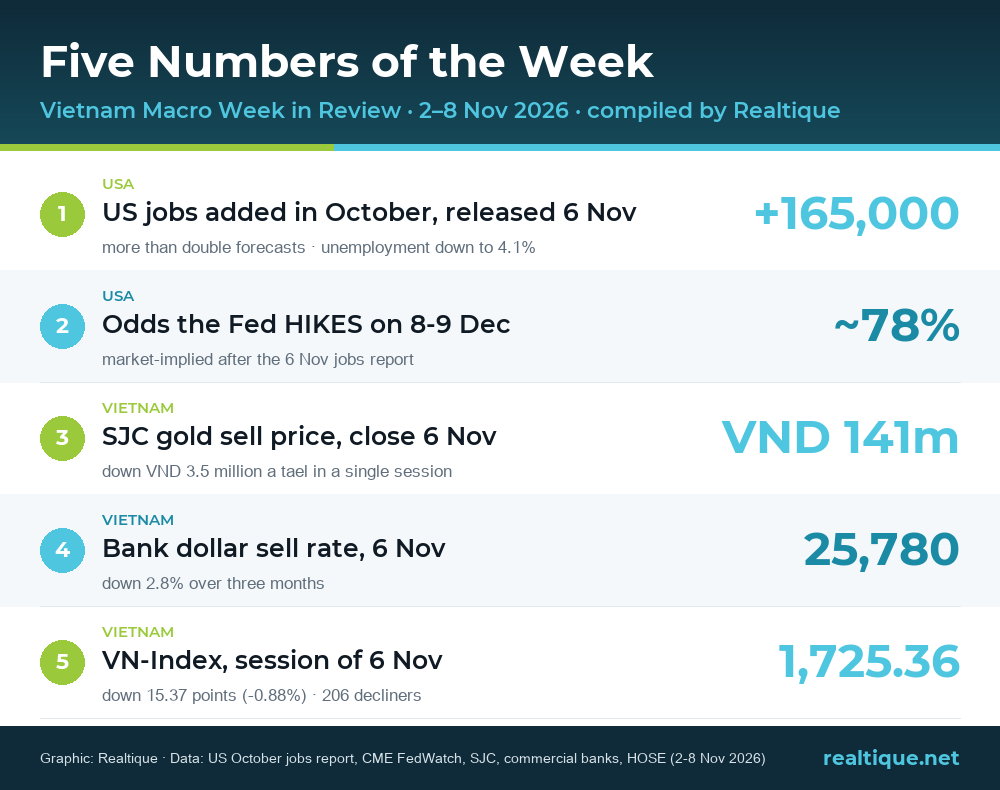
Graphic: Realtique · Data: US October jobs report, CME FedWatch tool, SJC, commercial banks, HOSE (2–8 Nov 2026)
The UK Raises Rates for the First Time in Three Years — Another Major Central Bank Turns
The Bank of England raised its reference rate for the first time since 2023 to contain inflation driven by energy prices. This is the second consecutive week in which signals from major central banks have leaned toward tightening, after both dissenting votes at the Fed’s 28 October meeting (covered in last week’s issue) called for a hike.
A limit on the data: the report we used did not state the resulting rate level, so we record only the direction of the decision, not the level.
What it means for buyers and landlords in Vietnam: The significance is the trend rather than the UK itself: the expectation that cheap global money is about to return is weakening. For overseas Vietnamese and foreign buyers who borrow in their home market to buy in Vietnam, funding costs on that side are higher too — a factor worth putting into the calculation alongside the purchase price.
💬 Questions investors often ask
Question: “Everyone is raising rates — does that mean a crisis like 2008 is coming?”
Suggested approach: Raising rates to contain inflation is a different situation from 2008, when the problem was subprime debt and a liquidity failure in the banking system. That does not mean there is no risk; it means today’s risk is borrowing that is expensive for longer, not a credit collapse. For a buyer, the sensible defence is a low loan-to-value ratio and six to twelve months of repayment reserves, rather than trying to time the peak in rates.
Sources: VnExpress
China Buys Gold for a 24th Straight Month, Yet SJC Gold Still Lost VND 3.5 Million in One Day
The People’s Bank of China kept adding to its gold reserves in October — a 24th consecutive month — and notably did so during the month the gold market suffered its steepest drop in 18 years.
In Vietnam, trading on 6 November showed an unusually wide range: in the morning SJC gold bars were quoted around VND 139.5–142.5 million a tael (buy–sell), and by the close had slipped to VND 138–141 million — a fall of roughly VND 3.5 million a tael within a single session. World gold briefly traded above USD 4,100 an ounce the same day before easing as the dollar recovered.
This is Realtique’s reading: a central bank still buying while prices fall sharply shows that reserve demand and speculative demand run on different logics — so do not read “the PBoC is buying” as “prices will rise in the short term”.
What it means for buyers and landlords in Vietnam: Gold competes directly with property for the same savings in Vietnam. The notable feature this week is not the direction but the spread: a buy–sell gap combined with a VND 3.5 million daily swing means a short-term gold buyer can lose money even when the price moves their way. A channel-by-channel comparison is in savings, gold, stocks or a rental apartment.
💬 Questions investors often ask
Question: “Gold just dropped — is this a good moment to sell gold and buy an apartment?”
Suggested approach: Realtique does not advise on buying or selling gold and does not forecast its price. What can be said is that the two assets do different jobs: gold stores value and produces no income; a rental apartment produces monthly income but is slow to sell and carries running costs. The question to answer first is whether you need monthly cash flow or something you can liquidate quickly — once that is clear, the allocation usually answers itself.
Sources: VnExpress, 8 Nov (PBoC) · VnExpress, 6 Nov (SJC) · Bao Da Nang, 6 Nov · VnExpress (world gold)
The Bank Dollar Rate Fell 2.8% in Three Months — The Opposite of the Usual Worry
The dollar sell rate at Vietnamese banks eased to VND 25,780, down 2.8% over three months. On the evening of 5 November alone, banks cut both buy and sell quotes by VND 150–200 — the sharpest move in a month. The buy side was quoted around VND 25,370.
This matters because it runs against the familiar script: normally, when markets raise their bets on Fed tightening, the dollar strengthens and the dong comes under pressure. This week both happened at once, and the rate still fell.
What it means for buyers and landlords in Vietnam: This is the most overlooked good news of the week. An easing exchange rate widens the State Bank’s room for manoeuvre — and in practice domestic lending rates are falling, with a number of banks stepping up support for businesses. For foreign and overseas Vietnamese buyers remitting money in, a softer dollar against the dong means the same amount of dollars now converts to fewer dong than three months ago, which is worth factoring into the timing of a transfer.
💬 Questions investors often ask
Question: “The rate is falling — should I wait for a better rate before transferring money to buy?”
Suggested approach: Waiting on the exchange rate adds a second variable on top of the property price, and no one forecasts currencies reliably — Realtique included. A sounder sequence is to secure the specific unit, its price and its legal status first (including whether a foreign-ownership slot is still available), then choose the transfer timing within the agreed window. Done the other way around, the bigger risk is not a few percent on the rate — it is losing the unit.
Sources: VnExpress, 6 Nov (dollar, 3 months) · VnExpress (session of 5 Nov) · Government Newspaper, 4 Nov (lending rates)

Illustration: Wikimedia Commons · CC0 1.0 (Realtique image kit)
VN-Index Lost 15.37 Points on 6 November With 206 Decliners — Risk Assets Fell Together
In the 6 November session, selling pressure covered more than 200 stocks: 206 fell, over 57% of HoSE listings, and the index lost 15.37 points (−0.88%) to 1,725.36.
Other risk assets sold off in the same stretch: Bitcoin was dumped, with more than USD 1 billion in derivative positions liquidated, while the combined market value of SpaceX and Tesla fell by more than USD 450 billion after the US election. Wall Street technology stocks fell 10–17% in one session.
Scope of these figures: they are from the session cited, not a weekly move — equity indices move daily.
What it means for buyers and landlords in Vietnam: When equities, crypto and gold all fall in the same session, what is being sold is risk appetite in general, not one sector. For rental property this usually shows up more slowly and more mildly, because most of the return comes from monthly rent rather than daily repricing — the trade-off is that property cannot be exited quickly when cash is needed. That is a trade-off, not an advantage. Local supply and rent context is in the Ho Chi Minh City Q3 2026 market report.
💬 Questions investors often ask
Question: “Stocks are falling — will that money rotate into property?”
Suggested approach: It is unwise to count on an automatic rotation like that. Sharp sell-offs usually push investors into cash first, rather than straight into a less liquid asset. The more reliable basis for a decision is actual rent, occupancy and new supply in the specific area you are looking at — numbers that do not depend on yesterday’s trading session.
Sources: VnExpress, 6 Nov (VN-Index) · VnExpress (Bitcoin) · VnExpress (SpaceX/Tesla) · VnExpress (US equities)
The National Assembly Sets a 2027 GDP Target of at Least 10%, With GDP per Capita Around USD 6,100
On 7 November 2026, the National Assembly passed a resolution on the 2027 socio-economic plan targeting GDP growth of at least 10% and GDP per capita of about USD 6,100. Several localities were given higher targets than the national figure: Hai Phong 13%, Quang Ninh 12% and Hanoi 11.1%.
For international context, the IMF forecasts Vietnam’s 2026 GDP at more than USD 542 billion.
Hedge: these are plan targets, not results, and they can be adjusted during implementation.
What it means for buyers and landlords in Vietnam: A double-digit growth target implies heavy capital needs, and with the Fed holding rates high most of that capital has to come from domestic sources and FDI. That is why foreign investment into real estate is worth tracking — context in FDI in Vietnam real estate 2026. For buyers, high local targets usually come with pressure to accelerate infrastructure and project approvals.
💬 Questions investors often ask
Question: “If GDP grows 10%, will house prices rise 10% too?”
Suggested approach: There is no one-to-one relationship. GDP measures the output of the whole economy, while prices in a particular area depend on new supply, transport links and local purchasing power — there have been stretches where GDP grew well and a segment went sideways because supply was heavy. The better use of this number is as a signal about the funding and employment environment, while still checking each project against the real supply and rents in that specific area.
Sources: VnExpress, 7 Nov · CafeF, 7 Nov · VnExpress (local targets) · CafeF, 9 Nov (IMF)
Money-Flow Corner: SpaceX and Tesla Shed Over USD 450 Billion, Chinese EV Exports Overtake Korea
The combined market value of SpaceX and Tesla fell by more than USD 450 billion after the US election. Separately, China’s comparative advantage in electric-vehicle exports overtook South Korea for the first time, after rising eightfold in six years. US imports in September reached more than USD 426 billion, a record high.
Why this belongs in a property newsletter: not to discuss tech stocks, but because those three figures describe the same thing — global money is repricing growth assets, and that sentiment reaches individual investors in Vietnam too.
What it means for buyers and landlords in Vietnam: When growth assets are repriced, investors tend to return to the basic question: how much cash does this asset produce each month. For property that means rent actually received after management fees, rental tax and vacancy — not the asking price of the unit next door. China’s industrial export expansion is also a long-run variable for supply chains and for expatriate rental demand around industrial parks.
💬 Questions investors often ask
Question: “Tech stocks are falling — does that affect the apartment I’m looking at?”
Suggested approach: The effect is indirect and slow, mostly through sentiment and through expatriate rental demand if companies cut back. It does not change what determines the value of the apartment: location, transport links, management quality and competing supply within a few kilometres. If you are buying to rent, the indicators to watch are occupancy and achieved rents in that building, not the Nasdaq.
Sources: VnExpress (SpaceX/Tesla) · VnExpress (China EVs) · VnExpress (US imports)
Frequently Asked Questions
Will the Fed raise rates in December 2026?
Nobody knows for certain. After the October jobs report released on 6 November 2026, futures markets priced roughly a 78% chance of a 0.25 percentage point increase at the 8–9 December meeting — down from 85% immediately after the release and up from about 67% the day before. This is market expectation, not a Fed commitment, and some analysts argue a single jobs report is not enough to settle the decision.
How did SJC gold move during the week of 2–8 November 2026?
On 6 November 2026, SJC gold bars were quoted in the morning at about VND 139.5–142.5 million a tael (buy–sell) and had eased by the close to roughly VND 138–141 million, a fall of about VND 3.5 million a tael in one session. World gold traded above USD 4,100 an ounce that day before easing as the dollar recovered. Gold moves daily, so these figures belong to the session cited.
Why did the dong strengthen while markets bet on a Fed hike?
That was the week’s anomaly. The bank dollar sell rate fell to VND 25,780 on 6 November, down 2.8% over three months, and on the evening of 5 November banks cut both sides by VND 150–200. Normally, expectations of Fed tightening strengthen the dollar and pressure the dong. The reports we used did not give a specific cause, so we record the movement without speculating on the reason.
What is Vietnam’s GDP growth target for 2027?
On 7 November 2026 the National Assembly passed a resolution targeting GDP growth of at least 10% in 2027, with GDP per capita of about USD 6,100. Some localities were given higher targets: Hai Phong 13%, Quang Ninh 12% and Hanoi 11.1%. These are plan targets and may be adjusted during implementation.
Stocks and crypto fell together — should I move into property?
Realtique does not make buy or sell recommendations for any channel. In practice, sharp sell-offs tend to push investors into cash first rather than straight into less liquid assets. If you are weighing a rental apartment, the reliable basis is rent actually received after management fees and vacancy, the occupancy of that specific building, and new supply within a few kilometres — not a single trading session.
⚠️ Note: This article compiles figures published during the week of 2–8 November 2026, each with its source and date. Market expectations on interest rates (the probability of a Fed hike in December) change session by session and are not a Fed commitment. Gold prices, exchange rates and equity indices move daily — the figures here belong to the sessions cited. The 2027 GDP target is a plan target and may be adjusted. This is not investment or financial advice; Realtique does not recommend buying or selling stocks, gold or foreign currency.
Vietnam Macro Week in Review #3 (Oct 26 – Nov 1, 2026): Two Fed Dissents Called for a Hike
Read more →Savings, Gold, Stocks or a Rental Apartment? Investing in Vietnam 2026
Read more →High Loan Interest Rates in Vietnam (2026): What Home Buyers Should Do
Read more →FDI in Vietnam Real Estate 2026: What It Means for Buyers
Read more →Weighing gold, a savings deposit or a rental apartment?
Tell Realtique the area and budget you have in mind. We will build a table of achieved rent, management fees, rental tax and vacancy for each unit so you can compare it against other channels on real cash flow, not on price-growth expectations.
📞 Hotline: +84 866 810 689

KC Pham
KC Pham advises foreign buyers and overseas Vietnamese on Ho Chi Minh City apartments — setting real rental income against deposit rates and checking legal status and foreign quota before a client commits.