

Vietnam Macro Week in Review (Nov 9–15, 2026): The Fed Thins Out Its Rate Votes, Gold Sheds 4.5%, and Foreign Investors Turn Net Buyers
No single headline dominated the week of 9–15 November 2026, yet almost every number pointed the same way: the cost of US dollar funding will stay high, and the market has stopped waiting for a cut. Two items from Washington made that clearest. A calendar released on 12 November shows the Federal Reserve will cut the number of rate-setting votes from eight to seven in 2027 and to six in 2028. And after the US October producer price index landed on 13 November, CME’s FedWatch tool still priced a 91.4% chance that the Fed raises rates by 0.25 of a percentage point in December.
Three familiar asset classes moved almost in step. World gold closed the week at USD 3,883 an ounce, USD 187 below the previous Friday and roughly 4.5% lower on the week — its sharpest weekly fall since early June 2026. In Vietnam, SJC gold bars ended the week at VND 137.5 million a tael on the ask, down VND 3.5 million in seven days. Bitcoin fell to USD 63,311, a three-month low. Running the other way, the VN-Index closed on 13 November at 1,734.93 points — its first green week after two losing ones — with foreign investors net buying about VND 300 billion.
Pulling together the Fed calendar published on 12 November, CME FedWatch readings after the 13 November PPI print, world and SJC gold quotes at the 15 November week close, HOSE data for the 13 November session and crypto moves on 14–15 November, Realtique reads the week this way: high rates are repricing every asset that does not generate cash flow, while foreign money has not left Vietnamese assets. For anyone buying a home with a loan, that reorders the question — not “can I wait for cheaper credit?” but “does this unit’s cash flow survive today’s rate?”
Vietnam Macro Week in Review — 9–15 Nov 2026
Table of Contents
The Fed Cuts Its Rate Votes: Eight to Seven in 2027, Six in 2028
Under a calendar published on 12 November 2026, the Federal Reserve still holds eight meetings a year but will no longer decide rates at every one of them. In 2027 the Federal Open Market Committee votes on rates only seven times; the October 2027 meeting is reserved for strategy discussion, with no rate vote and no monetary policy statement. By 2028 the number of rate decisions falls to six, and from the autumn of 2027 the gap between decisions widens to about two months instead of today’s six weeks.
This is among the more consequential changes under Fed Chair Kevin Warsh, who took office this year. He has already shortened policy statements and press conferences, stopped publishing individual economic projections, and set up five working groups to review how the central bank operates. His stated rationale: a constant cycle of policy meetings pushes officials to react to the latest data release rather than think about longer-run trends.
What this item is and is not: it changes the voting calendar, not the direction of policy. The number of meetings stays at eight.
What it means for buyers and landlords in Vietnam: Vietnamese dong lending rates are not pegged to the Fed, but every Fed decision is a date the USD/VND rate reacts to. Stretching the gap to roughly two months means volatility around each date can arrive in larger lumps, and a wrong expectation can hold the exchange rate off-track for longer — a technical reason to keep hedged language in any mortgage plan. How to size cash flow against today’s lending rates is set out in our piece on high loan interest rates in 2026.
💬 Questions investors often ask
Question: “If the Fed decides on rates less often, does that mean looser policy?”
Suggested approach: No. The Fed still meets eight times a year; only the number of rate votes falls. What changes is the calendar of dates to watch, not the direction of policy. For a floating-rate loan, the useful response is to size repayments against the rate available today and diarise the meetings that still carry a vote, rather than waiting for an easing signal that is not in the data.
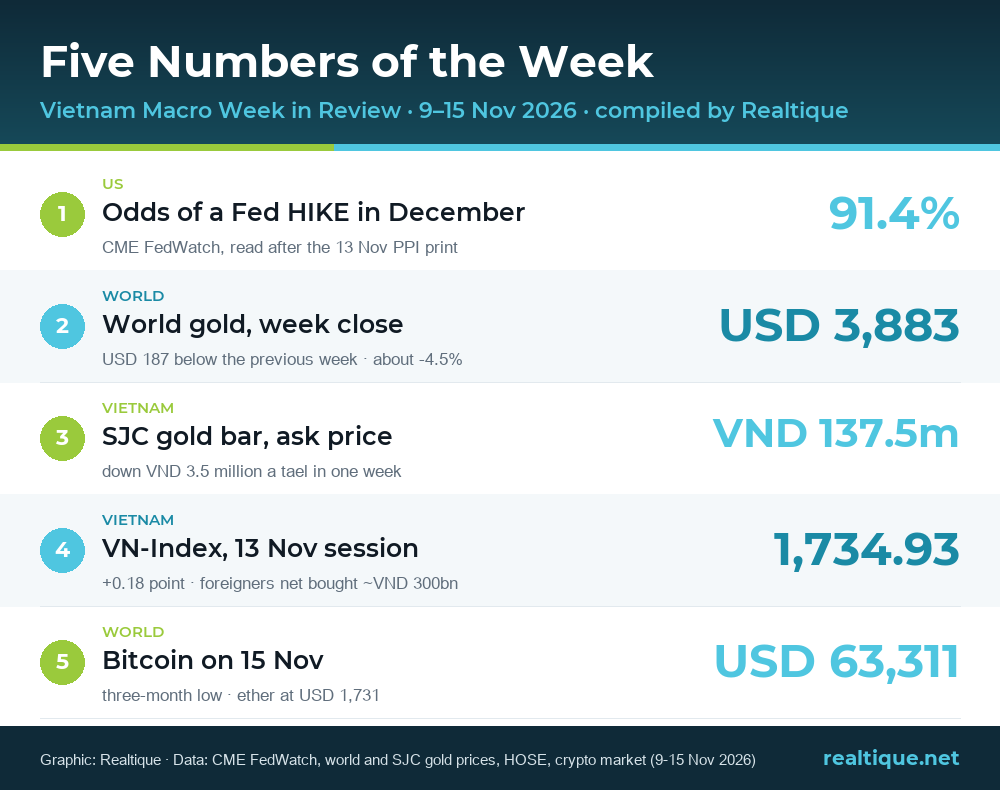
Graphic: Realtique · Data: CME FedWatch (read 13 Nov), world and SJC gold prices (week close, 15 Nov), HOSE (13 Nov), crypto market (15 Nov)
Markets Still Price a December Fed Hike — 91.4% After the 13 November PPI Print
After the US October producer price index rose 0.3% on 13 November — below the 0.4% expected in a Reuters poll — CME’s FedWatch tool priced a 91.4% probability that the Fed raises rates by 0.25 of a percentage point in December, and 8.6% for a half-point move. The October consumer price index rose 0.4% (0.3% expected), published on 10 November. Fed Governor Christopher Waller said he would consider half a percentage point if core October inflation held at 0.3%. The dollar reached its strongest level since April 2025 during the week.
The limits of this number: 91.4% is a market-implied probability at the time of reading (13 November), not a Fed commitment, and it moves with every session and every new inflation print. No fresher FedWatch reading appeared in the 15–16 November scan window, so the figure here keeps its 13 November date label.
What it means for buyers and landlords in Vietnam: This is the single most important change for any argument along the lines of “when the Fed cuts, Vietnamese mortgage rates follow”: the market is now pricing the opposite direction. A strong dollar pressures USD/VND, and when defending the exchange rate takes priority the State Bank of Vietnam has less room to cut policy rates — so mortgage rates may stay high for longer than planned (floating rates of 13–15%, the range used in our lending-rate analysis). For overseas Vietnamese and foreign buyers bringing dollars in, however, a strong dollar is the helpful side of the trade at conversion.
💬 Questions investors often ask
Question: “Should I wait for the Fed to cut before buying, so borrowing is cheaper?”
Suggested approach: The scenario the market is pricing is a hike, not a cut, so waiting on the old assumption means waiting for a date that is not in the data — while apartment prices and rents keep moving. Realtique does not forecast interest rates. The more durable approach is to model the cash flow of the specific unit at today’s lending rate, lock any fixed promotional period for as long as possible, and avoid leverage that only works if rates fall. If the plan stands up only under a cut, the problem is the loan-to-value ratio, not the Fed.
Sources: Bnews/VNA, 14 Nov 2026 (CME FedWatch, 13 Nov PPI) · Thanh Nien, 15 Nov 2026 (October PPI)
Gold Falls 4.5% on the Week — Vietnamese Ring-Gold Buyers Are Down as Much as VND 7 Million a Tael in Seven Days
World gold closed the week at USD 3,883 an ounce, USD 187 below the previous Friday and about 4.5% lower from the week’s start — its sharpest weekly drop since early June 2026, with one session touching the lowest level in more than a year.
In Vietnam at the week close: SJC gold bars at VND 134.5 – 137.5 million a tael (bid – ask), down VND 3.5 million from the previous week’s close. With SJC holding its bid–ask spread at VND 3 million a tael, a bar buyer was down VND 6.5 million. SJC four-nines ring gold fell to VND 133.3 – 137.3 million (down 3.2 million) and Doji rings to VND 133.5 – 137.5 million (down 3 million) on a VND 4 million spread — leaving ring-gold buyers down as much as VND 7 million a tael after a single week.
A Kitco News survey of 13 Wall Street analysts found 62% expect gold to keep falling next week, 15% expect a rebound and 23% see it flat. Moving the other way, the People’s Bank of China added about 25.8 tonnes of gold in October 2026 — its largest monthly purchase in three years, according to the World Gold Council.
What it means for buyers and landlords in Vietnam: The notable feature of the week is not the direction but the cost of getting in and out: a bid–ask spread of VND 3–4 million a tael means a short-term gold holder can lose money even when the price moves their way. That is why comparing gold with a rental apartment has to be done after costs, not on quoted prices. A full channel-by-channel comparison sits in savings, gold, stocks or rental property.
💬 Questions investors often ask
Question: “Gold has fallen hard — is this the moment to sell gold and buy an apartment?”
Suggested approach: Realtique does not advise on buying or selling gold and does not forecast its price. The two assets do different jobs: gold stores value and sells quickly but generates no cash flow; a rental apartment generates cash flow but is slow to exit and carries running costs. It is also worth knowing that gross rental yields on Ho Chi Minh City apartments currently sit around 2–3% a year — below deposit rates — so if the objective is pure yield, a rental apartment is not the obvious answer; if the objective is holding a usable long-term asset, the calculation differs. One week of price movement is not a basis for a multi-year holding decision.
Sources: Thanh Nien, 15 Nov 2026 (weekly gold, SJC, Kitco) · Bnews/VNA, 14 Nov 2026 (PBoC, world gold)
VN-Index Closes the Week at 1,734.93 — First Green Week After Two Losses, With Foreigners Net Buying About VND 300 Billion
In the final session of the week on 13 November, the VN-Index traded between 1,724 and 1,738 points and spent most of the day below the reference level; buying in the closing auction turned it around to finish at 1,734.93 points (+0.18 point, +0.01%) — the first green week after two losing weeks. The VN30 closed at 1,844.91 (+5.48); the HNX-Index fell to 254.98 (−1.64) while the UPCoM-Index rose to 121.39 (+0.14).
Breadth stayed negative: on HOSE, 100 stocks rose, 69 were unchanged and 189 fell, with 12 of 18 sectors down. HOSE turnover was 655 million shares, about VND 15,138 billion, below the 20-session average. Foreign investors were net buyers of roughly VND 300 billion market-wide and VND 320 billion on HOSE; on the sell side, CTG (−VND 221 billion), GMD (−56 billion) and BID (−38 billion). Late support came from STB (+3.34%, with afternoon turnover 4.5 times the morning’s), VJC (+2.12%), TCB (+1.39%) and FPT (+1.11%), while VIC and VHM were pulled back to flat.
Scope of these figures: they are for the 13 November session — the week’s last trading day, since 14–15 November fell on the weekend.
What it means for buyers and landlords in Vietnam: Two details are worth keeping. First, foreigners were net buyers in the very week the Fed tilted towards a hike — foreign capital has not left Vietnamese assets, which is the context to read alongside our FDI in Vietnamese real estate coverage. Second, turnover below the 20-session average says this is not a wave of fresh money. In other words, equities drifted sideways on thin volume — not a channel pulling money out of property, and not one money is rushing into either.
💬 Questions investors often ask
Question: “Equities turned green again — should I trim property and move across?”
Suggested approach: A weekly gain of 0.01% on below-average turnover is not a trend signal, and breadth in that session was still negative. The two channels differ in horizon and liquidity, so they do not substitute for each other: shares cannot produce a monthly rent cheque, and property is a poor choice if you may need to exit quickly. The more reliable inputs are net rent received and new supply in the specific area under consideration — see the Ho Chi Minh City market report for Q3 2026.
Sources: Bao Dau Tu, 13 Nov 2026 · Vietnam Financial Times, 13 Nov 2026
Illustration: Wikimedia Commons · CC0 1.0 (Realtique image kit)
Bitcoin Drops to USD 63,311, a Three-Month Low — Same Root Cause as Falling Gold and a Strong Dollar
Bitcoin fell 5.7% in the 14 November US session, slid a further 1.7% in Asia on 15 November and touched USD 63,311 — its lowest since 17 August. Ether dropped 8% on 14 November to USD 1,731, the weakest since 9 July.
Rich Rosenblum, co-founder of crypto market maker GSR, described the move as technical: bitcoin broke its 200-day moving average around USD 73,000, triggering the sell-off. The pressure came from three things together — expectations of higher interest rates, outflows from US spot bitcoin ETFs, and broad risk aversion.
Why this sits in a property bulletin: not to discuss crypto, but because it shares a root cause with falling gold and a strong dollar in the same week — markets are pricing higher rates, so assets that produce no cash flow get sold first.
What it means for buyers and landlords in Vietnam: In a high-rate cycle, assets that generate cash flow — rental apartments, deposits — are repriced more favourably than assets that only promise appreciation, but only when the actual rental yield covers the cost of capital. For property, the number to examine is net rent after management fees, rental tax and vacancy, not the asking price of the unit next door.
💬 Questions investors often ask
Question: “Crypto and gold are both falling — will that money move into property?”
Suggested approach: Nothing in the week’s data shows such a rotation. Even equities, the most liquid channel, merely drifted sideways on below-average turnover. Sharp sell-offs usually push investors into cash first rather than straight into less liquid assets. The safer reading is that high rates are repricing all risk assets at once, so the deciding criteria should be real cash flow and debt serviceability, not an assumption that money “has to go somewhere”.
Sources: CafeF, 15 Nov 2026
The Asia Angle: Chinese Construction Groups Want a Bigger Role in Vietnam’s Urban Rail and Industrial Parks
On the afternoon of 12 November, the Vietnam Association of Construction Contractors (VACC) met the China International Contractors Association (CHINCA). A representative of PowerChina said the group wants to expand cooperation in energy and infrastructure — it reports annual revenue above USD 100 billion, has operated in Vietnam since 2000 across more than 70 projects with contract value of roughly USD 9 billion, and recently joined the main-contractor consortium for the Dau Tieng 5 solar plant (over VND 7,700 billion) and Segment 1 of the Phu Quoc urban railway.
CCCC (China Communications Construction Company) proposed taking part in rail connectivity, specifically the Lao Cai – Hanoi – Hai Phong line, plus seaports tied to logistics, urban infrastructure and equipment for industrial parks. Its representative said that, given an investment opening, the company would want to move manufacturing into Vietnam step by step and build a local supply chain. China Railway 16th Bureau Group, Beijing Urban Construction Group and CMEC also attended.
Hedge: these are cooperation proposals raised at a meeting between two industry associations, not signed contracts or registered capital. In the same week, Prime Minister Le Minh Hung attended the opening of the 49th ASEAN Summit in the Philippines on 15 November; no economic commitments were published in figures within this week’s window.
What it means for buyers and landlords in Vietnam: This is a capital story rather than a diplomatic one. If industrial-equipment supply chains do relocate into Vietnam, the direct beneficiaries are industrial property and rental housing around industrial parks — capital-flow context in our FDI coverage. It is worth reading next to the ten-month 2026 trade data: Ho Chi Minh City reached USD 176.4 billion in combined trade and Dong Nai ran a USD 9.03 billion surplus. For residential property, the transmission runs through infrastructure: every urban rail line that accelerates redraws the price map — see our piece on the Thu Dau Mot – central Ho Chi Minh City metro line.
💬 Questions investors often ask
Question: “With more foreign contractors involved, will infrastructure move faster — and should I buy ahead of a planned metro line?”
Suggested approach: More capable contractors usually shorten construction time, but the bottleneck on most Vietnamese infrastructure projects is land clearance and funding procedure, not a shortage of contractors — so one meeting between two associations should not be read as a schedule milestone. On buying ahead: VARS IRE data released this week shows projects with convenient access to a metro station rose about 10–20% more than the market average over the past two years, yet VARS IRE itself cautions that proximity to a metro station does not guarantee price growth, and that buyers should be wary of projects whose asking prices already embed a great deal of future-infrastructure expectation. More practical tests: has the line been formally approved and has land recovery actually begun, how many minutes is the walk to the nearest station, and what rent does that specific building achieve today.
Sources: VnExpress, 13 Nov 2026 (VACC – CHINCA) · Vietnam Government Portal, 15 Nov 2026 (ASEAN 49) · CafeF, 15 Nov 2026 (VARS IRE) · CafeF, 15 Nov 2026 (ten-month trade data)
Frequently Asked Questions
Will the Fed raise interest rates in December 2026?
Nobody knows for certain. After the US October producer price index rose 0.3% on 13 November 2026, CME’s FedWatch tool priced a 91.4% chance of a 0.25-point Fed hike in December and 8.6% for a half-point move. Fed Governor Christopher Waller said he would consider half a point if core October inflation held at 0.3%. This is a market-implied probability at the time of reading, not a Fed commitment, and it shifts session by session.
From when does the Fed decide on rates less often, and how often?
Under the calendar published on 12 November 2026, the FOMC still meets eight times a year but votes on rates only seven times in 2027 and six times in 2028. The October 2027 meeting is reserved for strategy discussion, with no rate vote and no policy statement. From the autumn of 2027, the gap between rate decisions widens to about two months instead of six weeks.
How did gold move in the week of 9–15 November 2026?
World gold closed the week at USD 3,883 an ounce, USD 187 below the previous week and about 4.5% lower — the sharpest weekly fall since early June 2026. In Vietnam, SJC gold bars ended the week at VND 134.5 – 137.5 million a tael, down VND 3.5 million; SJC four-nines ring gold at VND 133.3 – 137.3 million (down 3.2 million) and Doji rings at VND 133.5 – 137.5 million (down 3 million). With bid–ask spreads of VND 3–4 million a tael, ring-gold buyers were down as much as VND 7 million a tael after one week. Gold prices move daily, so these are the quoted week-close levels.
Where did the VN-Index close last week, and were foreigners buying or selling?
In the 13 November 2026 session — the week’s last trading day — the VN-Index closed at 1,734.93 points, up 0.18 point (+0.01%), its first green week after two losing weeks. The VN30 closed at 1,844.91. Foreign investors were net buyers of about VND 300 billion market-wide and VND 320 billion on HOSE. Breadth was still negative, however (189 fallers against 100 risers on HOSE), and HOSE turnover of 655 million shares, roughly VND 15,138 billion, was below the 20-session average.
Why did gold, bitcoin and the US dollar all move sharply in the same week?
All three were reacting to one thing: markets pricing US dollar rates to be higher for longer. When expected rates rise, the dollar strengthens — it reached its strongest level since April 2025 this week — and assets that generate no cash flow, such as gold and crypto, get sold first. Bitcoin fell to USD 63,311, a three-month low, on the same higher-rate expectations plus outflows from US spot bitcoin ETFs. This is an observation about a shared cause, not a price forecast; Realtique does not advise on buying or selling gold, currencies or crypto.
⚠️ Please note: this piece compiles figures published during the week of 9–15 November 2026, each with its source and date. The 91.4% probability of a December Fed hike is a market-implied expectation at the time of reading on 13 November; it changes session by session and is not a Fed commitment. Gold, foreign exchange, equity indices and crypto prices move daily — the figures here are for the exact moment cited. The cooperation proposals from Chinese contractors at the VACC – CHINCA meeting on 12 November are proposals, not signed contracts. This is not investment or financial advice; Realtique does not recommend buying or selling shares, gold, currencies or crypto assets.
Vietnam Macro Week in Review (Nov 2–8, 2026): A US Jobs Beat Pushes the Fed Towards a Hike
Read more →Savings, Gold, Stocks or Rental Property: Where Does Vietnamese Money Go in 2026?
Read more →High Loan Interest Rates in Vietnam 2026: What Buyers Should Do
Read more →FDI in Vietnamese Real Estate 2026: What It Means for Buyers
Read more →Weighing gold, a deposit account or a rental apartment?
Tell Realtique the area and budget you have in mind. We will lay out real achieved rents, management fees, rental tax and vacancy for each unit so you can compare it with other channels on actual cash flow rather than on expected price growth.
📞 Hotline: +84 866 810 689

KC Pham
KC Pham advises foreign buyers and overseas Vietnamese on Ho Chi Minh City apartments — setting real rental income against deposit rates and checking legal status and foreign quota before a client commits.