
Ho Chi Minh City’s 100-Year Master Plan Goes to the People’s Council, 29 October 2026: Five Growth Poles, Five Satellite Centres, 18 Metro Lines (961 km), 27 Million People by 2050 — Which Pole Is Your Project In?
Short answer: on the morning of 29 October 2026, at the 6th (thematic) session of the 11th HCMC People’s Council, Vice-Chairman Nguyễn Mạnh Cường presented the Ho Chi Minh City Master Plan for 2025–2050 with a 100-year vision — the first plan to treat the merged city (former HCMC, Bình Dương and Bà Rịa – Vũng Tàu) as one space of 6,772 km² and roughly 14 million people. The city is organised as a multi-pole, multi-centre, multi-layer megacity: five growth poles (the financial core; innovation in the east; industry and logistics in the north; ports, free trade and energy in the south; urban, education and healthcare in the west), five satellite centres, five strategic linkage systems and ten development-governance zones; population projected at 18 million in 2030 and over 27 million in 2050; and, by 2050, 18 urban-rail lines totalling about 961 km plus ~450 km of light rail (VnExpress, 29 Oct 2026; Tuổi Trẻ, 29 Oct 2026; VTC News/CafeF, 29 Oct 2026; Dân Việt, 29 Oct 2026). Delegates discuss in groups on the afternoon of 29 October and vote in plenary on the morning of 30 October (Thanh Niên, 29 Oct 2026).
Realtique’s reading of the five same-day reports: the submitted plan keeps the five-pole framework we analysed in our planning guide for foreign investors from the July draft, but adds the specifics — the names of the five satellite centres, the ten governance zones, population at each milestone, built-up land, GRDP per head and the rail inventory. This article does not repeat that guide. It does three things: places every project Realtique distributes in its pole, shows what is new versus the draft, and lists five questions to ask before you trust the word “planning”. Every milestone here is planning direction that may change at each approval step; this is not investment advice.
HCMC Master Plan 2025–2050 — As Submitted on 29 October 2026
Table of Contents
Where the Plan Stands: Submitted 29 October, Vote 30 October — Then Who Approves It?
The 6th session of the 11th HCMC People’s Council (2026–2031 term) opened on the morning of 29 October to consider 47 draft resolutions, the headline one being the resolution adopting the city’s Master Plan; delegates discuss in groups on the afternoon of 29 October and in plenary, with a vote, on the morning of 30 October (Thanh Niên, 29 Oct 2026). Vice-Chairman Nguyễn Mạnh Cường presented the summary report at the opening; the submission, signed by Vice-Chairman Hoàng Nguyên Dinh, covers the city’s entire administrative area of 6,772.59 km² (Dân Việt, 29 Oct 2026).
On what happens after the Council, two reports describe two different layers: VnExpress writes that the city “submits to the Council for adoption, after which the Chairman of the People’s Committee approves within his authority”; Dân Việt quotes the submission saying the Council resolution “is an important legal basis for the city to submit to the Prime Minister for consideration and approval as regulated”. Realtique records both and reads it this way: the Council resolution locks the content; the final approval document is still one step away, so every figure below remains “as submitted”, not a document in force. The file was finalised after taking in more than 960 comments from ministries, experts and the public (Dân Việt, 29 Oct 2026; VnExpress, 29 Oct 2026).
The legal backdrop the session gives effect to is the new Law on Urban Development and Politburo Resolution 09-NQ/TW; the same session carries resolutions on municipal bonds, a free-trade zone, high-tech parks and the lists of land plots for investor tender and land recovery in the third batch of 2026 (Thanh Niên, 29 Oct 2026; VTC News/CafeF, 29 Oct 2026). This continues the “19 October update” in our planning guide.
The Five Growth Poles — and the Projects Realtique Tracks in Each
The plan’s core shift, per the submission, is from concentration in the urban core to a network of tightly linked growth poles (VTC News/CafeF, 29 Oct 2026; Dân Việt, 29 Oct 2026). VnExpress gives the most specific geography for each pole — Realtique places the projects and topics it already covers beside them:
| Pole | Area (as submitted) | Core functions | What Realtique tracks there |
|---|---|---|---|
| International core | Saigon, Chợ Lớn, Thủ Thiêm and both banks of the Saigon River | International finance, megacity governance, premium services, knowledge economy, creative culture | Thủ Thiêm, the new CBD · International Financial Centre, 898 ha (VI) · Lotte Eco Smart City (VI) · Palm City next to Thủ Thiêm · Thủ Thiêm vs The Global City |
| Innovation pole, east | Thủ Đức, Thuận An, Dĩ An, Thủ Dầu Một — linked to Long Thành | AI, semiconductors, R&D, universities, start-ups, high tech — “Southeast Asia’s innovation valley” | Lusso Saigon – La Pura (Highway 13, Thuận An) · Norton Park (Gamuda, next to AEON Mall) · Long Thành airport city |
| Industry – logistics pole, north | Bình Dương (new city), Bến Cát, Bàu Bàng | Advanced manufacturing, high-tech industry, logistics, regional distribution centres | Bình Dương New City guide · Orchard Collection (CapitaLand) |
| Ports – free trade – energy pole, south | Châu Đức → Vũng Tàu, Cái Mép, Phú Mỹ, Cần Giờ | International transshipment port, free-trade zone, global logistics, maritime economy, energy | Cần Giờ mega-port (VI) · Vinhomes Green Paradise Cần Giờ · Blanca City, Vũng Tàu |
| Urban – healthcare – education pole, west | Vĩnh Lộc, Bình Lợi, Bình Chánh | Healthcare and education tied to eco-urban development; research, medical and education centre | No Realtique-distributed project yet; the neighbouring Hóc Môn – Củ Chi satellite hosts Vinhomes Saigon Park (VI) |
How to read this table: a pole is not an old province. Thuận An and Dĩ An (former Bình Dương) sit in the eastern pole with Thủ Đức, while “Bình Dương” in the northern pole means the new-city – Bến Cát – Bàu Bàng area. In other words, an apartment in Thuận An is now read by the plan as part of the Thủ Đức – Long Thành high-tech corridor, not as “out of town”. Conversely, the western pole is where the plan places healthcare and education, not premium housing — which is why Realtique’s portfolio has no project there.
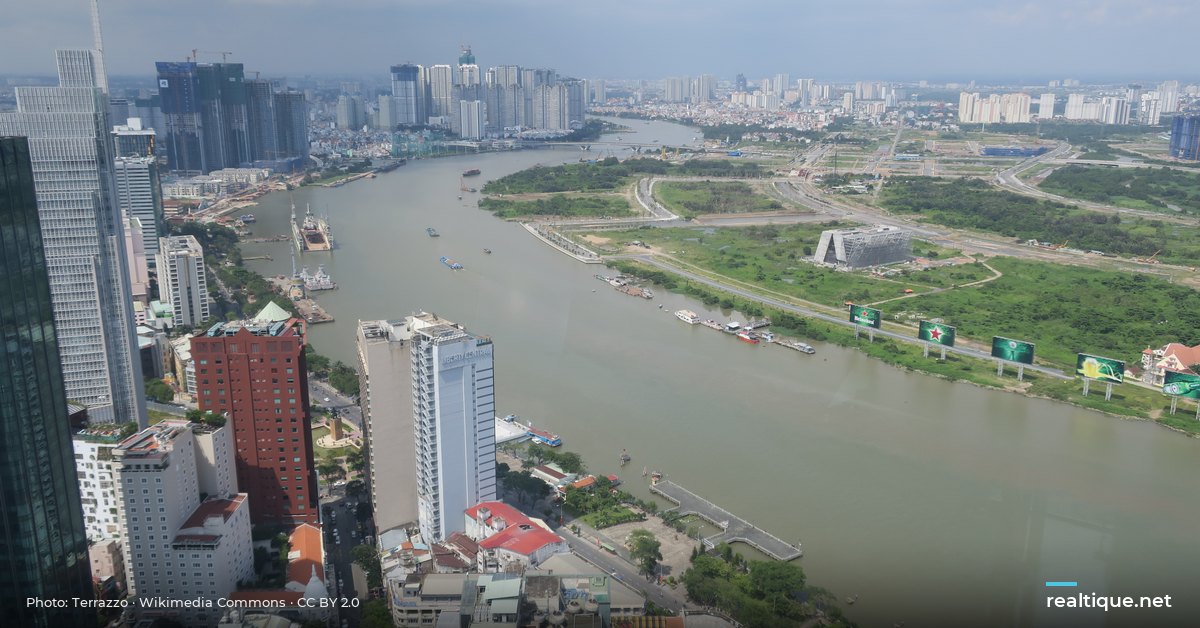
Thủ Thiêm and both banks of the Saigon River — the international core pole in the plan (illustrative) · Photo: Terrazzo · Wikimedia Commons · CC BY 2.0 (Realtique image kit)
Five Satellite Centres, Five Linkage Systems and Ten Governance Zones
The five satellite centres are named: Côn Đảo · Long Hải – Hồ Tràm · Hóc Môn – Củ Chi · Bàu Bàng · Tân Uyên – Bắc Tân Uyên, oriented to island tourism, eco-urban living, high-tech industry and industrial services (VnExpress, 29 Oct 2026; Tuổi Trẻ, 29 Oct 2026; VTC News/CafeF, 29 Oct 2026). For buyers, the two to watch are Long Hải – Hồ Tràm (the resort corridor) and Hóc Môn – Củ Chi, home to the 880-ha International University Township (VI) whose capital was restated at VND 173,115 billion on 28 October.
Five strategic linkage systems (per VTC/CafeF): north–south from the border gates to the sea; east–west between the Mekong Delta and the Southeast; industry – manufacturing – multimodal logistics; multi-layer urban infrastructure; and a green–blue linkage with the Saigon and Đồng Nai rivers as the ecological spine.
Ten development-governance zones — the basis for allocating population, jobs and infrastructure — are: the urban core – finance – heritage; eastern innovation; western and south-western gateway; Bình Dương industrial-service urban area; ecology and development reserve; Nhà Bè – Hiệp Phước port city; Cần Giờ marine ecology; the Cái Mép – Thị Vải port – logistics – industry – energy cluster; Vũng Tàu – Long Hải – Hồ Tràm coastal tourism; and the Côn Đảo special zone (VnExpress, 29 Oct 2026). Marine space is organised along the Gành Rái Bay – Cần Giờ – Cái Mép, Thị Vải – Vũng Tàu – Côn Đảo axis (VTC News/CafeF, 29 Oct 2026).
Realtique’s note: “ecology and development reserve” and “Cần Giờ marine ecology” are separate governance zones — the plan deliberately keeps land undeveloped there. Any pitch of “urban-zoned land” in those areas should be checked against the zone map once the plan is published, not against the name of a pole.
The Framework Numbers: 27 Million People, 365,000–390,000 ha of Built-Up Land, USD 75,000 GRDP per Head by 2045
Population: about 14 million today (VnExpress, 29 Oct 2026) → 18 million in 2030 → more than 27 million in 2050 (Tuổi Trẻ, 29 Oct 2026; Dân Việt, 29 Oct 2026). Put differently, the plan assumes the merged city absorbs almost 13 million more people in 24 years — more than another old Ho Chi Minh City added on top.
Built-up land: about 280,000–290,000 ha in 2030 (150–155 m² per person) and 365,000–390,000 ha in 2050 (135–140 m² per person) (VTC News/CafeF, 29 Oct 2026). The per-capita figure falls as population rises — the plan chooses density, together with TOD and three-dimensional space (ground, underground, overhead).
Economy: GRDP growth of at least 10% a year to 2030; GRDP per head of about USD 14,500 in 2030, striving for at least USD 75,000 in 2045; the digital economy at 40% of GRDP by 2030; 17 large economic clusters and 7 special zones with sandbox mechanisms (Dân Việt, 29 Oct 2026). Four high-value-added sectors: advanced manufacturing (0.85–0.95 percentage points), a regional financial centre (0.74–0.84), digital services and AI (0.64–0.74), advanced logistics (0.64–0.74) (Tuổi Trẻ, 29 Oct 2026; VTC News/CafeF, 29 Oct 2026).
Education and health: by 2050 the city targets 2 million students, adding 1,400–2,000 ha of university land in 2030–2050; healthcare of 45 beds and 35 doctors per 10,000 people by 2045 (Tuổi Trẻ, 29 Oct 2026). These are the numbers behind the western pole and the Hóc Môn – Củ Chi satellite (the 60,000-student university township).
Realtique’s reading: USD 75,000 per head in 2045 is a target in the submission, not a statistical forecast; a buyer should not discount it into today’s prices. The usable number is 18 million people in 2030 — it drives rental and purchase demand across the poles over the next four years, the window in which a project selling today is handed over.
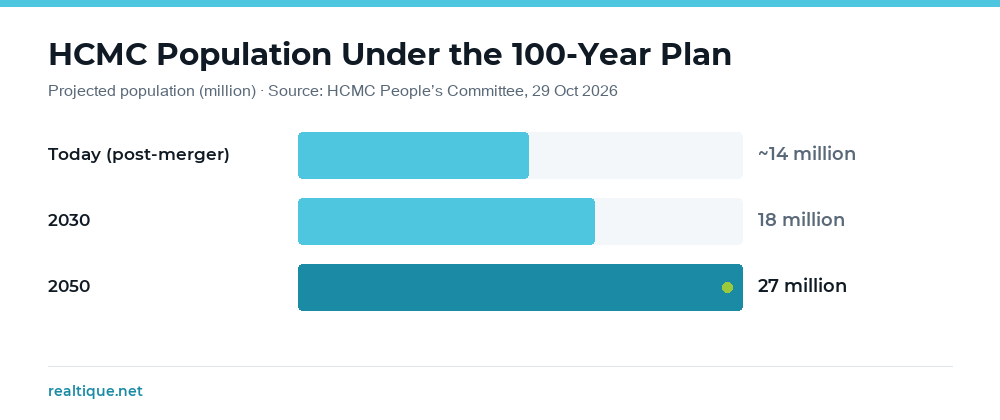
Graphic: Realtique · Data: HCMC Master Plan 2025–2050 summary presented to the People’s Council, 29 Oct 2026 (via Tuổi Trẻ, Dân Việt); today’s population per VnExpress, 29 Oct 2026.
Infrastructure: 18 Metro Lines (961 km), 450 km of LRT, TOD and Three-Tier Underground Space
On transport, the plan targets 18 urban-rail lines totalling about 961 km completed by 2050, plus about 450 km of light rail (LRT) and tramway; public transport is to carry 55–65% of trips (VTC/CafeF says 55–65%, VnExpress 55–60%); inter-area road density at least 2.22 km/km² (VnExpress, 29 Oct 2026; VTC News/CafeF, 29 Oct 2026; Dân Việt, 29 Oct 2026). For scale, Metro Line 1 Bến Thành – Suối Tiên, the only line in service, is 19.7 km — the planned network is almost 50 times that. The nearest steps are the five lines due to break ground in late 2026 (see our five-lines hub) and the Bến Thành – Cần Giờ railway, in full-scale construction from 30 October.
Multimodal interchanges are placed at stations, airports, seaports and urban centres, with priority for transit-oriented development (TOD). Waterways: about 322 km of maritime channels, linked to the Cái Mép – Thị Vải gateway port and integrating urban passenger and river-tourism transport. Underground space develops at key centres and transport hubs in three tiers: shallow 0–20 m, deep 20–40 m, very deep beyond 40 m; flood and subsidence control by basin; offshore wind under study (VTC News/CafeF, 29 Oct 2026; Tuổi Trẻ, 29 Oct 2026; VnExpress, 29 Oct 2026).
Two takeaways for a buyer: (1) “near a planned metro station” will appear in almost every sales deck because 961 km covers nearly every direction — the right question is whether that line is among the five breaking ground in 2026 or in the remainder due by 2050; (2) TOD comes with land-value capture, so station areas may get infrastructure priority and new financial obligations at the same time — the submission explicitly names “capturing added land value tied to infrastructure, municipal bonds” as a funding source.
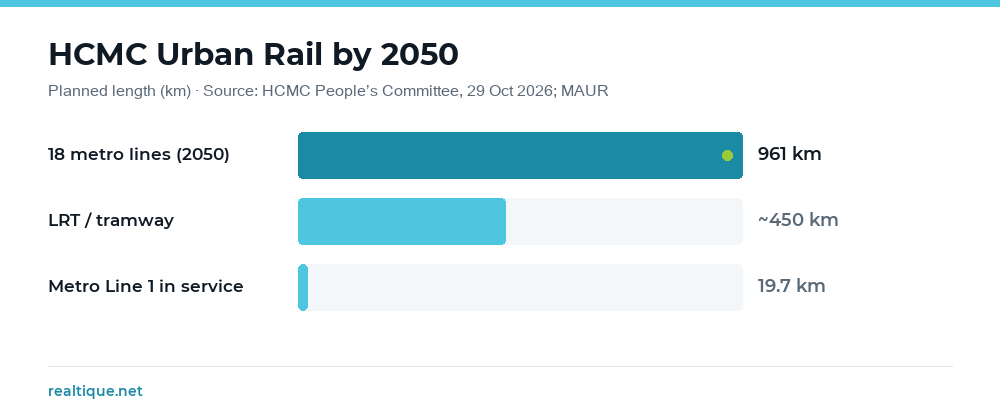
Graphic: Realtique · Data: HCMC Master Plan as submitted on 29 Oct 2026 (18 lines, 961 km; ~450 km LRT); Metro Line 1 is 19.7 km per MAUR. Planned length is a target, not built track.
What Changed From the July 2026 Draft — and the Three Milestones: 2030 · 2045 · 2075
Compared with the draft Realtique analysed in our 22 July guide, the five poles – ten zones – 100-year vision framework is unchanged. The submitted plan adds or sharpens: the names of the five satellite centres; five strategic linkage systems; the 18 → 27 million population path; built-up land at two milestones; GRDP per head of USD 14,500 → 75,000; the inventory of 18 lines/961 km + 450 km LRT; 17 economic clusters and 7 special zones; and the funding mechanism (state capital leading, PPP, land-value capture, municipal bonds). These differences are what Realtique reads out of the 29 October press coverage against the earlier draft; the full plan has not been published, so how “new” each item is will be rechecked when the city releases it.
| Milestone | Target as submitted | Realtique’s note |
|---|---|---|
| 2030 | Smart, modern city leading Southeast Asia; 18 million people; GRDP ≥10%/year; USD 14,500 per head; digital economy 40% of GRDP | Coincides with the handover cycle of most projects selling in 2026–2027 |
| 2045 | Economic, cultural, science-technology and innovation centre of Asia; USD 75,000 per head; 45 hospital beds per 10,000; among the world’s most liveable cities | Aspirational target, not a forecast |
| 2050 / 2075 | 27 million people; 18 metro lines, 961 km; from 2075 a smart, modern, comprehensively developed global city (100 years after reunification) | Vision — use it to read direction, not to price a unit |
Sources for the milestones: VnExpress, 29 Oct 2026; Dân Việt, 29 Oct 2026; Tuổi Trẻ, 29 Oct 2026.
What It Means for Buyers, Overseas Vietnamese and Foreigners — Five Questions to Ask
1. Which pole is the project in — or is it in a “development reserve” zone? Ask by pole and governance zone, not by old province. The table in section 2 is how Realtique answers for its own portfolio.
2. Which group is the metro line “near the project” in? The five lines breaking ground in late 2026, the lines under construction (Line 2, Cần Giờ), or the rest of the 961 km due by 2050. Three groups, three levels of timing risk.
3. Is the plot inside a TOD or renewal area? TOD comes with land-value capture; renewal areas may see population and height limits change — both affect price and timing.
4. For foreigners: is the project on the list open to foreign buyers? The plan does not change ownership rules — a foreign individual still buys apartments in listed projects, up to 30% of units per building, on a 50-year term; see can foreigners buy property in Vietnam and the 30% quota explained. The core and eastern poles hold most of the quota-open projects in Realtique’s portfolio; the southern pole (Blanca City, Cần Giờ) and several Sun Group projects are not open to foreigners — ask project by project.
5. For overseas Vietnamese: which pole rents best? Expat rental demand follows where new jobs are planned: finance in Thủ Thiêm and the core, high tech in Thủ Đức – Thuận An – Dĩ An, ports and logistics in Cái Mép – Phú Mỹ. Primary prices by area are in our Q3 2026 condo-price report; FDI by area in our FDI guide (updated 29 October with the 12-project, USD 13.58 billion list); area comparisons in best areas for foreign investors.
What not to infer: adoption of the plan does not mean prices rise at once in every pole. It allocates functions and infrastructure; prices follow the real progress of each line and project, and interest rates — in October 2026 floating mortgage rates still sit around 12–14%. Realtique will update this article after the Council vote (30 October) and when the plan is officially published.
Frequently Asked Questions
Has Ho Chi Minh City’s 100-year master plan been approved?
Not as of the morning of 29 October 2026. The People’s Committee presented it to the People’s Council at the 6th session on 29 October; delegates discuss in groups that afternoon and are expected to vote on the morning of 30 October. After the Council resolution there is a further approval step (VnExpress says the Committee Chairman approves within his authority; Dân Việt quotes the submission saying it goes to the Prime Minister). All figures are “as submitted”.
What are the five growth poles in the new HCMC plan?
The international core (Saigon, Chợ Lớn, Thủ Thiêm, both banks of the Saigon River — finance, governance, premium services); the eastern innovation pole (Thủ Đức, Thuận An, Dĩ An, Thủ Dầu Một, linked to Long Thành — AI, semiconductors, universities); the northern industry–logistics pole (Bình Dương, Bến Cát, Bàu Bàng); the southern ports–free trade–energy pole (Châu Đức, Vũng Tàu, Cái Mép, Phú Mỹ, Cần Giờ); and the western urban–healthcare–education pole (Vĩnh Lộc, Bình Lợi, Bình Chánh).
What are the five satellite centres and ten governance zones?
Satellite centres: Côn Đảo; Long Hải – Hồ Tràm; Hóc Môn – Củ Chi; Bàu Bàng; Tân Uyên – Bắc Tân Uyên. Governance zones: urban core – finance – heritage; eastern innovation; western/south-western gateway; Bình Dương industrial-service urban area; ecology and development reserve; Nhà Bè – Hiệp Phước port city; Cần Giờ marine ecology; Cái Mép – Thị Vải port–logistics–industry–energy cluster; Vũng Tàu – Long Hải – Hồ Tràm coastal tourism; Côn Đảo special zone.
What population does the plan project for Ho Chi Minh City?
About 14 million today after the merger (on nearly 6,800 km²), 18 million in 2030 and more than 27 million in 2050. Built-up land is projected at 280,000–290,000 ha in 2030 (150–155 m² per person) and 365,000–390,000 ha in 2050 (135–140 m² per person).
How many metro lines will Ho Chi Minh City have under the 100-year plan?
By 2050 the target is 18 urban-rail lines totalling about 961 km, plus about 450 km of light rail and tramway, with public transport carrying 55–65% of trips. Today only Metro Line 1 (19.7 km) is in service; five more lines are due to break ground in late 2026.
Does the new plan change the rules for foreigners buying property in HCMC?
No. The plan allocates functions and infrastructure by pole; it does not amend ownership rules. A foreign individual still buys apartments only in projects on the eligible list, up to 30% of units per building, on a 50-year (renewable) term. Overseas Vietnamese who keep Vietnamese citizenship buy as domestic citizens.
⚠️ Note: Compiled from reports on the HCMC People’s Council session of 29 October 2026 in VnExpress, Tuổi Trẻ, VTC News/CafeF, Dân Việt and Thanh Niên; the full plan has not been published. All population, land, GRDP and rail milestones are planning direction as submitted and may be adjusted through discussion, vote and approval. Assigning projects to poles is Realtique’s reading of the reported geography, not a planning-authority document. This article is not investment or legal advice.
Ho Chi Minh City Urban Planning to 2030: What Foreign Investors Should Know
Read more →Binh Duong Metro & Line 6: Five HCMC Metro Lines Breaking Ground in Late 2026
Read more →Thu Thiem, Ho Chi Minh City’s New CBD: A Foreign Buyer’s Guide (2026)
Read more →FDI into Vietnam Real Estate 2026: What It Means for Buyers (updated with the USD 13.58 bn list)
Read more →Want to know which pole your shortlisted project sits in — and which construction group its nearest metro line belongs to?
Send Realtique the project or area you are looking at. We check it against the five-pole / ten-zone map, the real infrastructure start dates and the list of projects open to foreign buyers — so you pay for a location with infrastructure under construction, not for a line drawn to 2050.
📞 Hotline: +84 866 810 689

Grace Le
Grace Le advises foreign buyers, overseas Vietnamese and investors on choosing projects along the right planning axis of greater Ho Chi Minh City — reading the five-pole map, the list of projects open to foreigners and the real infrastructure schedule with a client before any deposit.